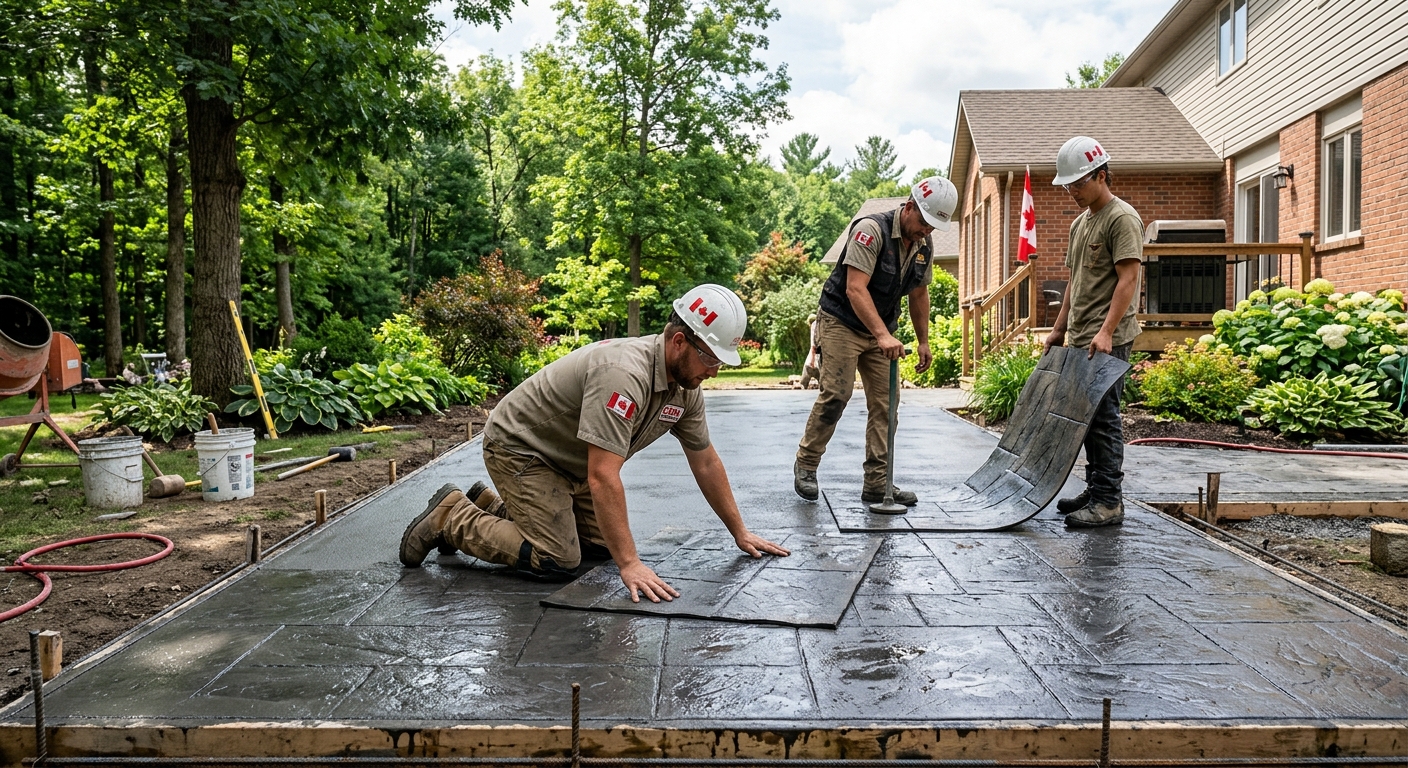
Concrete work options and costs in Caledon
Concrete work in Caledon is a steady need year-round, especially for homeowners in a market where most homes are single-detached (80.7% of dwellings) and a large share of households are owner-occupied (89.4%). With Caledon’s population at 76,581 (Statistics Canada, 2021 Census), there’s constant demand for driveways, patios, walkways, and foundation-related concrete as properties age and get refreshed. That’s important because Caledon’s soil and climate—wet shoulder seasons followed by deep freeze—push concrete contractors to build for freeze–thaw, not just appearance.
In the Toronto economic region, pricing is heavily influenced by frost depth requirements and how much base work is needed to keep slabs from heaving or settling. For most structural work, footings typically need to extend at least 1.2 m below grade (the practical minimum many projects target) to help prevent frost heave and differential movement. Exterior flatwork also needs air-entrained mixes and careful curing management, since colder temperatures around the edges of the pour season can slow strength gain and increase risk of surface defects. Availability of crews can tighten in spring and early summer because many contractors schedule exterior pours when the ground is workable and curing is more reliable.
Trade demand is especially common around established communities like Hwy 9 / Mayfield-area corridors, where homes often sit on older lots and see frequent driveway and patio upgrades tied to landscaping and drainage improvements. Below is a practical comparison of common concrete options and what drives typical price ranges for Caledon projects—so you can benchmark your quote before you book a site visit.
| Application |
Typical Size |
Key Spec |
Finish Option |
Price Range |
| Concrete driveway (standard broom finish) |
500–600 sq ft |
Air-entrained exterior mix; compacted granular base; control joints |
Broom finish |
$18,000–$28,000 |
| Exposed aggregate driveway |
500–600 sq ft |
Air-entrained mix; proper base for drainage; wash timing managed for look and durability |
Exposed aggregate |
$22,000–$34,000 |
| Stamped concrete driveway or patio |
400–500 sq ft |
Air-entrained exterior mix; adequate thickness; joint pattern planned for cracking control |
Stamped + colour hardener/release |
$24,000–$40,000 |
| Plain concrete patio or walkway |
200–350 sq ft |
Air-entrained mix; compacted granular sub-base; edge forms and drainage |
Plain (trowel/broom as specified) |
$16,000–$26,000 |
| Garage floor (interior slab) |
400–520 sq ft |
Vapour barrier (as required); fibre or mesh; proper base and jointing |
Broom or smooth finish |
$14,000–$22,000 |
| Foundation footings (structural, below frost) |
Per linear metre (varies by plan) |
Engineered footing dimensions; below-frost depth; excavation/shoring as needed |
Structural concrete placement |
$180–$300 |
Prices are estimates only and vary by project scope, site access and material selection.
What affects the price of concrete work in Caledon
In Caledon, it’s common to see quotes for the “same” concrete task come in 30–50% apart across the wider Toronto market. The big reason isn’t just contractor markup—it’s that exterior work is spec-driven. Toronto-area pricing is shaped by freeze–thaw: footings must extend below the design frost depth to prevent frost heave and differential movement, and exterior slabs should be built with air-entrained concrete mixes that can survive repeated winter temperature swings. Where crews have to do deeper excavation, build more base, install more reinforcement, or protect curing because temperatures drop toward 10 °C or below, costs rise quickly.
Concrete can also get more expensive in colder weather because curing needs protection (insulating blankets, temporary heat, or longer scheduling windows). De-icing salt in driveways and walkways accelerates surface deterioration if the concrete isn’t properly specified and sealed—so sealing and joint discipline are often non-negotiable for durability. On the other hand, costs can be lower when the site is straightforward: clean access for a concrete truck, stable subgrade, and drainage already in good shape can reduce excavation and shorten labour time.
Here are a few Caledon examples that commonly change the price: a driveway replacement on heavier clay soils usually needs thicker compacted granular base (pushing you toward the higher end of the driveway band), while a small stamped patio with tight geometry and more cutting/jointing can justify the jump from plain patio pricing into the stamped concrete driveway or patio band. If your existing concrete is already fractured but removal and haul-off are minor, you may stay closer to the concrete patio / walkway range; if you’re dealing with old, poorly compacted fill or poor drainage, the same square footage often ends up closer to the upper driveway pricing because base prep is where the money goes.
| Price Factor |
Why It Matters |
Cost Impact |
| Frost line depth — determines footing depth and form height |
Footings must extend below frost depth to resist heave and movement |
Higher depth = more excavation, shoring, and concrete volume |
| Site preparation — excavation, grading, compacted granular base |
Base stability controls settlement cracking and slab performance |
Clay/poor drainage sites add labour and granular tonnage |
| Reinforcement — rebar or wire mesh requirement |
Improves slab crack control and load distribution |
Rebar mats + chairs tie-in increases material and labour |
| Mix design — air-entrainment and compressive strength spec |
Air entrainment helps concrete resist freeze–thaw damage |
Specified mixes can raise material cost and scheduling lead time |
| Finish type — broom vs. stamped vs. exposed aggregate |
Finishes change labour time, tooling, and material system |
Stamped/exposed generally costs more than plain broom-finish |
| Pour size and concrete truck access to site |
Access affects whether large pours need multiple loads or pump work |
Pump lines, extra crew time, and truck waiting can increase cost |
| Cold-weather curing precautions — heating and blankets |
Slower cold pours need protection to achieve intended strength |
Added thermal blankets/heaters and extended schedules increase labour |
| Control joint pattern and sealing cost |
Joints manage cracking; sealing reduces salt-driven spalling |
Proper joint layout and sealing are small line items that prevent big failures |
Permits & regulations in Ontario
In Ontario, most structural concrete work requires a building permit, and often engineered drawings are reviewed by the municipality. That typically includes footings, foundation walls, grade beams, and any structural slab work tied to load-bearing elements. Concrete flatwork like patios, walkways, and driveways usually does not require a permit by default, unless it affects lot grading, changes drainage patterns, impacts impervious surface coverage limits, or touches municipal right-of-way requirements (for example, driveway approaches or work near boulevards). The safest approach for Caledon homeowners is to ask what triggers a permit before breaking ground—even if your contractor says “it’s just concrete.”
Step-by-step, here’s how you can verify a contractor and protect yourself: (1) request a copy of their Ontario liability insurance certificate of insurance (COI) and confirm you’re named as an additional insured if offered; (2) confirm WSIB coverage (for Ontario-based contractors) and ask for a clearance letter or evidence of account status; (3) verify the contractor’s business details and licensing information through Ontario’s official online resources; (4) ask for references on comparable footing/flatwork jobs; and (5) ensure the quote clearly states whether permit work (if required), excavation, and disposal are included.
If you’re planning anything that touches foundation or structure, treat permits as mandatory. For driveway and patio work, still confirm drainage and grading expectations—those are what municipalities care about most in freeze–thaw regions.
Getting concrete right in Caledon's freeze-thaw climate
Concrete fails in Caledon when freeze–thaw damage is allowed to progress. The most common homeowner-visible problems are surface scaling, spalling, and random cracking—usually tied to inadequate air-entrainment, weak or poorly prepared base, or joints/curing handled too casually. To spec the job correctly for Ontario’s Toronto region conditions, build from the ground up: start with a compacted granular sub-base at the right depth for your soil and frost exposure, and ensure drainage slopes away from the house. Next, use an air-entrained concrete mix with exterior durability targets (commonly 5–7% air content) and a minimum 32 MPa compressive strength. Then control cracking before it happens with a deliberate control-joint layout, rather than relying on random shrinkage cracks.
Curing matters just as much. In practice, exterior pours need at least 7 days of proper curing, with extra protection when temperatures drop. After the concrete has cured, apply a penetrating sealer about 28 days post-pour to help repel de-icing salts and reduce moisture cycling. That’s how you prevent the spalling that shows up first along edges, expansion points, and driveway wheel paths.
If you’re comparing options, here’s a realistic example: a plain broom-finish patio may land near the lower end of the concrete patio / walkway band (roughly $16–$26 per square foot equivalent pricing structure depending on scope), while stamped concrete can be closer to the stamped range (about $24–$40). The price difference is justified when the contractor also nails base depth, air-entrainment, joint planning, and curing—because those are what make the decorative look last through the winter, not just what the stamps cost.
| Spec |
Why It Matters in Caledon |
What to Ask For |
Impact if Skipped |
| Compacted granular base (depth?) |
Reduces settlement and frost-related movement |
Depth and material type documented; proof of compaction |
More cracking, uneven surfaces, and early edge failure |
| Air-entrained concrete mix (target air %?) |
Helps resist freeze–thaw deterioration |
Confirm air content (commonly 5–7% for exterior flatwork) |
Spalling and scaling, especially at edges and joints |
| Compressive strength (MPa rating) |
Controls how quickly and how well concrete develops durability |
Minimum 32 MPa specified |
Surface weakness, increased wear, and poor long-term performance |
| Control joints (spacing per ACI guidelines) |
Manages where shrinkage cracks occur |
Joint layout plan and saw-cut/timing approach |
Random cracking that can turn into water pathways |
| Minimum 7-day curing period |
Strength gain and freeze resistance depend on curing |
Curing plan and what happens if nights get cold |
Reduced strength and higher risk of surface defects |
| Penetrating sealer (when applied after cure) |
Moisture and de-icing salts cause damage cycles |
Apply after cure (around 28 days post-pour) |
Faster salt-driven deterioration and increased scaling |
How to choose a concrete work contractor in Caledon
Choosing the right concrete contractor in Caledon comes down to proof: proof they can legally work, proof they can build to Ontario’s durability expectations, and proof they’ll stand behind the finished surface. Start with licensing and coverage. In Ontario, verify (1) liability insurance via a certificate of insurance (COI); (2) WSIB status by requesting a clearance letter or confirmation of account status; and (3) business information and any trade/designation details that apply to the scope you’re hiring for. A contractor who won’t provide COIs and WSIB paperwork up front is a risk.
Next, get 2–3 itemised written quotes. Don’t accept “one number” without a line-by-line breakdown. You want to see labour and materials separation, and clarity on concrete thickness, reinforcement type, base prep depth, jointing method, sealing (if included), and disposal/removal. Ask whether a permit pull is included where needed for structural work; most flatwork typically doesn’t need a permit unless grading/drainage rules are affected, but you should still confirm. Review warranty details: workmanship warranty length, product/manufacturer warranty (if any), and whether it transfers if you sell your home.
For payment terms, never pay more than 10–15% upfront. Hold back a portion until completion and final inspection. Finally, insist on timeline clarity in writing: a start date tied to weather windows and an estimated completion date. In freeze–thaw climates, scheduling and curing protection aren’t “extras”—they’re core to a durable job.
- Ask for COI (liability insurance) and verify coverage limits.
- Request WSIB clearance letter or written WSIB status proof.
- Confirm permit responsibility in writing for any structural concrete work.
- Get thickness specs (slab and driveway thickness), not just “concrete supply.”
- Confirm air-entrained mix for exterior flatwork and request documentation.
- Require base preparation details: excavation depth, granular material type, compaction.
- Ask what reinforcement is used (mesh vs. rebar, spacing, support chairs).
- Require a control joint plan (layout and cutting vs. tooled timing).
- Clarify curing protection when temperatures drop (blankets/heating plan if needed).
- Ask whether sealing is included and the target timing (about 28 days post-pour).
- Confirm disposal/removal is included (old concrete haul-off, not just breaking).
- Use itemised quotes and compare apples-to-apples scope before choosing.
Concrete red flags I see in Caledon include: quotes that omit base depth and compaction details, “no need” talk about air-entrainment for exterior slabs, skipping control joints, vague curing timelines with no mention of cold protection, and payment schedules that ask for large upfront deposits without a signed holdback plan.
Frequently asked questions — concrete work in Caledon
What is the difference between concrete and cement?
In everyday Ontario talk, people say “cement” when they mean the finished concrete product—but they’re not the same. Cement is one ingredient (a powder) used to make concrete. Concrete is the full mixture: cement plus water, aggregates (sand and stone), and often admixtures like air-entrainment agents for freeze–thaw durability. In Caledon and the Toronto region, the distinction matters because exterior flatwork should typically be air-entrained to help manage freeze–thaw cycles. That air-entrained mix is part of the concrete spec, not a “cement only” choice. When you compare quotes, ask whether they specify air content and compressive strength for the concrete they’ll deliver.
How much does concrete work cost in Caledon?
Pricing in Caledon usually tracks the Toronto-area reality of frost depth specs, base preparation, and exterior durability requirements. For budgeting, many homeowners land within the typical bands for their scope. For example, concrete patios and walkways commonly fall around $16,000 – $26,000 depending on size, access, drainage corrections, and finish details. Driveways tend to run higher, commonly around $18,000 – $28,000 for standard broom-finish, with decorative options like stamping and exposed aggregate increasing costs. If your site needs more granular base or improved drainage due to older soils (and Caledon has plenty of older housing stock), costs can move toward the upper end of the band because preparation is what prevents winter damage.
How deep must footings be for Caledon's frost line?
Footing depth is designed to extend below the local frost exposure zone to prevent frost heave and differential movement. In the Toronto economic region, most projects target at least about 1.2 m below grade for structural footings (as a practical minimum many designs follow), though the final depth should match the engineer’s or municipality’s design requirements for your lot conditions. The purpose is straightforward: when frost penetrates and moisture is present under slabs or foundations, it can lift portions of the structure if the footing is too shallow. If you’re doing anything structural in Caledon—footings, foundation walls, or grade beams—your permit package and drawings will dictate the required depth and dimensions. Don’t rely on “typical”—confirm depth in the engineering set.
Why does concrete crack in Caledon and how is it prevented?
Concrete cracking in Caledon is usually normal shrinkage combined with movement from freeze–thaw cycles—especially when base prep, joints, and curing aren’t handled correctly. Exterior flatwork also sees moisture cycling: water enters micro-spaces, freezes, expands, and can lead to spalling if the concrete isn’t air-entrained. Prevention is about controlling where cracks form: proper thickness, a properly compacted granular base, the right concrete mix, and a deliberate control joint pattern. Joints should be spaced to reduce random cracking and timed correctly (saw-cut or tooled as specified). Also, curing should be protected for at least 7 days so the concrete develops adequate strength before winter stress. Sealing after curing helps limit salt and moisture exposure.
Stamped vs broom-finish concrete — cost difference?
Stamped concrete costs more than broom-finish primarily because of labour time and the decorative system. Decorative work also typically involves stricter surface preparation, joint planning for a cleaner look, and careful finishing to maintain stamp crispness. In Caledon’s Toronto-area market, that often means stamping moves you from the standard driveway/flatwork band into a higher decorative range—commonly around $24,000 – $40,000 for stamped concrete driveway or patio projects (depending on size and site access). A broom-finish driveway or walkway typically sits closer to $18,000 – $28,000 (driveway) or $16,000 – $26,000 (patio/walkway). The key point: the “look” is the difference, but the durability still depends on air-entrained mix, base prep, curing, and joints.
When is the best time to pour concrete in Caledon?
For Caledon and the broader Toronto region, the best time to pour is when the ground is workable and temperatures support proper curing. Contractors typically plan exterior pours for warmer months to reduce the risk that temperatures fall too close to freezing during the critical early curing window. You’ll see crews prioritize late spring through summer when it’s easier to maintain the intended curing conditions for durable exterior slabs. If you must pour late in the season, a qualified contractor should include cold-weather precautions such as insulating blankets and sometimes temporary heating, along with a clear curing plan. It’s also worth scheduling so concrete can cure for at least 7 days under suitable conditions. Waiting for the right weather prevents surface defects and improves long-term freeze–thaw performance.