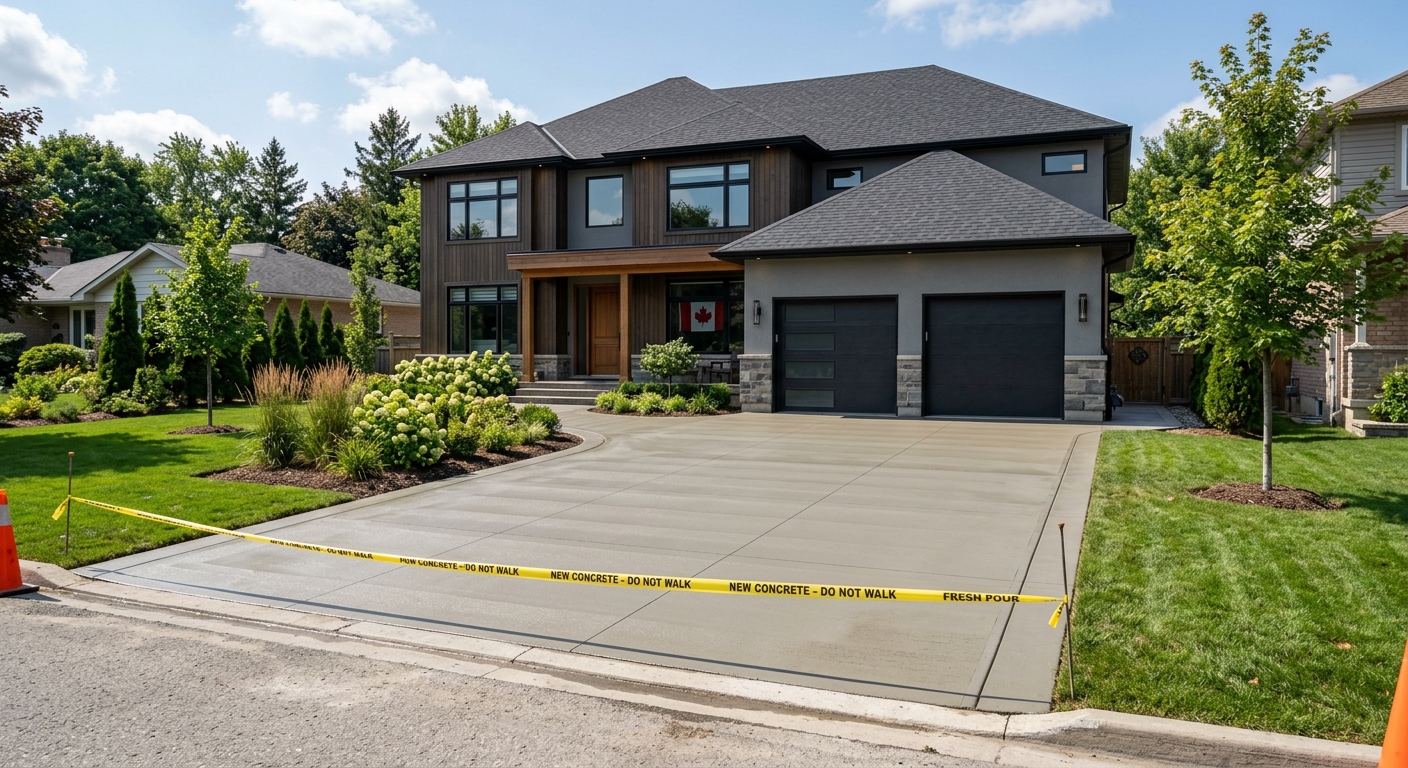
Concrete work options and costs in College Heights
Concrete work in College Heights is a practical upgrade for many homeowners—especially with the way Toronto-area freeze–thaw cycles stress exterior flatwork. College Heights has a population of 5,476 (Statistics Canada, 2021 Census), and most local concrete demand comes from the surrounding housing stock, where driveways, walkways, and patios are high-touch features around single-detached homes. In a market like this, it’s common to see contractors booked ahead in the busier spring and early summer weeks, because exterior pours need dependable temperatures and careful curing management.
Pricing is shaped by frost depth requirements and the need for air-entrained concrete on anything exposed outdoors. Local specs generally push footings down to at least about 1.2 m below grade to reduce frost heave and differential movement, and that extra excavation shows up in foundation and footing budgets. For flatwork, labour and base preparation matter just as much as the concrete itself: properly compacted granular base and drainage keep saturated soil from expanding and contracting against the slab every winter.
In College Heights, the area where concrete crews are often in highest demand is the older, established residential pockets near local collectors and busier access routes (where truck access and material handling take extra planning). Once you choose an option—standard broom-finished driveway, exposed aggregate, or stamped decoration—the differences in materials, jointing, and curing protection usually explain most of the spread you’ll see in quotes. Use the table below as a realistic starting point before you compare itemized estimates with a contractor.
| Application |
Typical Size |
Key Spec |
Finish Option |
Price Range |
| Concrete driveway (standard broom finish) |
16 ft × 30 ft (480 sq ft) |
Air-entrained mix, compacted granular base, control joints |
Broom finish |
$8,640–$13,440 |
| Exposed aggregate driveway |
16 ft × 30 ft (480 sq ft) |
Air-entrained mix, proper curing to support wash/exposure |
Exposed aggregate |
$10,080–$16,800 |
| Stamped concrete driveway or patio |
12 ft × 24 ft (288 sq ft) |
Air-entrained mix, thicker slab, control joints |
Stamped pattern + release + sealer |
$6,912–$11,520 |
| Plain concrete patio or walkway |
10 ft × 18 ft (180 sq ft) |
Air-entrained mix, compacted base, edging |
Float + light broom |
$2,880–$4,680 |
| Garage floor (interior slab) |
22 ft × 22 ft (484 sq ft) |
Vapour barrier (if specified), mesh or rebar (as required), proper curing |
Light trowel (or broom if traction needed) |
$8,712–$13,552 |
| Foundation footings (structural, below frost) |
Per typical house bearing footprint (allowance) |
Reinforced concrete, excavation to frost-depth bearing |
Structural concrete (not decorative) |
$180–$300 |
Prices are estimates only and vary by project scope, site access and material selection.
What affects the price of concrete work in College Heights
In the Toronto economic region, it’s common to see concrete quotes for the “same” project land 30–50% apart once you read the details. Two contractors can price a driveway differently because frost-protection depth, the quality of base prep, the mix design, reinforcement choices, and even how many truckloads of concrete a crew can place during a single pour all change labour and material costs. When you’re comparing driveway or patio options, you’ll also notice finish premiums: a broom finish will usually sit near the lower end of the local driveway/flatwork bands (for example, concrete driveway pricing often falls around $18,000–$28,000 per typical sized job), while stamped options carry higher material and labour requirements (often $24–$40 per sq ft range depending on complexity).
The biggest driver is frost depth and freeze–thaw cycles. Ontario requirements generally mean footings must be carried below the design frost depth—commonly at least 1.2 m in many GTA residential setups—to prevent frost heave and differential movement. Exterior flatwork should use air-entrained concrete mixes so water freeze within the slab doesn’t cause progressive cracking and scaling. Toronto-area curing is also time-sensitive: exterior pours are typically concentrated in warmer months so crews can maintain proper curing, especially when temperatures drop toward 10 °C or below. Finally, de-icing salt accelerates surface deterioration on poorly prepared or unsealed concrete, which is why sealer and surface protection can be a meaningful cost-to-durability decision.
In College Heights specifically, small site realities can swing cost up or down: tight driveway access may slow concrete placement and add labour for spreading; poor drainage (or removal of soft, wet soils) usually forces deeper, wider granular base; and existing grading or old slabs that need removal increase disposal and demo labour. As a rule of thumb, the cheapest quote is often the one that underestimates base prep and curing protection—those are the items most linked to long-term cracking and spalling.
| Price Factor |
Why It Matters |
Cost Impact |
| Frost line depth |
Determines footing depth and form height |
More excavation and rebar work can add significant labour; structural items move quickly toward higher footing budgets. |
| Site preparation |
Excavation, grading, compacted granular base |
Removing unsuitable soil and building a compacted base increases material and equipment time. |
| Reinforcement |
Rebar or wire mesh requirement |
Labour and material costs rise when engineered reinforcement or heavier mesh is specified. |
| Mix design |
Air-entrainment and compressive strength spec |
Air-entrained and higher spec concrete typically costs more but improves freeze–thaw durability. |
| Finish type |
Broom vs. stamped vs. exposed aggregate |
Decorative work increases finishing labour and adds materials like colouring/release agents and extra curing attention. |
| Pour size and concrete truck access |
How many truckloads and how quickly you can place |
Tight access can require smaller placements, more crew time, and added logistics. |
| Cold-weather curing precautions |
Heating and blankets |
If weather timing forces cold-weather protection, labour and material allowances increase. |
| Control joint pattern and sealing cost |
Cracking control and salt resistance |
Proper jointing reduces random cracking; sealing adds line-item cost but protects surfaces from de-icing salt. |
Permits & regulations in Ontario
In Ontario, structural concrete work—like foundation footings, foundation walls, and grade beams—typically requires a building permit and often engineered drawings that a municipality reviews before inspection. That includes anything that supports the structure and transfers loads into the ground. In contrast, concrete flatwork such as patios, walkways, and driveways usually does not require a permit by itself unless the work changes lot grading, affects impervious surface coverage limits, or involves work within a municipal right-of-way. Because rules can vary based on lot drainage and proximity to services, confirm with the local authority before breaking ground.
Before work starts in College Heights, also verify the contractor is properly insured and set up to work safely: ask for proof of liability insurance and WSIB coverage (or applicable WCB arrangements). For projects involving excavation or demolition, you should also confirm the contractor has the right processes for site protection and debris handling.
To check a contractor step-by-step, homeowners can: (1) confirm the contractor’s licensing/registration information through the relevant Ontario registry/online listing, (2) request a current certificate of insurance and ensure the policy is active for the current project dates, (3) request WSIB clearance/coverage documentation (or WCB equivalent as applicable), and (4) ask for references on similar-scale projects in the GTA where frost-depth footings and exterior curing requirements were managed.
Getting concrete right in College Heights's freeze-thaw climate
Concrete failures in College Heights are usually not “mystery concrete” problems—they’re spec and prep problems that show up once winter arrives. The main pathway to failure in the Toronto area is freeze–thaw damage: if water gets into the slab or base and freezes, it expands and pushes against the concrete. That’s why base preparation is critical: a properly compacted granular sub-base to the correct depth for the soil conditions helps prevent saturation and reduces movement. Next is mix design—exterior flatwork should use air-entrained concrete with a target air content of about 5–7%, along with a minimum 32 MPa compressive strength. Without adequate air entrainment, freeze–thaw can cause scaling and spalling (surface flaking), especially where de-icing salts are used.
Control joints are another must-have. They’re what give cracking a planned path rather than random cracks. For curing, you want at least 7 days under suitable conditions; when temperatures drop toward 10 °C or below, the crew should protect the slab with insulating blankets and/or other cold-weather curing precautions. Finally, sealing matters: apply a penetrating sealer once the concrete has cured properly—commonly 28 days post-pour—so salt and water don’t penetrate deeply.
How to spec it correctly means asking questions that connect to durability. For example, a stamped patio often costs more than plain concrete (typical decorative pricing sits near $24–$40 per sq ft versus plain patio/walkway commonly around $16–$26 per sq ft). Paying for proper air entrainment, base prep, and jointing is usually the real value—even if you choose plain concrete, because those items prevent expensive rebuilds.
| Spec |
Why It Matters in College Heights |
What to Ask For |
Impact if Skipped |
| Compacted granular base (depth?) |
Reduces saturation and movement through freeze–thaw; supports slab thickness |
Confirm excavation depth and granular base thickness/compaction method for your soil and slab type |
More settlement and cracking; higher risk of spalling if water pools under/near edges |
| Air-entrained concrete mix (target air %?) |
Helps concrete tolerate repeated freezing and thawing |
Ask for target air content (typically 5–7% for exterior flatwork) and that the mix is air-entrained |
Surface scaling/spalling becomes much more likely during winter seasons |
| Compressive strength (MPa rating) |
Controls structural integrity and resistance to damage from weather exposure |
Ask for minimum 32 MPa for exterior flatwork and confirm it matches the design/quote |
Increased wear, surface weakness, and earlier deterioration |
| Control joints (spacing per ACI guidelines) |
Limits random cracking from shrinkage and thermal movement |
Request the joint spacing plan and whether joints will be saw-cut/formed as scheduled |
Random cracks widen; water infiltration increases winter damage |
| Minimum 7-day curing period |
Ensures strength gain before cold weather stresses the slab |
Ask how curing will be maintained, especially if daytime temps drop and nights get near/under 10 °C |
Lower early strength and higher chance of surface defects |
| Penetrating sealer (when applied after cure) |
Repels water and helps resist salt penetration in freeze–thaw winters |
Confirm sealer type and timing—typically after full cure (often around 28 days post-pour) |
More salt and water ingress, leading to accelerated scaling |
How to choose a concrete work contractor in College Heights
Choosing a contractor in College Heights comes down to verifying they’re qualified, insured, and transparent—because concrete problems tend to show up after the first winter, not on day one. In Ontario, start by verifying Ontario contractor licensing/registration information and then request proof of liability insurance and WSIB/WCB coverage. Ask for current certificates (not expired documents) and confirm the policy covers the type of work being performed (excavation, demolition, and placement of concrete). If they can’t provide clear documentation quickly, that’s a red flag.
Next, get 2–3 itemized written quotes that break down labour and materials rather than only quoting “one lump sum.” For example, ask how much is allocated for excavation, granular base supply/compaction, reinforcement (if any), concrete supply with air entrainment, formwork, finishing, joint cutting, and sealing. Confirm whether the permit pull (if required for the structural scope) is included, and whether disposal and protection of landscaping and property lines are covered. A well-prepared quote typically includes site conditions assumptions and exclusions (like unplanned rock removal).
Look closely at warranty terms: workmanship warranty length, whether product/manufacturer warranties apply to the concrete materials and surface protection, and whether anything is transferable to future owners. For payment, plan to never pay more than 10–15% upfront; hold back a portion until the final completion items are done and you’ve received documentation. Finally, insist on a start date and completion estimate in writing—Toronto-area scheduling is seasonal, so a realistic timeline matters for curing and temperature protection.
- Verify Ontario licensing/registration information before signing.
- Request a current certificate of liability insurance showing active coverage dates.
- Get WSIB/WCB clearance/coverage proof for the crew on your job.
- Ask for 3–5 references on similar slab sizes and exterior work.
- Require an itemized quote: excavation, base, rebar/wire mesh, concrete mix, finishing, joints, sealing.
- Confirm air-entrained mix is included for all exterior flatwork.
- Ask about frost-depth excavation assumptions and how they handle soft/wet soils.
- Check whether reinforcement is included where needed (mesh vs. rebar based on slab design).
- Verify control joint locations, spacing, and whether joints will be saw-cut/formed as scheduled.
- Ask how cold-weather curing will be managed if temperatures drop.
- Clarify exclusions: permit fees, disposal, hauling away old concrete, landscaping restoration.
- Use a payment schedule with a holdback until cure/sealer/documentation is complete.
Concrete contractor red flags in College Heights: (1) quotes that don’t address base depth/compaction, (2) no mention of air-entrained concrete for exterior work, (3) vague wording like “standard concrete” with no strength/air specs, (4) reluctance to provide insurance/WSIB/WCB documentation, and (5) pushing for large upfront payments (well beyond 10–15%).
Frequently asked questions — concrete work in College Heights
How do I maintain concrete in College Heights's freeze-thaw climate?
For concrete in College Heights (Ontario), maintenance is mostly about limiting water and salt contact. Start by keeping edges and joints clear—leaves and debris hold moisture, and moisture plus freeze–thaw is what accelerates surface wear. Use de-icing products carefully; avoid over-salting and try to use sand for traction when possible. If your slab is sealed, sweep and rinse lightly in wet seasons rather than scrubbing aggressively. A penetrating sealer applied after full cure (often around 28 days) helps reduce salt penetration, and you may re-seal every few years depending on traffic and exposure. Finally, watch for early issues: small cracks with dark staining often indicate water movement—addressing those sooner is cheaper than waiting for spalling.
What causes concrete to spall in College Heights winters?
Spalling in College Heights winters usually comes from freeze–thaw damage where water finds its way into the concrete. The biggest technical cause is inadequate air-entrainment: without proper air content (commonly 5–7% for exterior flatwork), freeze–thaw cycles can break down the surface and flake it off. Another common contributor is base or drainage problems—if the granular base isn’t compacted properly or water pools near slab edges, the concrete experiences repeated stress. De-icing salt then penetrates and speeds deterioration, especially on unsealed or poorly sealed surfaces. Finally, poorly planned joints and inadequate curing can leave the slab more vulnerable to early surface defects. If you’re comparing quotes, ask whether the mix is air-entrained and whether sealing is included, because those two items are often the difference between a long-lived slab and a recurring repair cycle.
What is rebar and when is it required in Ontario?
Rebar is steel reinforcement embedded in concrete to improve tensile strength and control cracking. In Ontario, whether rebar is required depends on the structural design and the load expectations for the specific element—not just “all concrete always needs rebar.” For typical residential foundations and structural components, reinforcement requirements are often set by engineered drawings and are closely tied to frost depth, soil conditions, and load paths. For slabs and exterior flatwork, some projects use wire mesh or rebar depending on thickness, soil support, and the slab’s design. Because College Heights is subject to freeze–thaw movement and seasonal loading, reinforcement choices usually need to align with a proper design and a contractor who understands local durability practices. If a quote for a driveway or garage floor doesn’t clearly state the reinforcement approach (mesh vs. rebar and where it sits in the slab), ask for it in writing before work starts.
How long does a concrete project take in College Heights?
Timelines in College Heights depend on the scope and the weather window, but you can think in phases. Demo and excavation can be as quick as a day for small flatwork or several days if there are complications like soft soils or tight access. Forming, base prep, reinforcement placement, and pour day are typically short relative to curing—pouring usually takes hours, but finishing and protection still happen the same day. The bigger schedule factor is curing and temperature management: exterior pours are most reliably done during the warmer months to maintain proper conditions. Even after the slab is placed, you should plan around a minimum 7-day period before expecting full traffic, and allow more time for sealant application (commonly around 28 days). If you’re budgeting, remember timing affects cost too—cold-weather curing blankets/heating can move the price. For example, a standard patio/walkway might be priced near the $16–$26 band, but a late-season pour with curing protection can push higher than a mid-summer schedule.
What is a concrete overlay and is it suited to College Heights?
A concrete overlay is a new layer placed over an existing slab, usually after surface preparation that may include grinding, patching, and sometimes bonding agents. Overlays can be suited to College Heights when the existing concrete is generally sound—meaning it’s not failing structurally and the base beneath the original slab isn’t shifting significantly. The challenge in freeze–thaw climates is that if the old slab is already moving due to drainage or base issues, the overlay can crack and fail in the same spots. Overlays also don’t “fix” poor base drainage; they may hide problems temporarily. Whether an overlay is right for your home depends on inspection: look for widespread scaling, deep spalling, major settlement, or repeated cracking—those often point to full replacement being the durable choice. If you’re considering resurfacing to stay within a budget, ask contractors to detail how they’ll prepare the surface, what product system they’ll use, and how they’ll manage salt resistance with sealing.
How do I seal concrete to protect it in College Heights?
Sealing is one of the best defences against freeze–thaw deterioration in Ontario because it helps repel water and reduce how easily de-icing salt penetrates the surface. For College Heights projects, the usual approach is a penetrating sealer applied after the concrete has cured properly—commonly around 28 days post-pour for new exterior slabs. Before sealing, the surface should be clean, dry, and free of dust, construction residue, and curing compounds that can block penetration. Ask the contractor to confirm the sealer type (penetrating vs. film-forming), the coverage rate, and the drying window. Also, don’t seal too early—sealing before full cure can trap moisture and lead to premature performance issues. When you’re comparing quotes for driveways and patios, sealing should be a line item you understand, not an afterthought, because it’s closely tied to long-term durability in Ontario winters.