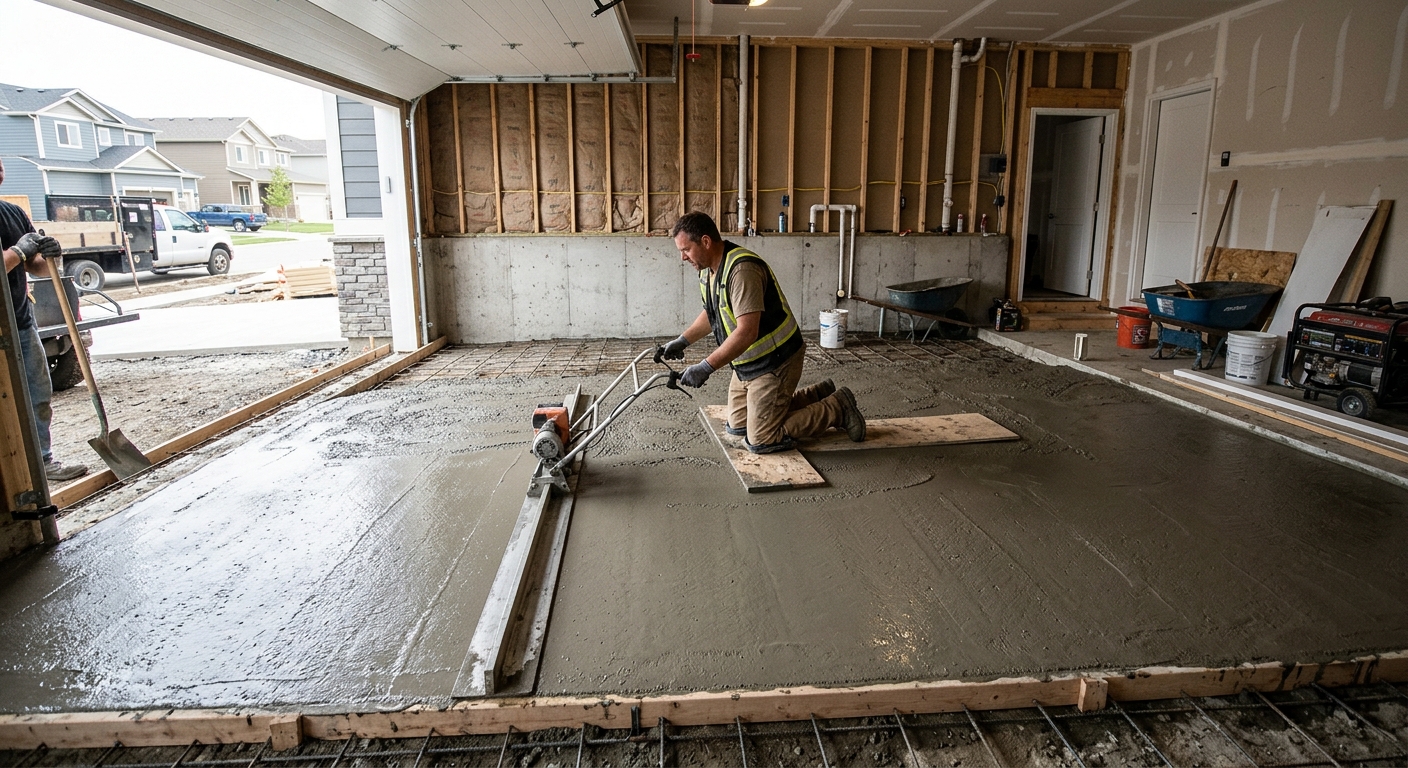
Concrete work options and costs in Alliston
Concrete work in Alliston is a big part of everyday property upgrades—especially for homeowners in the Collingwood Street and McDonald’s Corners areas where driveways, patios, and walkways see heavy seasonal traffic. With Alliston’s population at 18,809 (Statistics Canada, 2021 Census), demand is steady across the year, and you’ll often notice multiple crews competing for exterior work slots in spring. The housing base is also dominated by single-family properties, which typically means more garage slabs, side yards, and longer driveway runs—ideal applications for both standard and decorative flatwork.
In the Toronto economic region, costs are shaped less by “the concrete” and more by how it’s built to handle frost depth and freeze–thaw cycles. Most structural footings must extend to at least 1.2 m below grade in Ontario to reduce frost heave and differential movement, and exterior slabs are usually specified with air-entrained concrete plus proper drainage and a well-compacted granular base. Local contractors also plan pour dates around temperature and curing protection; when daytime temperatures drop toward 10 °C or below, protection measures (blankets, curing plans) become a real labour/material driver.
You’ll see wider pricing swings for stamped and exposed aggregate surfaces because they require tighter sub-base preparation, colour/finish materials, and additional crew time—often placing them closer to the higher end of the local price bands. Use the table below as a grounded starting point, and then match the spec to your soil conditions and access constraints before comparing quotes.
| Application |
Typical Size |
Key Spec |
Finish Option |
Price Range |
| Concrete driveway (standard broom finish) |
12 m x 3 m (approx. 36 m²) |
Air-entrained mix, compacted granular base, control joints |
Broomed surface, light edging |
$18,000 – $28,000 |
| Exposed aggregate driveway |
12 m x 3 m (approx. 36 m²) |
Air-entrained mix, dressed base, proper curing |
Exposed aggregate with sealer |
$20,000 – $34,000 |
| Stamped concrete driveway or patio |
10 m x 3.5 m (approx. 35 m²) |
Air-entrained mix, release agent, stamped pattern, joints |
Stamped pattern with colouring |
$24,000 – $40,000 |
| Plain concrete patio or walkway |
8 m x 1.8 m (approx. 14.4 m²) |
Compacted base, air-entrained exterior mix where exposed |
Broom finish or smooth trowel (low-slump control) |
$16,000 – $26,000 |
| Garage floor (interior slab) |
6 m x 7 m (approx. 42 m²) |
Vapour barrier, insulated edge option if required, mesh/rebar |
Steel trowel or broom/brush texture |
$11,000 – $20,000 |
| Foundation footings (structural, below frost) |
Typical single-house perimeter (project-dependent) |
Engineered footing design, below frost depth |
Reinforced concrete footings |
$180 – $300 |
Prices are estimates only and vary by project scope, site access and material selection.
What affects the price of concrete work in Alliston
Even when two contractors are quoting “the same” driveway or patio, you can see 30–50% differences across the Toronto region. In practice, pricing varies because contractors are pricing for your site conditions (soil and drainage), the structural depth required for Ontario frost protection, and the labour/time needed to finish and cure properly. Contractors also differ in what they include—excavation limits, base thickness, reinforcement, saw-cut jointing, disposal, and sealing—so one quote may look cheaper until you compare the scope line by line.
Here’s the core driver for Alliston: frost depth and freeze–thaw cycles dictate specs. Footings must extend below design frost depth (Ontario commonly around 1.2 m or more below grade for structural applications), and exterior slabs typically use air-entrained concrete to survive repeated freezing and thawing. When temperatures drop toward 10 °C or below, cold-weather curing precautions—insulating blankets, heating, and extended protection—add cost and scheduling complexity. Finally, de-icing salt in driveways accelerates surface deterioration if concrete isn’t protected; sealing is often the difference between a surface that lasts and one that starts to spall early.
Local examples that move costs in Alliston: (1) poor drainage or soft subgrade can force deeper/stronger granular base and additional preparation; (2) a longer driveway with narrow access may require alternate truck-and-pump logistics; (3) if you’re choosing stamped versus broom finish, you’re paying for pattern labour and typically tighter joint planning—often closer to stamped pricing. That’s why standard broom driveways often fall near the $18–$28 band, while decorative work pushes toward $24–$40 depending on pattern complexity and base requirements.
| Price Factor |
Why It Matters |
Cost Impact |
| Frost line depth |
Determines footing depth and form height |
Higher excavation and concrete volume; can materially increase foundation/footing costs |
| Site preparation |
Excavation, grading, compacted granular base |
Soft or wet soils require more base and labour; improves durability |
| Reinforcement |
Rebar or wire mesh requirement |
Material + placing time; can prevent sagging and early cracking |
| Mix design |
Air-entrainment and compressive strength spec |
Better freeze–thaw resistance; affects material selection and sometimes truck scheduling |
| Finish type |
Broom vs. stamped vs. exposed aggregate |
More labour and specialty materials; higher end of driveway/patio bands |
| Pour size and concrete truck access to site |
Long runs, tight turns, or limited reach |
May require pump/extra labour; delays can increase labour costs |
| Cold-weather curing precautions |
Heating and blankets |
Adds cost and extends scheduling; critical when temps drop |
| Control joint pattern and sealing cost |
Limits random cracking and protects edges |
Sealing materials and saw-cut/finish labour add up but reduce callbacks |
Permits & regulations in Ontario
In Ontario, the rule of thumb is that structural concrete work requires a building permit, while most exterior flatwork does not. If you’re doing foundation walls, grade beams, structural footings, or any new structural slab, the project typically needs a building permit and often engineered drawings reviewed by the municipality. That’s because these elements are part of the primary structure and must meet Ontario Building Code requirements for load capacity, exposure protection, and frost-related performance.
By contrast, concrete patios, walkways, driveways, and garage floor slabs usually do not require a permit by default—unless the work affects lot grading, stormwater/servicing, impervious surface limits, or the work ties directly into municipal right-of-way conditions. In Alliston, it’s still smart to confirm with the local authority before breaking ground, especially if you’re changing drainage paths or lowering grade near the house.
To verify a contractor properly in Ontario, start with these steps: (1) ask for a current certificate of insurance (liability coverage) and confirm the insured entity matches the quote; (2) verify workers coverage (WSIB/WCB) so you’re not exposed if labour is injured; (3) request proof of licensing/registration where applicable for contracting scope; and (4) confirm clearance or account status if provided for your project type. Then, check references for similar-size driveway/patio jobs in the Toronto region and look specifically for freeze–thaw durability outcomes—spalling repairs are the most common “learning cost” we see when specs were light.
Getting concrete right in Alliston's freeze-thaw climate
In Alliston, concrete failures are usually about three things: water, weak base preparation, and air/mix/curing that doesn’t match winter conditions. Freeze–thaw cycles pull moisture in and out of the surface and edges. If the base isn’t well-compacted and drained, the slab can flex slightly; if the concrete isn’t air-entrained enough for exterior exposure, micro-ice formation can drive spalling over time. On top of that, curing is timing-sensitive: pouring when cold nights are forecast without proper protection can reduce early strength gain and increase surface damage risk.
To spec the job correctly, get clear requirements for (1) base preparation—a compacted granular sub-base to the right depth for your soil and frost considerations, with grading that sheds water away from the foundation; (2) mix design—for exterior flatwork, air-entrainment typically in the 5–7% range and a minimum 32 MPa compressive strength (or higher if the designer specifies); (3) control joints—planned joint locations and spacing to limit random cracking; (4) curing—minimum 7 days under appropriate conditions, with cold-weather protection when needed; and (5) sealing—a penetrating sealer after the cure window, often around 28 days post-pour, to repel de-icing salts.
A concrete-dollar example: choosing an air-entrained exterior mix and proper joint layout typically adds a modest amount to a standard driveway estimate (often keeping you within the $18–$28 band), while “saving” on base compaction or skipping sealing can create early spalling and joint-edge deterioration. Fixing those issues later usually costs more than doing it right the first time—especially in a climate where winters are hard on unprotected surfaces.
| Spec |
Why It Matters in Alliston |
What to Ask For |
Impact if Skipped |
| Compacted granular base (depth?) |
Prevents settlement and limits water movement under the slab |
Confirm base thickness and compaction method; ask for drainage grading details |
Flexing, cracking, and faster deterioration after freeze–thaw cycles |
| Air-entrained concrete mix (target air %?) |
Helps concrete resist freeze–thaw damage and reduces spalling risk |
Request exterior air content target (commonly 5–7%) for the mix design |
Spalling and surface pop-outs, especially near edges and in salted areas |
| Compressive strength (MPa rating) |
Supports durability and performance under loads |
Confirm minimum 32 MPa (or higher if specified) |
Reduced durability, increased wear, and higher risk of premature cracking |
| Control joints (spacing per ACI guidelines) |
Controls where cracks form so they’re predictable and manageable |
Ask for joint spacing and saw-cut timing plan |
Random cracking across panels and harder-to-repair damage patterns |
| Minimum 7-day curing period |
Early strength gain is crucial before winter exposure |
Confirm curing protection plan for night temperatures |
Surface weakness, scaling, and reduced long-term performance |
| Penetrating sealer (when applied after cure) |
Repels de-icing salts and moisture that drive freeze–thaw damage |
Ask for application timing (often after a 28-day cure) and product type |
Faster spalling and staining; more frequent maintenance |
How to choose a concrete work contractor in Alliston
Choosing the right concrete contractor in Alliston is mostly about verification and scope clarity—not just the lowest number. In Ontario, verify the contractor can legally perform your scope and that they carry proper insurance and workers coverage. Ask for: (1) a certificate of insurance for liability (and confirm the insured party matches your contract); (2) proof of WSIB/WCB coverage for employees or subcontractors; and (3) evidence of any required registrations/licensing for the type of contracting they’re doing. If they can’t provide documentation promptly, that’s a major warning sign.
Next, request 2–3 itemised written quotes that separate labour and materials—especially excavation/grading, granular base thickness, reinforcement type, concrete mix design, finishing, jointing, curing protection (if cold weather is possible), and sealing. Make sure the quote specifies whether disposal is included, whether demolition is separate, and whether permits are handled (when needed for structural work). A true apples-to-apples quote will also include a timeline: start date, concrete pour date, cure/protection window, and completion estimate in writing.
For money movement, use a practical schedule: never pay more than 10–15% upfront, and hold back a portion until key items—forms removal, finishing, jointing, and cleanup—are completed. Finally, compare warranties: workmanship warranty length, product/manufacturer warranty terms, and whether coverage is transferable if you sell the home.
- Ask for a detailed scope with measurements (length, width, thickness) and number of panels if applicable.
- Confirm base thickness and compaction testing/standard (don’t accept vague “good base”).
- Require the concrete mix description: exterior air-entrainment and compressive strength.
- Confirm reinforcement plans (mesh vs rebar, and where it’s placed).
- Ask how they handle drainage so water sheds away from the foundation.
- Ensure control joint spacing and saw-cut timing are included.
- Clarify curing and cold-weather protection procedures when nights are cool.
- For driveways/sidewalks, confirm sealer type and application timing (after cure).
- Verify disposal/hauling is included in the quote.
- Check whether truck access/pump options are discussed for your driveway layout.
- Request a written warranty for workmanship and confirm what triggers a service visit.
- Confirm payment schedule and retainage rules in the contract.
Red flags I see with concrete contractors in Alliston: (1) a quote that stays silent on air-entrainment for exterior work; (2) “lump sum” pricing with no base thickness or reinforcement described; (3) no plan for cold-night curing protection; (4) willingness to start without verifying drainage/grading; and (5) requesting a large upfront payment before forms, base prep, and scheduling are confirmed.
Frequently asked questions — concrete work in Alliston
How much does concrete work cost in Alliston?
In Alliston, your price depends mainly on what you’re building, the thickness/specs, and how much site preparation your property needs. For typical exterior work, homeowners often budget around the local bands: concrete driveway/flatwork commonly lands in the $18,000 – $28,000 range for standard driveway scopes, while patios/walkways tend to run about $16,000 – $26,000 depending on size and access. Stamped upgrades are usually higher because of labour and finishing materials—often tied to the $24,000 – $40,000 band. Toronto-region costs are also influenced by freeze–thaw requirements: footings deeper than “minimums,” air-entrained concrete, proper base compaction, and sealing. If you compare quotes, insist each one lists base depth, mix type, reinforcement, jointing, curing, and sealing so you’re truly comparing like-for-like.
How deep must footings be for Alliston's frost line?
For structural footings in Ontario, the design requirement is to extend below the design frost depth to reduce frost heave and movement. In the Toronto economic region, the common code-driven practice is to place most structural footings at least about 1.2 m (roughly 4 ft) below grade (exact depth still depends on soil conditions and the engineered design). That depth matters because Alliston experiences repeated freeze–thaw cycles, and any extra movement at the base can translate into foundation issues over time. Driveways and other exterior slabs don’t use “structural footing depth” the same way, but they still require well-compacted granular base and good drainage. If your contractor can’t point to the engineered footing requirement (or the municipal plan set), that’s a prompt to pause.
Why does concrete crack in Alliston and how is it prevented?
Concrete cracking in Alliston is usually a shrinkage-and-temperature story made worse by freeze–thaw. As slabs cool and dry, they naturally shrink; without a planned control joint pattern, cracks form randomly. Then winter adds cycles of moisture expansion/contraction around edges and joints, especially where water can reach the surface or sub-base. Prevention is spec-based: proper sub-base prep and compaction, correct air-entrainment for exterior exposure, planned joint spacing, and saw-cut timing. Sealing later (often around 28 days after pour) helps repel de-icing salts that accelerate spalling. When quotes under-specify jointing or skip air-entrainment, you typically see early surface pop-outs and jagged cracking—repairs are much more expensive than doing joints correctly the first time.
Stamped vs broom-finish concrete — cost difference?
Stamped concrete costs more than broom-finish mainly because it’s labour-intensive and needs a tighter finishing workflow. A broom-finish driveway is typically aligned with the $18,000 – $28,000 band for typical scopes, while stamped concrete driveway or patio projects commonly fall into the $24,000 – $40,000 band depending on pattern complexity, colour, and how much preparation is required. Stamped work also depends on consistent joint placement and finishing timing, and it’s more noticeable if the base is uneven. If your sub-base or drainage is marginal, spending on stamping won’t fix that—so the best value comes when the contractor first proves base prep and curing protection, then adds the decorative finish. Always ask whether sealer is included and when it will be applied.
When is the best time to pour concrete in Alliston?
In Alliston (and the wider GTA), exterior pours are usually scheduled for the warmer months to support strength gain and reduce curing problems. Contractors aim for conditions where daytime temperatures and early curing can be managed; local schedules often tighten when nights trend toward cooler periods (around 10 °C and below). If you pour late fall, a contractor should show you a cold-weather curing plan: insulating blankets, temperature monitoring, and protective measures so the concrete reaches safe early strength. Even if the slab is air-entrained, poor curing timing can weaken the surface. The best approach is to plan your pour after site prep is ready (forms, base, drainage) and keep flexibility in the forecast. For larger projects, ask for the start date and pour date in writing.
How long does concrete take to cure?
Concrete curing has two “clocks”: early strength gain and long-term durability. For homeowners, the practical minimum is that exterior slabs should be protected and allowed a minimum 7-day curing period under proper conditions before expecting full exposure to traffic or moisture stress. Long-term performance—especially when you plan sealing—depends on full curing. Penetrating sealers are typically applied after cure completion, often around 28 days post-pour, to better repel de-icing salts and moisture during the freeze–thaw season. If cold weather hits early, curing time and protection requirements can increase. Ask your contractor to state the curing method (blankets/heating if needed) and the sealing timeline so you’re not relying on “it’s fine because it looks set.”