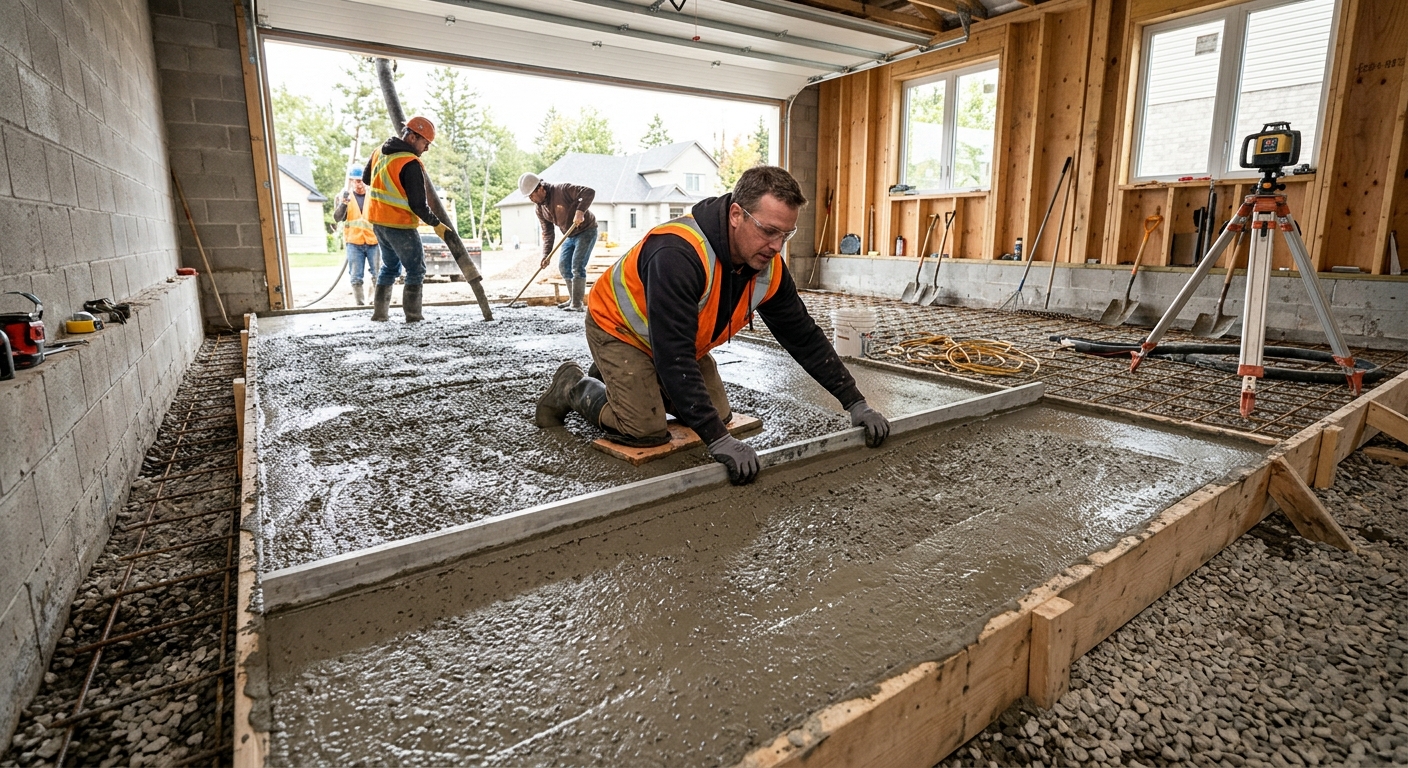
Concrete work options and costs in Fairfield
In Fairfield, Ontario, homeowners typically start thinking about concrete when they plan a driveway refresh, add a patio, or stabilize a settling entrance. Fairfield’s small-town feel is supported by a steady mix of housing types, and most concrete flatwork demand comes from single-detached residential properties (Statistics Canada, 2021 Census). With a population of 3,651 (Statistics Canada, 2021 Census), contractor availability can be slightly tighter than larger GTA centres, so booking earlier often helps—especially for exterior work that must fit the city’s freeze–thaw-driven construction windows.
In the Toronto economic region, concrete costs are strongly influenced by frost depth and the number of freeze–thaw cycles your concrete experiences. That’s why Ontario specs for structural footings usually require deeper installs below grade, and why exterior slabs (driveways, patios, walkways) typically use air-entrained mixes, adequate thickness, and well-planned control joints. Crews also concentrate exterior pours in warmer months to manage curing; when temperatures drift toward 10 °C or below, contractors need extra protection to keep concrete developing strength properly.
Across Fairfield—particularly around the busier local residential corridors where homeowners frequently upgrade entries and curb appeal—driveways and front patios are the most requested projects. For planning, it’s useful to compare finishes and scopes side-by-side before you request quotes, since the price swings mostly come from base preparation, mix design, and finishing.
Here are typical cost ranges you can use as a starting point for discussions with local contractors.
| Application |
Typical Size |
Key Spec |
Finish Option |
Price Range |
| Concrete driveway (standard broom finish) |
400–600 sq. ft. |
Air-entrained exterior mix; compacted granular base |
Broom finish with control joints |
$7,200–$14,800 |
| Exposed aggregate driveway |
400–600 sq. ft. |
Air-entrained mix; surface retarder + proper curing |
Exposed aggregate look with sealer |
$9,600–$18,600 |
| Stamped concrete driveway or patio |
300–600 sq. ft. |
Air-entrained mix; thicker placement for crisp stamping |
Stamp patterns + colour integral or dry-shake |
$7,200–$24,000 |
| Plain concrete patio or walkway |
150–350 sq. ft. |
Well-compacted base; drainage slope |
Float/screed with light broom finish |
$2,400–$9,100 |
| Garage floor (interior slab) |
400–700 sq. ft. |
Vapour barrier; fibre or mesh depending on use |
Plain finish (broom optional) and curing |
$7,200–$18,900 |
| Foundation footings (structural, below frost) |
Varies by plan |
Engineered design; excavation and inspection |
Typical structural concrete finish |
$2,700–$9,000 |
Prices are estimates only and vary by project scope, site access and material selection.
What affects the price of concrete work in Fairfield
In Fairfield, Ontario, it’s common to see quotes for the “same” concrete job vary by 30–50% once you factor in how each contractor handles base preparation, frost protection, and finish detailing. Concrete isn’t just the truckload—it’s excavation, formwork, granular base, reinforcement decisions, mix design, curing management, and the finish that determines whether the slab performs through our freeze–thaw winters.
In the Toronto economic region, frost depth and freeze–thaw cycles dictate the entire build-up. Structural footings generally must extend at least 1.2 m (about 4 ft) below grade to help prevent frost heave and differential movement. Exterior slabs also need air-entrained concrete and the right thickness so water doesn’t freeze and expand in the near-surface zone. When temperatures fall toward 10 °C or below, contractors either pause the pour or add cold-weather curing precautions (insulating blankets and sometimes heated enclosures), which increases labour and material costs.
For Fairfield homeowners, two practical examples are easy to spot. First, adding a properly compacted granular base and correct drainage can raise the ticket, but it prevents the uneven settlement and early surface scaling that usually leads to costly rework. Second, moving from a plain broom finish to stamped or exposed aggregate can increase costs—often matching the Toronto-area price bands of about $18–$28 per sq. ft. for driveways and $16–$26 per sq. ft. for patio/walkway work—because these finishes require extra crew time, special materials, and tighter quality control.
Finally, older housing stock and tight lots near driveways often mean more manual handling and less straightforward truck access. When a contractor has to break up and haul out existing concrete, or when reinforcement needs to be installed to meet engineered expectations, you’ll see that dollar difference immediately.
| Price Factor |
Why It Matters |
Cost Impact |
| Frost line depth — determines footing depth and form height |
Deeper below-grade installs reduce frost heave and movement |
Higher excavation and concrete volume (commonly +$2,000 to +$6,000 on footing scopes) |
| Site preparation — excavation, grading, compacted granular base |
Good base prevents voids, pumping, and early cracking |
Improves durability but adds labour and material costs (+10% to +25% on exterior flatwork) |
| Reinforcement — rebar or wire mesh requirement |
Supports load and reduces uncontrolled cracking |
Material + placement time (often +$500 to +$2,500 depending on design) |
| Mix design — air-entrainment and compressive strength spec |
Air-entrainment helps survive freeze–thaw; strength supports structural performance |
Premium mix and testing (-/+) depending on specs; typically +$250 to +$1,500 per pour |
| Finish type — broom vs. stamped vs. exposed aggregate |
Finish complexity affects crew time, tooling, and surface protection |
Stamped/exposed usually +$6 to +$15 per sq. ft. versus broom finish |
| Pour size and concrete truck access to site |
Access controls labour, pump use, and pour efficiency |
Limited access can add mobilization/pumping costs (+$300 to +$2,500) |
| Cold-weather curing precautions — heating and blankets |
Keeps concrete above minimum curing conditions as temps drop |
Can add +$800 to +$3,000 depending on timing and enclosure needs |
| Control joint pattern and sealing cost |
Joints manage cracking; sealing helps resist de-icing salt damage |
Small line item, but often +$200 to +$900 when included properly |
Permits & regulations in Ontario
In Ontario, structural concrete work such as footings, foundation walls, and grade beams typically requires a building permit, and many municipalities expect engineered drawings for review before concrete is placed. Concrete flatwork—like patios, walkways, and standard driveways—often does not require a permit by default. However, permits can be triggered if the work affects lot grading, changes drainage, impacts impervious surface coverage limits, or alters municipal right-of-way areas (for example, where driveways connect to curb infrastructure). Because rules can vary by how your site drains and what exactly you’re changing, confirm with the local authority before the first excavation.
For Fairfield homeowners, also verify the contractor’s credentials. Start by confirming they carry liability insurance and WSIB/WCB coverage where applicable (or the correct equivalent coverage for the work). Ask for a clearance letter if the contractor can provide one, and request updated certificates with the correct legal business name.
Then, follow a simple step-by-step check:
- Ask for their Ontario business details and whether they are registered/eligible for the trade work being done.
- Check the contractor registry online for the business name to confirm status.
- Request a current Certificate of Insurance (COI) showing liability coverage.
- Confirm WSIB/WCB coverage is active by asking for documentation or a clearance letter where provided.
- Verify references for similar-scale Ontario projects (exterior flatwork or structural pours).
Concrete projects go smoother—and stay safer—when the permit expectations and insurance paperwork are handled before forms and rebar go in the ground.
Getting concrete right in Fairfield's freeze-thaw climate
Concrete failures in Fairfield usually trace back to the same handful of problems: poor drainage, weak or non-air-entrained mix, inadequate base preparation, and rushed curing. In the Toronto market, freeze–thaw cycles and de-icing salt combine to drive deterioration—especially on exterior slabs where water can sit just under the surface. When contractors don’t build the sub-base correctly or miss air-entrainment targets, you’ll often see early spalling and surface scaling, even if the slab looks fine for the first year.
To spec concrete that performs, focus on five fundamentals. First is base preparation: the granular sub-base needs to be compacted to the right depth for local soil and frost considerations, with proper grading so water drains away from your home. Second is mix design: for exterior flatwork, air-entrained concrete is standard, typically aiming for about 5–7% air, with a minimum 32 MPa compressive strength for durability. Third is control joints: joints should be planned to control where cracking happens. Fourth is curing: plan for at least 7 days of curing under appropriate conditions—cold weather protection matters when pours run later in the season. Fifth is sealing: penetrating sealer is usually applied about 28 days after the pour to help repel de-icing salts and reduce moisture ingress.
One dollar example that helps homeowners make sense of trade-offs: if a stamped patio quote is higher than a broom-finished patio by roughly the difference between typical patio/ walkway pricing bands (about $16–$26 per sq. ft.), that premium is often justified by more complex finishing steps and better surface protection planning—not by “nicer troweling” alone. If the contractor can’t clearly explain joints, curing protection, and sealer timing, the cheaper broom option usually isn’t the real bargain.
| Spec |
Why It Matters in Fairfield |
What to Ask For |
Impact if Skipped |
| Compacted granular base (depth?) |
Prevents frost-related movement and settlement that stresses the slab |
Base depth tied to soil conditions and drainage plan; compaction method |
Uneven slabs, early cracking, and voids leading to premature failure |
| Air-entrained concrete mix (target air %?) |
Protects surface from freeze–thaw scaling and spalling |
Air content target of about 5–7% for exterior flatwork |
Higher risk of spalling during winter freeze–thaw cycles |
| Compressive strength (MPa rating) |
Supports durability and structural performance |
Minimum 32 MPa compressive strength (or higher if specified) |
Lower strength gain; surface wear and cracking can accelerate |
| Control joints (spacing per ACI guidelines) |
Directs cracking to predetermined locations |
Planned joint layout and spacing consistent with ACI guidance |
Random cracking, wider crack openings, and more water infiltration |
| Minimum 7-day curing period |
Ensures proper strength development before the first winter moisture hits |
Documented curing approach; cold-weather protection if needed |
Surface weakness, increased permeability, and faster scaling |
| Penetrating sealer (when applied after cure) |
Helps reduce moisture penetration from de-icing salts and winter wetting |
Sealer application after full cure—typically around 28 days post-pour |
More aggressive salt damage and reduced surface lifespan |
How to choose a concrete work contractor in Fairfield
Choosing a concrete contractor is less about who has the lowest number and more about who will build the right assembly for Fairfield’s winters. Start with Ontario-related checks: request their liability insurance certificate (COI), and confirm WSIB/WCB coverage is active for the crews that will be on your site. For licensing status, verify their business details using the appropriate online registry resources available in Ontario and match the legal business name on the COI and contract.
Next, get 2–3 itemised written quotes rather than a single lump sum. Itemisation should break out labour, excavation/disposal, forms, rebar or mesh (if required), base materials, concrete supply/mix type, finish labour, curing protection, and sealing. If a quote doesn’t clearly state whether disposal, sawcutting, and protection of landscaping are included, you’ll likely absorb unexpected costs later.
Also read warranty language carefully. Ask for a workmanship warranty length in writing, and ask whether product/manufacturer warranties apply to the materials (like sealers or admixtures). If the contractor changes subcontractors mid-project, or if the warranty is not clearly transferable to future homeowners, get that clarified before signing.
For payment, keep it safe: never pay more than 10–15% upfront. Use a holdback until completion and walkthrough items are signed off. Finally, insist on a start date and a completion estimate in writing, because exterior work in the Toronto region often depends on weather windows.
- Confirm liability insurance is current and the coverage amount is appropriate for the job size.
- Verify WSIB/WCB clearance/documentation is provided before work starts.
- Ask whether permits are required for your specific scope and whether they’re included if needed.
- Require an itemised breakdown (labour vs materials vs disposal vs finishing).
- Confirm base depth and compaction method, not just “granular base.”
- Ask for the concrete mix type and air-entrainment plan for exterior work.
- Require reinforcement details: rebar size, spacing, and placement location (top/middle/bottom).
- Request the joint layout plan (control joint spacing and where sawcuts will occur).
- Ask about curing protection during cool spells and how long curing will be maintained.
- Confirm whether the contractor will seal after cure (and when that happens).
- Check warranty terms for workmanship and materials; ask if it’s in writing and transferable.
- Set a payment schedule tied to milestones; keep 10–15% holdback until final acceptance.
Red flags in Fairfield: (1) “One price fits all” quotes with no base depth or joint plan, (2) contractors who won’t discuss air-entrained mix and curing, (3) missing WSIB/WCB or vague insurance paperwork, (4) no written scope for disposal and protection, and (5) high upfront payments with minimal contract detail.
Frequently asked questions — concrete work in Fairfield
How do I maintain concrete in Fairfield's freeze-thaw climate?
In Fairfield, Ontario, maintenance is mainly about controlling moisture and protecting the surface from winter salts. First, keep the slab draining properly—clear leaves and debris from weep paths and ensure the grading slopes away from the foundation or garage. Second, use de-icing products carefully; some rock salts are harsher on concrete surfaces. The most effective step for exterior flatwork is sealing after the concrete has fully cured (typically around 28 days post-pour). A penetrating sealer helps reduce how much moisture and salt can soak into the pores, which can lower the risk of scaling. If your driveway or patio shows early roughness or minor scaling, address it sooner rather than waiting. Typical repairs are much cheaper than replacing a slab, and a preventative seal is often far more cost-effective than redoing finishes that cost roughly in the $16–$26 per sq. ft. patio/walkway band or the $18–$28 per sq. ft. driveway band.
What causes concrete to spall in Fairfield winters?
Spalling in Fairfield usually happens when water enters near the surface, then freezes and expands during freeze–thaw cycles. Over time, this creates pressure in the cement paste and can break off small pieces, especially when de-icing salt is present. The biggest preventable cause is inadequate air-entrainment. In the Toronto region, exterior concrete should be air-entrained (commonly targeting about 5–7% air for exterior flatwork) so freeze–thaw damage is managed. Another major contributor is poor base preparation or drainage—if water pools or the slab is on a weak/voided base, it can increase cracking and allow more moisture migration. Curing is also critical: if concrete is exposed too soon to cold, wind, or temperature drops, surface strength and permeability can suffer. Finally, skipping or delaying sealing can make salt exposure worse. If you’re comparing quotes, ask directly how they handle air-entrainment, curing protection, and sealing timing, because those factors typically matter more than small differences in appearance.
What is rebar and when is it required in Ontario?
Rebar (reinforcing steel) is steel bars embedded in concrete to control cracking and carry tensile forces that plain concrete can’t handle well. In Ontario, whether rebar is required depends on the structure and engineering design—not just a contractor’s preference. For structural elements like footings, foundation walls, and grade beams, rebar requirements are commonly specified by engineers or determined by applicable design loads and soil conditions. For exterior flatwork such as patios and some driveways, many contractors use either wire mesh, fibres, or rebar depending on thickness, base conditions, and expected loads (like heavy vehicles). In the Toronto area, contractors also plan for freeze–thaw durability by pairing reinforcement with proper base prep and air-entrained mixes; reinforcement alone won’t prevent spalling if the surface mix isn’t right. If you have a permit or engineered drawing, check whether it calls for rebar size, spacing, and cover. If there’s no engineering, ask what reinforcement they recommend for your thickness and loading so you’re not paying for reinforcement you don’t need—or missing it where it matters.
How long does a concrete project take in Fairfield?
Typical concrete timelines in Fairfield, Ontario depend on weather, pour size, and site complexity. For small exterior work like a plain patio or walkway, many jobs are a short sequence: site prep on day one, pour and finishing on day two (sometimes the same day depending on access), then normal use restrictions while it cures. Driveways take longer mainly because excavation, granular base prep, and forming take time—plus the crew needs room for truck access. Stamped concrete adds extra finishing time for stamping, colouring, and curing protection. The curing period doesn’t mean you’re “done” that day: concrete needs proper curing, and you should plan for at least 7 days before heavy use, with sealing often scheduled around 28 days post-pour. Cold weather can extend timelines because contractors may need heating blankets and longer protection to keep concrete developing strength safely. If you’re booking, plan your start date around a warmer curing window—late autumn pours often cost more in protection and can take longer to complete to spec.
What is a concrete overlay and is it suited to Fairfield?
A concrete overlay is a new concrete layer placed over an existing slab, usually after assessment and surface preparation (often grinding, patching, and sometimes bonding solutions). It can be suited to Fairfield when the existing slab is still structurally sound—meaning there aren’t major settlement issues, widespread base failure, or significant heaving. However, if the original concrete already has severe cracking from freeze–thaw movement, poor drainage, or base voids, an overlay may simply trap the problem and new cracking can appear at the interface. The biggest decision factor is whether the existing slab’s base is stable and whether water is being managed. Since Toronto-area winters can be hard on surfaces with salt exposure, overlays often perform best when the preparation is thorough and the new mix is correctly specified for exterior freeze–thaw durability, including air-entrainment and appropriate thickness. If your driveway is only cosmetically worn, overlay can sometimes be a better value than full replacement—especially when the quote for replacement would land in the driveway band of roughly $18–$28 per sq. ft. But you should always require an on-site evaluation before deciding, because a “cheap” overlay on a failing base can cost more later.
How do I seal concrete to protect it in Fairfield?
In Fairfield, sealing is one of the most practical ways to extend the life of exterior concrete exposed to winter wetting and de-icing salts. The key is timing: seal only after the concrete has properly cured—commonly around 28 days post-pour. Use a penetrating sealer designed for concrete (not a surface film) so it repels water while still allowing some moisture movement. Before sealing, clean the slab thoroughly (remove dirt, efflorescence, and contaminants) so the sealer can penetrate effectively. You’ll also want to seal when temperatures are in a suitable range and the surface is dry; sealing too early or onto damp concrete can reduce performance. After sealing, reapplication cycles depend on product and wear, but many homeowners plan maintenance on a multi-year basis. When you compare quotes, ask whether sealing is included and whether they specify the product type and application date. Done right, sealing can help protect slabs that otherwise face spalling risk during freeze–thaw cycles—especially when the work is already built with air-entrained concrete.