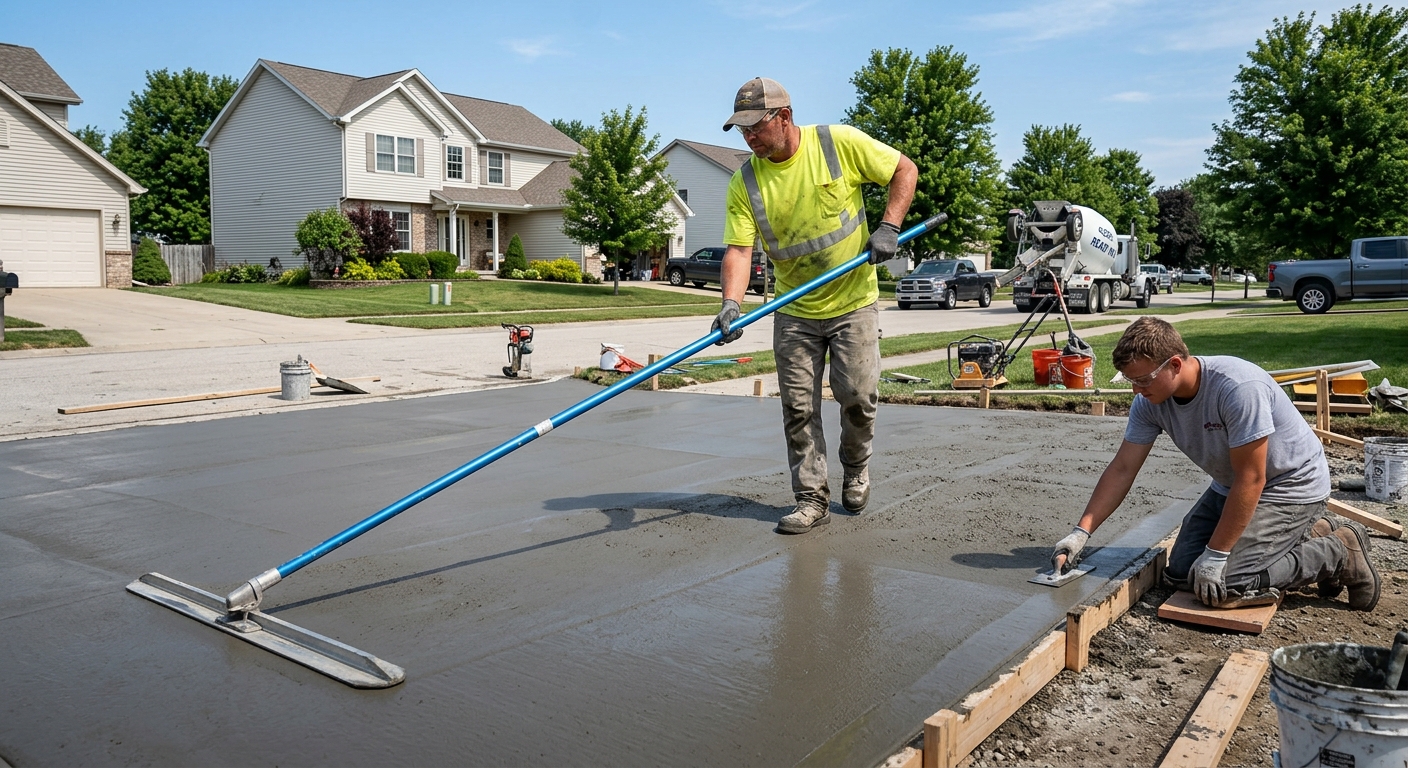
Concrete work options and costs in Elmvale
In Elmvale, concrete is the go-to choice for durable driveways, patios, walkways, and foundation work on the kind of homes most common around town. Elmvale sits within the broader Toronto economic region, where the concrete market is busy and pricing reflects both demand and the seasonal reality of freeze–thaw. With a population of 2,314 (Statistics Canada, 2021 Census), local crews tend to serve a steady mix of full replacements and smaller infill projects, especially around older residential pockets where driveways and entry slabs are nearing the end of their service life. Concrete flatwork is particularly in demand in the Elmvale Station area, where residents commonly renovate to improve curb appeal and manage water runoff from sloped lots.
Toronto-area concrete costs are strongly shaped by frost depth and repeated winter cycling between freezing and thawing. Ontario typically requires structural footings to extend to about 1.2 m (roughly 4 ft) below grade to help prevent frost heave and differential movement, and that depth alone affects excavation and forming time. Exterior flatwork pricing also accounts for air-entrained mixes, proper drainage, and control joints that limit random cracking when concrete expands and contracts. In practice, you’ll see quote-to-quote differences based on how crews build the base (compacted granular), what reinforcement is included, and whether you choose a simple broom finish or a higher-end stamped or exposed aggregate look.
Below are realistic cost ranges homeowners in Elmvale typically see for common projects, then we’ll break down what drives those numbers up or down.
| Application |
Typical Size |
Key Spec |
Finish Option |
Price Range |
| Concrete driveway (standard broom finish) |
300 sq. ft. (e.g., 10 ft x 30 ft) |
Air-entrained concrete, compacted base, control joints |
Broom finish |
$5,400–$8,400 |
| Exposed aggregate driveway |
300 sq. ft. |
Air-entrained mix, standard base, proper edging |
Exposed aggregate |
$7,000–$10,800 |
| Stamped concrete driveway or patio |
200 sq. ft. (e.g., 10 ft x 20 ft) |
Air-entrained mix, integral colour, release agent, sealer |
Stamped pattern |
$4,800–$8,000 |
| Plain concrete patio or walkway |
120 sq. ft. (e.g., 6 ft x 20 ft) |
Well-compacted base, drainage slope, control joints |
Plain |
$2,000–$3,500 |
| Garage floor (interior slab) |
400 sq. ft. (e.g., 20 ft x 20 ft) |
Minimum thickness, vapour considerations for some sites, saw-cut joints |
Broom finish |
$7,500–$12,000 |
| Foundation footings (structural, below frost) |
Per linear foot (typical footing run) |
Engineered sizing, below-grade excavation, waterproofing coordination |
Structural concrete |
$180–$300 |
Prices are estimates only and vary by project scope, site access and material selection.
What affects the price of concrete work in Elmvale
In Elmvale, even when two contractors describe the “same” driveway or patio, you can see pricing swing by 30–50% across the wider Toronto region. That gap usually comes down to the parts homeowners can’t easily see: excavation depth and base thickness, reinforcement decisions, the concrete mix design, and how long the crew waits for proper curing in cold snaps. Toronto-area concrete work is also competitive, and scheduling matters—when the region is busy, crews price in faster turnarounds and higher labour demand.
Frost depth and freeze–thaw cycles dictate the core specs in Ontario. Structural footings typically must extend to at least about 1.2 m below grade to reduce frost heave and differential movement, so deeper digging increases forming, disposal, and labour. Exterior slabs also rely on air-entrained concrete mixes to survive repeated freezing and thawing. When temperatures drop toward 10 °C or below, contractors often need cold-weather curing precautions (insulating blankets and/or temporary heating), and that adds cost. De-icing salt can accelerate surface scaling/spalling if the mix and finishing aren’t right—so a penetrating sealer is commonly recommended after cure.
Two real examples show how local conditions change the bill. First, driveways on tighter Elmvale lots with limited equipment access often cost more than the base price band because saw-cutting, wheelbarrowing, and extra protection slow the pour; a standard driveway in the $18–$28 band can stretch upward when access and grading are difficult. Second, if your soil is prone to poor drainage and the contractor needs additional granular base and better drainage swales, a “plain” patio can move from the lower $16–$26 band toward the higher end due to earthwork. Finish choice matters too: stamped work typically moves you into the $24–$40 decorative range because of colour, texture mats, and extra labour.
| Price Factor |
Why It Matters |
Cost Impact |
| Frost line depth — determines footing depth and form height |
Controls excavation and prevents frost heave under structural elements |
Higher excavation and forming can add significant labour/material costs |
| Site preparation — excavation, grading, compacted granular base |
Good base prevents settlement and reduces cracking from moisture movement |
Extra trucking/haul-off and base material can shift price upward |
| Reinforcement — rebar or wire mesh requirement |
Improves load capacity and helps limit cracking patterns |
More steel and tying supports increase labour and material totals |
| Mix design — air-entrainment and compressive strength spec |
Air-entrainment is critical for freeze–thaw durability of exterior concrete |
Higher-spec mix costs more and may require longer curing management |
| Finish type — broom vs. stamped vs. exposed aggregate |
Complex finishes require added steps, timing, and often sealer systems |
Stamped/exposed aggregate generally increases cost over plain broom |
| Pour size and concrete truck access to site |
More volume and limited access increase labour and placement time |
Access constraints can add crew time, protective measures, and handling |
| Cold-weather curing precautions — heating and blankets |
Protects early-age concrete from temperature-related strength loss |
May add rented equipment and materials; often needed in shoulder season |
| Control joint pattern and sealing cost |
Joints manage shrinkage cracking and sealing reduces de-icer scaling |
Proper jointing/sealer adds materials and labour but improves longevity |
Permits & regulations in Ontario
In Ontario, structural concrete work typically requires a building permit because it affects the building’s load path. This includes footings, foundation walls, grade beams, and any structural underpinning or engineered concrete elements. In many cases, engineered drawings are reviewed by the municipality or required as part of the permit package. Concrete flatwork such as patios, walkways, and driveways usually does not require a permit by default, unless it changes lot grading in a way that affects drainage, falls under impervious surface coverage considerations, or impacts municipal requirements like right-of-way conditions. If your concrete work ties into foundation drainage or changes how water runs off your property, always confirm locally before breaking ground.
For Elmvale homeowners, a safe verification process is straightforward and worth doing before you sign. Step one: ask the contractor for proof of liability insurance and WSIB/WCB coverage (or the applicable coverage status). Step two: check their documentation on day one—your contractor should provide clear certificate of insurance showing coverage limits and the expiry date. Step three: confirm the contractor’s licensing/registration status using Ontario’s online resources and any contractor registry tools available through your municipality or provincial portals. Step four: request a copy of the permit pull (if needed) and review whether the scope includes engineered drawings where structural elements are involved. Step five: verify past projects with references on similar-scale flatwork or foundation work, ideally with photos showing base prep and jointing.
Concrete is only as good as the compliance and the prep. When permits and coverage are handled correctly, you reduce the risk of rework and warranty disputes after freeze–thaw cycles start.
Getting concrete right in Elmvale's freeze-thaw climate
Concrete fails in Elmvale winters most often due to moisture getting in, then expanding as it freezes—leading to surface scaling and spalling, especially where de-icing salt is used. The fix isn’t “just thicker concrete.” It’s a full system: compacted base for stability, an air-entrained mix for durability, properly spaced control joints to control cracking, and curing and sealing done at the right times.
1) Base preparation: the granular sub-base has to be compacted to the correct depth and shaped for drainage so saturated soils don’t pump and move under freeze–thaw. 2) Mix design: exterior flatwork should use air-entrainment—typically around 5–7% air content—and a minimum 32 MPa compressive strength so the concrete can resist freeze–thaw damage. 3) Control joints: joints need a planned spacing pattern so cracking happens where it’s meant to, not randomly across the slab. 4) Curing: allow a minimum 7-day curing period under proper conditions; if you pour in colder weather, contractors need protection such as insulating blankets to keep temperatures in a safe range for strength gain. 5) Sealing: apply a penetrating sealer after full cure (commonly around 28 days post-pour) to reduce how easily de-icing salts and water reach the surface.
When homeowners skip any one of these, you can get early scaling that costs money to repair later. For example, moving from a basic broom-finish patio to a properly specified “exterior-ready” mix and jointing might cost a few extra dollars per square foot, but that difference is usually far less than future patching. In the Elmvale market, that’s why many crews keep standard patios within the $16–$26 band when the base prep and mix meet the durability requirements; upgrades that actually improve freeze–thaw performance are easier to justify than decorative upgrades alone.
Use the questions below to pressure-test the technical details before you sign.
| Spec | |
Why It Matters in Elmvale |
What to Ask For |
Impact if Skipped |
| Compacted granular base (depth?) |
Prevents settlement and moisture-driven movement during freeze–thaw |
“What base depth and compaction method are you using, and what drainage slope?” |
Cracking, uneven surfaces, and premature failure |
| Air-entrained concrete mix (target air %?) |
Protects against freeze–thaw scaling and spalling |
“What air content are you targeting for exterior exposure (about 5–7%)?” |
Surface scaling and spalling in winter, especially with salt |
| Compressive strength (MPa rating) |
Ensures adequate early-age and long-term strength for exterior use |
“Minimum 32 MPa—what’s the specified strength and cure plan?” |
Reduced durability, higher risk of cracking under loads |
| Control joints (spacing per ACI guidelines) |
Controls shrinkage cracking location and width |
“What joint spacing are you using and will you show the layout before the pour?” |
Random cracking across the slab and difficult repairs |
| Minimum 7-day curing period |
Cold nights can slow strength gain and increase early vulnerability |
“How will you protect the slab if daytime temps drop—blankets/heating if needed?” |
Weaker concrete, increased cracking and surface damage |
| Penetrating sealer (when applied after cure) |
Reduces water and de-icer absorption to slow surface scaling |
“Sealer applied after full cure—what product and when (around 28 days)?” |
Faster deterioration and more frequent patching |
How to choose a concrete work contractor in Elmvale
Choosing a contractor for concrete in Elmvale is mostly about verifying coverage and then reading the scope like a contract, not a brochure. In Ontario, start by asking for proof of liability insurance (with limits shown on the certificate), then request confirmation of WSIB/WCB coverage. You should also verify the contractor’s standing through Ontario’s online contractor resources and any municipal requirements where applicable—especially for work that may need permits or engineered drawings.
Next, get 2–3 itemised written quotes. You want a breakdown that shows labour, concrete volume, base prep, reinforcement, finishing, and disposal so you can compare “apples to apples.” Make sure the quote states whether a permit is included for structural work, whether engineering drawings are required, and whether debris removal is part of the price. For warranty, ask for the workmanship warranty length in writing and clarify if it’s tied to the contractor or to a product manufacturer. For payment, avoid paying more than about 10–15% upfront; hold back a portion until the job is complete and cleaned up, and don’t accept verbal promises.
Finally, request a start date and a completion estimate in writing. In the Toronto region, shoulder-season weather can affect curing and surface protection, so a realistic schedule and clear protection plan matter as much as price.
- Ask for liability insurance and review the certificate (expiry date and coverage limits).
- Confirm WSIB/WCB status in writing for the workers who will be on your site.
- Request proof of Ontario contractor registration/licence status before work starts.
- Get an itemised quote (labour, materials, base prep, reinforcement, disposal).
- Verify whether a permit is included where structural concrete requires one.
- Check that site protection is included (property protection, erosion control).
- Confirm granular base thickness and compaction method, not just “we’ll prep the base.”
- Ensure the mix is specified for exterior exposure (air-entrained) and strength rating.
- Ask to see the control joint layout and finishing schedule (timing affects quality).
- Get the curing and cold-weather protection plan in writing if temps can drop.
- Confirm whether sealing is included, when it’s applied, and what type of sealer.
- Review warranty details: workmanship length, what’s covered, and exclusions.
Elmvale-specific red flags: no discussion of air-entrainment for exterior freeze–thaw exposure; vague promises like “we’ll pour when it warms up” with no curing plan; missing or outdated insurance/WSIB documents; quotes that omit base thickness/compaction and control joints; and insisting on large upfront deposits without a schedule or written scope.
Frequently asked questions — concrete work in Elmvale
What causes concrete to spall in Elmvale winters?
In Elmvale and across Ontario’s freeze–thaw conditions, spalling is usually caused by water entering the concrete and then expanding as it freezes. This is made worse when de-icing salts contact the surface, especially if the mix isn’t properly air-entrained. If the contractor didn’t include adequate air content (typically targeted around 5–7% for exterior flatwork), freeze–thaw cycles can break down the surface over time, leading to scaling and flaking. Spalling can also happen when the slab sits on an under-compacted base, letting water collect or pumping moisture into the bottom of the slab. The best prevention is correct mix design, proper base prep and drainage, correctly spaced control joints, and a penetrating sealer applied after full cure (often around 28 days). If you’re comparing quotes for a patio in the $16–$26 band, make sure durability specs aren’t being replaced with “cheaper concrete” to hit the low end.
What is rebar and when is it required in Ontario?
Rebar (reinforcing steel bars) is used in concrete to help resist tensile forces and control cracking under load. In Ontario, whether you need rebar is determined by the structural design and the type of concrete element. For structural work—like foundation footings, grade beams, or foundation walls—reinforcement is commonly specified by engineers and reviewed as part of the permit/structural package. For exterior slabs and flatwork, rebar may or may not be required depending on slab thickness, soil conditions, and intended loads (for example, heavier vehicle loads on driveways vs. lighter foot traffic on walkways). In Elmvale’s climate, even when reinforcement isn’t mandatory for every slab, the durability requirements still are: air-entrained concrete, correct base prep, and proper control joints to manage freeze–thaw and shrinkage. If you’re getting a driveway quote, ask whether reinforcement is included and where it’s placed (and whether the thickness and base are designed for the loads).
How long does a concrete project take in Elmvale?
Timeframes in Elmvale usually depend on the size of the pour, how much demolition/excavation is needed, and curing conditions. For many exterior flatwork projects, the active work (forms, base prep, steel placement, pour, finishing, and saw cutting) can happen in one to three days. However, the waiting period matters: concrete needs time to cure before you can treat it as fully finished and before heavy loads are permitted. A key rule of thumb is a minimum 7-day curing period for strength development, with extra protection if temperatures drop during the early days. If you pour closer to cool fall or early spring conditions in the Toronto region, contractors often add insulating blankets or other cold-weather curing precautions, which can extend the schedule and shift work to the next suitable window. Sealing is typically done after full cure—often around 28 days post-pour—especially if you want long-term resistance to de-icing salt impacts on exterior surfaces.
What is a concrete overlay and is it suited to Elmvale?
A concrete overlay is a new concrete layer placed on top of an existing slab, usually after surface preparation such as grinding and patching. It can be a good option when the original slab is still structurally sound but has surface issues like minor scaling or unevenness. In Elmvale’s freeze–thaw winters, overlays can last well only if the base is prepared properly and the concrete mix and bonding system are appropriate. If the original slab has widespread cracking, ongoing movement, or significant frost-related heaving, an overlay may fail because the movement transfers upward into the new layer. Overlays can also trap moisture if drainage and detailing aren’t handled correctly. Cost-wise, homeowners sometimes look at overlays to stay closer to the $16–$26 patio/walkway band, but if the base is failing, removal and replacement will usually be the more durable long-term solution. Ask your contractor to assess slab condition, describe the prep method, and explain how they’ll manage moisture and joints.
How do I seal concrete to protect it in Elmvale?
Sealing in Elmvale is mainly about reducing water and de-icer salt absorption so freeze–thaw damage slows down. The most common approach is a penetrating sealer applied after the concrete has fully cured—commonly about 28 days post-pour for exterior flatwork. Before sealing, the surface should be clean and properly dry; sealing too early can trap moisture and reduce performance. In the Toronto region, where humid wet periods can occur in fall and spring, moisture control is important—surface appearance alone isn’t enough to confirm readiness. After you seal, you should still follow best practices: avoid heavy salt use immediately after storms, and keep drainage functioning (downspouts and slope away from slabs). When comparing quotes, don’t assume sealing is included—ask whether it’s part of the scope and what type of sealer (penetrating vs. coating) they plan to use. This is one reason reputable bids for concrete patios near the $16–$26 band often still cost more than the cheapest option: the sealer step improves winter durability.
What is the difference between concrete and cement?
Concrete is the final building material you see and walk on, while cement is one of the ingredients inside concrete. Cement is a binder (typically Portland cement) that reacts with water and helps “glue” the rest of the mix together. Concrete also contains aggregates (sand and gravel/crushed stone) and water, and for exterior work in Ontario it commonly includes admixtures—most importantly air-entrainment. That air-entrained mix component is critical in Elmvale’s freeze–thaw climate because it helps concrete tolerate repeated freezing and thawing without spalling. When contractors talk about “concrete specifications,” they usually mean the full mix design: the air content target, the minimum compressive strength (often at least 32 MPa for exterior flatwork), and the curing plan. So if a quote just says “cement” or doesn’t specify air-entrainment and strength, that’s a red flag. For example, decorative stamped projects in the $24–$40 range often include mix and finishing steps beyond basic broom concrete, but the cement is still just one part of the overall concrete system.