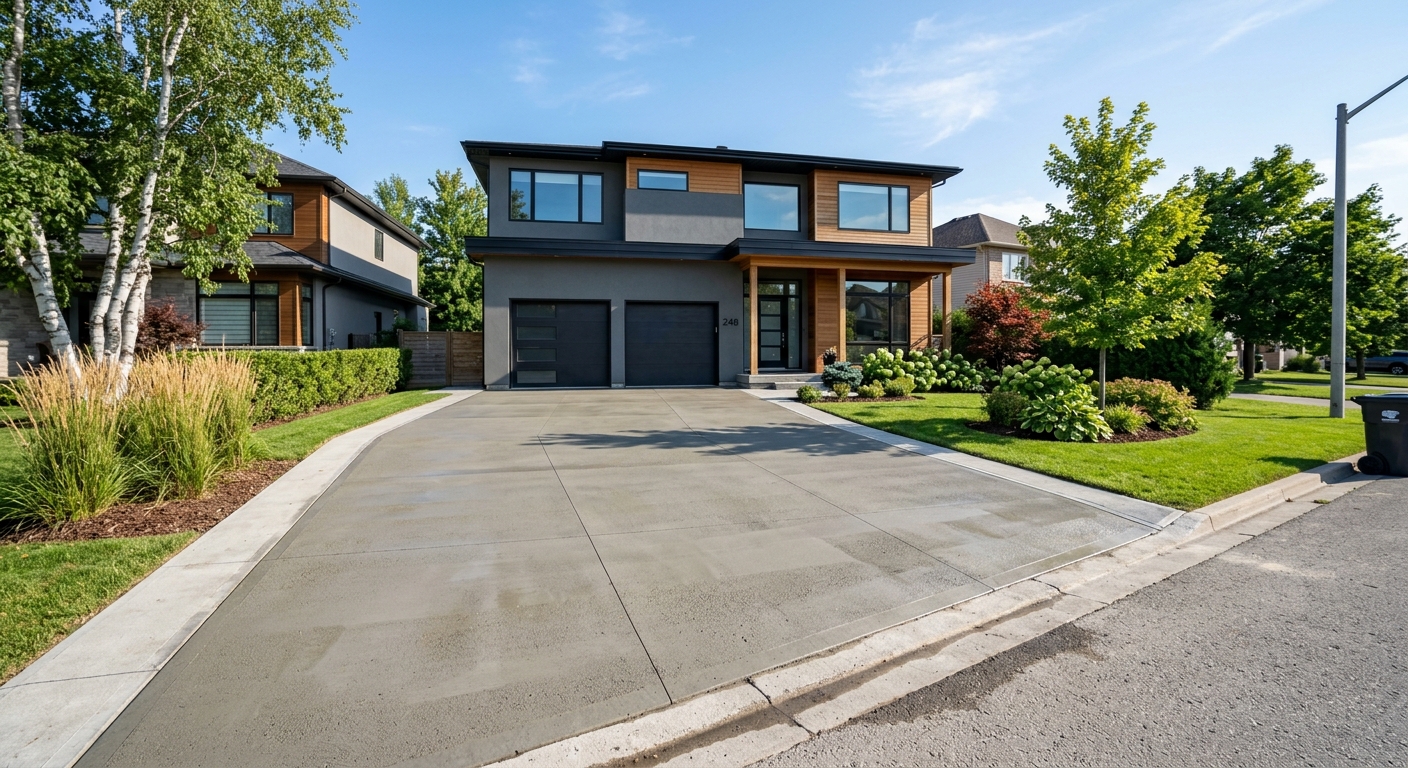
Concrete work options and costs in Casselman
Casselman is a tight-knit community in the Ottawa region where concrete flatwork is in high demand, especially on single-detached lots. With single-detached houses making up 66.5% of dwellings (Statistics Canada, 2021 Census) and 72.5% of households owning their homes (Statistics Canada, 2021 Census), driveways, patios and walkways are often the first exterior upgrades homeowners tackle. In this part of Eastern Ontario, pricing is heavily shaped by the deep frost line and strong freeze–thaw cycles. Those conditions don’t just affect concrete quality—they affect how much excavation, granular base, reinforcement detailing and curing effort contractors need to plan into the schedule.
In Casselman (and nearby neighbourhoods along routes like Highway 417 / Cedar Street area where access can be tight), contractor availability and truck access can also sway costs. Exterior work is more weather-sensitive: cold snaps shorten finishing windows, slow strength gain, and can raise costs for heating/blanketing during cold-weather pours. That’s why “standard” looks can still require more labour here than in milder Ontario regions—particularly at slab edges, driveway transitions and walkway corners where freeze–thaw stress is highest.
Below is a practical comparison of common concrete options homeowners request in Casselman, using current local price bands for Ottawa-area work.
| Application |
Typical Size |
Key Spec |
Finish Option |
Price Range |
| Concrete driveway (standard broom finish) |
400 sq ft (approx. 20 ft x 20 ft) |
Air-entrained mix; compacted granular base; control joints |
Broom finish + basic sealer optional |
$16,000–$25,000 |
| Exposed aggregate driveway |
400 sq ft (approx. 20 ft x 20 ft) |
Proper base + air-entrainment; wash/retard finish system |
Exposed aggregate finish |
$20,000–$32,000 |
| Stamped concrete driveway or patio |
300 sq ft (approx. 15 ft x 20 ft) |
Air-entrained mix; joint layout to manage thermal movement |
Stamp + colour hardener + release (pattern choice) |
$18,000–$30,000 |
| Plain concrete patio or walkway |
200 sq ft (approx. 10 ft x 20 ft) |
Air-entrained mix; compacted base; edge forms |
Broom finish or smooth trowel (as specified) |
$2,800–$4,400 |
| Garage floor (interior slab) |
300 sq ft (approx. 20 ft x 15 ft) |
Vapour barrier (if required); proper sub-base; joints |
Plain finish (no stamp); optional stain/sealer |
$6,000–$10,000 |
| Foundation footings (structural, below frost) |
Typical footing package for a small addition |
Engineered design; below frost excavation; rebar per drawings |
Standard structural concrete |
$3,600–$6,500 |
Prices are estimates only and vary by project scope, site access and material selection.
What affects the price of concrete work in Casselman
If you’re comparing quotes in Casselman and across the Ottawa area, it’s normal to see the same “type” of project come in 30–50% apart once the details are unpacked. Ottawa-area pricing is higher than in milder parts of Ontario because contractors are protecting the work from freeze–thaw stress. For example, frost line requirements dictate footing depth and form height; even when flatwork seems simple, exterior slabs must be engineered with a well-compacted granular base and good drainage to limit frost movement. Exterior concrete is also typically air-entrained so it can survive repeated freeze–thaw cycling without spalling or scaling.
Cold weather is a cost driver too. During shoulder seasons, contractors may need heating/blanketing to protect green concrete and meet early strength targets, and curing becomes more labour-intensive. De-icing salts further increase surface wear risk, so sealing is often recommended to extend service life and reduce early deterioration. That’s one reason a broom-finished driveway can still cost more in winter-exposed areas, especially where runoff or wind concentrates temperature swings.
Local examples: (1) on older homes—28.8% were built before 1981 (Statistics Canada, 2021 Census)—you commonly see unpredictable base conditions and more debris removal, which increases excavation and disposal. (2) narrow access along established lots can mean longer equipment set-up and more hand work around forms, pushing cost toward the higher end of the $16–$25 per-sq-ft band for driveways. (3) opting for stamped work typically adds labour and materials; that’s where the higher $22–$35 decorative band is often justified, rather than trying to “upgrade later.”
| Price Factor |
Why It Matters |
Cost Impact |
| Frost line depth — determines footing depth and form height |
Deeper excavation and more concrete to keep frost heave away from foundations and edges |
Can add substantial labour and materials; often one of the biggest drivers for structural work |
| Site preparation — excavation, grading, compacted granular base |
Freeze–thaw performance depends on base density, thickness, and drainage |
Improper prep can lower bid, but fixing later is far more expensive; good prep raises upfront cost |
| Reinforcement — rebar or wire mesh requirement |
Controls cracking and improves slab load capacity, especially at edges and driveways |
Material and tying/placement labour; usually a moderate cost increase |
| Mix design — air-entrainment and compressive strength spec |
Air entrainment helps resist freeze–thaw damage; strength targets support long-term durability |
Often modest per-yard cost but can be a major difference between bids |
| Finish type — broom vs. stamped vs. exposed aggregate |
Finishes change labour time, crew skill, and material system complexity |
Stamped/exposed generally moves you toward higher decorative pricing |
| Pour size and concrete truck access to site |
Longer carries, limited access, or multiple placements increase labour and scheduling |
Can push costs up quickly, especially with tight lots or seasonal access constraints |
| Cold-weather curing precautions — heating and blankets |
Protects early-age strength gain and prevents surface damage in cold snaps |
Adds labour/materials; increases the cost of “rush” scheduling in shoulder seasons |
| Control joint pattern and sealing cost |
Joint spacing reduces random cracking; sealing can reduce salt-driven surface deterioration |
Typically a cost increase worth it for exterior durability |
Permits & regulations in Ontario
In Ontario, concrete isn’t “one-size-fits-all” for permits. Structural concrete work—typically footings, foundation walls and grade beams—usually requires a building permit, and in many cases engineered drawings are reviewed by the municipality to confirm design loads and reinforcement. For homeowners, that means you should expect permit involvement for work that supports the structure or changes the foundation system.
Concrete flatwork like driveways, patios and walkways usually does not require a building permit by default. However, it can become a permit issue if it affects lot grading, impacts stormwater/drainage, triggers impervious surface coverage limits, or interferes with municipal right-of-way requirements (for example, works near a driveway apron or sidewalk tie-in). Always confirm with the local authority before breaking ground.
Contractor verification is straightforward. In Casselman, start by ensuring the contractor can legally work in Ontario: ask for their liability insurance certificate and confirm they carry WSIB/WCB coverage. Then check their references for similar-scale jobs (driveways/patios and—if applicable—structural work).
- Licence/registration: look up the contractor through Ontario’s public online registry where applicable for their trade.
- Liability insurance: request the Certificate of Insurance naming the correct insured parties and coverage limits.
- WSIB/WCB: confirm clearance/coverage status and request proof.
- Ask for a permit plan (when structural): confirm who applies, who pays, and timeline impact.
- Get everything in writing: scope, inclusions, and responsibility for inspections.
Getting concrete right in Casselman's freeze-thaw climate
Concrete failures in Casselman usually trace back to one of five issues: poor base prep, inadequate drainage, wrong mix design, weak curing, or missing joint/sealing practices. In freeze–thaw weather, the surface and edges experience the highest stress; water in the slab or base can freeze and expand, leading to heaving, scaling, and spalling. To avoid that, spec the work for Ottawa-region conditions from day one.
(1) Base preparation: require excavation to the right depth for local soils and frost protection, followed by a well-compacted granular sub-base that supports drainage and resists pumping. (2) Mix design: for exterior flatwork, ask for air-entrained concrete with a target of about 5–7% air, plus a minimum 32 MPa compressive strength specified for the application. (3) Control joints: ask the contractor to lay out joints to control shrinkage and thermal movement, rather than hoping the slab “just works.” (4) Curing: insist on minimum 7 days of proper curing conditions; cold weather makes this more sensitive, often requiring insulating blankets or heaters to maintain temperature and moisture. (5) Sealing: use a penetrating sealer after the concrete has cured—typically applied about 28 days post-pour—to help repel de-icing salts and reduce surface wear.
What to ask about specifically: “What air content are you targeting for this exterior slab?” Spalling risk drops when air entrainment is correct. As a dollar example, a basic broom-finish driveway might sit around $16–$25 per-sq-ft in this market; spending a bit more up front for correct base and mix design is usually cheaper than replacing a failure two winters later.
| Spec |
Why It Matters in Casselman |
What to Ask For |
Impact if Skipped |
| Compacted granular base (depth?) |
Helps prevent frost-driven movement and reduces voids where water freezes |
Show base thickness and compaction method (and drainage details) |
Uneven settling, heaving at edges, early cracking |
| Air-entrained concrete mix (target air %?) |
Resists freeze–thaw damage and reduces surface scaling/spalling |
Request target air content (about 5–7% for exterior flatwork) |
Spalling and rapid deterioration within a few winters |
| Compressive strength (MPa rating) |
Supports strength gain despite cold snaps and freeze–thaw stress |
Minimum 32 MPa specified for the application |
Soft, weak surface and accelerated wear |
| Control joints (spacing per ACI guidelines) |
Controls random cracking from shrinkage and thermal movement |
Joint spacing plan and locations at stress points |
Random cracks that can widen with freeze–thaw |
| Minimum 7-day curing period |
Proper curing is harder in Ottawa-area temperature swings |
Confirm curing plan and winter protection if needed |
Surface weakness, scaling, and poor long-term durability |
| Penetrating sealer (when applied after cure) |
Helps block salt and moisture from reaching porous surfaces |
Penetrating sealer after cure—about 28 days post-pour |
Salt damage, more potholing-like spall areas over time |
How to choose a concrete work contractor in Casselman
Choosing the right concrete contractor matters in Casselman because freeze–thaw performance depends on details that aren’t visible after the pour—base density, joint layout, mix air content, and curing practices. Start by verifying Ontario licensing/registration where applicable for their trade, then check documentation for liability insurance and WSIB/WCB coverage. Ask for the certificate of insurance and confirmation of coverage (clearance/letter). Don’t rely on verbal assurances.
Next, request 2–3 itemised written quotes that break out labour and materials instead of a single lump sum. Make sure the scope lists excavation limits, granular base thickness, reinforcement details, concrete mix requirements (including air entrainment for exterior work), finish type, saw cutting/joint sealing, and disposal/regrading responsibilities. Ask whether permits are included when the work is structural (footings/foundation elements) and who pulls them.
Warranty should be clear: workmanship coverage length, whether it’s tied to crack type or freeze–thaw movement, and whether there’s a product/manufacturer warranty for materials like sealers or decorative systems. Payment should be conservative—generally no more than 10–15% upfront—with a holdback until completion. Finally, insist on a written start date and completion estimate, especially since exterior pours in Ottawa-area cold weather can get delayed for curing and finishing conditions.
- Ask who manages snow/ice and weather protection during the pour and curing window.
- Confirm concrete specifications in writing: air entrainment and minimum strength.
- Require the joint spacing and sealing plan for exterior flatwork.
- Get base thickness and compaction expectations stated in the quote.
- Check if reinforcement is included where it should be (edges, driveways, slabs on grade).
- Confirm disposal/loading for excavated material (and topsoil replacement, if needed).
- Verify truck access and placement plan (especially for narrow Casselman lots).
- Ask about curing method (standard vs winter blankets/heaters).
- Request examples/photos of similar projects locally around Ottawa.
- Clarify exclusions: staining, re-sealing, utility locates, and site drainage fixes.
- Review warranty terms and what happens if a crack occurs within first year.
- Ensure proof of insurance and WSIB/WCB coverage is current before work begins.
Concrete red flags to watch in Casselman: (1) quotes that don’t specify air entrainment or curing protections, (2) vague “we’ll pour and see” wording on joints and base prep, (3) missing or expired insurance/WSIB proof, (4) unusually low pricing that skips granular base depth or reinforcement, and (5) pressure to pay most of the job upfront before forms and materials are confirmed.
Frequently asked questions — concrete work in Casselman
What is the difference between concrete and cement?
In Ontario (including Casselman), “cement” is one ingredient inside “concrete.” Cement is the binder powder—commonly Portland cement—that reacts with water to create strength. Concrete is cement plus water, sand and gravel (and sometimes air-entraining admixtures, fibres, or other additives). When contractors talk about exterior durability in our freeze–thaw climate, the key spec is usually not just the cement brand—it’s the full concrete mix design: water-cement ratio, air entrainment (for freeze resistance), and the minimum compressive strength rating. That’s why two driveways can look similar at first but perform very differently after winter if the mix details are different.
How much does concrete work cost in Casselman?
Concrete pricing in Casselman generally aligns with Ottawa-region freeze–thaw driven costs: deeper frost protection details, thicker granular base, and weather-sensitive curing. For a concrete driveway, you’ll often see pricing around the local band of $16–$25 per sq ft depending on base prep, reinforcement, thickness, and finish. Patios/walkways typically land around $14–$22 per sq ft with broom or smooth finishes, while stamped/decorative work is usually higher—around $22–$35 per sq ft—because it adds labour and finishing materials. Your quote can move 30–50% based on site access, excavation/disposal, and whether cold-weather heating/blanketing is needed to cure properly.
How deep must footings be for Casselman's frost line?
Footing depth is determined by the design frost depth and the engineered foundation requirements, which is why contractors can’t give one universal “magic number” for every lot in Casselman. In practice across Ontario, footing depth commonly needs to extend to around the design frost depth to prevent frost heave—often in the range of about 1.5–2.4 m depending on local conditions and design requirements. What matters to homeowners is that structural work (footings and foundation elements) should be specified on engineered drawings and tied to soil conditions, drainage, and frost protection details. Because Casselman experiences strong freeze–thaw cycles, cutting corners on footing depth or base preparation risks heaving and cracking—costly problems that are expensive to correct.
Why does concrete crack in Casselman and how is it prevented?
Concrete cracks in Casselman mostly due to shrinkage, temperature changes, and frost-related movement—made worse if water gets into weak base areas or if joints aren’t planned. Freeze–thaw stress is highest at slab edges and in areas exposed to salt and water. Prevention comes from specifying the right air-entrained mix for freeze resistance, building a well-compacted granular base with proper drainage, and using control joints at a reasonable spacing and location plan (rather than random cracking). Good curing also matters: curing too quickly or under cold conditions without protection can reduce surface strength. Finally, sealing helps reduce de-icing salt attack. When these steps are done together, cracking becomes predictable and manageable rather than destructive.
Stamped vs broom-finish concrete — cost difference?
Stamped concrete costs more than broom-finish because it includes additional materials (release agent, colour system or hardener depending on design) and extra labour for pattern stamping, texture finishing and curing/handling requirements. In Casselman’s Ottawa-area market, broom-finish exterior flatwork typically aligns with the driveway band around $16–$25 per sq ft, while decorative stamped pricing commonly sits around $22–$35 per sq ft depending on complexity, joint layout, and whether the contractor is using colour and stamp systems that require more time. The best way to decide is to compare apples-to-apples quotes: thickness, base prep depth, reinforcement, and joint sealing should be the same in both options. The difference should be finish system labour—not missed base or weaker mix specs.
When is the best time to pour concrete in Casselman?
For exterior concrete in Casselman, the safest window is late spring through early fall when temperatures support good curing without relying heavily on heating/blankets. Ottawa-area cold snaps shorten finishing windows, slow strength gain, and increase the risk of surface damage if curing isn’t protected. That said, contractors can pour in colder conditions if they plan for cold-weather curing (heating, insulation blankets, moisture control and proper protection), but that adds cost and needs tighter scheduling. If you’re aiming for a durable driveway or walkway, plan early and confirm the pour date, weather plan, and curing protection in writing. Homeowners with older properties in the area—built before 1981 in 28.8% of the local housing stock (Statistics Canada, 2021 Census)—often need more site prep time too, so early scheduling helps.