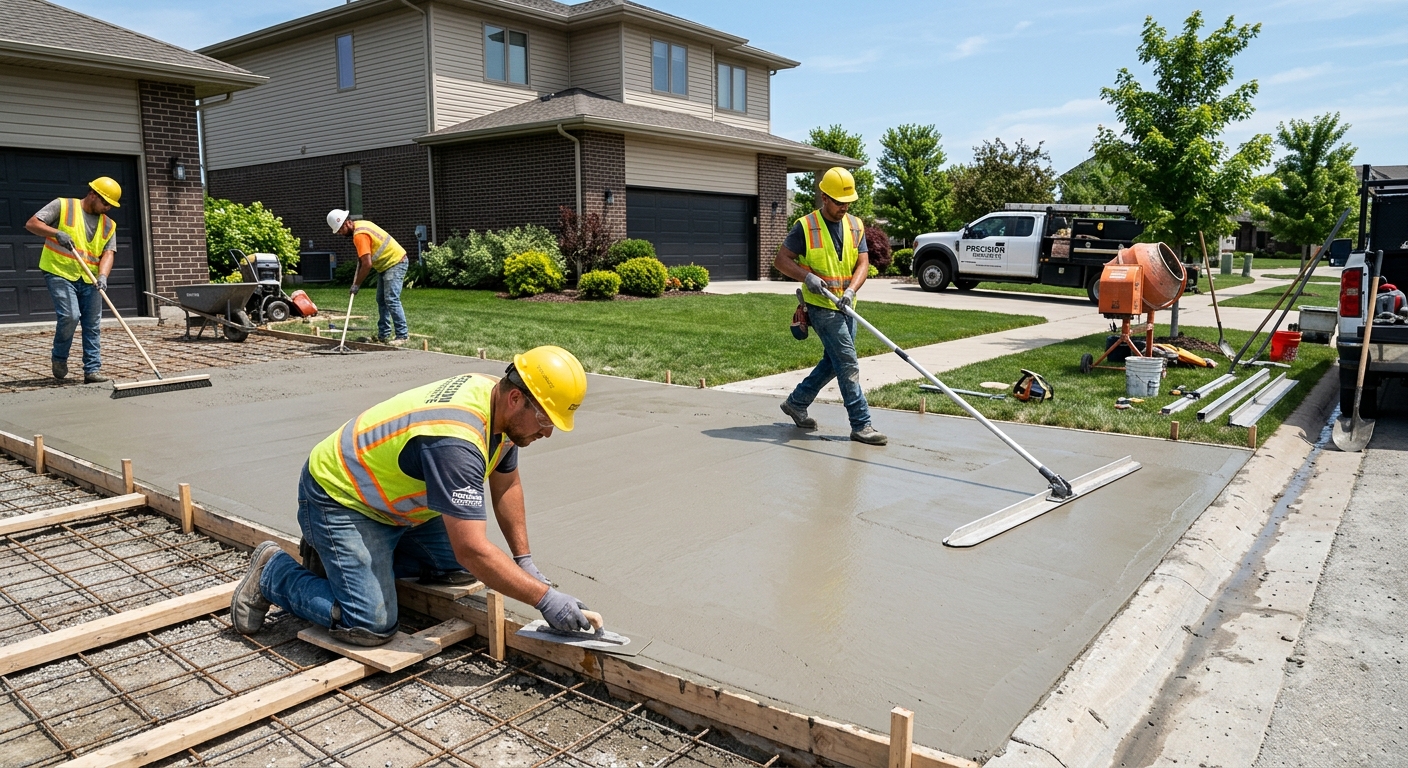
Concrete work options and costs in Humbermede
Concrete is a major part of property upkeep in Humbermede, and choosing the right option matters as much as the price. In a community of 15,545 residents (Statistics Canada, 2021 Census), the demand is largely tied to the type of housing—Humbermede is dominated by single-detached homes, which typically drive front-driveway replacements, backyard patios, and walkway upgrades. With the Toronto economic region’s active construction market, contractors often book quickly during peak season, so timing can influence your total cost and scheduling.
In Humbermede, concrete pricing is shaped by Toronto-area freeze–thaw cycles and frost protection requirements. Local specs generally aim for footings extending at least about 1.2 m below grade for structural support, and exterior flatwork needs air-entrained mixes plus a well-drained, compacted granular base. These requirements cost more upfront than “cheap” mixes, but they reduce the common winter problems—surface spalling, settlement, and uneven cracking.
You’ll typically see the most demand around established residential pockets such as the Humbermede neighbourhood near the busier arterial roads where driveways and walkways get heavier daily use. That steady replacement cycle is why you’ll find multiple crews offering standard broom-finish work, while stamped and decorative upgrades are usually the first to sell out for summer schedules.
Below are realistic cost bands homeowners in Humbermede can expect as a starting point, before adjustments for site access, reinforcement, and design.
| Application |
Typical Size |
Key Spec |
Finish Option |
Price Range |
| Concrete driveway (standard broom finish) |
16 ft x 24 ft (384 sq. ft.) |
4 in (100 mm) slab; air-entrained mix; compacted granular base; control joints |
Broom finish |
$6,900 – $10,700 |
| Exposed aggregate driveway |
16 ft x 24 ft (384 sq. ft.) |
4 in (100 mm) slab; air-entrained mix; base prep and proper drainage |
Exposed aggregate |
$7,400 – $12,200 |
| Stamped concrete driveway or patio |
300 sq. ft. |
4 in (100 mm) slab; air-entrained mix; release agent and colour hardener; joints |
Stamped |
$9,200 – $15,000 |
| Plain concrete patio or walkway |
200 sq. ft. |
4 in (100 mm) slab; air-entrained mix where exposed; compacted base |
Plain broom/steel-trowel blend |
$3,200 – $5,200 |
| Garage floor (interior slab) |
20 ft x 22 ft (440 sq. ft.) |
4 in (100 mm) slab; vapour control where required; standard reinforcement |
Plain smooth/trowel finish |
$6,600 – $11,000 |
| Foundation footings (structural, below frost) |
Typical per plan (varies by house) |
Engineered sizing; excavation, formwork; below-frost depth; concrete + reinforcement |
Structural concrete |
$180 – $300 |
Prices are estimates only and vary by project scope, site access and material selection.
What affects the price of concrete work in Humbermede
In Humbermede, the same-looking concrete job can swing by 30–50% across the Toronto region because contractors price risk differently—soil conditions, required frost protection, and how much base and reinforcement the job truly needs. Two driveways can both be “16 by 24,” but if one site needs deeper excavation, more granular base, and additional reinforcement due to soft subgrade, the material and labour jump quickly. Also, local scheduling matters: Toronto-area crews concentrate exterior pours in the warmer months, which can increase demand for skilled finishing and formwork in summer.
Here’s what drives most of the cost in this region. Frost depth and freeze–thaw cycles dictate every structural decision: footings generally must extend below the design frost depth to prevent frost heave and differential movement, while exterior slabs must use air-entrained concrete mixes to manage repeated freezing and thawing. Colder periods also shorten the practical pour season, so cold-weather precautions—like insulating blankets and on-site heating—add labour and fuel costs when temperatures drop toward 10 °C or below. Finally, de-icing salt accelerates surface spalling if the mix and finishing aren’t built for it; a proper sealing plan can protect the surface over time.
In Humbermede specifically, you’ll often see higher driveway costs where older soils are saturated in spring and need drainage improvements before the slab goes in. Conversely, a straightforward patio replacement on compact, dry ground with easy truck access can come in closer to the lower end of plain concrete pricing—while stamped concrete adds colour hardeners and extra labour, which is why stamped work typically lands above standard broom-finish driveway ranges (for example, plain patio/walkway can be closer to $16 – $26 per sq. ft., while decorative/stamped tends to price higher). Foundation work may look expensive per linear or plan quantity because it’s engineered and poured below frost, not “just concrete.”
| Price Factor |
Why It Matters |
Cost Impact |
| Frost line depth — determines footing depth and form height |
Deeper footings increase excavation, formwork, and concrete volume needed for frost protection |
Often a major driver on foundation/footing scopes (and increases unit costs for structural work) |
| Site preparation — excavation, grading, compacted granular base |
Poor subgrade or weak base leads to settlement and cracking; compaction and drainage prevent water-driven failures |
Can add significant labour and haul/disposal costs; may swing quote by tens of percent |
| Reinforcement — rebar or wire mesh requirement |
Reinforcement helps control cracking and improves load resistance, especially in driveways and slabs over variable soils |
Materials cost plus extra labour for placement/spacing |
| Mix design — air-entrainment and compressive strength spec |
Air-entrainment is essential for freeze–thaw durability; strength targets impact mix price and quality control |
Higher-spec mixes cost more, but reduce spalling and early failure |
| Finish type — broom vs. stamped vs. exposed aggregate |
Stamped and exposed finishes require more steps and skilled finishing timing |
Decorative options typically raise overall cost compared with plain broom-finish |
| Pour size and concrete truck access to site |
Longer carrying distances, tight gates, or crane/buggy needs increase labour time and risk |
Can trigger minimum truck charges and extra crew time |
| Cold-weather curing precautions — heating and blankets |
Proper curing at cooler temps protects strength gain and surface durability |
Extra materials and labour; often necessary outside the warm pour window |
| Control joint pattern and sealing cost |
Joints guide cracking; sealing helps repel salt and moisture to reduce surface deterioration |
Adds line-item cost but can extend the service life of exterior flatwork |
Permits & regulations in Ontario
In Ontario, the rule of thumb is that structural concrete needs approval, while many cosmetic flatwork projects do not. For Humbermede homeowners, concrete work that typically does require a building permit includes: foundation walls, grade beams, footings for new/underpinning, retaining-wall elements, and any structural concrete tied to engineered drawings or changes to the building’s structural system. If you’re altering load paths, changing foundation elevations, or doing underpinning/reconstruction, expect a permit and plan review—often with engineered details submitted to the municipality.
Concrete flatwork like patios, walkways, and driveways usually does not require a permit unless it affects lot grading, drainage, or impervious surface coverage limits, or it impacts municipal right-of-way/sidewalk conditions. Even when permits aren’t required, contractors must still follow safety practices and meet Ontario Building Code requirements for concrete durability and drainage.
How to verify a contractor in Humbermede (and satisfy yourself before you sign): first, confirm they’re properly licensed for the scope (and that their business is active). Next, request a current certificate of insurance—liability limits should be clearly shown—and verify coverage is for the work being done at your address. For workforce coverage, ask for proof of WSIB/WCB coverage (or the appropriate exemption documentation, if applicable). Finally, look for references on similar-scale concrete jobs—especially exterior flatwork with freeze–thaw exposure—and ask to see photos of joints, drainage, and finished surfaces after winter.
Getting concrete right in Humbermede's freeze-thaw climate
Concrete fails most often in Humbermede when the slab is built without respecting Toronto-area freeze–thaw cycles. The “classic” problems—random cracking, settled edges, and spalling—usually come from insufficient base compaction, water trapped under the slab, or concrete that isn’t properly air-entrained. To spec the job correctly, start with base preparation: use a compacted granular sub-base to the right depth and ensure drainage so saturated soils don’t pump against the concrete in spring thaw. Then specify the mix design: exterior flatwork should use air-entrainment (targeted around 5% to 7% air content for typical exposure conditions) and a minimum compressive strength of 32 MPa so the concrete develops adequate durability.
Control joints are what prevent random cracking from looking terrible. Ask for a joint pattern that spaces cuts to limit uncontrolled fractures, and make sure joints are properly executed (cleaned and sealed where recommended). Curing is also critical—don’t treat curing as “set and forget.” In cold snaps, you may need cold-weather curing protection to keep the slab from curing too slowly and losing surface durability. Finally, sealing matters in a de-icing-salt environment: plan for a penetrating sealer applied after full cure—commonly around 28 days post-pour—to help repel moisture and salt.
Where the price difference is justified: a stamped concrete driveway typically costs more than broom-finish because of extra steps and labour, but if it’s paired with correct base prep and air-entrained mix, the decorative surface can last instead of scaling around the first winter. If a quote is only marginally higher yet skips joint planning or sealing, that’s where you’ll pay later.
| Spec |
Why It Matters in Humbermede |
What to Ask For |
Impact if Skipped |
| Compacted granular base (depth?) |
Helps prevent settlement and “pumping” under freeze–thaw |
Granular base depth specified for your soil; compaction proof (where possible) and drainage grading |
Edge settling, rocking, and cracked corners within a few winters |
| Air-entrained concrete mix (target air %?) |
Improves freeze–thaw durability by controlling internal ice formation |
Ask the mix design for target air content (commonly 5% to 7% for exterior flatwork exposure) |
Spalling and surface scaling, especially where salt hits the slab |
| Compressive strength (MPa rating) |
Adequate strength ensures durability and performance under winter cycles |
Minimum 32 MPa compressive strength |
Reduced longevity and increased risk of surface damage |
| Control joints (spacing per ACI guidelines) |
Directs cracking to planned locations and helps limit random fracture |
Joint layout and spacing plan that matches slab size and use (driveway vs walkway) |
Random cracks that telegraph through finish and lead to moisture intrusion |
| Minimum 7-day curing period |
Strength gain and surface integrity depend on proper curing time/conditions |
Confirm protection/curing steps and minimum time before heavy use |
Premature wear, cracking risk, and weaker resistance to freeze–thaw |
| Penetrating sealer (when applied after cure) |
Repels de-icing salts and moisture to reduce surface deterioration |
Penetrating sealer application after full cure (commonly at ~28 days) |
Faster spalling and higher maintenance costs after the first winters |
How to choose a concrete work contractor in Humbermede
Choosing the right concrete contractor in Humbermede is mostly about verifying coverage, getting clean scope details, and matching the crew’s method to the freeze–thaw reality. Start by verifying Ontario licensing relevant to the work they’re doing, then request proof of liability insurance with a current certificate showing your project as the location of work. For workforce protection, ask for WSIB/WCB coverage documentation—this should be current and aligned to the period of the project. If you can’t get clear documentation, that’s your first signal to pause.
Next, get 2–3 itemised quotes—not vague lump sums. A good quote breaks out labour and materials (concrete, base/granular, reinforcement, finishing steps, cutting/jointing, sealing, and disposal). Ask what’s included for site access, excavations, and compaction, and whether the quote covers forms, reinforcement placement, and any required cold-weather curing provisions. If a contractor says “don’t worry, it’ll be fine,” ask what specific air content and curing plan they’ll use for exterior flatwork.
Warranty should be specific: a workmanship warranty length (for example, against premature cracking/spalling), plus manufacturer or product warranty details for any membranes/sealers and whether it’s transferable if you sell the home. Payment schedule matters too—don’t pay more than about 10–15% upfront, and hold back a portion until the finish and cleanup meet the scope. Finally, request the start date and estimated completion date in writing so you can plan deliveries of materials and coordinate vehicle access.
- Provide proof of liability insurance before any work begins
- Provide WSIB/WCB coverage documentation for their workers
- List who pulls permits (if required) and whether it’s included
- Get a detailed base-prep scope: excavation depth, granular material, compaction
- Confirm concrete mix design details: air-entrainment and 32 MPa minimum (for exterior/appropriate scopes)
- Require joint layout details: spacing, where control joints go, and sealing plan
- Confirm curing/protection plan for late pours and cold snaps
- Ask how they handle water: grading, edge drains (if applicable), and runoff control
- Request reinforcement details: mesh/rebar type, size, and placement height
- Ensure decorative work includes steps for release agent/colour hardener (if stamped) and curing timing
- Confirm disposal/hauling is included (or ask for the separate line item)
- Put the warranty terms in writing and define what triggers service
In Humbermede, red flags include: (1) quotes that don’t mention air-entrainment for exterior flatwork, (2) skipping a clear base-prep and drainage plan, (3) no joint/cutting schedule or no sealing mention, (4) asking for large upfront payments beyond 10–15%, and (5) vague curing protection language when temperatures drop in the shoulder season.
Frequently asked questions — concrete work in Humbermede
Why does concrete crack in Humbermede and how is it prevented?
Concrete in Humbermede commonly cracks because it has to expand and contract through freeze–thaw cycles, and because slabs inevitably move slightly as moisture conditions change. Cracking looks worse when joints aren’t planned or when water sits at the edges—spring thaw and wet fall can exaggerate that movement. The best prevention is proper base preparation with compaction and drainage, air-entrained concrete for exterior exposure, and a control joint pattern that directs where cracks will occur. A contractor should also describe curing protection, especially if you pour when nights get cold. If you’re comparing quotes, don’t accept “we’ll smooth it out later” as a plan—ask for the joint spacing and mix design. A correctly built plain walkway can be closer to $16 – $26 per sq. ft., but a poorly planned slab will cost you twice in replacements.
Stamped vs broom-finish concrete — cost difference?
In Humbermede and across the Toronto economic region, stamped concrete costs more because it requires additional labour steps and materials: release agent, colour hardeners/integral colours, timed stamping, and careful finishing to keep joints and edges crisp. Broom-finish concrete is comparatively straightforward—finish is simpler and scheduling is easier, which helps keep the price lower. As a homeowner baseline, plain patio/walkway work often sits in the lower-to-mid portion of local price bands, while decorative/stamped choices typically land higher due to labour and material intensity. That’s why you’ll see driveway and patio pricing rise when you move from standard broom to stamped options. If you want stamped, the “value” is only there when the contractor also nails the basics—base compaction, air-entrained mix, and correct curing—because decorative concrete fails the same way if it’s built on weak or wet subgrade. Always request an itemised quote so the premium is clearly tied to the extra finish work.
When is the best time to pour concrete in Humbermede?
The best time to pour in Humbermede is during the warmer months when daytime temperatures stay reliable and curing conditions are easier to manage. In the Toronto area, contractors typically concentrate exterior pours in late spring through summer because cold nights and damp weather in fall can slow curing and increase durability risks. Even though crews can pour in cooler periods with heating/insulating blankets, that protection adds cost and complexity. Practically, you want your contractor to confirm both pour-day conditions and curing protection if temperatures drop toward about 10 °C or below. If you’re planning a driveway replacement or patio, lock your scheduling early, because freeze–thaw management specs require more careful setup than the “quick pours” people remember. If your quote is sitting near the low end of the $18 – $28 driveway band but it doesn’t discuss curing protection for shoulder-season temps, ask questions before you sign.
How long does concrete take to cure?
Concrete gains strength over time, but curing is more than just “letting it sit.” A realistic expectation for exterior work in Ontario is a minimum 7-day curing period under proper conditions before normal light use, with full strength and best long-term durability development over a longer timeline. In Humbermede’s freeze–thaw climate, curing protection becomes more important during cooler stretches to avoid surface weakness and early deterioration. A properly managed job will also include temperature protection measures when needed and will limit heavy loads until the slab has reached adequate strength. If you’re sealing exterior flatwork, penetrating sealer is typically applied after full cure—commonly around 28 days post-pour—so the concrete has dried and stabilized enough to accept the sealer. If you’re comparing quotes, ask for the curing plan, what “protection” means, and when the slab can be driven on.
Do I need a permit for concrete work in Ontario?
In Humbermede, Ontario permits usually come down to whether the concrete work is structural. Foundation work—such as footings, foundation walls, grade beams, or underpinning—typically requires a building permit and often engineered drawings reviewed by the municipality. Concrete flatwork like patios, walkways, and driveways usually doesn’t require a permit unless it changes lot grading, drainage, impervious surface coverage limits, or impacts municipal right-of-way conditions. The safe approach is to confirm with the municipality before excavation, especially if you’re altering drainage patterns or elevating surfaces near the foundation. No matter the permit requirement, verify your contractor carries liability insurance and WSIB/WCB coverage, and ask for references on similar exterior freeze–thaw projects. If you’re doing a driveway or patio replacement, a reputable contractor should still explain how they’ll manage drainage so you don’t create a moisture problem even if a permit isn’t required.
Concrete vs pavers for a patio in Humbermede?
Concrete and pavers both work well for patios in Humbermede, but they fail differently under freeze–thaw. Concrete—when installed on a properly compacted granular base with air-entrained mix and good jointing—tends to provide a monolithic, smooth finish with predictable cracking control. Pavers move more visibly if the base is weak, but they can be easier to repair piece-by-piece after heaving or settlement. Cost-wise, a plain concrete patio often lands in the lower end of local bands—for example, plain concrete patio/walkway estimates can be around $16 – $26 per sq. ft.—while paver systems add base materials and labour for placement, cutting, and edging. If you expect heavy de-icing salt use, a concrete surface can be long-lasting when sealed after cure, whereas pavers rely heavily on joint sand stability and drainage. The better choice usually comes down to your soil conditions and how well the contractor prepares the sub-base—ask for base depth, compaction approach, and drainage plan in both options.