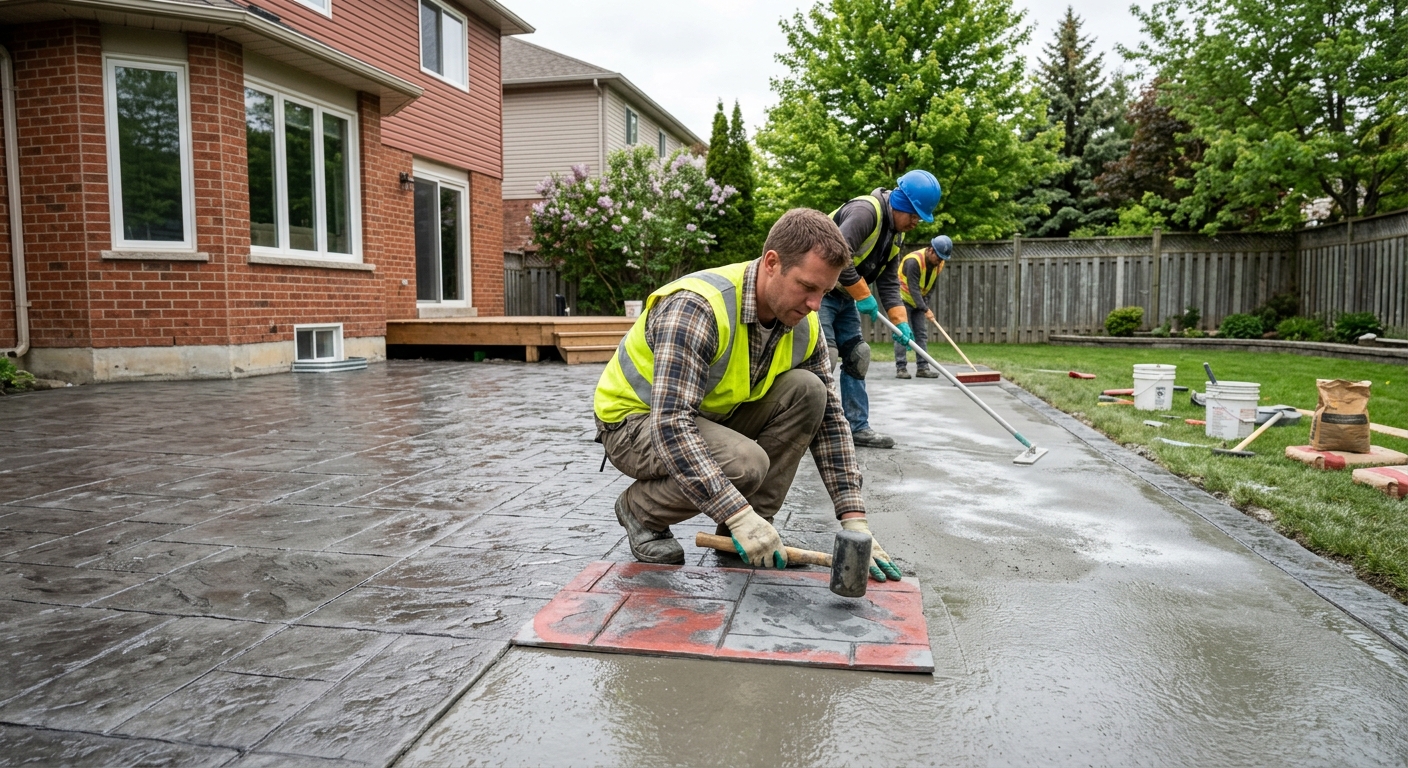
Concrete work options and costs in Thistletown-Beaumond Heights
Concrete work in Thistletown-Beaumond Heights ranges from simple broom-finished driveways to decorative stamped patios, and the right choice usually comes down to use, drainage, and your tolerance for maintenance. This neighbourhood has a lot of family homes—Thistletown-Beaumond Heights had a population of 10,360 in the 2021 Census (Statistics Canada, 2021 Census)—and most concrete flatwork is tied to the day-to-day needs of detached and semi-detached properties: vehicles, kids, and seasonal wet weather. The Toronto economic region’s freeze–thaw cycles are a major reason pricing is rarely “one rate fits all.” Exterior pours are commonly scheduled in the warmer portion of the year so concrete can cure properly; when temperatures hover near 10 °C or drop below, contractors often need more protection (insulating blankets, monitoring, and sometimes heating), which adds labour and material cost.
In this area, demand is especially strong around local streets and main connectors near Thistletown and Beaumond Heights where driveways and front steps see heavy wear from winter traction and ploughing. That’s also where sealing, proper base grading, and air-entrained mixes make the biggest difference to long-term durability. If you’re comparing options, it helps to anchor your expectations with the typical price bands for this tier, then adjust for thickness, reinforcement, and site access.
Below is a practical comparison of common applications so you can line up like-for-like scopes before you request quotes.
| Application |
Typical Size |
Key Spec |
Finish Option |
Price Range |
| Concrete driveway (standard broom finish) |
400–600 sq. ft. |
Air-entrained mix, compacted granular base, typical thickness 4 in. |
Broom finish, joints cut to control cracking |
$18,000–$28,000 |
| Exposed aggregate driveway |
400–600 sq. ft. |
Air-entrained mix, proper curing and aggregate exposure timing |
Exposed aggregate finish for slip resistance |
$22,000–$34,000 |
| Stamped concrete driveway or patio |
300–500 sq. ft. |
Air-entrained mix, reinforced edges, control joint plan |
Stamp pattern + release + integral or topical colour |
$24,000–$40,000 |
| Plain concrete patio or walkway |
200–400 sq. ft. |
Compacted base, drainage slope, air-entrainment |
Broom or trowel/steel finish with joints |
$16,000–$26,000 |
| Garage floor (interior slab) |
300–500 sq. ft. |
Vapour barrier (as needed), reinforcing per design, 4 in. typical |
Steel trowel finish + hardener (optional) |
$14,000–$24,000 |
| Foundation footings (structural, below frost) |
Varies by home plan |
Concrete placement below design frost depth; engineered rebar cage |
Unfinished structural concrete |
$12,000–$25,000 |
Prices are estimates only and vary by project scope, site access and material selection.
What affects the price of concrete work in Thistletown-Beaumond Heights
In the Toronto market around Thistletown-Beaumond Heights, it’s common to see the “same” concrete job come back 30–50% apart, even when the finish looks identical on a sketch. The biggest reason is that concrete isn’t just poured—it’s built on a system: excavation, granular base thickness and compaction, subgrade condition, reinforcement, mix design, curing protection, and a control-joint layout. One contractor may include proper drainage and a deeper, well-compacted base; another may price to the minimum that keeps the slab standing but doesn’t hold up well through winter.
Frost depth and freeze–thaw cycles dictate the spec. Ontario projects generally require exterior structural footings to extend at least 1.2 m (about 4 ft) below grade, below the design frost depth, to prevent frost heave and differential movement. Exterior slabs also typically need air-entrained concrete to survive repeated freeze–thaw, and they require careful curing management when temperatures drop toward 10 °C or below. Cold-weather precautions—insulating blankets, temperature monitoring, and sometimes temporary heat—can add meaningful cost compared with a late-spring or summer pour.
Local conditions in Thistletown-Beaumond Heights can raise or lower your bill quickly. If your driveway subgrade is soft or already saturated, more excavation and replacement granular base is often needed before you pour; that can push the job toward the higher end of the $18,000–$28,000 driveway band. If you’re switching from broom-finished concrete to stamped concrete, the finish and installation time typically justify the move into the $24,000–$40,000 decorative band—especially when you also want better traction and a more controlled cracking plan. For foundation footings, labour and rebar work vary with access and engineered design; even a modest scope can move because the excavation and steel placement are the real cost drivers.
| Price Factor |
Why It Matters |
Cost Impact |
| Frost line depth — determines footing depth and form height |
Footings must sit below frost to prevent heave and settlement. |
Major variation if excavation depth or shoring requirements change. |
| Site preparation — excavation, grading, compacted granular base |
Durable slabs need a stable, drained base—not just concrete. |
Often the biggest “hidden” line item when subsoil is wet or soft. |
| Reinforcement — rebar or wire mesh requirement |
Rebar cages and mesh reduce cracking and improve slab performance. |
Adds material and labour; may be required by design or thickness. |
| Mix design — air-entrainment and compressive strength spec |
Air entrainment improves freeze–thaw durability and reduces spalling risk. |
Cost changes with air content and strength class requirements. |
| Finish type — broom vs. stamped vs. exposed aggregate |
Decorative work increases labour, timing, and material handling. |
Stamps and exposed aggregate typically move you to the higher band. |
| Pour size and concrete truck access to site |
Access affects how crews place and finish concrete efficiently. |
Low access can mean smaller batches, more time, and extra equipment. |
| Cold-weather curing precautions — heating and blankets |
Concrete must cure under suitable conditions for strength development. |
Increases labour/material costs for insulating and monitoring. |
| Control joint pattern and sealing cost |
Joints manage cracking; sealing helps repel de-icing salt damage. |
Cutting, labour, and materials can add a moderate but valuable cost. |
Permits & regulations in Ontario
In Ontario, structural concrete work usually triggers permitting because it affects the building’s structural system. That means foundation footings, foundation walls, and grade beams typically require a building permit and often engineered drawings that the municipality reviews as part of the process. If your project involves altering load-bearing elements or the foundation system, assume a permit is required and budget time for approvals.
Concrete flatwork—like driveways, patios, and walkways—often does not require a separate permit by default, especially when it stays within typical lot grading and doesn’t change drainage in a way that affects neighbouring properties. However, permits or approvals can become necessary if your design changes lot grading, increases impervious surface beyond local allowances, impacts drainage or ties into a municipal right-of-way, or if the work is part of a larger permitted project.
For Thistletown-Beaumond Heights, homeowners should also verify contractor compliance before work begins. Step-by-step: (1) ask for the contractor’s Ontario business details and permit/contractor registration information if applicable, then confirm licensing through the appropriate Ontario online registry; (2) request a current certificate of insurance showing liability coverage; (3) confirm WSIB/WCB coverage (or the correct exemption paperwork, if the contractor truly qualifies); (4) ask for references on similar driveway/patio and structural concrete jobs; and (5) ensure the quote reflects whether permits are included or the homeowner is responsible for pulling them. Do not start excavation until you have written scope details and the contractor’s proof documents on hand.
Getting concrete right in Thistletown-Beaumond Heights's freeze-thaw climate
Concrete failure in Thistletown-Beaumond Heights is usually about moisture movement and ice expansion—not “bad luck.” The freeze–thaw cycle drives water into tiny voids and along the slab edge, then repeated freezing creates pressure that can lead to scaling, cracking, and eventually spalling. The spec matters because the slab only performs as well as its base, its concrete chemistry, and its joint/cure plan.
To spec the job correctly, start with (1) base preparation: excavate to the right depth for your soil conditions, then place and compact granular sub-base in lifts so it drains and doesn’t pump during wet periods. Next, (2) mix design: for exterior flatwork, use air-entrainment targeting about 5–7% air content and a minimum 32 MPa compressive strength so it can handle freeze–thaw durability. Then add (3) control joints so cracks happen where you planned them, not randomly across the slab. (4) curing is critical: aim for at least 7 days of proper curing conditions; if you pour when temperatures drop, contractors may need insulation blankets and careful protection to ensure strength gain. Finally, (5) sealing: a penetrating sealer should be applied after the slab has cured (commonly around 28 days post-pour) to help repel de-icing salts and limit water intrusion.
Ask these technical questions: “What air-entrained mix are you using and what’s the target air percentage?” “How deep is the compacted base and what material are you bringing in?” “What’s your control-joint spacing and how are you detailing the edges?” “How do you manage curing if the forecast cools?” A practical example: if a plain driveway comes back around $18,000–$28,000 and the decorative option comes back around $24,000–$40,000, that extra spend is often justified by additional labour for stamps/exposure and an enhanced joint/seal approach—not just colour. Skimping on air entrainment and base compaction is where you pay twice later through patching and premature surface breakdown.
| Spec |
Why It Matters in Thistletown-Beaumond Heights |
What to Ask For |
Impact if Skipped |
| Compacted granular base (depth?) |
Provides drainage and stiffness to resist frost heave under driveway and patio loads. |
Confirm excavation depth and granular base thickness for your soil, plus compaction testing method. |
Settlement, edge cracking, and faster deterioration after wet winters. |
| Air-entrained concrete mix (target air %?) |
Helps concrete resist freeze–thaw cycling common in the GTA. |
Ask for target air content around 5–7% for exterior flatwork (and the mix design sheet if available). |
Scaling and spalling risk increases significantly during repeated winter freeze cycles. |
| Compressive strength (MPa rating) |
Strength ensures the slab achieves designed performance under thermal movement. |
Confirm minimum 32 MPa compressive strength and expected cure/protection plan. |
Surface wear, cracking, and reduced durability. |
| Control joints (spacing per ACI guidelines) |
Controls where shrinkage cracks form when the slab cools and dries. |
Ask for your joint spacing and cutting schedule, plus how joints will be sealed (if included). |
Random cracking pattern and moisture entry through unscheduled cracks. |
| Minimum 7-day curing period |
Allows strength development before traffic and seasonal temperature swings. |
Confirm curing duration and protection (coverings/heating) if temps fall. |
Lower strength gain, higher risk of cracking and early surface scaling. |
| Penetrating sealer (when applied after cure) |
Reduces water/salt penetration that accelerates freeze–thaw damage. |
Ask for application timing (commonly around 28 days post-pour) and sealer type. |
Faster deterioration from de-icing salts and moisture cycling. |
How to choose a concrete work contractor in Thistletown-Beaumond Heights
Choosing the right contractor matters in Thistletown-Beaumond Heights because the cost you see is only part of the story—durability is what protects your wallet years later. Start with compliance checks. In Ontario, verify the contractor’s licensing/registration details where applicable, then request a certificate of insurance showing liability coverage. Next, confirm WSIB/WCB coverage (or proper documentation if exempt). Don’t accept “we’ll get it later.” Ask for current documents dated for the current project window.
Then get 2–3 itemised written quotes rather than one lump sum. A good concrete quote breaks out labour and material: excavation and hauling/disposal, forms, reinforcement (rebar/mesh), concrete mix specification (including air-entrainment), base prep thickness and compaction, finishing, curing measures, and sealing (if included). Carefully read exclusions: is the quote for removal and disposal of the old slab? Is permit handling included for structural work? Who supplies the granular base and what depth is allowed? Also confirm whether the contractor includes cold-weather protection if the forecast cools mid-project.
Warranty should be specific: workmanship warranty length, what it covers (spalling, scaling, joint issues), and whether it transfers if you sell your home. Payment scheduling should be conservative—never pay more than about 10–15% upfront. Hold back funds until key milestones are done and documentation is provided. Finally, demand a start date and completion estimate in writing, including curing and protection time so you’re not rushed into traffic too early.
- Ask for a sample contract that lists scope, exclusions, and schedule in writing.
- Verify liability insurance limits on the certificate (and that it matches the contractor name).
- Confirm WSIB/WCB coverage before the first shovel of soil is moved.
- Request mix details (air-entrainment target and minimum strength) for exterior flatwork.
- Confirm granular base thickness and compaction method/testing (not just “we’ll grade it”).
- Check reinforcement plan: wire mesh vs. rebar and placement location (mid-depth vs. bottom).
- Ask for control joint spacing and whether joints will be sealed.
- Ensure curing/temperature protection is included for pours near cooler fall/spring weather.
- Get clarity on drainage: slopes to control water away from the foundation.
- Confirm whether sealing is included, and if not, what product/timing is recommended.
- Confirm disposal/hauling of demo materials is included (or quoted separately).
- Agree on milestones for inspections: sub-base approval, rebar inspection, then final finish.
Concrete contractor red flags in Thistletown-Beaumond Heights include: vague “one price covers it” quotes with no mix/curing details, refusal to show insurance/WSIB paperwork, no plan for control joints, finishing immediately on a weak/soft base, and promises of cold-weather pours without insulating/heating and cure monitoring—those are the setups that lead to winter spalling and early repairs.
Frequently asked questions — concrete work in Thistletown-Beaumond Heights
How do I compare concrete quotes?
To compare concrete quotes in Thistletown-Beaumond Heights (and across the Toronto economic region), make sure you’re comparing like-for-like scopes, not just the final number. Ask each contractor to itemize excavation/disposal, granular base thickness and compaction, reinforcement type (mesh vs rebar), concrete mix details (especially air entrainment for exterior flatwork), thickness, finishing method, curing protection, and sealing. If two driveway quotes both land in the $18,000–$28,000 band, the difference is often the quality of base prep and curing—not the concrete supply. Also compare allowances for truck access, site difficulty, and whether the quote includes saw-cut control joints and joint sealing.
Can concrete be poured in cold weather in Thistletown-Beaumond Heights?
Yes, concrete can be poured in cold weather in Ontario, but it should be done with a plan. In Thistletown-Beaumond Heights, the risk isn’t just the pour day temperature—it’s the curing window when strength gain matters. A responsible contractor uses cold-weather measures such as insulating blankets, temperature monitoring, and sometimes temporary heat to keep the concrete within workable curing conditions. If the schedule slips into wetter, colder periods, labour and materials can increase. If someone offers “no protection needed” or won’t discuss curing, that’s a problem. For many exterior projects, crews concentrate pours in the warmer months so curing is easier and the slab meets durability expectations through winter.
How do I maintain concrete in Thistletown-Beaumond Heights's freeze-thaw climate?
Maintenance in Thistletown-Beaumond Heights is about limiting water and de-icing salt intrusion—the two accelerators of freeze–thaw damage. Start with cleaning: remove leaves and debris that hold moisture against the slab. Use de-icing products carefully; some salts are harsher than others, and overuse can increase scaling. If your contractor included sealing, maintain it according to the product’s guidance; if not, plan for penetrating sealer after the slab fully cures (often around 28 days). For jointed slabs, keep an eye on joint edges—if joints were sealed, re-check them when you refresh the driveway/patio maintenance. The goal is to keep water from getting into cracks and widening them as temperatures swing.
What causes concrete to spall in Thistletown-Beaumond Heights winters?
Spalling in Ontario winters is typically caused by freeze–thaw pressure plus moisture and de-icing salt getting into the concrete. In practical terms, the most common root causes are inadequate air-entrainment, poor finishing/curing, and weak base drainage that leaves water sitting under or against the slab. When the concrete has insufficient air void structure, freeze–thaw cycling can break the surface and create flaking (spalling). Edge areas and areas near joints often show the problem first because water pathways are more direct. If you’re comparing jobs, ask specifically for target air content for exterior work (commonly about 5–7% air) and confirm the contractor’s curing plan. Sealing later can help, but it doesn’t fix an air-entrainment or base prep shortcut.
What is rebar and when is it required in Ontario?
Rebar (reinforcing steel) is used to improve concrete’s performance by helping control cracking and providing tensile capacity where concrete alone is weaker. When rebar is required depends on engineering design, slab thickness, loading (like vehicle traffic on driveways), and sometimes frost and soil conditions. For many exterior slabs and structural foundation elements, reinforcement is common. For structural foundation footings and foundation walls, engineering and permitting often drive rebar requirements, with steel placement tied to the design. For flatwork like patios and walkways, some jobs use wire mesh or thicker slabs instead of full rebar cages, but the decision should be stated in your quote. If a contractor can’t explain reinforcement type and placement, ask for the rationale in writing.
How long does a concrete project take in Thistletown-Beaumond Heights?
Project duration depends on scope and curing/protection time. In Thistletown-Beaumond Heights, small flatwork pours can be completed in a day, but the overall timeline is longer because you must plan around curing. Day 1 typically covers excavation, base prep, and reinforcement placement; concrete placement and finishing usually happen in a single working window; then the crew sets curing and protection. Even though concrete hardens quickly, proper curing usually means you should protect it for at least 7 days before heavy use, and many finishes (like sealing) are done closer to 28 days. If the weather cools toward late fall or early spring, crews may need extra time for insulation blankets and monitoring, which can extend the “usable” date. For example, a driveway project that costs within the $18,000–$28,000 band often looks fast in the schedule, but the protection and curing steps control the end date.