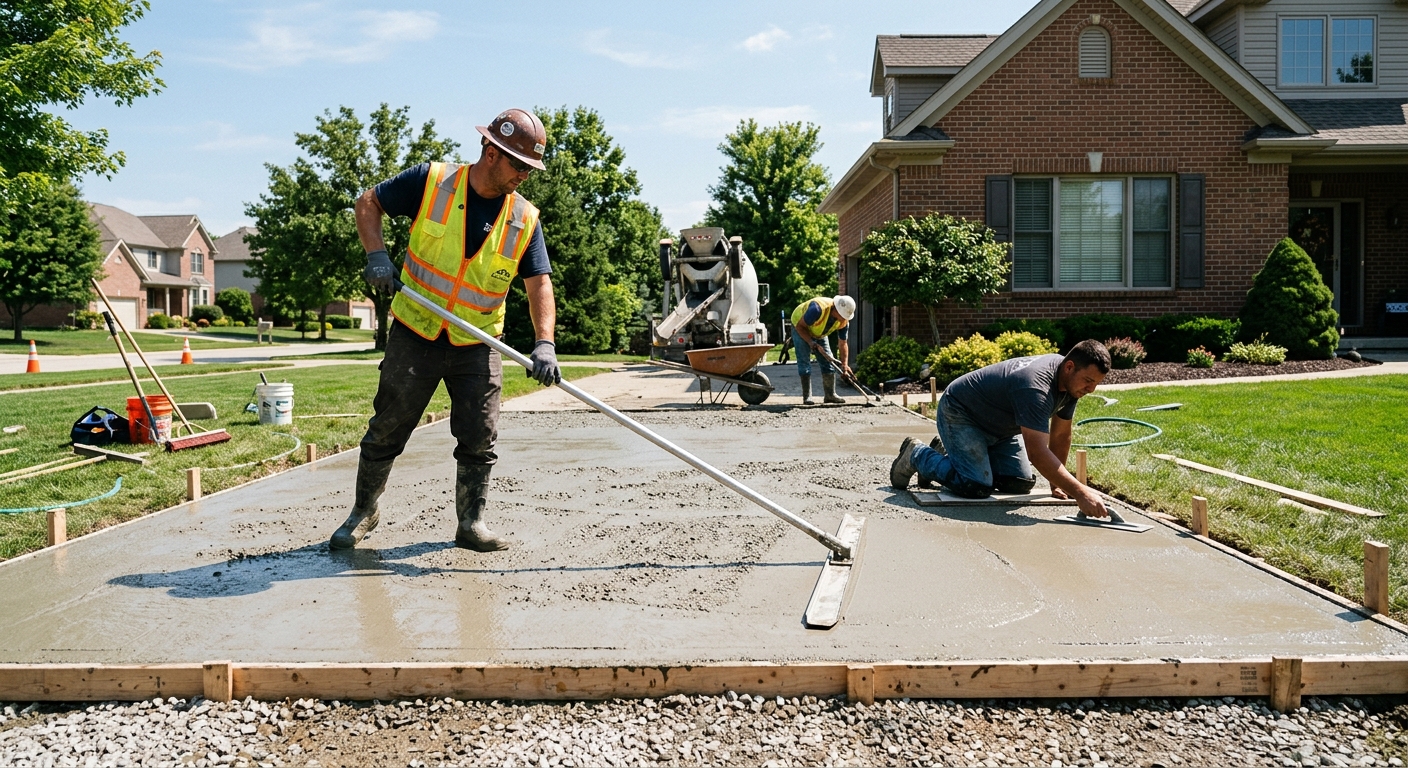
Concrete work options and costs in Wingham
In Wingham, Ontario, concrete is the go-to material for driveways, patios, walkways, garage slabs and structural foundation work. The town’s housing stock is dominated by single-detached homes, so outdoor flatwork is a frequent project—conveniently, Wingham’s population was 2,934 people in 2021 (Statistics Canada, 2021 Census). That demand is especially noticeable around downtown Wingham and the surrounding residential blocks where older houses get re-done walkways, porch landings and driveway replacements as families update curb appeal and accessibility.
Concrete pricing in the Toronto economic region is strongly shaped by frost depth and the freeze–thaw cycle. Even though Wingham isn’t the biggest city, local crews still design for the Ontario Building Code requirement that most structural footings sit at least 1.2 m below grade to limit frost heave and differential movement. For exterior slabs, contractors typically specify air-entrained concrete, adequate thickness, and control joints to manage cracking through repeated winter thawing. When temperatures drop toward 10 °C or below, curing management becomes a real cost driver: crews may need protection or cold-weather practices to keep concrete performing. Wet shoulder seasons can also slow scheduling and affect how quickly a site can be prepped and sealed.
Because contractor availability and mobilization costs can shift with the broader Toronto pour season, two homeowners can see noticeably different quotes for similar work. The table below compares common options and realistic price bands so you can start narrowing down what fits your scope.
| Application |
Typical Size |
Key Spec |
Finish Option |
Price Range |
| Concrete driveway (standard broom finish) |
300–450 sq. ft. |
6 in. (150 mm) thick, compacted granular base, control joints |
Broom finish, optional sealant |
$3,900–$8,500 |
| Exposed aggregate driveway |
300–450 sq. ft. |
Air-entrained mix, proper curing, dressed/etched surface finish |
Exposed aggregate (seeded or scraped), optional sealant |
$5,300–$10,500 |
| Stamped concrete driveway or patio |
200–400 sq. ft. |
Air-entrained mix, integral colour, release agent, joint layout |
Stamp mats, texture patterns, stains/colour |
$6,000–$14,500 |
| Plain concrete patio or walkway |
150–300 sq. ft. |
4–5 in. (100–125 mm) thickness, compacted base, control joints |
Steel trowel edge + light broom or float finish |
$2,400–$7,800 |
| Garage floor (interior slab) |
400–600 sq. ft. |
4 in. (100 mm) thick, vapour barrier, joint plan |
Power trowel, optional densifier/sealer |
$6,500–$12,500 |
| Foundation footings (structural, below frost) |
Per footing / foundation scope |
Engineered size/reinforcement, below-grade to Ontario frost depth |
Typically formed and rebar-reinforced |
$180–$300 |
Prices are estimates only and vary by project scope, site access and material selection.
What affects the price of concrete work in Wingham
In Wingham, you can see the same “driveway replacement” idea priced 30–50% differently across the Toronto economic region, and even between crews within Ontario. The gap usually comes down to how the contractor handles frost-depth requirements, freeze–thaw durability, and what’s included in base preparation and finishing. In the Toronto corridor, footings must extend below design frost depth (Ontario generally calls for about 1.2 m and up, depending on site conditions), and exterior flatwork should use air-entrained concrete to survive repeated freeze–thaw. If a bid assumes minimal excavation or a thin base, it can look cheaper—but it often shifts cost to repairs later.
Contractors also price in the reality of the pour season. In colder shoulder periods, cold-weather curing precautions may be needed to protect fresh concrete and keep hydration on track. That can add labour for insulating blankets or heaters, and it can affect scheduling (more start/stop time). Surface durability matters too: de-icing salt can accelerate spalling if the mix and air content aren’t right, and if sealing isn’t planned after cure.
In Wingham, one common cost driver is soil moisture and drainage. If the site has consistently damp ground, you typically pay more for proper grading, sub-drainage, and thicker compacted granular base so the slab doesn’t “pump” in winter. Conversely, a straightforward, level lot with easy access can keep your driveway in the lower end of the standard concrete range (for example, driveway concrete often lands around $18–$28 per sq. ft. for typical scope). If you move into stamped or exposed finishes, the added labour and materials can push you toward $24–$40 per sq. ft. equivalents. Finally, the age of neighbouring homes can matter: older areas may have more complex tie-ins around existing walks, stairs, and service trenches, raising demolition and prep effort.
| Price Factor |
Why It Matters |
Cost Impact |
| Frost line depth |
Footings must extend below design frost depth to prevent heave and movement |
Higher footing depth/forming increases excavation and concrete volume |
| Site preparation |
Excavation, grading, and well-compacted granular base control settlement |
More stripping/hauling and base material raises cost; easy access reduces it |
| Reinforcement |
Rebar or wire mesh helps control cracking and supports loads |
Material + placement labour can add significant cost on larger slabs |
| Mix design |
Air-entrainment and strength target improve freeze–thaw durability |
Specified air content and higher strength may cost more per yard |
| Finish type |
Broom vs. stamped vs. exposed aggregate changes labour and materials |
Stamped/exposed finishes typically cost more than plain work |
| Pour size and concrete truck access |
Longer hauls and smaller access paths affect productivity |
Extra setup time, pump needs, or hand finishing can increase price |
| Cold-weather curing precautions |
Heating/protection is needed when temperatures drop toward/under ~10 °C |
Insulation blankets, heaters, and monitoring add labour and material |
| Control joint pattern and sealing cost |
Joints manage where cracks occur; sealing helps repel de-icing salts |
Proper jointing layout and sealer can add up-front cost but reduce failures |
Permits & regulations in Ontario
In Ontario, structural concrete work generally needs the right approvals before you pour. For Wingham homeowners, the big rule of thumb is: foundation and structural elements typically require permits and often engineered drawings. Specifically, work that usually requires a building permit includes foundation walls, grade beams, footings, and other structural concrete components tied to the integrity of the building. Municipal review is common when these elements affect load-bearing capacity, waterproofing strategy, or structural design.
Concrete flatwork like patios, walkways and standard driveways often does not require a permit. However, if your plan changes lot grading, impacts impervious surface coverage limits, affects municipal right-of-way areas (especially if there’s curb/sidewalk involvement), or requires significant regrading away from the house, you should confirm requirements with the local authority before starting. It’s also wise to check with the municipality if you’re altering drainage patterns that could affect neighbouring property or municipal services.
To verify your contractor in Ontario, do three checks in order. First, verify credentials: search the relevant provincial contractor/registration resources for their licensing status (or the applicable registration type for concrete/contracting work). Second, request a certificate of insurance for liability coverage—make sure it lists you as a named additional insured where appropriate. Third, confirm WSIB/WCB coverage (clearance letter or current coverage proof). Ask for references on similar foundation and exterior flatwork scopes, not just decorative work, and ensure your contract identifies what permits (if any) are included.
Getting concrete right in Wingham's freeze-thaw climate
Concrete failures in Wingham usually trace back to a few predictable issues: weak or poorly compacted base, incorrect mix design for freeze–thaw, and curing/protection done too casually for Ontario weather swings. In this region, you need a build-up that can handle seasonal soil movement. For exterior slabs and any driveway or walkway poured on grade, the base needs to be compacted granular sub-base to the required depth for frost protection and drainage. If the sub-base stays wet, it can expand and contract through freeze–thaw, stressing the slab and increasing cracking.
Spec the mix with air-entrainment and durability in mind. For exterior flatwork, contractors commonly target about 5–7% air content and a minimum compressive strength around 32 MPa, using proper curing practices. Next, control joints: they should be spaced to limit random cracking so the slab cracks where it’s designed to. Curing matters just as much: plan for at least 7 days of proper curing conditions. When pouring late in the season or with nights near cold thresholds, cold-weather protection (blankets/temporary heat) can protect the hydration process.
Finally, sealing is a practical step against winter salt. A penetrating sealer applied after full cure (often around 28 days post-pour) helps repel chloride intrusion that can contribute to surface deterioration and spalling.
If you’re deciding between finishes, the price difference can be worth it. For example, moving from a standard broom-finish driveway in the typical $18–$28 per sq. ft. band to a stamped or more labour-intensive option near $24–$40 per sq. ft. is usually justified when you’re keeping the driveway long-term and want upgraded curb appeal—provided the base, air entrainment, joints and curing are still done correctly.
| Spec |
Why It Matters in Wingham |
What to Ask For |
Impact if Skipped |
| Compacted granular base (depth?) |
Controls settlement and protects against frost-driven movement |
Confirm excavation depth, lift compaction, and base thickness for your soil |
Uneven settling and early cracking; water retention under slab |
| Air-entrained concrete mix (target air %?) |
Helps concrete survive freeze–thaw without spalling |
Ask for air content target (often 5–7% for exterior flatwork) |
Higher risk of surface scaling and spalling after winters with salt |
| Compressive strength (MPa rating) |
Strength affects abrasion resistance and long-term performance |
Minimum 32 MPa (or higher per engineering/site requirements) |
Lower durability under vehicles and seasonal stress |
| Control joints (spacing per ACI guidelines) |
Directs cracking to planned locations and reduces random fissures |
Confirm joint spacing and joint sealing plan (if included) |
Random cracking that can open pathways for water and de-icers |
| Minimum 7-day curing period |
Enables proper hydration for strength and reduced permeability |
Confirm curing method and whether protection is used when it’s cold |
Weak, porous concrete that deteriorates faster in freeze–thaw |
| Penetrating sealer (when applied after cure) |
Repels salts and moisture at the surface |
Penetrating sealer applied after cure (commonly ~28 days post-pour) |
More salt exposure leading to scaling/spalling and quicker surface wear |
How to choose a concrete work contractor in Wingham
Choosing a concrete contractor in Wingham is mostly about verifying capability—then matching the quote to the actual technical requirements. Start by confirming Ontario licensing/registration where applicable for the scope you’re hiring for, and insist on liability insurance. Ask for a certificate of insurance (and confirm it covers the work being performed). Next, verify WSIB/WCB coverage—don’t rely on verbal statements. A clearance letter or current coverage documentation is the standard way to confirm the contractor is in good standing.
Then get 2–3 itemised written quotes, not just a single total. You want a labour + materials breakdown that clearly shows base excavation and disposal, granular base, forms, reinforcement, concrete supply, finishing, control joints, curing/protection, and sealing (if included). Make sure the scope says what’s excluded: for example, do they include sidewalk/curb saw cutting, hauling away excess soil, topsoil replacement, or crack sealing after the cure period?
Warranty should be more than a handshake. Ask for the workmanship warranty length, and separate it from any manufacturer warranty on materials. Also ask whether warranties are transferable if you sell the home.
On payment, don’t let a contractor pressure you into paying everything up front. A common best practice is keeping deposits around 10–15%, with the balance tied to milestones—especially base completion, formwork approval, pour day completion, and final cleanup/sealing. Finally, ask for a written start date and completion estimate that accounts for weather and curing time in Ontario’s freeze–thaw season.
- Request proof of liability insurance and confirm coverage aligns with the project scope.
- Verify WSIB/WCB coverage with a clearance letter or current documentation.
- Confirm what permits are required and who pulls them (if applicable).
- Use itemised quotes: base prep, reinforcement, concrete, finishing, curing, sealing, and disposal should be listed.
- Ask whether the mix is air-entrained and what the target air content is for exterior work.
- Confirm footing depth for foundations and that it aligns with below-frost requirements.
- Check that control joints and joint sealing (if included) are in the scope.
- Ask for the curing plan for cold nights (blankets/heating when needed).
- Require a timeline that includes minimum curing and when sealer is applied.
- Clarify access and logistics: truck access, pumping (if needed), and how they’ll handle grades.
- Review warranty terms in writing: workmanship duration, coverage limits, and exclusions.
- Keep payment milestone-based; avoid more than 10–15% upfront and hold back until close-out.
Concrete red flags in Wingham include: refusing to specify air-entrainment for exterior work, skipping or minimizing granular base prep, not discussing control joints and sealing strategy, providing only a lump-sum without detailing what’s included (especially disposal and reinforcement), and rushing pours without a cold-weather curing plan when overnight temperatures are dropping.
Frequently asked questions — concrete work in Wingham
Do I need a permit for concrete work in Ontario?
In Ontario, it depends on what you’re building. Structural concrete such as footings, foundation walls and grade beams typically requires a building permit, often supported by engineered drawings reviewed through the municipal process. For Wingham homeowners, that means any work that changes the building’s load-bearing system should be treated as permit-worthy from day one.
Concrete flatwork like patios, walkways and standard driveways often does not require a permit, unless it affects lot grading, impervious surface coverage limits, drainage, or municipal right-of-way/sidewalk areas. Because rules can vary based on how you alter drainage or access, confirm with the local authority before breaking ground. Also verify your contractor carries liability insurance and WSIB/WCB coverage—those requirements aren’t optional for protecting you.
Concrete vs pavers for a patio in Wingham?
Concrete and pavers can both work well in Wingham, but freeze–thaw drives the decision. Concrete patios tend to be lower maintenance and easier to keep level when they’re built on a properly compacted granular base, designed with control joints, and finished with the right mix. If de-icing salt is used in winter near the patio edges, a concrete patio also benefits from sealing after cure.
Pavers can be easier to patch when a localized settlement happens because individual stones can be lifted and reset. However, you still need correct base preparation and drainage so saturated soils don’t heave and settle through winter. Cost-wise, a plain concrete patio often falls in the typical $16–$26 band per sq. ft. depending on thickness and site conditions, while paver jobs can rise quickly if you’re adding edging, geotextile, and deeper base build-up.
How long does a concrete driveway last?
With the right base, mix and detailing, a concrete driveway is commonly described as lasting 25–40 years in Ontario conditions. The real story is whether it’s engineered for freeze–thaw: air-entrainment, adequate thickness, proper sub-base compaction, and a joint pattern that prevents random cracking. In Wingham, drainage matters—if water is trapped under the slab, you’ll get stress and early deterioration.
Finish and sealing also influence lifespan. Many owners skip sealing and then wonder why scaling appears sooner along edges where salt collects. Sealing typically comes after a full cure (often around 28 days post-pour) and helps repel moisture and de-icers.
Pricing doesn’t guarantee longevity, but it can reflect the spec. If you’re comparing bids, a broom-finish driveway in the typical $18–$28 per sq. ft. range should still include a proper base and air-entrained mix to reach the long-life target.
What is air-entrained concrete and why does it matter here?
Air-entrained concrete is mixed with tiny, evenly distributed air bubbles that give freezing water somewhere to expand. That’s the key mechanism that helps concrete survive Ontario’s repeated freeze–thaw cycles without spalling or surface scaling. For Wingham exterior flatwork—driveways, patios, and walkways—air entrainment is one of the most important durability specs.
If the concrete doesn’t have the correct air content, water freezing inside the paste can cause internal damage and break down the surface over time, especially where de-icing salt is present. That’s why reputable contractors will clearly state that they’re using an air-entrained mix and will plan curing and protection appropriately when temperatures cool.
When you’re reviewing quotes, ask whether the mix is air-entrained and what air content target they use for the project. This spec can be a bigger difference-maker than decorative finishes.
How do I prepare the base for a concrete slab?
Base preparation is the foundation of the foundation—for concrete slabs and exterior flatwork. In Wingham’s freeze–thaw climate, the goal is a compacted granular sub-base that drains and stays stable through winter. A good process starts with excavation to the right depth for your soil and frost protection needs, followed by proper grading to line and slope.
Next comes the granular layer placement in lifts with compaction testing/verification (or at least consistent equipment and lift thickness). The base should be granular and properly compacted, not topsoil or oversaturated material. If drainage is poor on your site, contractors may recommend additional drainage measures before placing concrete.
Finally, the slab needs reinforcement or joint detailing as specified. If a quote looks inexpensive, it’s often because the base build-up or compaction isn’t fully included—then the slab fails early, and repairs typically cost more than building it right.
How do I compare concrete quotes?
Start by comparing apples to apples, because concrete quotes often differ in the details that matter most in Ontario weather. Ask each contractor for an itemised breakdown: excavation and disposal, granular base type and depth, reinforcement (if any), concrete supply and mix design (including air entrainment for exterior work), thickness, forms, finishing, curing/protection, control joints, and sealing (if included).
Then compare scope exclusions. Does one quote include saw cutting, drainage corrections, joint sealing, and the minimum curing period? What happens if the weather shifts—are blankets/heating included when temperatures drop? Concrete costs can swing too based on access and concrete truck logistics.
Use the local price bands as a reality check: a basic driveway typically sits around $18–$28 per sq. ft., patios/walkways around $16–$26, and stamped work can move toward $24–$40. If a “low bid” is far below the band, confirm what spec they’re reducing—especially the base prep, air-entrainment, and curing protection.