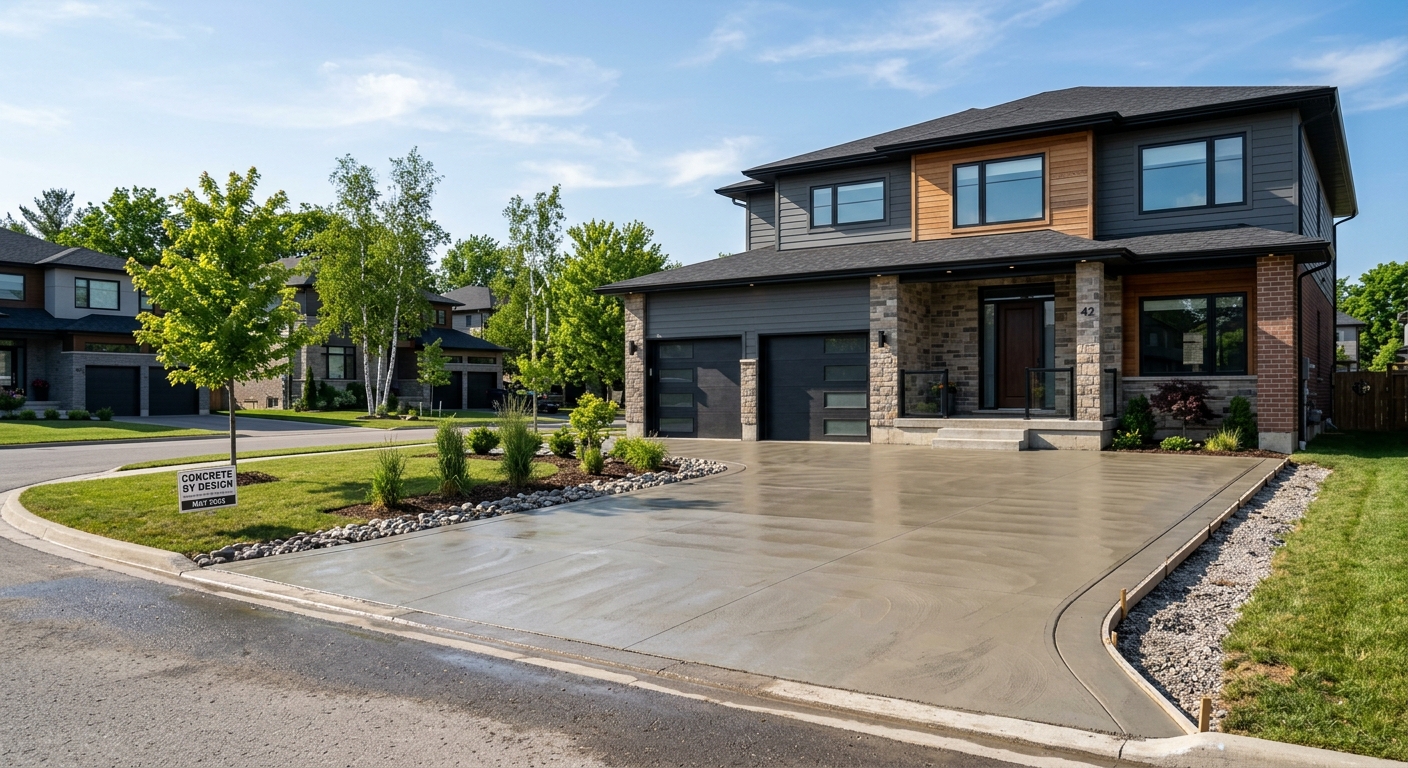
Concrete work options and costs in Brooklin
Brooklin, Ontario is a great place for concrete flatwork, but the local winters mean your driveway, patio, or walkway has to perform through repeated freeze–thaw cycles. With a population of about 25,000 (Statistics Canada, 2021 Census), Brooklin and the wider Toronto economic area have steady demand—especially where family homes are concentrated and people renovate exterior spaces. In a neighbourhood like Brooklin’s core and the surrounding residential streets, homeowners typically start with driveways and front-step walkways before moving to patios and garage slabs.
In the Toronto region, concrete pricing is strongly shaped by frost depth and how long we need to protect a pour during cooler weather. Structural footings generally must extend below the design frost depth to help prevent frost heave and differential settlement, and exterior flatwork usually uses air-entrained mixes plus proper base drainage. That means two contractors can quote the “same” driveway differently depending on excavation depth, compacted granular base thickness, reinforcement, and the finishing system. Stamped and exposed-aggregate work also adds labour and material allowances.
As a rough guide, Toronto-area projects fall within the same practical bands you’ll see in Brooklin: standard broom-finish driveways are commonly priced in the high teens to high 20s, while patios and walkways are a bit lower. Decorative finishes generally cost more, and foundation footings are priced per structural requirement rather than surface area. Below is a straightforward comparison to help you line up scopes before you request quotes.
| Application |
Typical Size |
Key Spec |
Finish Option |
Price Range |
| Concrete driveway (standard broom finish) |
400–600 sq. ft. (avg. Brooklin driveway) |
Air-entrained exterior mix; compacted granular base; control joints; drainage plan |
Broom finish |
$18,000 – $28,000 |
| Exposed aggregate driveway |
400–600 sq. ft. |
Air-entrained mix; proper base; higher material/labour for surface exposure |
Exposed aggregate (light/medium chip) |
$22,000 – $32,000 |
| Stamped concrete driveway or patio |
300–500 sq. ft. |
Air-entrained mix; control joints; sealer compatibility with stamping |
Stamp + release + colour hardener |
$24,000 – $40,000 |
| Plain concrete patio or walkway |
200–400 sq. ft. |
Sloped away from house; granular base; joints for movement control |
Broom or light trowel finish |
$16,000 – $26,000 |
| Garage floor (interior slab) |
400–600 sq. ft. |
Vapour barrier; reinforcement as specified; proper mix + finishing |
Smooth trowel or light broom |
$12,000 – $22,000 |
| Foundation footings (structural, below frost) |
Varies by house size |
Excavation; engineered design; concrete placement below design frost depth |
Structural concrete |
$180 – $300 |
Prices are estimates only and vary by project scope, site access and material selection.
What affects the price of concrete work in Brooklin
In Brooklin and across the Toronto economic region, it’s normal to see concrete quotes for the “same” scope differ by 30–50%. The biggest reason isn’t the finish—it’s the hidden groundwork. Two contractors can price very differently based on how much excavation they plan for, the granular base thickness and compaction quality, how they handle drainage, and whether reinforcement is included where it’s actually needed. Those choices tie directly to freeze–thaw durability and the Ontario practice of placing structural footings below design frost depth to reduce frost heave and movement.
For exterior work, air-entrained mixes are a must in this region because the freeze–thaw cycle repeatedly stresses the surface. In cold snaps, temperatures that drop toward 10 °C or below slow curing and can require additional protection (insulating blankets or controlled heating) to meet proper strength gain. That protection is labour and materials, so it adds cost when pours happen later in the season. De-icing salt use also accelerates surface scaling/spalling if the mix and curing weren’t managed correctly—so sealing and surface prep become part of the long-term value.
In Brooklin specifically, costs can rise when soils are saturated from spring thaw, when driveways require deeper regrading, or when truck access is tight near mature trees. On the other hand, projects that can reuse a stable base footprint or have straightforward slopes can land closer to the lower end of the bands—like a plain patio in the $16,000 – $26,000 range. Decorative work (stamped or exposed aggregate) often moves you toward the higher side, especially when staging and finishing labour are heavier within the $24,000 – $40,000 band.
Finally, housing-stock age matters: many Brooklin properties built decades ago have older subgrades, tight lot lines, and established drainage patterns that need careful adjustment—often translating into extra excavation and haul-away.
| Price Factor |
Why It Matters |
Cost Impact |
| Frost line depth — determines footing depth and form height |
Footings must sit below design frost depth to prevent heave |
Higher excavation depth increases labour and concrete volume |
| Site preparation — excavation, grading, compacted granular base |
Good base limits settlement and keeps water from saturating subgrade |
More haul, more compaction time, more granular material |
| Reinforcement — rebar or wire mesh requirement |
Controls cracking for slabs and structural performance where required |
Extra material + placement labour; may require chairs/spacers |
| Mix design — air-entrainment and compressive strength spec |
Air-entrainment helps resist freeze–thaw damage in exterior concrete |
Upgraded mix costs more and can require stricter placement procedures |
| Finish type — broom vs. stamped vs. exposed aggregate |
Decorative finishes require additional materials, forms, and labour |
Stamped typically increases crew time; exposed aggregate increases process steps |
| Pour size and concrete truck access to site |
Smaller access can increase pumping, labour, and staging |
Pumping/crane time and longer set-up/cleanup |
| Cold-weather curing precautions — heating and blankets |
Cold slows strength gain and increases risk of early-age problems |
Costs add for equipment, labour monitoring, and extra protection time |
| Control joint pattern and sealing cost |
Joints manage shrinkage cracks; sealing helps repel salts and water |
Extra layout labour + sealer product and return visit |
Permits & regulations in Ontario
In Ontario, structural concrete work such as new or modified foundation elements typically needs a building permit. That includes footings, foundation walls, and grade beams—anything tied to the structural system and load transfer. Often, you’ll also see engineered drawings required, and municipal reviewers will want to see the structural details before the concrete is placed. For Brooklin homeowners, this is important because excavation and rebar placement are “point of no return” steps once formed and inspected.
Concrete flatwork like patios, walkways, and driveways usually does not require a permit by default. However, it can require review or permits if the work changes lot grading, impacts stormwater management, or affects impervious surface coverage requirements. In some cases, permits can be triggered by work near the municipal right-of-way or by drainage alterations that affect how water is handled on the property. Always confirm with the local authority before breaking ground—especially if you’re raising elevation, regrading downspouts, or changing how surface water flows.
Before hiring, verify the contractor is properly insured and can handle Ontario requirements for work in the field. Step-by-step: (1) check the contractor’s licensing/credentials through the appropriate Ontario registry where applicable (industry-specific registrations vary by trade), (2) request a current certificate of insurance naming you and the project as additional insured where required by contract, and (3) ask for WSIB/WCB clearance documentation for the workers who will be on site. Finally, ask for references on similar Brooklin-scale projects (driveway + base drainage, or footing scopes if applicable) so you can judge workmanship and finish consistency.
Getting concrete right in Brooklin's freeze-thaw climate
Concrete fails in Brooklin most often because water and freezing get into the wrong places, and the mix doesn’t have the right protection for repeated freeze–thaw. The fix isn’t just “stronger concrete”—it’s a system: base preparation, air-entrainment, joint design, curing, and sealing. For exterior slabs and walkways, we start by building a compacted granular sub-base to the right depth for local soil and to manage drainage. The goal is to prevent saturated subgrade from expanding and contracting against the slab every winter.
Next is the mix design: for exterior flatwork, air-entrainment is typically in the 5–7% range, paired with a minimum 32 MPa compressive strength spec for performance. Control joints then manage where cracking will happen—spacing and finishing details are set up so random cracks are minimized. Curing is also critical in the Toronto market: expect a minimum 7-day cure under proper conditions. If you pour when temperatures are trending toward 10 °C or below, you need concrete curing protection (blankets or heating) so strength gain stays on track. Finally, a penetrating sealer is applied after the concrete has cured—commonly 28 days post-pour—to help repel de-icing salts and reduce spalling risk.
Here’s where specs translate into dollars: upgrading from a “standard” non-air-entrained approach to the correct exterior air-entrained mix doesn’t usually double the cost, but it can move the long-term outcome from patched and sealed early to durable, uniform performance. That’s the difference between doing a driveway closer to the $18,000 – $28,000 band with the right freeze–thaw spec, versus paying again later to address surface scaling or premature joint failure.
Ask your contractor these questions: How deep is the granular base, exactly? What air content and strength are you ordering? What joint spacing are you installing, and how will you protect curing in shoulder-season weather?
| Spec |
Why It Matters in Brooklin |
What to Ask For |
Impact if Skipped |
| Compacted granular base (depth?) |
Controls settlement and reduces water saturation under slab |
Base depth and compaction method; drainage slope details |
Uneven settling, premature cracking, and frost-related movement |
| Air-entrained concrete mix (target air %?) |
Air pockets help concrete survive freeze–thaw cycling |
Air content target (typically 5–7% for exterior flatwork) |
Spalling and surface scaling, especially with winter salts |
| Compressive strength (MPa rating) |
Ensures strength gain for durability and service loads |
Minimum 32 MPa compressive strength |
Soft surface, accelerated wear, and cracking under stress |
| Control joints (spacing per ACI guidelines) |
Provides planned crack locations under shrinkage and thermal movement |
Joint layout plan and saw-cut timing |
Random cracking that can open, letting water into the slab edges |
| Minimum 7-day curing period |
Strength development is temperature- and curing-condition dependent |
How they’ll protect curing in cool or wet periods |
Lower early strength, surface defects, and durability issues |
| Penetrating sealer (when applied after cure) |
Reduces water and salt penetration at the surface |
Schedule: typically after full cure (commonly 28 days post-pour) |
Faster salt scaling/spalling and higher maintenance needs |
How to choose a concrete work contractor in Brooklin
Picking a contractor in Brooklin is mostly about verifying three things up front: Ontario compliance, real insurance coverage, and workmanship that matches the climate demands. First, confirm their insurance certificate is current (liability coverage appropriate to the project). Second, request WSIB/WCB clearance paperwork so you know the workers are properly covered for the job site. For Ontario, also ask whether the company is properly registered for the type of work they’ll perform; if they hesitate or can’t provide documentation quickly, that’s a red flag.
Then get 2–3 itemised written quotes. You want line items for excavation/grading, granular base, reinforcement (if included), concrete supply, finishing, and any curing protection. Ask if the quote includes permit pulls where required (structural foundation work usually does) and confirm what’s excluded: disposal/haul-away, saw-cutting, sealing, protection during curing, and patching/landscaping restoration. A lump sum without scope detail often hides costs that pop up later.
Warranty matters too: ask for workmanship warranty length and what it covers (cracking limits, spalling issues, joint failures). Also ask about manufacturer/product warranty for concrete-admixture or sealer systems, and whether it’s transferable if you sell the home. For payment, keep deposits reasonable—never more than 10–15% upfront—and hold back a portion until the final finish and cleanup are complete. Finally, insist on a start date and completion estimate in writing, since Toronto-area pours can be affected by short seasonal windows and temperature swings.
- Ask for the air-entrained mix spec and minimum MPa strength in writing.
- Confirm granular base thickness and compaction standards.
- Require joint layout and saw-cut timing details.
- Check whether sealing is included and the application date (after cure).
- Verify liability insurance certificate before work begins.
- Verify WSIB/WCB clearance for the workers scheduled on site.
- Request references for driveways and flatwork done in freeze–thaw climates.
- Make sure haul-away/disposal is clearly stated.
- Clarify whether they handle drainage tie-ins (downspouts, swales, grading).
- Confirm truck access plan: pour logistics, pumping (if needed), and staging.
- Ensure a written warranty is provided for workmanship and materials.
- Use a payment schedule tied to milestones, not a large early payment.
Concrete red flags in Brooklin include: quotes that skip detailed base depth/compaction; no mention of air-entrainment for exterior work; “we’ll do it later” curing protection when cold weather is forecast; missing insurance/WSIB clearance paperwork; and payment requests that exceed 10–15% upfront or refuse holdbacks until sealing/joint work is complete.
Frequently asked questions — concrete work in Brooklin
Stamped vs broom-finish concrete — cost difference?
In Brooklin, stamped concrete usually costs more than a broom-finish driveway or patio because it requires extra finishing steps: release agents, colour hardener/colour release systems, patterning, and more skilled labour to keep textures crisp through the freeze–thaw cycle. For budgeting, broom-finish driveways typically land in the $18,000 – $28,000 range for typical Brooklin sizes, while stamped concrete driveways or patios commonly fall within the $24,000 – $40,000 band depending on area and surface prep. Both options should use air-entrained exterior concrete and proper control joints. The stamp itself doesn’t replace freeze–thaw requirements—so be wary of “cheap stamping” where the mix spec and joint plan are skipped.
When is the best time to pour concrete in Brooklin?
The best time for concrete pours in Brooklin is late spring through summer, when temperatures stay more consistently favourable for curing and finishing. In the Toronto economic region, shoulder-season weather can swing quickly; when temperatures approach 10 °C or below, contractors may need curing protection like insulated blankets or controlled heating to keep strength gain on track. Wet fall and early spring can also complicate base preparation if soils are saturated, adding time for drainage and granular compaction. If you can schedule in warmer months, you generally reduce protection labour and improve finishing quality. That said, reputable crews can pour later too—they just plan the mix, placement timing, and protection properly.
How long does concrete take to cure?
Concrete curing is a process, not a single day event. For most typical exterior flatwork in Brooklin, you should plan for at least a minimum 7-day curing period before treating the slab as fully “in service” for normal wear. Full strength development continues beyond that, and for many durable coatings/sealers, the common practice is to apply penetrating sealer around 28 days after the pour (after the concrete has cured sufficiently). If the temperature is cool, curing can be slower, which is why reputable contractors protect the slab and manage early-age conditions. For projects where de-icing salts are expected in winter, sealing timing matters because it impacts how well the surface repels water and salts.
Do I need a permit for concrete work in Ontario?
In Ontario, structural concrete work like new or modified footings, foundation walls, and grade beams generally requires a building permit and often engineered drawings reviewed by the municipality. For decorative or functional exterior flatwork—patios, walkways, and most driveways—a permit is often not required by default, but it can be triggered if the work changes lot grading, affects impervious surface coverage rules, or impacts municipal right-of-way/drainage requirements. Because Brooklin lot conditions vary, confirm with the local authority before demolition or forms go down. Also verify the contractor is properly insured and provides WSIB/WCB clearance, since Ontario expectations for worker coverage are part of safe jobsite practice.
Concrete vs pavers for a patio in Brooklin?
Both concrete and pavers can work well in Brooklin’s freeze–thaw climate, but the “best” choice depends on how your patio will move and how you want it to look. Concrete patios are typically simpler to maintain long-term if you get the right granular base, correct slope, air-entrained mix, and proper control joints. You’ll often see plain concrete patios and walkways fall in the $16,000 – $26,000 range for typical sizes, while pavers can cost similarly when you include excavation, base, edging, and proper drainage. Pavers allow easier localized repairs if a section shifts, but they require a well-designed base and correct jointing. If your soil is prone to saturation, both systems need excellent drainage—otherwise freeze–thaw will find weak points either way.
How long does a concrete driveway last?
A well-built concrete driveway in Brooklin can last decades. The lifespan depends heavily on the spec: air-entrained exterior concrete, adequate thickness, properly compacted granular base, good drainage, and a control joint plan that prevents random cracking. Sealing and maintenance matter too—especially because de-icing salts used in winter can accelerate surface scaling if the slab isn’t protected. When crews pour in warmer months and cure properly (minimum 7 days, with protection when temperatures drop), the surface typically performs better through the freeze–thaw season. If you’re budgeting, a properly specified driveway around the $18,000 – $28,000 band is often money well spent compared to cheaper installs that cut corners on base prep or exterior mix requirements.