Concrete work options and costs in Renfrew
In Renfrew, concrete work is a practical choice for driveways, patios, walkways, and foundation elements—especially in a housing market where 62.2% of dwellings are single-detached houses (Statistics Canada, 2021 Census). That matters because most exterior flatwork demand comes from homeowners maintaining long-lasting surfaces that can handle freeze-thaw cycles and de-icing use. It’s also an older housing base: 76.4% of homes were built before 1981 (Statistics Canada, 2021 Census), so many projects replace or repair existing driveways and porch slabs that have settled, cracked, or spalled.
In the Kingston–Pembroke region, pricing is shaped less by the slab thickness itself and more by site conditions and weather windows. Frost heave risk means contractors plan footing and base prep around deeper excavation and proper drainage; colder shoulder seasons can limit “open to traffic” timing. In Renfrew, trade demand is particularly high around downtown Renfrew and the wider Pembroke–Renfrew corridor, where homes often have established drive locations and limited access for trucks and equipment.
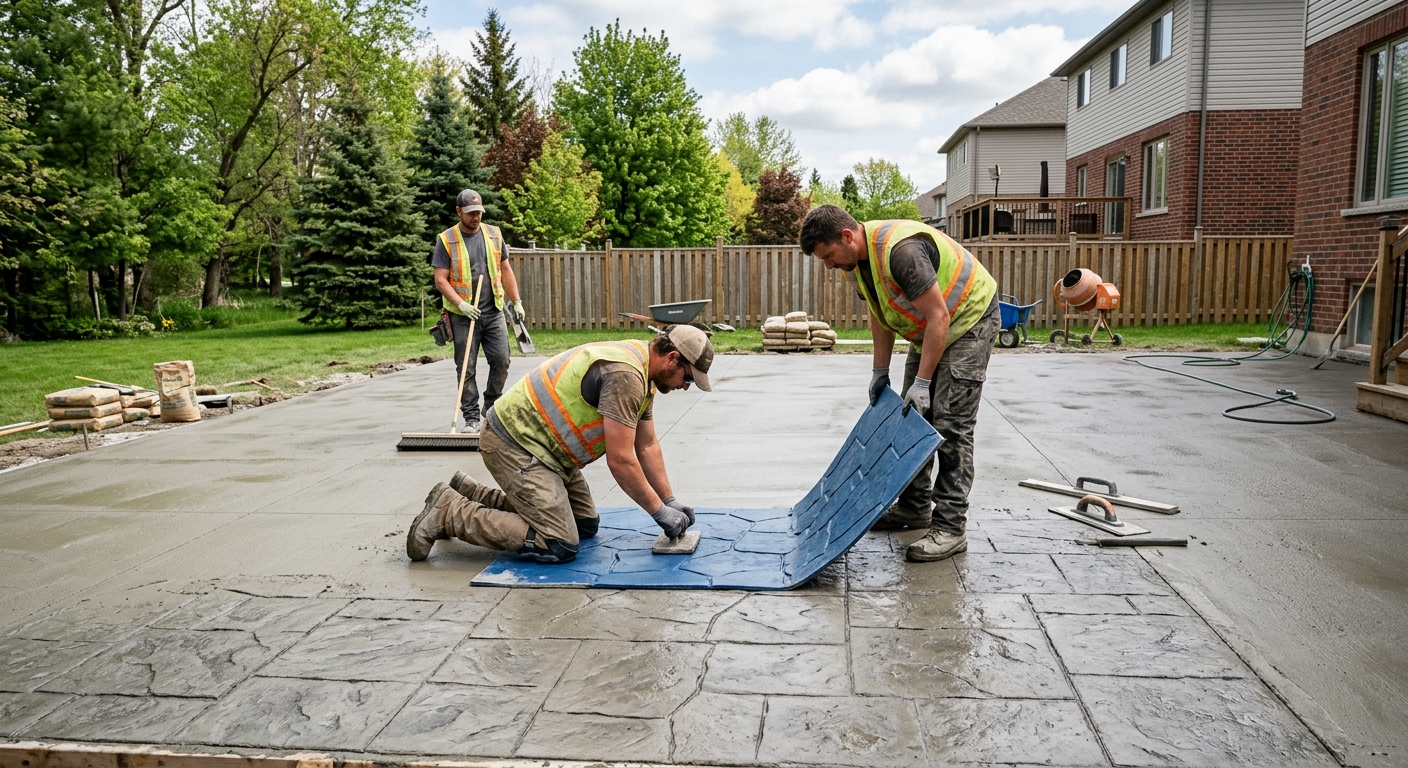
You’ll typically see differences even for “the same” job because reinforcement, compaction quality, and finishing complexity change labour time. Decorative options like stamped concrete cost more—while plain broom-finished concrete is usually the most budget-friendly way to get durable exterior flatwork. Use the ranges below as a starting point before you choose a finish and site details.
| Application |
Typical Size |
Key Spec |
Finish Option |
Price Range |
| Concrete driveway (standard broom finish) |
16 ft x 24 ft (384 sq. ft.) |
Air-entrained exterior mix, compacted base, control joints |
Broom finish |
$46,000 – $69,000 |
| Exposed aggregate driveway |
16 ft x 24 ft (384 sq. ft.) |
Air-entrained exterior mix, correct timing for wash/expose |
Exposed aggregate |
$55,000 – $85,000 |
| Stamped concrete driveway or patio |
12 ft x 20 ft (240 sq. ft.) |
Air-entrained mix, integral colour, release agent, seal |
Stamped pattern + sealing |
$38,000 – $60,000 |
| Plain concrete patio or walkway |
10 ft x 15 ft (150 sq. ft.) |
Air-entrained exterior mix, compacted granular base |
Float/trowel + light broom |
$13,000 – $22,500 |
| Garage floor (interior slab) |
20 ft x 22 ft (440 sq. ft.) |
Vapour barrier, 4 in slab typical, steel reinforcement as specified |
Standard broom or light trowel |
$44,000 – $70,000 |
| Foundation footings (structural, below frost) |
Typical house perimeter: 1,000–1,400 linear ft (varies) |
Excavate to frost depth, rebar cage, engineered embedment |
Structural concrete + reinforcement |
$180,000 – $360,000 |
Prices are estimates only and vary by project scope, site access and material selection.
What affects the price of concrete work in Renfrew
Two quotes for the same driveway or walkway in Renfrew can differ by 30–50% across the Kingston–Pembroke region and Ontario because concrete pricing is really “site and schedule” pricing. The slab is only part of the cost. Contractors spend time on excavation, hauling spoil away, grading, compacting granular base, installing proper drainage, and protecting the pour during cooler shoulder-season weather.
Frost line depth and repeated freeze-thaw cycles drive the specification. In Ontario, exterior footings generally need to extend below the design frost depth to help prevent frost heave, which often means more excavation and higher formwork. Exterior slabs also require air-entrained concrete to survive freeze-thaw, and cold weather curing precautions (insulating blankets or temporary heating when conditions demand it) add labour and materials. If the concrete is opened to traffic too early, surface damage can appear sooner—leading to rework.
In practical Renfrew terms, cost can rise when there’s poor drainage, soft spots, or restricted truck access on older lots—common in pre-1981 neighbourhoods. Conversely, a straightforward, open site with good granular base can keep your driveway closer to the lower end of the market. As a rough anchor, a simple broom-finished concrete driveway often lands in the lower pricing band (like $120–$180 per sq. ft. in the region’s driveway/slab range), while decorative work climbs when scheduling, colouring, stamping, and sealing are included—often aligning closer to the stamped/decorative band ($160–$280 per sq. ft.).
| Price Factor |
Why It Matters |
Cost Impact |
| Frost line depth |
Determines how deep footings/base must go to resist heave |
Often one of the biggest variable costs on foundations and base prep |
| Site preparation |
Excavation, grading, and compaction quality affect settlement and cracking |
Higher if hauling is needed or if base must be rebuilt |
| Reinforcement |
Rebar or mesh controls cracking and improves structural performance |
Adds material and labour; required more often for exterior slabs on questionable subgrades |
| Mix design |
Air-entrainment and strength requirements affect durability in freeze-thaw |
Air-entrained exterior spec and higher strength can raise concrete supply costs |
| Finish type |
Broom vs. stamped vs. exposed aggregate changes labour and timing |
Stamped and exposed aggregate usually land at the top of local ranges |
| Pour size and concrete truck access to site |
Smaller pours and difficult access increase labour time per yard |
Access constraints can increase mobilization and handling costs |
| Cold-weather curing precautions |
Heating/blankets protect strength gain and surface integrity |
Can add meaningful cost during cool shoulder-season weather |
| Control joint pattern and sealing cost |
Joints reduce random cracking; sealing helps resist de-icing salt damage |
Missed joints lead to repairs; sealing adds a separate line item |
Permits & regulations in Ontario
In Ontario, structural concrete work typically requires a building permit and often engineered drawings that the municipality reviews. That means work such as foundation footings, foundation walls, grade beams, and other load-bearing structural concrete elements generally needs permit approval before excavation and pour. For concrete flatwork—like driveways, patios, and walkways—a permit is usually not required unless the work affects lot grading, drainage patterns, impervious surface coverage rules, or the municipal right-of-way (for example, where a driveway ties into a ditch/municipal area). Because lot conditions vary, it’s smart to confirm the permitting path before breaking ground in Renfrew.
Before you sign, verify the contractor carries proper coverage: liability insurance and WSIB coverage where applicable (and the equivalent coverage required for workers). Then ask for references on similar-scale work in Ontario, not just portfolio photos. A solid contractor should also coordinate any required municipal inspections and documentation.
Step-by-step verification (homeowner-friendly):
- Check Ontario contractor licensing/registration details via the province’s online registry tools (use the company’s legal name).
- Request a current certificate of insurance and confirm it matches the exact project address.
- Ask for evidence of WSIB coverage (clearance letter or proof, as provided by the contractor).
- Confirm the quote includes any permit-related exclusions and inspection responsibilities.
- Verify the crew and subtrades are appropriately covered before any excavation begins.
Getting concrete right in Renfrew's freeze-thaw climate
In Renfrew, concrete failures almost always trace back to a few predictable causes: inadequate base preparation, wrong mix design for freeze-thaw, insufficient curing protection, and poor joint/sealing discipline. The Kingston–Pembroke market has a short pour season, and shoulder-season cold snaps can slow strength gain—so your spec must be practical for real weather, not ideal lab conditions.
Start with (1) base preparation: compacted granular sub-base to the correct depth for local soil and frost conditions. If the base is under-compacted or drainage is poor, you’ll get settlement and cracking. Then (2) mix design: exterior flatwork should use air-entrained concrete (targeted around 5–7% air) with a minimum around 32 MPa compressive strength so the concrete can endure freeze-thaw cycles.
(3) Control joints matter because they give cracks a place to happen. (4) Curing should be at least 7 days under proper conditions; when cold weather arrives, contractors should protect the pour with insulation blankets or heat as needed. Finally, (5) sealing should be applied after the concrete has fully cured—often 28 days post-pour—to repel de-icing salts and reduce spalling risk.
To justify price differences: a stamped patio may cost more than plain broom concrete because you’re paying for colouring, stamping, tighter finishing tolerance, and sealing. If your budget is tight, a plain patio in the lower range can be durable when the base, air-entrainment, and curing are done correctly—often far more important than the pattern.
| Spec |
Why It Matters in Renfrew |
What to Ask For |
Impact if Skipped |
| Compacted granular base (depth?) |
Limits settlement and protects against frost-related movement |
Granular type, lift thickness, compaction method, and target depth |
Cracking, uneven slabs, and premature failure |
| Air-entrained concrete mix (target air %?) |
Freeze-thaw resistance depends on stable microscopic air voids |
Air content spec around 5–7% for exterior flatwork, plus mix design |
Surface scaling/spalling, especially with salt use |
| Compressive strength (MPa rating) |
Strength gain helps the slab handle loads and curing discipline |
Minimum 32 MPa (or engineered requirement for the application) |
Soft surface, cracking from early loading |
| Control joints (spacing per ACI guidelines) |
Controls random cracking locations under thermal movement |
Joint spacing plan and sawcut timing |
Random cracks and water intrusion into the slab edges |
| Minimum 7-day curing period |
Cold/damp periods can slow strength development |
How curing will be protected during cool nights and wind |
Weakened surface and early spalling risk |
| Penetrating sealer (when applied after cure) |
Repels moisture and de-icing salt exposure |
Application timing (commonly after full cure) and sealer type |
Faster scaling and deterioration |
How to choose a concrete work contractor in Renfrew
To choose well in Renfrew, I recommend you verify three things early: Ontario licensing/registration, liability insurance, and WSIB coverage. How to check each: (1) confirm the contractor’s business name and contact match what’s on their quote and the online registry record, (2) request a certificate of insurance and ensure it lists you as a beneficiary/interest where applicable and covers the right time window, and (3) ask for WSIB clearance proof or coverage documentation before any work starts. If they can’t provide clear paperwork, that’s a red flag.
Next, get 2–3 itemised written quotes, not a single lump sum. You want line items that separate labour vs materials where practical—excavation, gravel base, reinforcement, concrete supply, forming, finishing, and sealing (if included). Read the scope carefully: what’s excluded (snow removal during pour setup, disposal/hauling, joint sealing, permit responsibility)? Make sure truck access limitations and any cut-and-replace areas are described. Also confirm warranty terms: workmanship warranty length, what’s covered, and whether manufacturer product warranties apply to integrals and sealers.
On payment, never pay more than 10–15% upfront. Use a holdback until the final finishing, cleanup, and any sealing (or seal readiness) are complete. Finally, ask for a written timeline with a start date, estimated completion window, and what happens if cool weather delays the schedule.
- Ask for a site plan that shows excavation limits, base thickness, and drainage.
- Confirm the concrete will be air-entrained for exterior flatwork.
- Request the reinforcement plan (mesh vs rebar) and placement depth.
- Clarify whether sawcut control joints will be installed on a schedule, not “as time permits.”
- Confirm how the pour will be protected during cool nights (blankets/heating if needed).
- Make sure cleanup and disposal are clearly included.
- Check that sealing is either included or listed as an optional add-on with timing.
- Ask what “standard broom” means on their crew’s finish guide (profile and texture).
- Verify they’ll protect edges/corners during finishing and curing.
- Request proof of insurance and WSIB coverage before equipment arrives.
- Ensure the quote includes the curing schedule and when you can use the driveway/patio.
- Confirm warranty terms are in writing and not vague (coverage period and exclusions).
Concrete contractor red flags I see in Renfrew: vague quotes that don’t mention base compaction or air-entrained mix, refusing to put joint spacing/sawcut timing in writing, inadequate curing language (no mention of blankets/heating during cool periods), asking for large upfront payments, and avoiding documentation for WSIB/insurance or past similar Renfrew-area projects.
Frequently asked questions — concrete work in Renfrew
What is rebar and when is it required in Ontario?
Rebar (reinforcing steel bars) adds tensile strength to concrete and helps control cracking and movement. In Ontario, rebar is commonly required for structural and load-bearing elements, including footing reinforcement and foundation components, and it’s typically specified through engineered drawings for your foundation design. For exterior flatwork like driveways and patios, some projects use wire mesh or rebar, but whether reinforcement is needed depends on slab thickness, subgrade conditions, and how the slab will be loaded (vehicle weight, slope, and base quality). In Renfrew, older lots often have variable subgrades, so I frequently see reinforcement specified when base prep is challenging or when the slab is exposed to freeze-thaw and heavy traffic. If your contractor can’t explain why reinforcement is—or isn’t—being used, ask for their basis in the design.
How long does a concrete project take in Renfrew?
For many homeowner projects in Renfrew, the “wet work” portion is relatively quick—often just a day or two for placing and finishing—but curing and weather protection are what control the calendar. A driveway pour is typically completed in one major placement, then sawcut control joints and finishing occur the same day or shortly after. However, you should plan around a minimum curing period of about 7 days before normal use, and longer if the weather is cool or damp. In Kingston–Pembroke’s shorter pour season, crews may also need to schedule around truck access, temperature windows, and how soon they can protect the slab from damage. If you’re comparing quotes, ask what curing plan is included and when the site is considered safe for vehicles. This is where a cheaper “broom finish only” quote can become expensive later if the slab is opened too early.
What is a concrete overlay and is it suited to Renfrew?
A concrete overlay is a new concrete layer installed over an existing slab (usually after preparation like grinding/chipping and repairing spalled areas). It can be suited to Renfrew when the existing surface is still structurally sound—meaning the slab hasn’t failed due to base settlement, widespread cracking, or drainage problems. The challenge in freeze-thaw zones is that overlay performance depends heavily on bonding and the condition of the old slab. If moisture pathways exist, water can get under the overlay and accelerate deterioration. For homeowners in Renfrew’s older housing stock (many homes pre-1981), overlays are sometimes attractive because they reduce excavation and haul costs, but they’re not a fix for a failing base. Before choosing an overlay, ask the contractor how they assess bonding and drainage, and whether they’ll address control joints. Your best durability comes from correct base prep when replacement is actually needed.
How do I seal concrete to protect it in Renfrew?
Sealing helps protect concrete from moisture and de-icing salts—both important in Renfrew where freeze-thaw cycles can push water into pores and along edges. The key is timing and product type. Typically, contractors apply a penetrating sealer after the concrete has cured sufficiently—often around 28 days post-pour—so the slab is dry enough to accept the sealer properly. Before sealing, the surface must be clean and free of dust, curing compounds, and contaminants. After sealing, avoid washing with harsh chemicals right away and reapply as recommended by the sealer manufacturer. If your quote includes sealing, make sure it specifies whether it’s included in the price and when it will be done. A sealed driveway in the correct finish (for example, a plain broom finish) can better resist scaling compared with an unsealed surface, especially if you use road salt in winter.
What is the difference between concrete and cement?
Concrete is the finished building material—made by mixing cement with water and aggregates (sand and gravel), plus sometimes admixtures like air-entrainment for exterior durability. Cement is just one component inside concrete; it acts like the binding ingredient that hardens when it reacts with water. In Ontario and in Renfrew’s freeze-thaw climate, the important part for homeowners isn’t the label—it’s the concrete specification: air-entrainment level, strength (often around 32 MPa for many flatwork specs), and how curing is managed. When contractors quote exterior work, they should be discussing the concrete mix design and curing plan that reduces spalling and scaling. If a contractor only talks about “cement” without talking about air content or strength, ask follow-up questions because those details affect real performance in winter.
How much does concrete work cost in Renfrew?
Concrete costs in Renfrew depend on the application and—more importantly—site conditions, drainage, and finishing complexity. For a quick baseline, local regional price bands put concrete driveway/slab work at about $120–$180 per sq. ft., while stamped and decorative concrete often lands higher at about $160–$280 per sq. ft. Plain patios and walkways typically fall around $90–$150 per sq. ft., and foundation/footings are often in the $180–$320 per sq. ft. range depending on engineered design and excavation depth. In Renfrew, the same driveway can swing in price if excavation and base replacement are needed, or if cold-weather curing precautions are required. When comparing quotes, insist on an itemised breakdown—otherwise the “cheaper” option may cut corners on base prep, air-entrainment, joints, or curing.