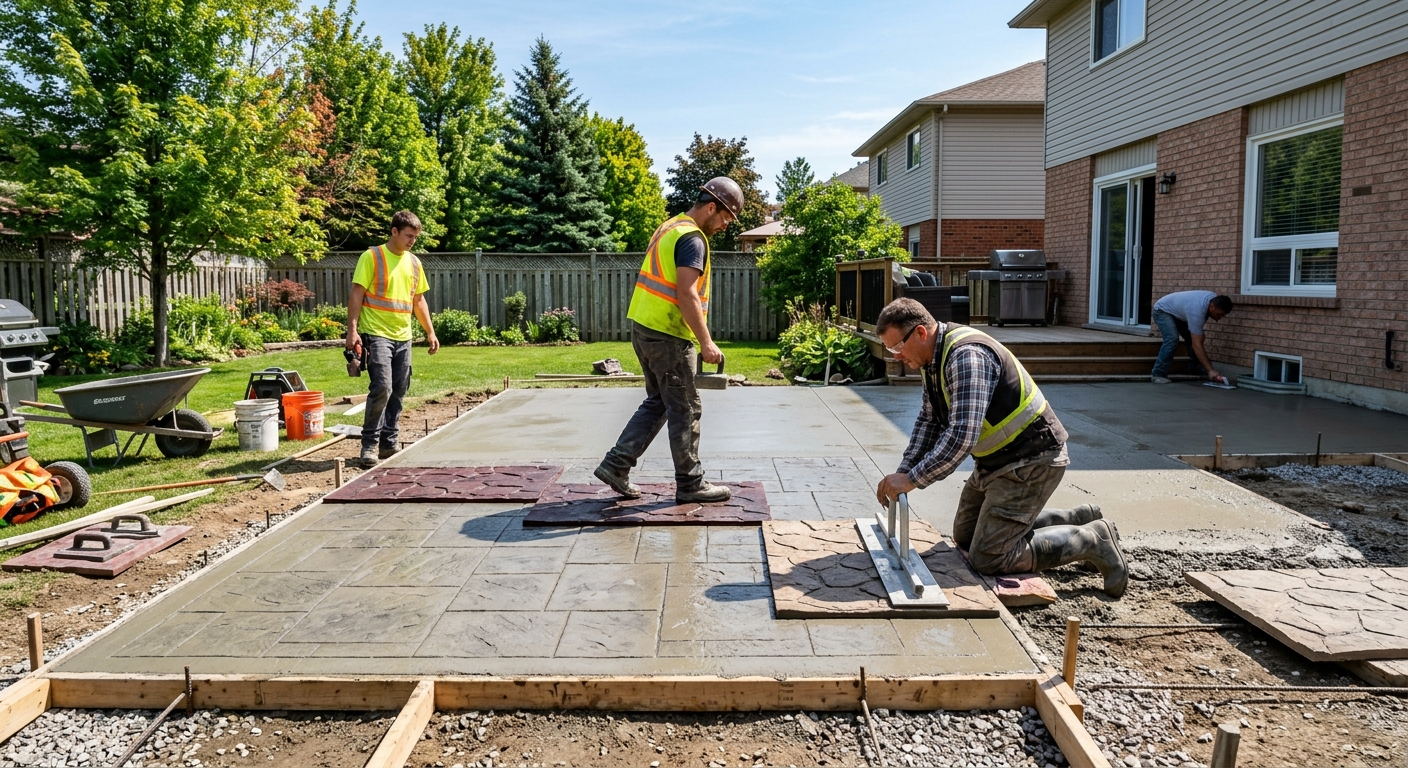
Concrete work options and costs in Bourget
Bourget concrete projects typically centre on driveways, patios, walkways and foundation work for the town’s roughly 1,169 residents (Statistics Canada, 2021 Census). In practice, most homeowners are working within an established neighbourhood pattern—think established lots where access is tight and the ground has already been altered over the years—so the “same” concrete job can cost noticeably different depending on excavation and site grading. Bourget’s housing mix is small-town and steady, and concrete flatwork is especially in demand in the residential areas close to the main service corridors where families upgrade entrances and backyard outdoor spaces. At the household level, concrete flatwork is commonly considered alongside other exterior improvements, because a well-built driveway or walkway improves both function and curb appeal.
In the Toronto economic region, concrete pricing is strongly shaped by frost depth requirements, freeze–thaw cycles, and the contractor’s ability to manage curing during Ontario’s shoulder-season temperatures. Local exterior pours rely on air-entrained mixes, properly compacted granular base, adequate thickness, and control joints to reduce cracking. When temperatures slide toward 10 °C or below, protecting the pour (blankets/coverage where needed) becomes part of the cost. Availability can also tighten in peak months, which influences scheduling and labour rates. For Bourget, that means your quote isn’t just “concrete material”—it’s excavation, base prep, reinforcement decisions, mix design, finishing time and curing protection.
Below are typical ranges homeowners in Bourget budget for common options, then you can compare the spec differences that drive the final number.
| Application |
Typical Size |
Key Spec |
Finish Option |
Price Range |
| Concrete driveway (standard broom finish) |
16 ft x 20 ft (320 sq. ft.) |
4" slab, compacted base, air-entrained mix |
Broom finish with control joints |
$5,760 – $8,960 |
| Exposed aggregate driveway |
16 ft x 20 ft (320 sq. ft.) |
Air-entrained mix, proper base & finishing |
Exposed aggregate with edging |
$7,680 – $10,880 |
| Stamped concrete driveway or patio |
12 ft x 20 ft (240 sq. ft.) |
Air-entrained mix, thicker section at edges |
Stamp + colour hardener, release powder |
$5,760 – $9,600 |
| Plain concrete patio or walkway |
10 ft x 16 ft (160 sq. ft.) |
4" slab, compacted granular base |
Float/screed + light broom |
$2,560 – $4,160 |
| Garage floor (interior slab) |
18 ft x 20 ft (360 sq. ft.) |
Poly/vapour barrier (as applicable), reinforced slab |
Float finish (no decorative) |
$6,480 – $10,080 |
| Foundation footings (structural, below frost) |
Per project (typical 2–3 walls) |
Excavate to frost depth, rebar cages, formwork |
Insulated/protected where specified |
$180 – $300 |
Prices are estimates only and vary by project scope, site access and material selection.
What affects the price of concrete work in Bourget
In the Toronto economic region, even “similar” concrete jobs can land 30–50% apart because quotes are usually built from different assumptions about excavation, base condition, reinforcement, mix design and finishing time. One contractor may price a 4" slab on a well-prepared granular base; another may price the same slab but include deeper base, higher-strength concrete, more robust air-entrainment, additional rebar, or better drainage details. In a place like Bourget where frost and freeze–thaw cycles repeat year after year, those spec choices aren’t cosmetic—they’re what prevent frost heave, settlement and winter surface damage.
Why the regional climate drives cost: exterior work needs air-entrained concrete mixes to survive freeze–thaw cycling, and Ontario’s structural requirements push footings below design frost depth (often about 1.2 m or more) to prevent differential movement. When weather dips, cold-weather curing precautions—insulating blankets and scheduling concrete pours earlier in the day—add labour and materials. De-icing salt in winter accelerates spalling risk if the slab surface is not protected; that’s why sealing is commonly recommended for exterior flatwork, and it adds a line item.
In Bourget specifically, costs often rise when old landscaping has left unsuitable fill or when the ground is soft and requires thicker compacted granular base before the concrete goes down. Costs can also increase if you want stamped or exposed aggregate because the finishing window and crew time are tighter (stamped/decorative commonly sit in the $24–$40 range). On the other hand, a basic broom-finished patio may stay closer to the $16–$26 band when access is straightforward and the sub-base is already clean and stable.
| Price Factor |
Why It Matters |
Cost Impact |
| Frost line depth |
Determines footing depth and form height |
Higher excavation/formwork can add substantial labour and disposal costs |
| Site preparation |
Excavation, grading, compacted granular base |
Soft subgrade or thick unsuitable fill increases base thickness and hauling |
| Reinforcement |
Rebar or wire mesh requirement |
Correct reinforcement adds material cost but reduces failure/cracking risk |
| Mix design |
Air-entrainment and compressive strength spec |
Air-entrained and higher-strength mixes cost more but improve freeze–thaw durability |
| Finish type |
Broom vs. stamped vs. exposed aggregate |
Decorative finishes typically raise labour time and material consumables |
| Pour size and concrete truck access to site |
Short pours vs. long placement distance |
Poor access may require smaller loads, extra crew, and additional hose/placement labour |
| Cold-weather curing precautions |
Heating and blankets |
When temps drop, protection methods add day-of labour and materials |
| Control joint pattern and sealing cost |
Limits random cracking; protects against salt damage |
More joints and sealing add cost, but reduce long-term patching |
Permits & regulations in Ontario
In Ontario, structural concrete work—such as footings, foundation walls, and grade beams—typically requires a building permit. Municipal review often includes engineered drawings, especially where there’s reinforcement design, bearing conditions, or special detailing. That’s because the structural system must be verified for loads and movement through freeze–thaw seasons.
By contrast, concrete flatwork like driveways, patios, and walkways usually does not require a permit unless it affects lot grading, impervious surface coverage limits, drainage patterns, or the municipal right-of-way (for example, work that changes how runoff enters ditches or swales). Even if a permit isn’t commonly required for the slab itself, you should confirm with the local authority before you break ground.
Step-by-step verification for Bourget homeowners:
- Confirm contractor credentials: Ask for the company’s Ontario business details and the specific scope (structural vs. flatwork).
- Check liability insurance: Request a current Certificate of Insurance (COI) showing liability coverage limits relevant to your project.
- Confirm WSIB/WCB coverage: Ask for WSIB (or applicable worker protection documentation) clearance—contractors should be able to provide proof.
- Verify clearance and references: Request references on similar-scale jobs (driveways/patios with freeze–thaw specs, or foundation pours if applicable).
- Get it in writing: Make sure permit responsibilities (if any) and job protections (base, curing, drainage) are included in your contract.
Getting concrete right in Bourget's freeze-thaw climate
Concrete failures in Bourget usually trace back to water movement, inadequate base preparation, or a mix/joint plan that doesn’t handle winter freeze–thaw. The practical way to spec the job correctly is to treat it like a system: build a stable, well-compacted granular base; use an air-entrained mix; control cracking with joints; cure properly; and protect the surface from de-icing salt. On exterior slabs, saturated soils can expand and contract against the concrete every winter, so drainage and base depth matter as much as the finish you see.
For Bourbon-ready durability, you want: (1) base preparation with compacted granular sub-base to the right depth for your soil and expected frost movement; (2) mix design with air-entrainment around 5–7% air for exterior flatwork and minimum 32 MPa compressive strength; (3) control joints spaced so cracks form where you want them; (4) curing long enough to reach strength reliably—plan for at least 7 days under proper conditions, and protect the pour more aggressively when temperatures trend low; and (5) sealing with a penetrating sealer applied after cure to help repel de-icing salts.
When comparing options, the price jump can be justified. For example, stamped concrete often runs in the $24–$40 band, while a plain patio may land closer to $16–$26. The higher cost is typically crew time, finishing skill, and materials (stamp mats, colour hardener, release system, and tighter scheduling). If your goal is simply a durable, low-maintenance path in a traffic lane, plain broom-finished concrete is often the better value.
| Spec |
Why It Matters in Bourget |
What to Ask For |
Impact if Skipped |
| Compacted granular base (depth?) |
Reduces settlement and blocks water from pumping under the slab during freeze–thaw |
Confirm base thickness, soil conditions, and compaction method/test |
Premature cracking, uneven slab, and joint failure |
| Air-entrained concrete mix (target air %?) |
Protects concrete paste against freeze–thaw damage and scaling |
Ask for air-entrainment target around 5–7% for exterior flatwork |
Higher risk of spalling and surface scaling in winter |
| Compressive strength (MPa rating) |
Improves durability and ability to carry loads without excessive surface wear |
Request minimum 32 MPa design strength for exterior flatwork |
Faster wear, crumbling edges and more frequent patching |
| Control joints (spacing per ACI guidelines) |
Manages shrinkage cracking so it happens in planned locations |
Ask for joint layout, spacing approach, and timing of cutting |
Random cracks and widening, especially after freeze–thaw cycles |
| Minimum 7-day curing period |
Ensures strength gain before traffic, moisture cycling and salt exposure |
Confirm curing plan and what “proper conditions” includes |
Weaker surface, higher risk of dusting/spalling |
| Penetrating sealer (when applied after cure) |
Repels moisture/salt and slows deterioration of the exterior surface |
Ask when sealer is applied—typically after full cure (about 28 days) |
More salt absorption and surface breakdown over winters |
How to choose a concrete work contractor in Bourget
Choosing a contractor in Ontario is mostly about verifying three things—credentials, workmanship process, and quote clarity. First, confirm the company has appropriate coverage. Ask for a Certificate of Insurance for liability (so you’re protected if something is damaged during excavation or formwork). Next, verify WSIB coverage (or applicable provincial worker protection documentation) and request a clearance letter/documentation before work starts. If a contractor can’t produce proof quickly, it’s a serious red flag—especially on foundation and footing work where risk is higher.
For pricing, get 2–3 itemised written quotes rather than a single lump sum. Ideally, the quote should separate labour, excavation/base prep, reinforcement, concrete supply, forming, finishing, curing/protection, joints, and sealing (if included). For exterior flatwork in Bourget, compare how each quote addresses air-entrainment, thickness, base depth, and drainage details—these are the areas where quotes can diverge by 30–50%.
Read the scope carefully for exclusions: Is disposal/hauling included? Is permit pulling included for structural work? Are winter protections included if the pour is delayed? Clarify warranty: ask for the workmanship warranty length, how long it lasts after completion, whether it covers cracking/spalling, and whether product/manufacturer coverage applies. Keep payment sensible: never pay more than 10–15% upfront. Use a holdback until finish details, cleanup and any sealing schedule are complete. Finally, request a written timeline with a start date window and completion estimate.
- Ask for COI liability limits and confirm the policy is active
- Request WSIB clearance documentation before work begins
- Confirm whether they handle permits for structural concrete scope
- Get itemised pricing (labour + materials) not just lump sum
- Verify slab thickness, base thickness, and compaction approach in the scope
- Confirm air-entrainment and min compressive strength (e.g., 32 MPa) for exterior work
- Ask for reinforcement type (rebar vs. mesh), spacing and placement method
- Require a control joint layout and when joints are cut
- Clarify curing method and whether cold-weather protection is included
- Confirm drainage and grading tie-ins (especially at driveway edges)
- Ask about sealing: who applies it, when (after cure), and what product
- Set a payment schedule with a holdback until completion and cleanup
Concrete red flags in Bourget: (1) “No need for air-entrainment” on exterior slabs, (2) unclear footing depth/formwork details for foundation work, (3) rush-cutting joints or no joint plan, (4) vague curing/blanket wording when temps drop, and (5) missing insurance/WSIB proof or refusing to put details in the contract.
Frequently asked questions — concrete work in Bourget
How do I prepare the base for a concrete slab?
In Bourget, base prep is where long-term performance is won or lost because the ground cycles through moisture and freeze–thaw. The contractor should excavate to reach suitable subgrade, remove organics/soft fill, and build a compacted granular sub-base to the required depth based on your soil and design frost considerations. Ask whether they’re using a granular type designed for base (and not random fill) and whether they’ll compact in lifts with proper compaction checks. Drainage matters too: surface and sub-surface water should be managed so it doesn’t saturate under the slab. If base prep is skipped or rushed, even the best-looking broom finish can crack or settle, and you’ll usually pay again sooner than expected.
How do I compare concrete quotes?
When comparing quotes for Bourget concrete, don’t compare only the total price—compare the specification. Ask each contractor to write down slab thickness, base depth and compaction method, reinforcement type (rebar vs. mesh), mix design (air-entrainment and minimum strength), joint pattern, curing plan, and whether sealing is included. This is how you avoid getting a “cheap” number that later turns into surface scaling in winter. For example, a plain patio might land around the $16–$26 band, while stamped concrete typically sits closer to $24–$40 due to extra finishing labour and materials. If the specs don’t align, the price difference isn’t a fair comparison.
Can concrete be poured in cold weather in Bourget?
Yes, concrete can be poured in cold weather in Bourget, but it requires cold-weather curing precautions to protect the pour. The key risk in Ontario is that when temperatures drop near or below about 10 °C, curing slows and strength gain can be compromised, which can increase cracking or surface scaling later. A responsible contractor will plan scheduling, use appropriate protection (insulating blankets and coverings), and manage curing time so the concrete can gain strength properly before it’s exposed to freeze events. Ask how they’ll monitor temperatures and what specific steps they’ll take if your pour date shifts due to rain or early cold snaps.
How do I maintain concrete in Bourget's freeze-thaw climate?
Maintenance is mainly about keeping water and de-icing salts off the surface and addressing minor issues early. In Bourget winters, regular sweeping of grit and salt helps reduce chemical attack and reduces trapped moisture. Use a penetrating sealer after the slab has fully cured (often around 28 days) if your contractor recommends it; sealing helps repel moisture and slows deterioration. Avoid using rock salt at high rates—use it sparingly and focus on scraping first when possible. If you notice small hairline cracks, don’t ignore them: prompt crack repair helps stop water infiltration, which is what drives freeze–thaw expansion. For exterior patios and walkways, re-check drainage at the edges so water can’t pool against the slab.
What causes concrete to spall in Bourget winters?
Spalling in Bourget is usually caused by freeze–thaw damage combined with salt exposure and inadequate mix or surface protection. The most common technical causes are insufficient air-entrainment (not enough microscopic air voids to relieve pressure when water freezes) and water getting into the slab through joints or exposed areas. If curing was rushed—especially when temperatures were low—concrete may not reach adequate early strength, making the surface more vulnerable. Also, poor base prep and drainage can keep the concrete saturated. Since de-icing salt accelerates surface deterioration, sealing and a proper joint plan become even more important for driveways and walkways. If spalling starts, repair plans should address both the surface and the source of water entry.
What is rebar and when is it required in Ontario?
Rebar is reinforcing steel placed inside concrete to help resist tensile forces and control cracking. In Ontario, whether rebar is required depends on the concrete application and the structural design. For structural elements like foundation footings, foundation walls and grade beams, reinforcement design is typically engineered and is part of the permit/structural review expectations. For exterior slabs such as driveways and some garage floors, reinforcement may be used based on slab thickness, soil conditions, and load expectations—your contractor should specify why mesh or rebar is being used (or not) in the quote. In a freeze–thaw environment like Bourget, reinforcement alone doesn’t replace good base prep, air-entrained mix, and proper joints; it complements them.