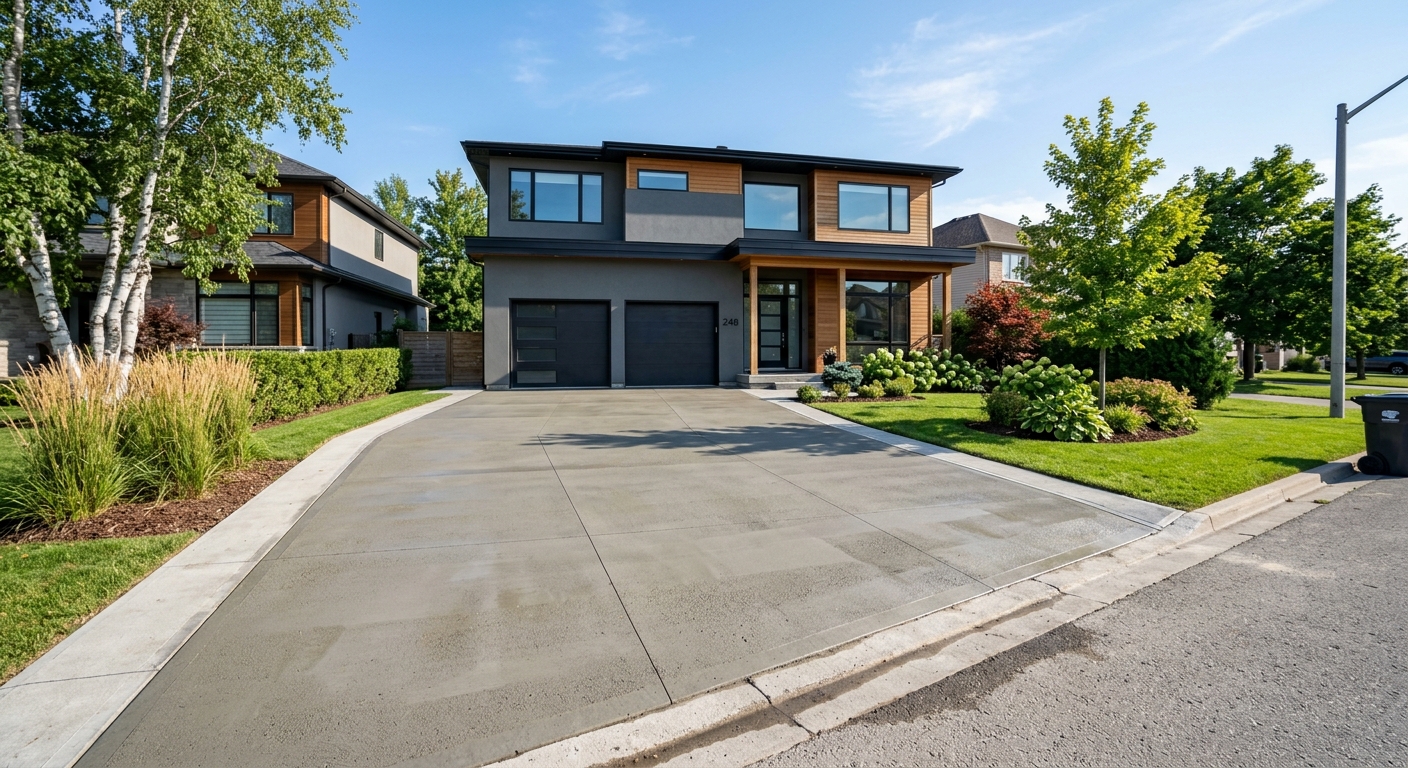
Concrete work options and costs in Corunna
Concrete work in Corunna tends to be practical, durable, and focused on exterior flatwork—because most homes here are the single-detached style where people want driveways, patios, and walkways that can handle Toronto-area freeze–thaw. With a population of 5,686 (Statistics Canada, 2021 Census), Corunna is small enough that homeowners often feel contractor availability and scheduling more than they would in the core of the GTA. That said, the Toronto economic region drives the “real” cost picture: frost depth requirements, longer logistics, and the need for properly air-entrained mixes on exterior slabs. Many pours are planned for the warmer months to support curing and finishing, and contractors typically factor in tighter time windows when temperatures drop toward 10 °C or below.
In particular areas like the Lambton County-side of Corunna (and nearby residential pockets with established driveways and older lots), demand is high for driveway replacements and interlocking/flatwork tie-ins. Quotes can shift quickly depending on how much removal is needed, how much compacted granular base is specified, and whether the job is treated as an exterior exposure that must be sealed against de-icing salt. If you’re comparing options, it helps to think in terms of thickness, base prep, and how the finish manages cracking. Standard broom finishes are usually the most budget-friendly, while stamped and exposed aggregate bring higher labour and material costs because of formwork, labour-intensive finishing, and more stringent curing and protection.
Below are realistic current bands for Corunna so you can compare like-for-like before calling for an estimate.
| Application |
Typical Size |
Key Spec |
Finish Option |
Price Range |
| Concrete driveway (standard broom finish) |
16 ft x 24 ft (384 sq ft) |
Air-entrained exterior mix; compacted granular base |
Broomed surface + control joints |
$6,900–$10,700 |
| Exposed aggregate driveway |
16 ft x 24 ft (384 sq ft) |
Air-entrained mix; proper stone exposure timing |
Exposed aggregate (bush-hammer or wash) |
$8,900–$12,600 |
| Stamped concrete driveway or patio |
12 ft x 18 ft (216 sq ft) |
Air-entrained mix; stamped surface + release agent |
Stamping with colour hardener |
$6,500–$9,400 |
| Plain concrete patio or walkway |
10 ft x 16 ft (160 sq ft) |
Exterior-grade mix; compacted base + drainage slope |
Smooth trowel or light broom |
$2,600–$4,100 |
| Garage floor (interior slab) |
22 ft x 20 ft (440 sq ft) |
Minimum cement content; vapour control if needed |
Broom finish or hard-trowel for light use |
$6,700–$10,900 |
| Foundation footings (structural, below frost) |
Typical small addition house lineal footage |
Engineered depth; rebar cage; waterproofing coordination |
Structural concrete, not a decorative finish |
$180–$300 |
Prices are estimates only and vary by project scope, site access and material selection.
What affects the price of concrete work in Corunna
In the Toronto economic region, it’s common to see quotes for the “same” concrete job vary by 30–50% once you compare what’s actually included. The gap usually comes down to base prep depth and compaction, reinforcement design, concrete mix requirements for exterior exposure, and the reality of site access (can trucks stage close to the pour?). Two crews can both install a driveway, but one might build a thicker granular base with better drainage and air-entrained concrete suited to freeze–thaw, while another may keep thickness or reinforcement minimal—leading to very different performance and, later, repair costs.
Specifically, frost depth and freeze–thaw cycles dictate every structural and exterior call in the region: footings must extend below the design frost depth to prevent frost heave and differential movement. Exterior slabs (driveways, patios, walkways) also need air-entrained concrete so freeze–thaw doesn’t turn minor moisture cycling into spalling. In colder Ontario conditions, the reliable pour season tightens, which adds cost via scheduling, waiting time, and cold-weather curing precautions (insulating blankets, temperature management). De-icing salt—widely used in the GTA—can accelerate surface deterioration if the surface isn’t sealed, especially on rougher exposed finishes.
In Corunna, a typical cost mover is whether your existing asphalt or old concrete is removed and disposed properly. Another is soil moisture: if the subgrade is saturated, contractors may need extra excavation and granular replacement before they can compact to spec. For budgets, a standard broom driveway often lands in the $18–$28 per sq ft band, while stamped work commonly lands in the $24–$40 per sq ft range; you’re usually paying for labour-intensive finishing and colour system materials rather than “extra concrete thickness alone.”
| Price Factor |
Why It Matters |
Cost Impact |
| Frost line depth |
Determines footing depth and form height |
More excavation and concrete per linear metre |
| Site preparation |
Excavation, grading, compacted granular base |
Can add major labour/materials if soil is soft or wet |
| Reinforcement |
Rebar or wire mesh requirement |
Increases material cost and adds tying/placement labour |
| Mix design |
Air-entrainment and compressive strength spec |
Higher-spec mix can cost more but improves durability |
| Finish type |
Broom vs. stamped vs. exposed aggregate |
Decorative finishes add labour, timing, and colour system materials |
| Pour size and concrete truck access to site |
Sequencing and placement efficiency |
Limited access may require pump/extra crew time |
| Cold-weather curing precautions |
Heating and blankets when temperatures drop |
Adds equipment, labour, and longer protection time |
| Control joint pattern and sealing cost |
Limits cracking and protects from salt exposure |
Skipping either can reduce short-term cost but increases long-term repairs |
Permits & regulations in Ontario
In Ontario, structural concrete work generally needs a building permit. That includes footings, foundation walls, and grade beams—essential parts of the structure that must be reviewed for design and inspection. Many projects also require engineered drawings or calculations before work starts, and municipalities typically schedule inspections at key stages (formwork/steel placement and pour stages).
Concrete flatwork—patios, walkways, and driveways—usually does not require a permit by itself. However, it may require approval if it changes lot grading, affects surface drainage in a way that impacts neighbouring properties, or intersects with municipal requirements around impervious surfaces and right-of-way limits (for example, work close to a driveway apron or municipal boulevard). The safest approach is to confirm with the local authority before breaking ground, especially if you’re raising or lowering an approach or adding new drainage.
For the contractor side, don’t assume: verify they carry liability insurance and WSIB/WCB coverage (as applicable). Step-by-step, homeowners in Corunna can check three things before signing:
- Ask for a current certificate of insurance for liability and ensure the address/job name matches.
- Request WSIB clearance (or WCB equivalent coverage proof as applicable) and confirm dates are current.
- Check the contractor’s Ontario licensing/registration status using the relevant online registry listing for trade contractors, then match the business name to the quote and invoice.
- Get references for similar scope (exterior flatwork with comparable soil conditions and traffic/loads).
Getting concrete right in Corunna's freeze-thaw climate
Concrete failures in Corunna are almost always about moisture movement and freezing—not “bad luck.” When water can sit in the subgrade or within small surface pores, it expands during freezing and can loosen the surface layer, causing spalling. In the Toronto market, that’s why proper base preparation, correct mix design, and tight control joints matter. For exterior flatwork, build on a compacted granular sub-base to the right depth for local soil and frost considerations, and ensure drainage slopes away from the house so the slab isn’t constantly exposed to saturation.
For mix design, insist on air-entrainment—typically 5–7% air content for exterior flatwork—paired with a minimum 32 MPa compressive strength target. Control joints must be planned so the slab cracks in the intended lines rather than randomly. Then curing: aim for a minimum 7-day curing period under proper conditions. When colder weather arrives, contractors may need insulated blankets and temperature management so the surface doesn’t cure too slowly, which can increase durability issues later.
Finally, sealing is key in Ontario’s salt-and-melt cycles. A penetrating sealer applied after the cure period (commonly at 28 days post-pour) helps repel de-icing salts and reduces the rate of surface breakdown. If you’re choosing between a standard broom driveway and an upgraded exposed aggregate, the price difference can be justified—but only if both are built correctly. For example, if your standard broom driveway is priced in the $18–$28 per sq ft range, the exposed aggregate upgrade might push you toward the higher side of the $24–$40 band for decorative finishes. The “extra money” is mostly labour and materials, while your freeze–thaw resilience still depends on base, air entrainment, and curing.
| Spec |
Why It Matters in Corunna |
What to Ask For |
Impact if Skipped |
| Compacted granular base (depth?) |
Prevents pumping and reduces frost-related movement |
Granular sub-base depth and compaction method (to spec); drainage slope plan |
Settling, voids, and early cracking/spalling |
| Air-entrained concrete mix (target air %?) |
Protects against freeze–thaw damage and spalling |
Air content target of 5–7% for exterior flatwork; confirm exposure class intent |
Surface scaling and flaking during winter cycles |
| Compressive strength (MPa rating) |
Ensures structural durability and proper performance |
Minimum 32 MPa target; note cure conditions |
Weaker surface, increased wear and cracking |
| Control joints (spacing per ACI guidelines) |
Directs shrinkage cracking into planned joints |
Joint spacing and layout plan; saw-cut timing and depth |
Random cracking and wider joint openings |
| Minimum 7-day curing period |
Builds strength and reduces early freeze damage |
How they cure in cold snaps; protection method if temps drop |
Surface defects and reduced long-term durability |
| Penetrating sealer (when applied after cure) |
Repels salt/melt water and slows surface breakdown |
Sealer application after cure (commonly at 28 days); product type and coverage |
Faster salt-related deterioration and staining |
How to choose a concrete work contractor in Corunna
Choosing a contractor in Corunna starts with verifying the three basics: Ontario licensing/registration (as applicable to their trade), liability insurance, and WSIB/WCB coverage proof. Here’s how to check each without guesswork. First, ask for their Ontario business details and confirm it matches what’s on the quote and invoices. Next, request a current certificate of insurance for liability and verify coverage limits are appropriate for exterior work (especially driveway tear-outs). For labour coverage, ask for WSIB clearance/letter or WCB proof with current dates so you know you’re not exposed if a worker is injured.
Then get 2–3 itemised written quotes—ideally broken into labour and materials—so you can compare apples to apples. A solid quote spells out excavation, granular base depth and compaction, reinforcement type (if needed), concrete mix designation, rebar/wire mesh placement, concrete thickness, finishing, joint layout, curing protection, and sealing allowances.
Read the scope carefully. Where will disposal go? Is permit pull included if structural work requires it? What’s excluded (e.g., hauling contaminated soil, tree root removal, electrical for saw cutting, or snow/ice protection during curing)? Ask about warranty: workmanship warranty length, whether the product/manufacturer warranty applies, and whether it’s transferable to the next owner if you sell. Finally, payment schedule matters—never pay more than 10–15% upfront. Hold back the remainder until the job is complete, inspected (where applicable), and clean-up is done. Get a start date and estimated completion timeline in writing as well.
- Confirm insurance certificate is current and names the correct legal entity.
- Request WSIB/WCB coverage proof (not just a verbal statement).
- Ask for 2–3 recent photos of similar Corunna exterior flatwork (same finish type).
- Require itemised pricing: base prep, reinforcement, concrete mix, finishing, and sealing.
- Check whether the quote lists thickness and base depth (not just “standard base”).
- Ask about air-entrainment and target strength (32 MPa minimum for durability).
- Confirm control joint spacing and when saw cutting will happen.
- Discuss curing plan for cold snaps (blankets/heating if needed).
- Ensure disposal/hauling of removed concrete/asphalt is included or clearly excluded.
- Clarify access: staging area for trucks, pumping needs, and protection of landscaping.
- Review warranty terms in writing and whether it covers cracking/spalling.
- Use a payment schedule with a holdback until final finish/clean-up is complete.
In Corunna, common red flags include: quotes that don’t specify air-entrainment or curing/protection; “too good to be true” pricing that skips base depth or reinforcement; a rush to pour without a temperature protection plan; no itemised scope (just a lump sum); and warranty terms that exclude cracking without discussing joints and sealing.
Frequently asked questions — concrete work in Corunna
What is rebar and when is it required in Ontario?
Rebar is steel reinforcement embedded in concrete to help control cracking and add tensile strength where concrete alone is weaker. In Ontario, reinforcement requirements depend on the structural design and exposure conditions, not just on “typical practice.” For structural work like footings, foundation walls, and grade beams (which typically require permits), rebar and/or engineered reinforcement layouts are commonly specified by the engineer’s drawings and reviewed through the permit/inspection process. For exterior flatwork like driveways, some projects use wire mesh or rebar depending on thickness, soil conditions, and loads (for example, heavier vehicle traffic or weak subgrade). In Corunna’s freeze–thaw climate, proper base prep is still the first line of defence, but reinforcement is often used to manage cracking so the slab doesn’t fail prematurely.
How long does a concrete project take in Corunna?
For a typical driveway or patio in Corunna, the “active” crew time is often one to three working days, but the overall timeline should include prep, cure protection, and finishing details. Base excavation, compacted granular placement, and forming can take 1–2 days depending on access and how much demolition is required. The pour itself is usually quick, but joints, finishing, and curing are where durability is won. If you’re pouring near the cooler end of the season (when temperatures hover around 10 °C or below), contractors may need additional protection and slower curing management, which can extend the schedule and cost. Even after the concrete looks dry, you should plan for at least 7 days of curing under proper conditions before normal heavy use. For sealing, plan around the cure period (commonly 28 days post-pour) for best results.
What is a concrete overlay and is it suited to Corunna?
A concrete overlay is a resurfacing approach that applies a new cementitious layer over an existing concrete slab after preparation (often grinding/scarification, cleaning, and crack/joint treatment). Overlays can be suited to Corunna when the underlying slab is still structurally sound—meaning it’s not actively moving, heaving, or failing badly. Overlays are less suitable if the base has lost support due to poor drainage or freeze–thaw pumping, because the new surface can repeat the same movement and crack. The key is a proper assessment: contractors should check for spalling, differential settlement, and drainage problems before recommending overlay. If your current slab is stable, overlays can be more cost-effective than full removal; for budgeting, driveways in Corunna often start around the $18–$28 per sq ft band for full concrete replacement, while overlays typically depend on surface prep and thickness requirements.
How do I seal concrete to protect it in Corunna?
Sealing is one of the most practical defences against Ontario’s de-icing salt and the wet-dry freeze–thaw swings. In Corunna, you’ll get the best results from a penetrating sealer (rather than a decorative film) applied after the concrete is cured—commonly at 28 days post-pour. Before sealing, the surface should be clean, dry, and free of dust, curing compounds, and anything that blocks penetration. Contractors usually recommend a light wash or preparation method if needed, then apply sealer evenly at the manufacturer’s coverage rate. If you seal too early, you can trap moisture and reduce performance. Also, sealing doesn’t fix drainage problems—so make sure the slab has proper slope and that water isn’t pooling at the edges.
What is the difference between concrete and cement?
Cement is an ingredient, while concrete is the finished product. Cement (typically Portland cement) acts as the binder that reacts chemically with water to form paste. Concrete includes cement plus aggregates (sand and gravel), water, and often additives such as air-entrainment for freeze–thaw resistance and plasticizers to control workability. In Corunna and the Toronto region, the “right” concrete matters more than the cement branding—because air-entrainment levels, curing conditions, and reinforcement/base prep determine how the slab survives winter. For example, exterior driveways are priced in the $18–$28 per sq ft range (depending on finish), but what you’re paying for is the full assembly of specs: correct mix design, proper base prep, finish, joints, and curing—not just a bag of cement.
How much does concrete work cost in Corunna?
Concrete costs in Corunna generally track the Toronto economic region, but your site and specs drive the final number. For budgeting, a standard broom-finish driveway commonly lands in the $18–$28 per sq ft band, while stamped decorative work often moves into the $24–$40 per sq ft range. If you’re comparing projects, a simple 10 ft x 16 ft patio (160 sq ft) might land around the $16–$26 per sq ft band, while a full stamped patio or driveway upgrade tends to cost more due to colour systems and extra labour. Foundation footings are usually quoted differently (often per linear foot or similar lineal measure) and commonly sit around the $180–$300 range based on the scope and engineered requirements. Always compare quotes on inclusions: base depth, reinforcement, disposal, and sealing. With those aligned, you’ll see less variation between contractors.