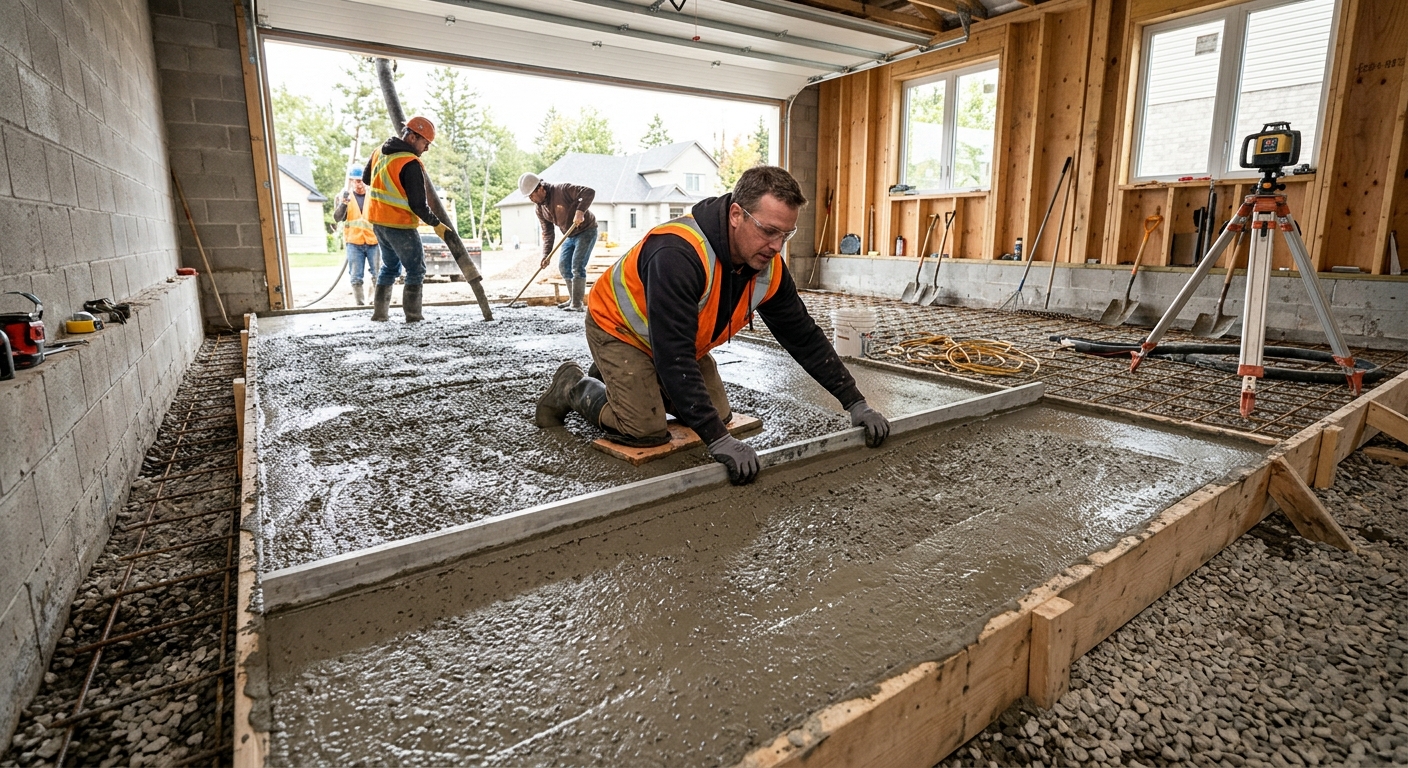
Concrete work options and costs in Eglinton East
Concrete work in Eglinton East is a practical, long-term investment for homeowners, especially where older housing stock and frequent freeze–thaw make durability a real concern. With a population of 22,776 in the broader area (Statistics Canada, 2021 Census), the Toronto market has steady demand for concrete flatwork like driveways, patios and walkways—work that often ties directly into single-detached home renovations and backyard upgrades. In the Eglinton East corridor (think Scarborough-facing lots and the Lesmill/Valleyfield-area approach), contractors see consistent year-over-year scheduling pressure for exterior pours because summer access and curing windows are limited.
In the Toronto economic region, your concrete quote is shaped less by “which contractor is cheaper” and more by frost depth requirements, base preparation, and the freeze–thaw cycles that drive cracking and spalling risk. Most structural footings must extend at least 1.2 m (about 4 ft) below grade to reduce frost heave and differential movement. For exterior slabs and driveways, crews typically use air-entrained concrete and planned control joints to manage expansion and contraction each winter. Local labour and truck scheduling also affect costs—especially when the site is tight (on-street parking restrictions, long driveway approaches, or limited crane access).
Below are typical options and realistic budget ranges for Eglinton East, so you can compare apples to apples before the contractor measures your form size and soil conditions. Use these bands as a starting point, then confirm details like footing depth, rebar coverage, and finish type in the scope.
| Application |
Typical Size |
Key Spec |
Finish Option |
Price Range |
| Concrete driveway (standard broom finish) |
400–500 sq. ft. |
Air-entrained mix, compacted granular base, control joints |
Broom finish |
$18,000–$28,000 |
| Exposed aggregate driveway |
400–500 sq. ft. |
Air-entrained mix, proper curing and surface cleaning |
Exposed aggregate finish (light sandblasting/etch) |
$24,000–$34,000 |
| Stamped concrete driveway or patio |
300–450 sq. ft. |
Air-entrained mix, integral colour, release agent |
Stamped pattern (ashlar/flagstone/brick) |
$24,000–$40,000 |
| Plain concrete patio or walkway |
200–350 sq. ft. |
Compacted base, jointing plan, drainage slope |
Broom or smooth-trowel edge |
$3,200–$9,000 |
| Garage floor (interior slab) |
350–450 sq. ft. |
Vapour control strategy as needed, minimum thickness and reinforcement |
Float/smooth finish with hardener (optional) |
$6,300–$12,500 |
| Foundation footings (structural, below frost) |
Per linear foot (varies by design) |
Structural concrete, rebar, excavation to design depth |
Formed concrete (typically no decorative finish) |
$180–$300 |
Prices are estimates only and vary by project scope, site access and material selection.
What affects the price of concrete work in Eglinton East
If you’re getting quotes for the “same” concrete job in Toronto and Ontario, it’s common to see swings of 30–50% once you account for real-site variables. Eglinton East homeowners often compare a driveway or patio price that looks similar on paper, but the differences are usually in footing depth/form height, base preparation depth, reinforcement, mix design, and how the contractor protects concrete during curing when temperatures drop toward 10 °C or below. In practice, two contractors can price different specs and still describe the project in general terms—so always demand a line-by-line scope.
Here are the biggest drivers tied directly to Ontario’s freeze–thaw behaviour. Frost-depth requirements dictate every footing detail: for structural work, footings generally extend at least 1.2 m below grade to prevent frost heave and movement. Exterior slabs (driveways, patios, walkways) also need air-entrained concrete to survive repeated freezing cycles, along with adequate thickness and properly spaced control joints. When cold nights arrive earlier than expected, contractors may need cold-weather curing precautions—like insulating blankets, temperature monitoring, or temporary heating—to keep strength development on track. Finally, de-icing salt accelerates surface wear and can contribute to spalling on inadequately designed mixes; sealing becomes a cost-effective safeguard if it’s specified at the right time.
In Eglinton East, cost can rise when soil is saturated and requires deeper excavation and additional granular base to reach stable bearing. It can also rise if your driveway approach needs higher forms and more rebar because of slope or existing drainage. Conversely, a straightforward, level backyard patio with good access may land closer to the lower end of the $16–$26 per sq. ft. patio/walkway band, while upgrading a broom-finish driveway to stamped work is where the $24–$40 stamped/decorative band becomes justified—mostly because of labour-intensive finishing and added materials.
| Price Factor |
Why It Matters |
Cost Impact |
| Frost line depth |
Determines footing depth and form height |
Higher depth increases excavation, concrete volume, and labour |
| Site preparation |
Excavation, grading, compacted granular base |
Unstable soils and over-excavation can add significant hours and materials |
| Reinforcement |
Rebar or wire mesh requirement |
Steel adds cost, and correct placement increases labour |
| Mix design |
Air-entrainment and compressive strength spec |
Proper freeze–thaw performance can add per-yard cost but reduces failure risk |
| Finish type |
Broom vs. stamped vs. exposed aggregate |
Decorative finishes add labour, tools, and surface treatments |
| Pour size and concrete truck access to site |
Sequencing, pumping/placement and traffic constraints |
Small access problems can trigger pump fees or additional labour |
| Cold-weather curing precautions |
Heating and blankets |
When nights are cool, protection and monitoring add direct costs |
| Control joint pattern and sealing cost |
Jointing controls cracking; sealing repels salts and water |
Better jointing and sealing add line items but protect against early deterioration |
Permits & regulations in Ontario
In Ontario, many concrete projects require oversight beyond “just pouring.” Structural concrete work—such as foundation footings, foundation walls, grade beams, and other engineered structural elements—typically needs a building permit, and it’s commonly supported by engineered drawings reviewed by the municipality. Concrete flatwork (a driveway, patio, and walkway) usually does not require a permit unless it affects lot grading, stormwater drainage, impervious surface coverage limits, or the municipal right-of-way. Even if a permit isn’t required for the slab itself, drainage changes can trigger reviews.
For homeowners in Eglinton East, verify key contractor credentials before you sign: confirm the contractor carries liability insurance and WSIB/WCB coverage (or the provincial equivalent coverage status they must have for their workers). Then ask for references on similar-size work (driveways and small slabs are not the same as structural foundation work).
Step-by-step verification checklist: (1) Ask for the company’s Ontario business information and the exact licence/registration they hold for the scope they’re performing. (2) Request a current certificate of insurance showing liability coverage and the property address/correct project name when applicable. (3) Ask for proof of WSIB/WCB coverage and any clearance letter if their administrative process provides one. (4) Cross-check the dates—coverage should be current for the start and duration of your project. (5) Only then compare your quotes, because a properly insured crew often prices risk correctly into the job.
Getting concrete right in Eglinton East's freeze-thaw climate
Concrete failures in Eglinton East are usually predictable: freeze–thaw cycling, water trapped under or on top of slabs, and insufficient air-entrainment or curing conditions. The fix isn’t guesswork—it’s specification. Start with base preparation: build a compacted granular sub-base to the right depth for your soil and drainage so the slab doesn’t sit on saturated, frost-susceptible material. Next, use a mix designed for exterior exposure. For outdoor flatwork, contractors typically target 5–7% air content in the air-entrained mix and specify minimum performance such as 32 MPa compressive strength (the exact spec should match the project and exposure class).
Control joints matter in the Toronto market because random cracking is far less acceptable when concrete repeatedly expands and contracts. Plan joint spacing to encourage cracks where they can be sealed and maintained. Then focus on curing: in a climate where fall and early spring nights can drop quickly, you need at least 7 days of proper curing conditions for strength development. If you pour near cooler weather, protection measures (blankets/heating) may be required. Finally, sealing is a practical add-on when you’re dealing with humid cycles and de-icing salts—apply a penetrating sealer after the concrete has cured (often around 28 days).
Here’s a simple budget example to justify decisions: a plain driveway might budget toward the lower $18–$28 range, while a decorative upgrade (like stamped) moves you into the $24–$40 stamped/decorative band. If the contractor cuts base depth or reduces air-entrainment to “save money,” you can end up paying twice through repairs. Spec the mix and base first; then decide whether decoration is worth it for your curb appeal goals.
| Spec |
Why It Matters in Eglinton East |
What to Ask For |
Impact if Skipped |
| Compacted granular base (depth?) |
Stable support prevents frost-related movement and pumping |
Granular base depth, compaction method, and drainage slope details |
Settlement, rocking, and accelerated cracking |
| Air-entrained concrete mix (target air %?) |
Helps concrete survive freeze–thaw cycles in GTA winters |
Air content target (typically 5–7% for exterior flatwork) on the mix ticket/spec |
Spalling and surface scaling in winter seasons |
| Compressive strength (MPa rating) |
Controls long-term durability and load capacity |
Minimum MPa rating (commonly 32 MPa for exterior flatwork unless engineered otherwise) |
Reduced strength gain and higher risk of premature deterioration |
| Control joints (spacing per ACI guidelines) |
Limits uncontrolled cracking from shrinkage and temperature changes |
Joint spacing, saw-cut timing, and joint depth plan |
Random cracks that are harder to seal and maintain |
| Minimum 7-day curing period |
Strength development is slower when temperatures dip |
Curing plan, temperature protection if needed, and who monitors conditions |
Weak surface, increased cracking, and lower durability |
| Penetrating sealer (when applied after cure) |
Helps repel water and reduce de-icing salt impact |
When sealing is applied (often after 28 days) and sealer type/coverage |
More water ingress and surface wear during repeated winters |
How to choose a concrete work contractor in Eglinton East
Choosing the right concrete contractor in Eglinton East starts with verification, not just price. In Ontario, ask for proof of liability insurance and WSIB/WCB coverage and check that the certificates are current for your project dates. You should also confirm the contractor is authorized for the work they’re doing and can provide documentation on request. Where relevant, request clearance details (or the paperwork they provide to demonstrate current coverage) before excavation begins.
Next, get 2–3 itemised written quotes. You want a breakdown showing concrete quantity estimates, granular base scope, excavation depth assumptions, reinforcement (rebar or mesh) and placement method, forming details, finish labour (broom vs. stamped vs. exposed aggregate), joints and sealing, and concrete truck/pump access. Avoid “lump sum only” quotes that don’t say whether disposal is included or whether backfill and grading tie-in work is part of the scope.
Warranty is another differentiator: ask how long the workmanship warranty lasts, whether it’s tied to specific defects (like spalling or excessive cracking) and whether it’s backed by the installer or transferable if you sell. For payment, a healthy approach is limiting upfront deposits to about 10–15% and using holdback until the work is completed and inspected.
Finally, timelines should be in writing: start date, concrete pour date window, expected curing/protection period, and completion estimate. In the GTA, schedules can shift when temperatures fall, so make sure the quote includes how they handle cold-weather curing precautions if the forecast turns.
- Confirm liability insurance coverage amount and expiry date.
- Verify WSIB/WCB coverage (or equivalent coverage status) for the contractor’s workforce.
- Ask for a detailed scope: excavation, base depth, compacted granular type, and drainage slope.
- Require mix specs: air-entrainment and minimum compressive strength rating.
- Confirm reinforcement: rebar/mesh type, size, spacing, and placement height.
- Get the joint plan: location, spacing, and saw-cut timing.
- Ask whether control joints and edges are sealed (and when).
- Clarify cold-weather curing: blankets/heating/temperature monitoring—what’s included?
- Request a line item for sealing if your slab is exterior.
- Ensure disposal/haul-away is included if there’s spoil or old concrete removal.
- Review warranty terms in writing (workmanship length and exclusions).
- Use a payment schedule with holdback until finish and cleanup are complete.
Red flags in Eglinton East: quoting exterior work without mentioning air-entrained mix for freeze–thaw; refusing to show mix tickets or joint spacing; proposing a payment structure that asks for most money upfront; skipping base depth/compaction details; and vague scopes that don’t state whether sealing, saw-cut timing, or disposal are included.
Frequently asked questions — concrete work in Eglinton East
Concrete vs pavers for a patio in Eglinton East?
In Eglinton East, both concrete and pavers can work well, but they fail differently under Toronto’s freeze–thaw. Concrete is typically best when you want a smooth, monolithic surface with control joints and a straightforward sealing plan. Pavers can be attractive for design flexibility and easier spot repairs, but the base still has to be built correctly—if drainage and compaction are off, you can get shifting and weed growth over time. Pricing depends on finish choices: a plain concrete patio often falls within the $16–$26 per sq. ft. band, while decorative options can move higher. If you’re comparing budgets, ask for the base build-up, joint plan (for concrete), and the bedding/sand layer and edging specs (for pavers). (Statistics Canada, 2021 Census)
How long does a concrete driveway last?
With correct specs, a concrete driveway in Eglinton East can last decades. The key is not just thickness—it’s the foundation under the slab, air-entrained mix for freeze–thaw survival, and a joint/sealing maintenance plan. If the contractor uses the wrong mix (or insufficient air) or doesn’t compact granular base properly, spalling and surface scaling can appear much earlier, especially where de-icing salt is used. A “standard” driveway price often sits within the $18–$28 range; spending closer to the middle usually buys better mix design, reinforcement/placement, and protection/cure. For the longest service life, ask for control joint timing and whether a penetrating sealer is included after cure (commonly around 28 days). That’s where the durability value is usually built in Ontario’s climate.
What is air-entrained concrete and why does it matter here?
Air-entrained concrete is designed with tiny, evenly distributed air bubbles that give freezing water room to expand, reducing internal damage. In Eglinton East, Ontario’s repeated freeze–thaw cycles and humid wet periods in fall and spring are exactly what can destroy “non-air” concrete over time through scaling and spalling. That’s why GTA contractors often specify an air-entrained mix for exterior slabs, and why your quote should call out the air content target (commonly around 5–7% for exterior flatwork) and the mix performance. If a contractor won’t discuss air content and curing conditions, treat it as a technical risk. The extra cost of correct mix design is usually small compared to the price of redoing a driveway or patio—so it’s one of the most important questions to ask before you sign.
How do I prepare the base for a concrete slab?
Preparing the base correctly is the foundation of a long-lasting slab in Eglinton East. The contractor should excavate to the right depth for your soil and frost-related movement risk, then place and compact a properly graded granular sub-base in lifts. You want stable bearing—so saturated “soft spots” don’t create voids under the slab. Drainage slope matters too: water must move away from the slab, not pool against edges. Ask for the compacted base depth (not just “we’ll put in gravel”), compaction method, and whether geotextile is used when soils are marginal. If you’re comparing quotes on a patio that might otherwise land around the $16–$26 band, base prep differences are often the real reason one quote is higher. Always make sure the scope includes excavation, grading, and compaction—those details drive performance.
How do I compare concrete quotes?
Comparing quotes in Eglinton East is about scope alignment, not just the total. Ask every contractor to provide an itemised quote showing labour and materials breakdown, including excavation depth assumptions, base material and compaction requirements, reinforcement type/placement, concrete mix specs (air-entrainment and strength rating), and finish details. For decorative work, confirm stamping mats, integral colour options, and what’s included in curing and sealing. Compare whether disposal/haul-away of old material is included, and whether permits are required for your specific scope (structural footings typically are, while standard patios/driveways often aren’t unless grading/drainage triggers review). If one contractor references cold-weather curing precautions while another doesn’t, that difference can explain a meaningful price gap. Use the local bands as a reality check—e.g., plain patios often align with $16–$26 per sq. ft., and stamped work typically sits higher within the $24–$40 band.
Can concrete be poured in cold weather in Eglinton East?
Concrete can be poured in cold weather in Eglinton East, but it must be done correctly. The Toronto region often sees late-season or early-season cold snaps where overnight temperatures drop toward 10 °C or lower. Without protection, curing can slow down and freeze at the wrong time, reducing strength gain and durability. A qualified contractor should include a cold-weather curing plan—temperature monitoring, insulated blankets, wind protection, and sometimes temporary heating—so the concrete reaches required strength under safe conditions. Ask what temperature triggers their protection measures, how long they keep protection in place, and whether they use admixtures (where permitted) for the planned exposure. If the quote doesn’t mention cold-weather steps, assume the risk is on you. It’s usually better to schedule when crews can cure properly, unless the contractor can demonstrate a robust cold-weather procedure.