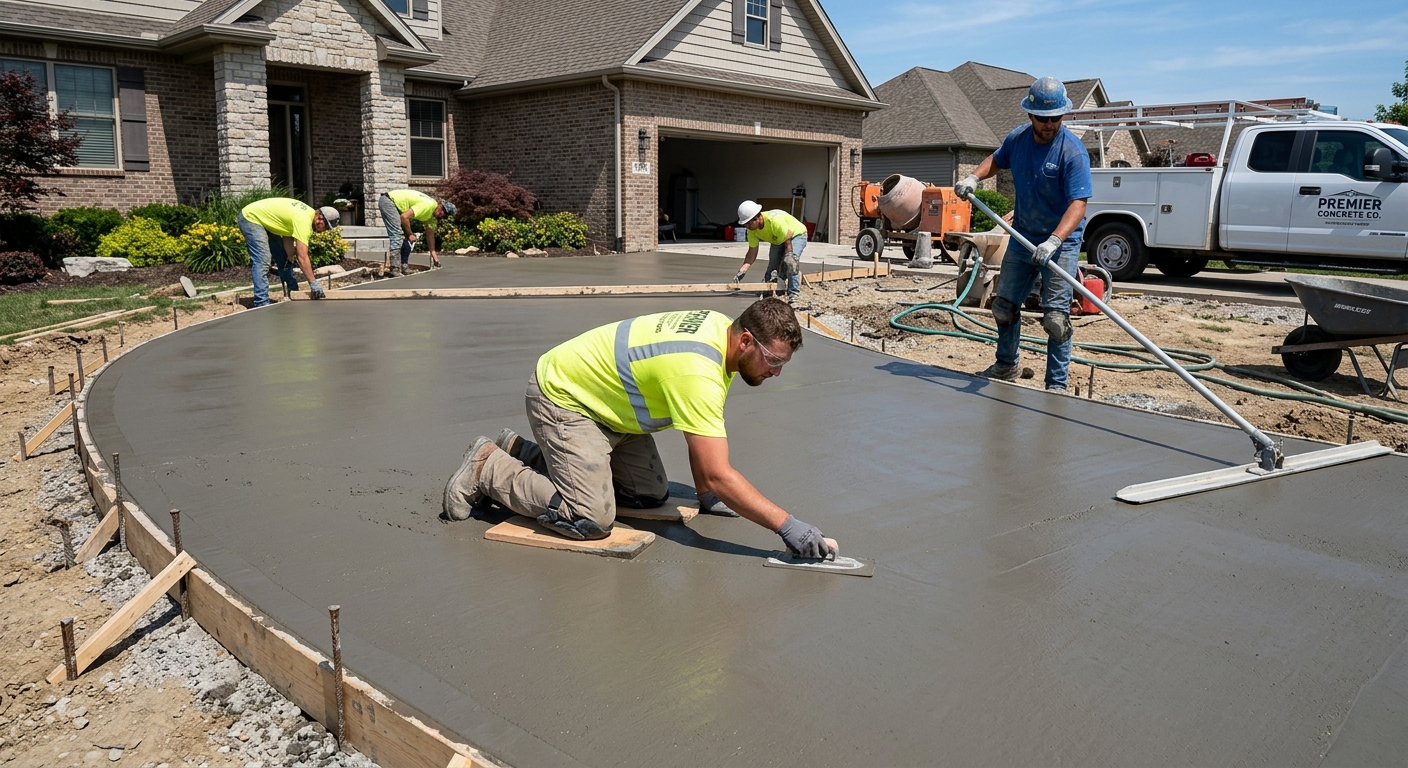
Concrete work options and costs in Ajax
Concrete work in Ajax is busiest around the older established pockets where homeowners are updating driveways, walkways and patios on single-detached properties. In Ajax, single-detached houses make up 64.7% of dwellings (Statistics Canada, 2021 Census), and that housing mix is a big reason concrete flatwork demand stays strong. Ajax also has a meaningful share of homes built before 1981, so many projects involve removal of older slabs and reworking drainage to stop water from sitting under concrete (Statistics Canada, 2021 Census).
In the Toronto economic region, pricing is heavily shaped by frost depth requirements and the region’s freeze–thaw cycles. Structural footings generally need to extend at least 1.2 m (about 4 ft) below grade to reduce frost heave and differential movement, and that affects excavation and formwork. For exterior flatwork, contractors typically specify air-entrained concrete, adequate thickness, and a controlled joint layout to manage winter cracking and surface wear. The trade also concentrates exterior pours in warmer months to protect curing quality when temperatures drop toward 10 °C or below. If you’re in a neighbourhood like Central Ajax, it’s especially common to see driveway replacements timed for spring and early summer.
Below are common options homeowners compare when they’re getting quotes—use these ranges as a starting point before you narrow the scope.
| Application |
Typical Size |
Key Spec |
Finish Option |
Price Range |
| Concrete driveway (standard broom finish) |
10 ft x 20 ft (200 sq ft) |
Air-entrained mix, compacted granular base, control joints |
Broom finish |
$3,600 – $5,600 |
| Exposed aggregate driveway |
10 ft x 20 ft (200 sq ft) |
Air-entrained mix, polished/washed exposure process |
Exposed aggregate finish |
$4,200 – $6,800 |
| Stamped concrete driveway or patio |
12 ft x 18 ft (216 sq ft) |
Air-entrained mix, integral color, proper release + sealing |
Stamped patterns with sealer |
$5,200 – $8,600 |
| Plain concrete patio or walkway |
10 ft x 12 ft (120 sq ft) |
Air-entrained mix, compacted base, edge forms |
Broom or smooth trowel |
$1,900 – $3,100 |
| Garage floor (interior slab) |
20 ft x 22 ft (440 sq ft) |
Vapour control + reinforced slab where required, proper cure |
Light trowel finish |
$6,600 – $11,000 |
| Foundation footings (structural, below frost) |
Per linear foot (varies by design) |
Engineered excavation, rebar cages, below-grade concrete |
Structural finish (not cosmetic) |
$180 – $300 |
Prices are estimates only and vary by project scope, site access and material selection.
What affects the price of concrete work in Ajax
In Ajax, homeowners often see surprisingly different quotes for the “same” concrete job because concrete costs are driven by site-specific preparation and the durability spec needed for Toronto-area winters. A driveway removal and replacement, for example, can swing by 30–50% when one crew includes proper drainage and a deeper granular base while another focuses only on the pour. Labour rates also vary by contractor capacity and the season—exterior work is typically concentrated when curing conditions are easiest.
Here’s the core reason the GTA prices don’t behave like a simple per-square-foot product: frost depth and freeze–thaw cycles dictate every structural and exterior spec. In Ontario, structural footings must extend below design frost depth to limit frost heave, and all exterior slabs need an air-entrained mix to survive winter expansion and contraction. When temperatures fall toward 10 °C or below, cold-weather curing precautions—such as insulating blankets, heated enclosures for smaller pours, and longer protection—add cost. Finally, de-icing salt accelerates surface spalling, so sealing becomes more than “nice to have” in Ajax’s wet fall and spring conditions.
Two quick examples of how local conditions change the number: (1) If your driveway subgrade is soft or water-prone, base excavation and drainage improvements can add thousands—yet they prevent early settlement that later forces a costly partial re-do. (2) If your soil holds moisture and you want a long-term finish, spending on air-entrained mix and a proper joint pattern can be justified compared with staying at the lowest bid. That’s why a standard broom driveway might land in the $18–$28 per sq ft band, while stamped options often move higher (within the regional $24–$40 decorative range) because of colour, labour and sequencing.
With many homes built before 1981, more projects start with older slabs and drainage that’s no longer ideal, which is a direct cost driver because demolition and grading can’t be skipped.
| Price Factor |
Why It Matters |
Cost Impact |
| Frost line depth — determines footing depth and form height |
Deeper footings reduce frost heave and differential movement |
Higher excavation/formwork; can add significant labour and equipment time |
| Site preparation — excavation, grading, compacted granular base |
Controls settlement and water retention under the slab |
More base thickness and drainage detail increases material and equipment costs |
| Reinforcement — rebar or wire mesh requirement |
Improves crack control for slabs and structural elements |
Rebar cages, chairs, and placement labour add cost, but reduce early failures |
| Mix design — air-entrainment and compressive strength spec |
Air entrainment helps resist freeze–thaw scaling and spalling |
More stringent mix designs raise material costs and require careful batching |
| Finish type — broom vs. stamped vs. exposed aggregate |
Finishes require additional materials, labour and sequencing |
Stamped/exposed finishes typically cost materially more than broom finishes |
| Pour size and concrete truck access to site |
Longer carry distances and limited access slow production |
Extra labour time; possible small-load premiums or pump/placement equipment |
| Cold-weather curing precautions — heating and blankets |
Protects strength gain and surface integrity when temperatures drop |
Blankets/heaters and longer job staging add direct labour and rental expense |
| Control joint pattern and sealing cost |
Joints manage cracking; sealing improves resistance to de-icing salts |
Better joint layout and sealer materials can add a few hundred to over $1,000 depending on area |
Permits & regulations in Ontario
In Ontario, most structural concrete work requires a building permit—especially anything tied to the structural system such as footings, foundation walls, grade beams, and engineered foundation elements. In many cases, engineered drawings must be reviewed as part of permitting. For concrete flatwork like driveways, patios, and walkways, a permit is often not required by default; however, you typically need to confirm with the municipality if the work affects lot grading, stormwater flow, impervious surface coverage limits, or anything near the municipal right-of-way. Before breaking ground, ask the contractor what they will obtain and what you need to approve.
For homeowners in Ajax, verify the contractor first. Step one: check the contractor’s business credentials and whether they carry the proper authorizations for the scope (your contractor should be able to provide documentation). Step two: request liability insurance—you should receive a certificate of insurance with the policy effective dates and coverage limits, and it should list the correct legal entity. Step three: confirm coverage for workers through WSIB/WCB. Finally, ask for references on similar-scale projects in the GTA (driveways and small patio removals are common, but confirm the contractor has done excavation and drainage work too). Do not proceed until you’ve reviewed the paperwork and the written scope.
Getting concrete right in Ajax's freeze-thaw climate
Concrete in Ajax fails most often for predictable reasons: water gets under the slab, freezing pushes and pulls the surface, and repeated expansion drives random cracking and—worst case—spalling when the concrete mix doesn’t have enough air or joints and drainage aren’t managed. To spec the job correctly, start with base preparation: use a compacted granular sub-base to the right depth and profile so the slab sits on stable, well-drained material. Next, insist on a correct mix design—for exterior flatwork, air entrainment is typically targeted in the 5–7% air content range, and concrete should meet a minimum 32 MPa compressive strength spec as a durability baseline.
Cracking is normal; uncontrolled cracking isn’t. Use a control joint pattern with consistent spacing so cracks form where the plan allows. Then protect the pour during curing: plan for minimum 7 days of curing under suitable conditions, and in cooler periods add protection so strength development isn’t compromised. After full cure, apply a penetrating sealer (often after about 28 days) to help repel de-icing salts and reduce moisture ingress.
If you’re comparing options, here’s a practical dollar example: moving from a basic broom finish ($18–$28 per sq ft band) to stamped concrete typically adds cost (often into the $24–$40 decorative range), but it can be justified when you want consistent colour and curb appeal—provided the contractor still uses the same freeze–thaw durability spec (air-entrained mix, joints, drainage). Paying for appearance while compromising on structure is where homeowners get burned.
| Spec |
Why It Matters in Ajax |
What to Ask For |
Impact if Skipped |
| Compacted granular base (depth?) |
Prevents settlement and limits water pumping under the slab during winter cycles |
Ask for granular base thickness, compaction method, and drainage plan |
Uneven settlement, scaling, and early cracking |
| Air-entrained concrete mix (target air %?) |
Improves freeze–thaw durability and reduces surface scaling/spalling risk |
Confirm air-entrainment target of 5–7% for exterior flatwork |
Spalling in Ajax winters and higher maintenance costs |
| Compressive strength (MPa rating) |
Strength gain supports durability and load performance through temperature swings |
Confirm minimum 32 MPa design/verified strength |
Weak concrete, cracking, and reduced life expectancy |
| Control joints (spacing per ACI guidelines) |
Controls where cracks occur as the slab contracts/expands |
Ask for joint spacing plan, depth, and saw-cut timing |
Random cracking and costly early repairs |
| Minimum 7-day curing period |
Ensures proper strength development despite humid spring/fall and temperature swings |
Confirm cure method and protection in cooler weather |
Surface deterioration, dusting, and reduced durability |
| Penetrating sealer (when applied after cure) |
Repels moisture and helps guard against de-icing salt exposure |
Ask for sealer type and application timing (commonly after cure, around 28 days) |
Higher risk of scaling, staining and spalling acceleration |
How to choose a concrete work contractor in Ajax
Choosing the right contractor in Ajax comes down to proof, not promises. Start by verifying Ontario licensing relevant to the work scope, then request a certificate of liability insurance and confirm it’s active for the project dates. Next, ask for evidence of WSIB/WCB coverage for workers—especially important for excavation, demolition and concrete placement crews. A legitimate contractor should hand these documents over quickly and answer questions about how they protect work in freeze–thaw conditions.
Get 2–3 itemised written quotes instead of one lump sum. You want a breakdown that separates demolition/removal, excavation and granular base, reinforcement, concrete supply, finishing, saw-cutting and sealing. Ask whether the quote includes a permit pull (when required for structural work), disposal of concrete, and any required protection during curing. In Ontario, structural permits and engineered review are common for footings and foundation elements—don’t assume they’re covered.
Warranty matters too. Ask for a workmanship warranty length and what it covers (cracking, spalling, settlement) and whether any manufacturer product warranty is included and transferable. For payment, avoid large upfront deposits—many quality crews structure payments with 10–15% maximum at the start, then partial payments tied to completion milestones, and a holdback until final cure and sealing tasks are done. Finally, request a written timeline with a start date and completion estimate. In Ajax, weather windows can shift, so “dependable staging” is part of the value.
- Request insurance COI (liability) and confirm job-site coverage dates.
- Confirm WSIB/WCB coverage for workers before any site work starts.
- Ask for proof of prior similar jobs in the GTA (driveways, patios, or basement footings).
- Get an itemised quote: demo, excavation, base, reinforcement, concrete, finishing, joints, sealing.
- Confirm whether site drainage grading is included (not just “pour and go”).
- Ask for the proposed concrete mix spec: air-entrainment and strength target (e.g., 32 MPa baseline for durability).
- Require a joint plan: where joints will be located and timing of saw cutting.
- Ask how they protect the pour during cooler periods (blankets/heating if needed).
- Clarify whether sealing is included and when it will be applied after cure.
- Confirm disposal: who hauls away concrete and excess materials.
- Review warranty terms in writing, including what triggers repair.
- Use a payment schedule with a holdback until final finishing/sealing and cleanup.
Concrete red flags in Ajax include: quotes that don’t mention air-entrainment or control joints, no clear plan for granular base compaction and drainage, vague timelines that ignore curing protection, “cash-only” arrangements without proper documentation, and warranties that exclude cracking/spalling even when it’s clearly linked to mix, joints, or drainage.
Frequently asked questions — concrete work in Ajax
How do I maintain concrete in Ajax's freeze-thaw climate?
In Ajax and across Ontario’s freeze–thaw cycle, maintenance is mostly about controlling moisture and salt exposure. Keep surface water draining away from the slab by maintaining downspouts and ensuring the slope isn’t reversing toward your driveway or patio. Use sand for traction where possible and avoid flooding the surface after storms—standing water under edges accelerates scaling. If your contractor included a penetrating sealer, refresh it as recommended by the product (often after a couple of seasons for high-salt areas). For routine cleaning, use a non-acid cleaner and rinse thoroughly. If you see hairline cracks, don’t ignore them: properly seal cracks to limit water entry, because trapped water expands when it freezes. If your concrete is older (many Ajax homes are pre-1981), periodic inspection and sealing can help you stretch service life without replacing the slab.
What causes concrete to spall in Ajax winters?
Spalling in Ajax winters usually comes from a combination of moisture entry and insufficient durability in the concrete. The biggest technical cause is often inadequate air-entrainment: without the right air content, freeze–thaw cycles can damage the paste structure, leading to scaling and spalling. Another frequent contributor is poor base preparation or drainage—if water sits beneath or against the slab, freezing pressure and movement break down the surface over time. De-icing salts make it worse by increasing surface deterioration, which is why sealing after cure is important. Finally, skipping or incorrectly installing control joints can create random cracking paths where water penetrates. If your driveway or walkway spalls after only a few winters, it’s a strong sign the mix/joint/drainage spec wasn’t aligned with the Toronto area’s climate.
What is rebar and when is it required in Ontario?
Rebar is steel reinforcement embedded in concrete to improve strength and control cracking under load and movement. In Ontario, the exact “required or not” depends on the engineered design and the type of concrete element—especially for structural work like foundation components and footings, which often require engineered drawings and therefore reinforcement details. For typical residential exterior flatwork, some slabs may use wire mesh or rebar depending on thickness, intended loads (for example, heavy vehicle routes on a driveway), and the contractor’s design approach to crack control. The safe homeowner approach is to ask your contractor to reference the slab thickness and reinforcement plan in the written scope. If the work is part of structural systems, permit/engineering review commonly ties reinforcement requirements to the foundation design. Done properly, reinforcement supports durability alongside the freeze–thaw-ready mix (air-entrainment) that we need in Ajax.
How long does a concrete project take in Ajax?
In Ajax, the timeline depends on the scope and the curing conditions. For typical exterior flatwork replacements, demo and excavation often take 1–3 days, base prep and reinforcement placement another 1–2 days, and then the pour and finishing are usually completed within the same day once materials arrive. Curing is the limiting step for full strength and, for many homeowners, for normal use—concrete typically needs at least 7 days under suitable conditions before you treat it as fully cured. Sealing is commonly applied after full cure (often around 28 days), so some tasks feel “done” earlier but durability work finishes later. If you’re doing stamped concrete or decorative finishes, the process is more sequential, which can add time for colour placement and finishing details. Seasonal weather matters in the GTA: if temperatures drop toward 10 °C or below, crews protect the pour longer. On price, remember: a simple plain patio might be closer to the $16–$26 band, while stamped projects at $24–$40 often take more finishing time as well.
What is a concrete overlay and is it suited to Ajax?
A concrete overlay is a new concrete layer placed over an existing concrete surface (usually after concrete prep like grinding, crack repair, and sometimes bonding agents are used). In Ajax, overlays can be suited when the existing slab is generally stable—meaning it’s not deeply broken, heavily settled, or failing structurally. Overlays are often a cost-effective alternative to full removal and replacement because demolition is avoided. However, overlays are not a fix for problems caused by poor drainage or ongoing subgrade movement; in freeze–thaw climates, water trapped at joints or edges can still undermine the bond and lead to future failure. If your driveway or walkway has multiple spalled areas, standing water, or widespread cracking, removal is often the more durable long-term answer. For homeowners who want a face-lift and the base is sound, an overlay can reduce the immediate disruption—just be sure the contractor explains how they’ll address drainage and moisture, not just “pour a new layer.”
How do I seal concrete to protect it in Ajax?
Sealing in Ajax is about creating a moisture and de-icing salt barrier to reduce scaling and staining. The timing is important: wait until the concrete has cured properly—often around 28 days for the best results—so the sealer can penetrate and bond effectively rather than trapping excess moisture. Use a penetrating sealer designed for exterior concrete, and apply it only when the surface is clean, dry, and free of dust or curing compounds. Ask your contractor what product they use and whether it’s formulated for freeze–thaw exposure and salt resistance typical of Ontario winter maintenance. If you’re choosing between standard and enhanced options, sealing is one reason stamped or decorative jobs can cost more than basic broom finishes; you’re paying for durability steps as well as appearance (for example, driveway projects generally range within the $18–$28 per sq ft band for standard work and higher for decorative work).