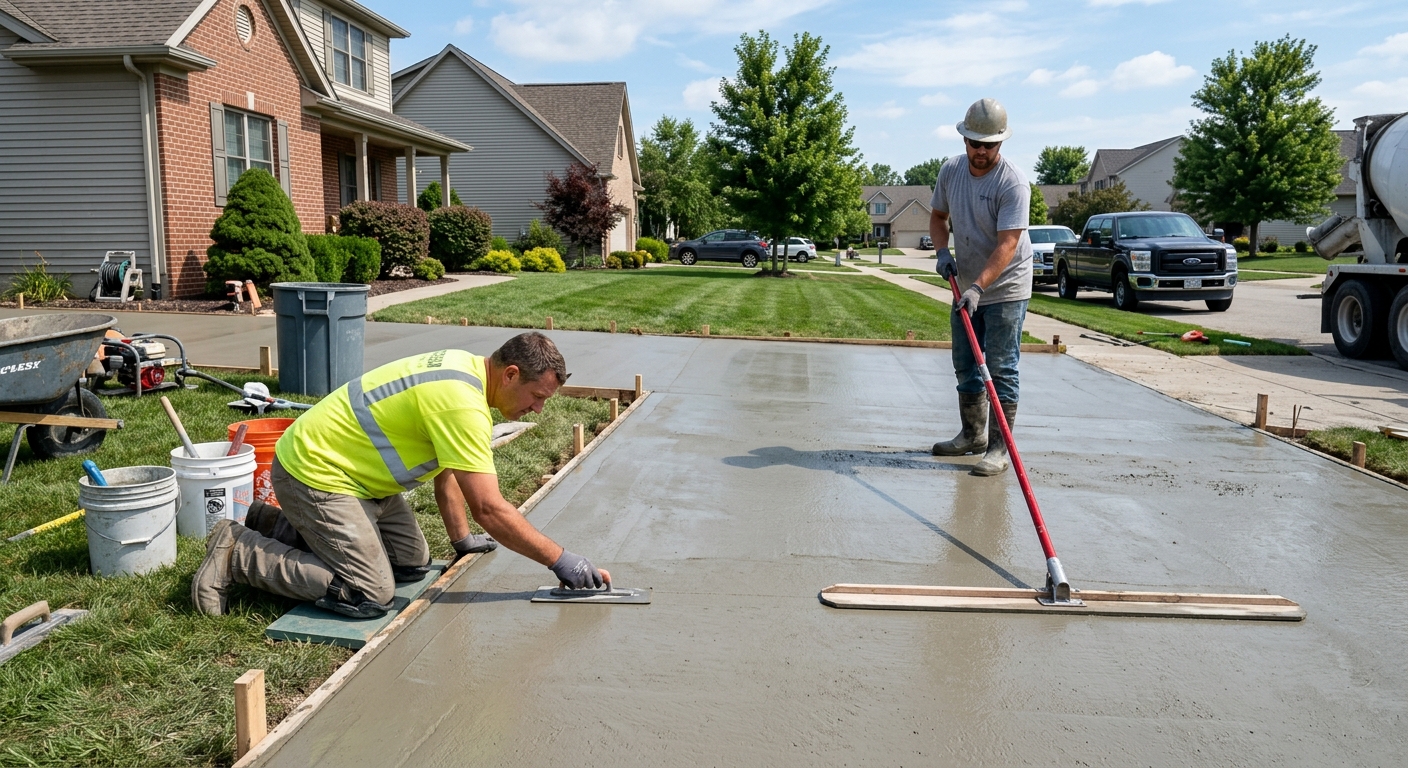
Concrete work options and costs in Idlewood
Idlewood homeowners usually start by comparing driveway and flatwork options, because that’s where you’ll feel the “GTA premium” the most. The community is home to 5,560 residents (Statistics Canada, 2021 Census), and much of the local demand for concrete flatwork comes from the area’s established residential stock—driveways, patios, and walkway replacements are common as properties are updated. In the Toronto economic region, pricing is shaped by frost depth requirements, freeze–thaw cycles, and the practical reality of scheduling crews during the warmer pour season.
In Ontario, exterior concrete is more than just a slab: it’s a system. Contractors typically design footings to extend at least 1.2 m below grade (to help manage frost movement), and for driveways and patios they rely on air-entrained mixes, well-compacted granular base, and control joints to limit cracking. That’s why a “same size” job can vary meaningfully between contractors—one quote may include deeper base prep and a higher-spec mix, while another may not, which shows up later as scaling or spalling.
In Idlewood, trade demand is especially steady around the more established residential pockets where homes are older and landscaping is mature—areas with tight access and more soil disturbance tend to book out faster. If you’re planning work near drive lanes and landscaping beds, expect slightly higher costs for excavation, disposal, and traffic-safe staging.
Below is a practical comparison of common options and realistic price bands for Idlewood, Ontario, before you request an itemised quote.
| Application |
Typical Size |
Key Spec |
Finish Option |
Price Range |
| Concrete driveway (standard broom finish) |
12 ft x 18 ft (216 sq. ft.) |
Air-entrained mix, compacted granular base, control joints |
Broom finish |
$3,888–$6,048 |
| Exposed aggregate driveway |
12 ft x 18 ft (216 sq. ft.) |
Air-entrained mix, surface retard/cleaning, proper base |
Exposed aggregate (water-spray wash) |
$4,320–$7,128 |
| Stamped concrete driveway or patio |
10 ft x 20 ft (200 sq. ft.) |
Air-entrained mix, integral colour or densifier, joints |
Stamped pattern |
$4,800–$8,000 |
| Plain concrete patio or walkway |
10 ft x 16 ft (160 sq. ft.) |
Air-entrained mix, compacted base, edging |
Steel-trowel + light broom/texture |
$2,560–$4,160 |
| Garage floor (interior slab) |
20 ft x 20 ft (400 sq. ft.) |
Vapour barrier, smooth finish, joints if required |
Smooth trowel / burnished finish |
$7,200–$11,200 |
| Foundation footings (structural, below frost) |
Varies by design |
Structural concrete, rebar, excavation, below-frost depth |
Engineered foundation concrete |
$180–$300 |
Prices are estimates only and vary by project scope, site access and material selection.
What affects the price of concrete work in Idlewood
In Idlewood and across the Toronto region, two quotes for the “same” concrete project can differ by about 30–50% once you compare what’s included. The spread usually isn’t the cement—it’s the total scope behind it: excavation depth, granular base thickness, reinforcement, mix design, finishing method, concrete truck logistics, and how crews protect curing surfaces when temperatures slip. Even in the same neighbourhood, different soil conditions and access constraints can force extra labour, disposal, or a thicker build-up to prevent early cracking.
Frost line depth and freeze–thaw cycles drive the biggest technical differences. In Ontario, exterior footings typically extend at least 1.2 m below grade (to manage frost heave), and that requirement influences excavation and formwork height. For exterior slabs, contractors almost always specify air-entrained concrete so the surface can survive repeated freeze–thaw. Toronto’s humid fall and spring also means you can see wet soil conditions that complicate base prep and curing. When conditions dip toward 10 °C or below, cold-weather curing measures (insulating blankets, protection, and longer cure management) can add cost.
Concrete examples that commonly raise costs in Idlewood: (1) a driveway replacement that requires removing older, cracked sub-base down to a stable depth can push you toward the higher end of the $18–$28 per sq. ft. driveway band; (2) a stamped job adds colour/densifier, extra labour for stamping, and more precise finishing, which often aligns with the $24–$40 per sq. ft. decorative band. On the other hand, a simple walkway with good existing grade and easy access may land closer to the lower end of the patio/walkway $16–$26 band.
In practice, older homes and landscaping in established parts of Idlewood often mean more uneven ground, more rerouting of drainage, and higher disposal volumes—so even “straightforward” slabs can land mid-to-upper pricing.
| Price Factor |
Why It Matters |
Cost Impact |
| Frost line depth — determines footing depth and form height |
Helps prevent frost heave and differential movement |
$ — higher excavation and formwork when deeper |
| Site preparation — excavation, grading, compacted granular base |
Bad base prep leads to settlement and early cracking |
$$ — disposal and granular material volumes |
| Reinforcement — rebar or wire mesh requirement |
Controls cracking and supports structural loads |
$$ — material + labour tying/install time |
| Mix design — air-entrainment and compressive strength spec |
Air entrainment reduces freeze–thaw spalling risk |
$–$$ — small material change, big durability effect |
| Finish type — broom vs. stamped vs. exposed aggregate |
Finishes require different crews, tools, and extra steps |
$$–$$$ — labour and materials increase |
| Pour size and concrete truck access to site |
Access impacts pumping, labour, and schedule coordination |
$–$$$ — tighter sites can add hours or pumping |
| Cold-weather curing precautions — heating and blankets |
Protects strength gain when temperatures drop |
$$ — temporary protection materials and labour |
| Control joint pattern and sealing cost |
Joints manage shrinkage cracks; sealing helps repell de-icing salts |
$–$$ — materials + a separate sealing visit |
Permits & regulations in Ontario
In Ontario, structural concrete work—think footings, foundation walls, and grade beams—typically requires a building permit, and engineered drawings are often reviewed by the municipality as part of the foundation permit process. Concrete flatwork like patios, walkways, and driveways usually does not require a permit by default, unless it affects lot grading, impacts municipal drainage plans, triggers impervious surface coverage constraints, or involves work near the municipal right-of-way. Because rules can vary based on the exact site conditions, always confirm with the local authority before breaking ground in Idlewood.
Before you hire anyone, verify coverage and professionalism. Start by confirming the contractor carries liability insurance and is registered for WSIB/WCB coverage (or the appropriate exemption/coverage if they qualify—ask for documentation either way). Then request references for similar-scale projects—particularly exterior work where air-entrained mixes and proper base prep are non-negotiable.
Step-by-step for Idlewood homeowners: (1) Ask for the contractor’s business details and licence information where applicable; (2) request a current certificate of insurance (showing liability limits) and confirm the effective dates; (3) ask for their WSIB clearance letter or proof of coverage status; (4) compare the written scope—permit pull responsibility, inspection scheduling, and whether engineering requirements are included; and (5) document everything in writing.
If a contractor can’t provide insurance/coverage documentation or tries to steer you away from written scope details, that’s a red flag—especially for foundation work.
Getting concrete right in Idlewood's freeze-thaw climate
Concrete failures in Idlewood are rarely “mystery concrete issues.” Most come from one of five things: insufficient base preparation, lack of air-entrainment, weak or non-appropriate mix design, poor control joint placement, or curing/sealing shortcuts. The Toronto region’s freeze–thaw cycles stress the concrete surface every winter; if water gets into pores and the mix isn’t properly air-entrained, freeze pressure can cause scaling and spalling.
To spec the job correctly, focus on five steps. (1) Base preparation: use a compacted granular sub-base to the design depth for the local soil and to provide a stable bearing layer. (2) Mix design: for exterior flatwork, target air entrainment in the range of 5–7% air and specify minimum 32 MPa compressive strength (as supplied and placed under your project specs). (3) Control joints: plan the joint layout and spacing to limit random cracking, and ensure joints are cut/sealed as required. (4) Curing: protect the slab so it reaches strength; plan for at least 7 days of proper curing conditions, with additional precautions if weather drops in shoulder seasons. (5) Sealing: apply a penetrating sealer about 28 days after the pour to repel de-icing salts and reduce moisture ingress.
When homeowners ask whether sealing is “worth it,” a simple way to think about it: a driveway replacement often sits in the $18–$28 per sq. ft. range. Choosing the correct air-entrained mix and doing sealing properly can cost less than replacing a prematurely scaling surface, especially in a region where winter de-icing is routine.
If you’re comparing stamped vs. broom-finish, remember that decorative finishes still require the same durability fundamentals. In other words: good-looking concrete that fails early is the most expensive outcome.
| Spec |
Why It Matters in Idlewood |
What to Ask For |
Impact if Skipped |
| Compacted granular base (depth?) |
Stable support prevents settlement and reduces cracking after freeze–thaw |
Base depth by drawing/spec; compaction testing method if available |
Uneven sinking, early cracking, water pooling |
| Air-entrained concrete mix (target air %?) |
Air voids reduce freeze–thaw spalling risk |
State air content target of 5–7% for exterior flatwork |
Scaling/spalling within a few winters |
| Compressive strength (MPa rating) |
Strength gain supports load capacity and surface durability |
Minimum 32 MPa rating (as specified) |
Surface wear, spalling, reduced long-term performance |
| Control joints (spacing per ACI guidelines) |
Controls shrinkage cracking to predictable locations |
Joint layout and spacing plan; sealing plan for joints |
Random cracking, harder water infiltration paths |
| Minimum 7-day curing period |
Ensures proper strength development under Idlewood weather swings |
Protection plan; what happens if temps drop toward 10 °C or below |
Reduced strength, surface defects and higher deterioration risk |
| Penetrating sealer (when applied after cure) |
Reduces moisture and salt penetration |
Confirm application at about 28 days post-pour |
Faster salt damage and surface erosion/spalling |
How to choose a concrete work contractor in Idlewood
Choosing a concrete contractor in Idlewood is mostly about verifying basics before you compare aesthetics. Start with Ontario coverage and compliance: ask for their liability insurance certificate (with current effective dates and limits), and request proof of WSIB/WCB coverage status. Then confirm the contractor can show documentation for their concrete crews and sub-trades where applicable. A legitimate contractor should respond quickly with paperwork and a clear scope, not vague promises.
Next, get 2–3 itemised written quotes. You want a breakdown that separates labour and materials and clearly states what’s included: excavation and haul/disposal, granular base depth and compaction assumptions, reinforcement type, concrete mix specifics (including air-entrainment and strength), finishing method, and whether sealing is included. Ask if the permit process is included for structural work, and who is responsible for pulling permits and scheduling inspections.
Warranty matters, too. Ask for the workmanship warranty length and whether it includes the risk of surface defects from early freezing or curing issues (especially important in GTA shoulder seasons). Clarify whether the manufacturer’s product warranty (for sealers, admixtures, or finishing systems) is transferable.
On payment schedule, avoid big upfront amounts: keep deposits around 10–15% and use a holdback until the job is fully complete and any required cure/sealing steps are done. Finally, insist on a written timeline with a start date window and completion estimate so the crew isn’t pushed into cold-weather conditions without protection.
- Ask for insurance certificate and confirm liability limits before signing.
- Request WSIB/WCB clearance or proof of coverage status in writing.
- Verify the quote lists mix design details (air content and strength).
- Confirm granular base thickness and compaction approach.
- Check whether reinforcement (mesh/rebar) is included where needed.
- Ask about joint layout and whether joints are cut and sealed appropriately.
- Confirm curing protection plan for nights near 10 °C or below.
- Verify disposal/haul is included or clearly excluded.
- Confirm concrete truck access and whether pumping/placement allowances are included.
- Get a clear description of edging, drainage details, and slope.
- Ask if sealing (penetrating sealer) is included and the expected timing (about 28 days).
- Request references or photos from similar Idlewood-era exterior projects.
Concrete red flags in Idlewood: (1) quotes that don’t mention air-entrained mix for exterior flatwork; (2) no written plan for base prep depth and compaction; (3) vague timelines that ignore curing protection when temperatures drop; (4) refusal to provide insurance/WSIB documentation; and (5) payment schedules requesting large upfront deposits with no holdback until cure/sealing steps are complete.
Frequently asked questions — concrete work in Idlewood
How long does a concrete driveway last?
In Idlewood and across the Toronto region, a well-built concrete driveway commonly lasts 25 to 40 years, but “lifetime” depends on the details. Exterior slabs are exposed to freeze–thaw cycles and de-icing salts, so air-entrainment and good drainage matter as much as thickness. A properly compacted granular base helps prevent settlement, and control joints manage shrinkage cracking. If the contractor also seals the driveway after curing (typically around 28 days), the surface tends to resist moisture and salt penetration better. If you’re budgeting, a standard driveway often lands in the $3,888–$6,048 range for typical sizes, and skipping durability specs to chase the low end is usually what shortens service life.
What is air-entrained concrete and why does it matter here?
Air-entrained concrete is mixed with tiny, uniformly distributed air bubbles that give freezing water a place to expand. In Ontario’s freeze–thaw climate, that directly reduces the risk of surface scaling and spalling, especially for exterior slabs like driveways, walkways, and patios in Idlewood. Without air entrainment, water absorbed into the concrete can expand during freeze events and break off the surface over a few winters. This is why reputable GTA contractors explicitly specify air-entrained mixes for exterior flatwork and plan curing protection when temperatures approach 10 °C or below. When you compare quotes, look for a stated air target (often in the 5–7% range for exterior flatwork) and not just a vague “concrete is included.”
How do I prepare the base for a concrete slab?
Base prep is where most problems start, so in Idlewood you should expect excavation, grading, and a compacted granular base designed for frost and soil conditions. The granular material needs to be placed in lifts and compacted to the required density; thin or poorly compacted base can allow settlement and cracking after freeze–thaw. Good contractors also manage drainage so water doesn’t sit against or under the slab. Ask your contractor what base depth they’re assuming, what granular material they use, and whether any soil issues (soft spots, landscaping fill, or poor drainage) will trigger extra work. A driveway or walkway quote should reflect this—because the right base approach is what keeps a job in the $16–$28/sq. ft. (patio/walkway vs. driveway) range from turning into early repairs.
How do I compare concrete quotes?
To compare concrete quotes fairly in Ontario, don’t just compare the total price—compare the scope and specs. Ask each contractor to itemise labour and materials and to clearly list excavation/disposal, granular base depth, reinforcement (mesh or rebar), and the concrete mix design (including air-entrainment and minimum strength). Confirm the finish method (broom, exposed aggregate, or stamped) and whether joints and sealing are included. Also ask about scheduling and protection: GTA pours are often concentrated in warmer months, and cold nights require insulation blankets or other cold-weather curing precautions to avoid weak surface strength. Finally, verify what’s excluded: permit pull responsibilities (for structural work), site access/pumping allowances, and whether sealing is included about 28 days after the pour. A stamped driveway typically sits higher in the $24–$40 range, so the quote should justify those added steps.
Can concrete be poured in cold weather in Idlewood?
Yes, concrete can sometimes be poured in cold weather in Idlewood, but it depends on temperature, wind, and the curing plan—not just the forecast day. When temperatures drop toward 10 °C or below, concrete needs protection to maintain proper strength gain. That often means insulation blankets, wind breaks, heated enclosures in some cases, and careful timing so the concrete doesn’t freeze before it reaches sufficient strength. Ontario contractors typically manage this by scheduling exterior work during the warmer pour season and using cold-weather procedures when later pours are unavoidable. If a contractor is offering a low price without discussing curing protection, that’s a concern, because reduced curing conditions can lead to surface defects and durability failures within a few winters. Ask for their specific cold-weather curing steps in writing.
How do I maintain concrete in Idlewood's freeze-thaw climate?
Maintenance in Idlewood is mostly about moisture and salt management. After your slab is fully cured, applying a penetrating sealer (commonly around 28 days post-pour) helps repel de-icing salts and reduces water ingress, which helps limit freeze–thaw damage. Use de-icers carefully—avoid over-salting and consider less aggressive products when possible. Keep water from pooling: check the surrounding grading and ensure downspouts and drainage discharge away from the slab. For minor cracks, sealing or patching early can prevent water from working into the slab. If you want a practical budgeting anchor, most homeowners consider driveway and slab investments in the $18–$28 driveway band; maintaining with sealing and drainage checks can be a fraction of the cost of replacement, and it’s especially important after the first winter cycle.