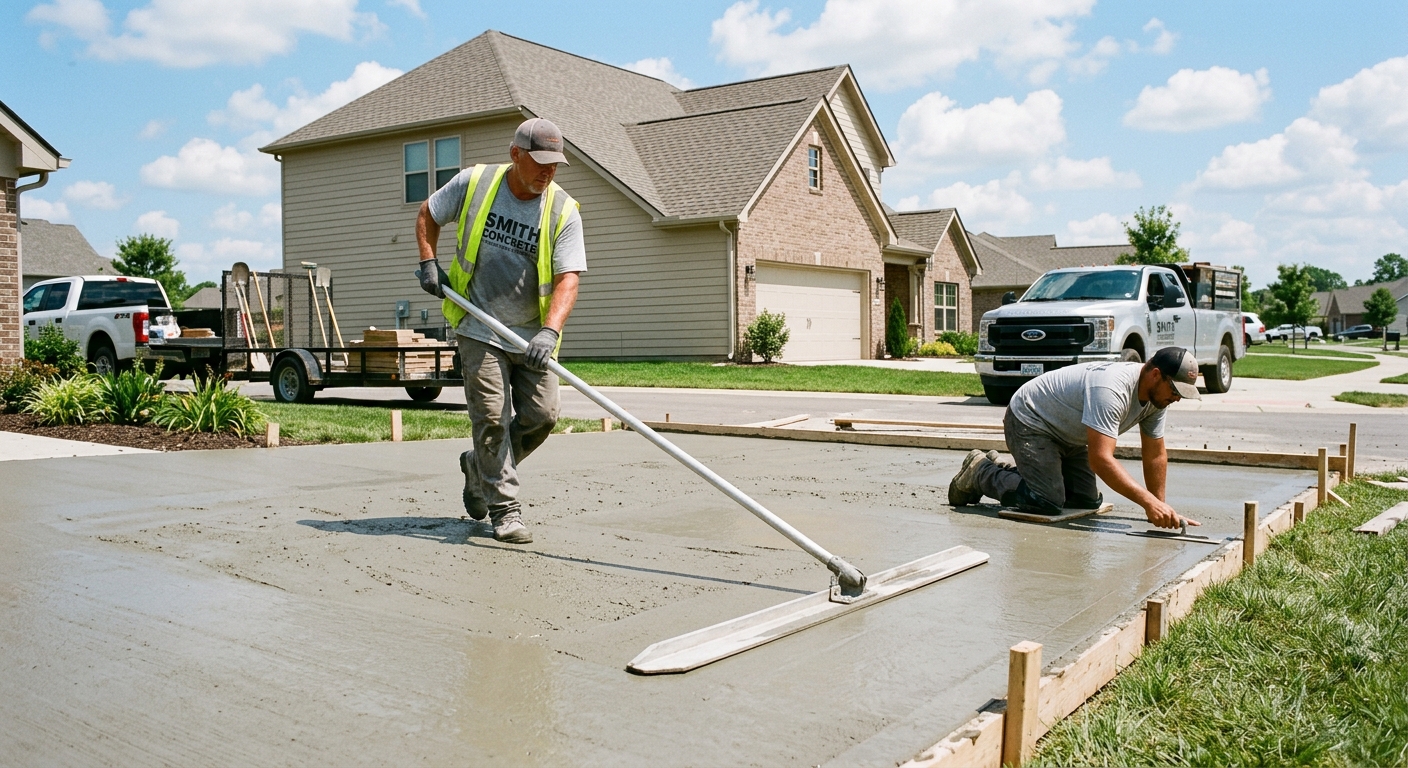
Concrete work options and costs in Prince Edward
Prince Edward, Ontario is a smaller community with steady demand for concrete flatwork like driveways, patios, and walkway slabs—work that’s heavily influenced by the Toronto economic region’s freeze–thaw swings. With a 2021 population of 25,496 (Statistics Canada, 2021 Census), homeowners here tend to invest in durable, low-maintenance surfaces, especially in established neighbourhoods where properties are older and grading drainage details matter. In the broader Toronto area, the trade is busiest where access is tight and homeowners want a clean finish; in Prince Edward this often shows up around the Bayfield/Cherrywood-style cottage-to-residential transition and along main residential corridors where parking and storm runoff are frequent concerns.
Concrete pricing in Prince Edward generally sits close to Toronto-area contractor pricing, but your exact quote can move noticeably because exterior slabs have to survive repeated freezing and thawing. That means deeper structural footings extending below the design frost depth, air-entrained concrete mixes for exterior work, and a well-managed pour and cure window when temperatures dip toward 10 °C or below. Availability and crew scheduling in Ontario’s shorter reliable pour season can also affect costs, especially when multiple customers want the same weeks.
Below are realistic homeowner-friendly ranges for common jobs, using typical local crew-and-material pricing for Prince Edward. Once you pick an option (standard broom, exposed aggregate, stamped, or structural), the next steps usually involve base preparation, reinforcement choices, and joint/sealing planning to reduce cracking and surface wear over time.
| Application |
Typical Size |
Key Spec |
Finish Option |
Price Range |
| Concrete driveway (standard broom finish) |
400 sq. ft. (e.g., 12' x 34') |
4" slab, air-entrained mix, compacted granular base, control joints |
Broom finish |
$7,200 – $11,200 |
| Exposed aggregate driveway |
400 sq. ft. |
Air-entrained mix, proper curing and exposure timing, base prep |
Exposed aggregate |
$9,200 – $14,000 |
| Stamped concrete driveway or patio |
300 sq. ft. (e.g., 15' x 20') |
Air-entrained mix, integral colour, release agent, crack control plan |
Stamped pattern + seal |
$8,500 – $12,500 |
| Plain concrete patio or walkway |
200 sq. ft. (e.g., 10' x 20') |
4" thickness, compacted base, air-entrained mix, joints |
Plain broom or smooth steel |
$3,200 – $5,200 |
| Garage floor (interior slab) |
500 sq. ft. (e.g., 20' x 25') |
4" slab, vapour barrier (if required), fibre or mesh, finished edges |
Light broom / trowel-finish |
$8,200 – $13,000 |
| Foundation footings (structural, below frost) |
Typical home footing system |
Engineered footing dimensions, excavation & below-grade concrete |
Structural concrete |
$3,600 – $7,200 |
Prices are estimates only and vary by project scope, site access and material selection.
What affects the price of concrete work in Prince Edward
In Prince Edward and across the Toronto economic region, the same “simple” concrete job can come back with bids that differ by 30–50%. The usual reason isn’t profit—it’s scope interpretation. Two contractors might both say “driveway,” but one includes full granular excavation and proper drainage, while the other assumes a shallow base. Labour productivity and material procurement can also swing, especially when weather compresses the pour calendar.
Every exterior spec is dictated by frost depth and freeze–thaw cycles. In Ontario, structural footings must extend at least 1.2 m (about 4 ft) below grade to reduce frost heave and differential movement, so formwork and excavation depth directly drive costs. Exterior slabs should be air-entrained to survive repeated freeze–thaw; without it, you’ll often see scaling and surface spalling after winters and de-icing use. Cold-weather curing precautions (heating, insulated blankets, and longer protection) raise costs because crews need more time and materials when temperatures drop toward 10 °C or below. Even surface finishing changes the price: a broom-finish driveway often lands in the lower end, while stamped or exposed aggregate usually pushes you toward the higher ranges (for stamped and decorative concrete, pricing commonly reflects that as $24 – $40 per sq. ft.).
Local conditions in Prince Edward can either add or reduce cost. A driveway replacement on a clay-rich site may require thicker compacted granular base and careful drainage, while a flatter lot with easy truck access can save several hours of labour. If your current slab removal is shallow and disposal is straightforward, you might stay closer to the $18 – $28 per sq. ft. driveway backbone; if access is tight (small gate, steep driveway approach), truck time and extra labour for rebar/mesh and finishing can move the quote upward.
| Price Factor |
Why It Matters | What |
Cost Impact |
| Frost line depth |
Determines footing depth and form height |
More excavation and concrete volume; can add several thousand dollars on structural work |
| Site preparation |
Excavation, grading, compacted granular base |
Hard clay/poor base conditions increase labour and granular supply costs |
| Reinforcement |
Rebar or wire mesh requirement |
Material plus tying/chairs can add cost, especially for larger slabs |
| Mix design |
Air-entrainment and compressive strength spec |
Air-entrained exterior mixes and specified strength can raise per-yard costs |
| Finish type |
Broom vs. stamped vs. exposed aggregate |
Stamped/exposed require more steps and sealing; typically higher finish premium |
| Pour size and concrete truck access to site |
How quickly the slab can be placed and finished |
Tight access can mean extra labour for wheelbarrowing and faster crew mobilization |
| Cold-weather curing precautions |
Heating and insulating blankets |
Adds material and labour; also can extend the schedule and labour days |
| Control joint pattern and sealing cost |
Controls cracking and protects from de-icing salts |
Better joint planning and a proper sealer can add cost but reduce long-term repairs |
Permits & regulations in Ontario
In Ontario, structural concrete work is typically not a “permit-by-default” home project—you’ll usually need a building permit and, in many cases, engineered drawings reviewed by the municipality. Examples of work that generally DOES require a permit include foundation footings, foundation walls, grade beams, and other structural elements that support a building. If you’re underpinning, changing load paths, or altering foundation sizes, expect permitting and inspection.
Concrete flatwork like patios, walkways, and driveways usually does NOT require a permit as a standalone project. However, a permit may be required if your work changes lot grading, affects drainage that impacts neighbouring properties, or touches impervious surface coverage rules. It can also trigger requirements if you’re doing driveway widening or bringing concrete close to municipal right-of-way or drainage infrastructure.
Before the first shovel hits the ground, verify your contractor’s compliance. Start by confirming they carry liability insurance and WSIB coverage (or the applicable coverage status, depending on their setup). Ask for a certificate of insurance showing the jobsite name/address. You can also request a clearance letter/confirmation of WSIB status. Then, for Ontario licencing, confirm the contractor’s registration through the relevant provincial/industry registry access point and ensure it matches the company you’ll pay. Finally, ask for references on similar-scale projects in Ontario—driveway and foundation jobs that include freeze–thaw durability planning are the most relevant. If any contractor won’t provide insurance documentation or won’t clearly separate what is and isn’t included in the scope, that’s a major red flag.
Getting concrete right in Prince Edward's freeze-thaw climate
The big failure mode for concrete in Prince Edward is freeze–thaw damage, often showing up as scaling, spalling, and random cracking—especially if the base is weak or the mix isn’t properly air-entrained. In this part of Ontario, the fix isn’t just “more concrete.” It’s correct base prep, correct mix design, intentional joints, and disciplined curing and sealing timing.
1) Base preparation: use a compacted granular sub-base to the right depth and shape for your soil conditions, with drainage planned so water doesn’t pool under the slab. 2) Mix design: for exterior flatwork, air-entrainment around 5–7% air content is commonly specified to manage freeze–thaw stress, and most durable residential specs target at least 32 MPa compressive strength. 3) Control joints: joints should be cut or installed to limit random cracking; if you skip them or space them too widely, you can get ugly cracks where you least want them. 4) Curing: plan for a minimum 7-day curing period under proper conditions. When cold weather hits (near or below about 10 °C), curing protection and sometimes heating are crucial. 5) Sealing: apply a penetrating sealer after the concrete has cured—commonly about 28 days post-pour—so de-icing salt doesn’t rapidly degrade the surface.
As for value, stamped vs. broom-finish is where you’ll feel the cost difference. If you’re deciding between a standard broom patio in the $16 – $26 per sq. ft. band versus stamped concrete closer to the $24 – $40 per sq. ft. band, the premium is justified when you’re doing it for long-term curb appeal and you can confirm proper air-entrainment, joint layout, and sealing (not just the stamps). If those fundamentals aren’t handled, paying extra for looks won’t protect you from spalling in winter.
| Spec |
Why It Matters in Prince Edward |
What to Ask For |
Impact if Skipped |
| Compacted granular base (depth?) |
Controls settlement and water movement under the slab through freeze–thaw |
Granular depth and compaction testing method for your soil condition |
Premature cracking, uneven surface, and accelerated deterioration |
| Air-entrained concrete mix (target air %?) |
Creates freeze–thaw resistance for exterior exposure |
Air content target of 5–7% for exterior flatwork and documented mix |
Scaling and spalling, especially where salt is used |
| Compressive strength (MPa rating) |
Strength supports wear resistance and overall durability |
Minimum 32 MPa rating specified for the concrete |
Surface wear, brittle behaviour, and early failure in traffic areas |
| Control joints (spacing per ACI guidelines) |
Limits uncontrolled cracking from shrinkage and temperature swings |
Joint spacing plan based on slab dimensions and reinforcement plan |
Random cracks that can admit water and worsen freeze–thaw damage |
| Minimum 7-day curing period |
Ensures hydration and strength gain; critical in shoulder/cold weather |
How curing is protected if temps drop toward 10 °C or below |
Lower strength and higher cracking/roughness risk |
| Penetrating sealer (when applied after cure) |
Repels salt and water intrusion in winter cycles |
Sealer type and timing—commonly around 28 days post-pour |
Faster surface breakdown and increased staining/spalling |
How to choose a concrete work contractor in Prince Edward
Choosing the right contractor in Prince Edward is mostly about verifying the basics before you compare finish samples and pricing. First, verify Ontario licencing for the type of work they’re doing, then confirm liability insurance and WSIB/WCB coverage. In practice, you want to see (a) a certificate of insurance that names the right insured parties and shows coverage suitable for the job, and (b) WSIB clearance documentation or an up-to-date confirmation of coverage status. Don’t accept “we’re covered” verbally—ask for the document and check it matches the company name on the quote.
Next, request 2–3 itemised written quotes. You want a line-by-line breakdown that distinguishes labour, material supply (including air-entrained mix), reinforcement, base preparation and excavation, disposal, and finishing/sealing. A lump-sum quote with vague language like “concrete and finish included” makes disputes more likely. Read the exclusions carefully: is permit handling included, is disposal of existing concrete included, and what’s the plan for drainage at edges?
For warranty, look for two layers: a workmanship warranty for cracking/spalling issues and a product/manufacturer warranty for materials like sealers or admixtures. Ask if the warranty is transferable to future owners. Also be realistic about payments: never pay more than 10–15% upfront, and insist on a holdback until completion and cleanup are done. Finally, get a written timeline with a start date and expected completion window.
- Ask whether the mix is air-entrained for exterior exposure and confirm the target air content.
- Confirm footing depth and frost requirements for any structural work (typically at least 1.2 m below grade in Ontario specs).
- Require itemised base prep scope (excavation, granular depth, compaction method).
- Confirm reinforcement type (mesh vs. rebar) and placement (chairs/spacers) rather than “included.”
- Ask how control joints will be laid out to limit random cracking.
- Get the curing plan for cooler days (blankets/heating if needed).
- Confirm sealing—what product and when it’s applied after cure (often around 28 days).
- Ensure disposal and site restoration are included (haul-away of old concrete and debris).
- Verify truck access route and pour logistics so they don’t cut corners on finishing time.
- Require proof of liability insurance and WSIB/WCB coverage documentation before work begins.
- Ask for at least two recent references from similar projects in Ontario climate conditions.
- Clarify payment schedule, holdback amount, and what triggers final payment.
Concrete red flags in Prince Edward include: quotes that don’t specify air-entrainment for exterior work, vague joint spacing (or no mention of joints), promises to pour without any plan for cold-weather curing around 10 °C or below, missing insurance/WSIB documentation, and payment terms that ask for large upfront deposits with no holdback until completion.
Frequently asked questions — concrete work in Prince Edward
What is the difference between concrete and cement?
Concrete is the full construction mix: cement, water, aggregate (sand and stone), and often admixtures (like air-entrainers for freeze–thaw durability). Cement is one ingredient inside concrete—it’s the powder component that reacts with water to bind everything together. In Ontario’s freeze–thaw climate, what matters to homeowners is the concrete specification (for example, air-entrainment for exterior slabs and adequate compressive strength), not just “what cement brand” someone uses. When you compare quotes in Prince Edward, ask for the actual concrete mix requirements and finishing/cure plan, because that’s what determines whether your driveway or patio will resist scaling after winters.
How much does concrete work cost in Prince Edward?
Costs in Prince Edward typically track the Toronto economic region’s pricing pressures—especially excavation depth, base preparation quality, and exterior freeze–thaw durability specs. For homeowners, a concrete driveway often budgets around $18 – $28 per sq. ft., while patios and walkways commonly fall in the $16 – $26 per sq. ft. band. If you want stamped work, pricing is usually higher, often landing in the $24 – $40 per sq. ft. range because of extra steps and sealing. The big swing factor is how much site prep (and drainage) is required—especially where soils hold moisture and can expand/contract against the slab.
How deep must footings be for Prince Edward's frost line?
For structural concrete in Ontario, footings generally need to extend at least 1.2 m (about 4 ft) below grade to reduce the risk of frost heave and differential movement. Your exact depth should be confirmed through your engineered foundation design and the local application for the property. In the Toronto area, frost protection is a core part of how contractors plan formwork height, excavation and below-grade concrete volume. If a contractor proposes shallower footings to reduce cost, it can create long-term settlement or movement problems when the ground freezes and thaws repeatedly.
Why does concrete crack in Prince Edward and how is it prevented?
Concrete cracks for a few predictable reasons: shrinkage as it cures, temperature movement, and moisture effects from repeated freeze–thaw. In Prince Edward and across Ontario, the freeze–thaw cycle and de-icing salt can also worsen surface damage if air-entrainment and sealing are missing or rushed. The most effective prevention is technical: proper compacted granular base, correct air-entrained mix for exterior exposure, and a planned control joint pattern to limit random cracking. Also, don’t skip curing protection when temperatures drop toward about 10 °C or below—premature finishing or drying can increase cracking risk.
Stamped vs broom-finish concrete — cost difference?
Stamped concrete costs more than broom-finish because it involves extra materials and steps (colour or release system, stamping operations, and finishing/sealing expectations). In the Ontario bands used for Prince Edward estimates, broom-finish driveways commonly sit around $18 – $28 per sq. ft., while stamped and decorative concrete often lands in the $24 – $40 per sq. ft. range. The best way to decide is to compare apples to apples: ensure both options have the same air-entrained exterior mix, comparable thickness, proper base prep, correct joints, and a sealer applied after cure (commonly around 28 days). If someone under-specifies the basics on the cheaper option, the “savings” can disappear in repairs.
When is the best time to pour concrete in Prince Edward?
For durable exterior work in Ontario’s freeze–thaw climate, the best time is typically the warmer months when concrete can cure properly without temperature-related stress. Contractors often concentrate exterior pours in periods when daytime temperatures are safely above the cold-weather threshold and when they can protect the slab during cure. If you must pour later in the season, you need a cold-weather curing plan—heating, insulating blankets, and longer protection—because curing quality directly affects long-term durability. Since Prince Edward sits within the Toronto region’s climate pattern, ask your contractor what their temperature plan is for your scheduled pour day, not just what month they “prefer.”