Concrete work options and costs in Milton
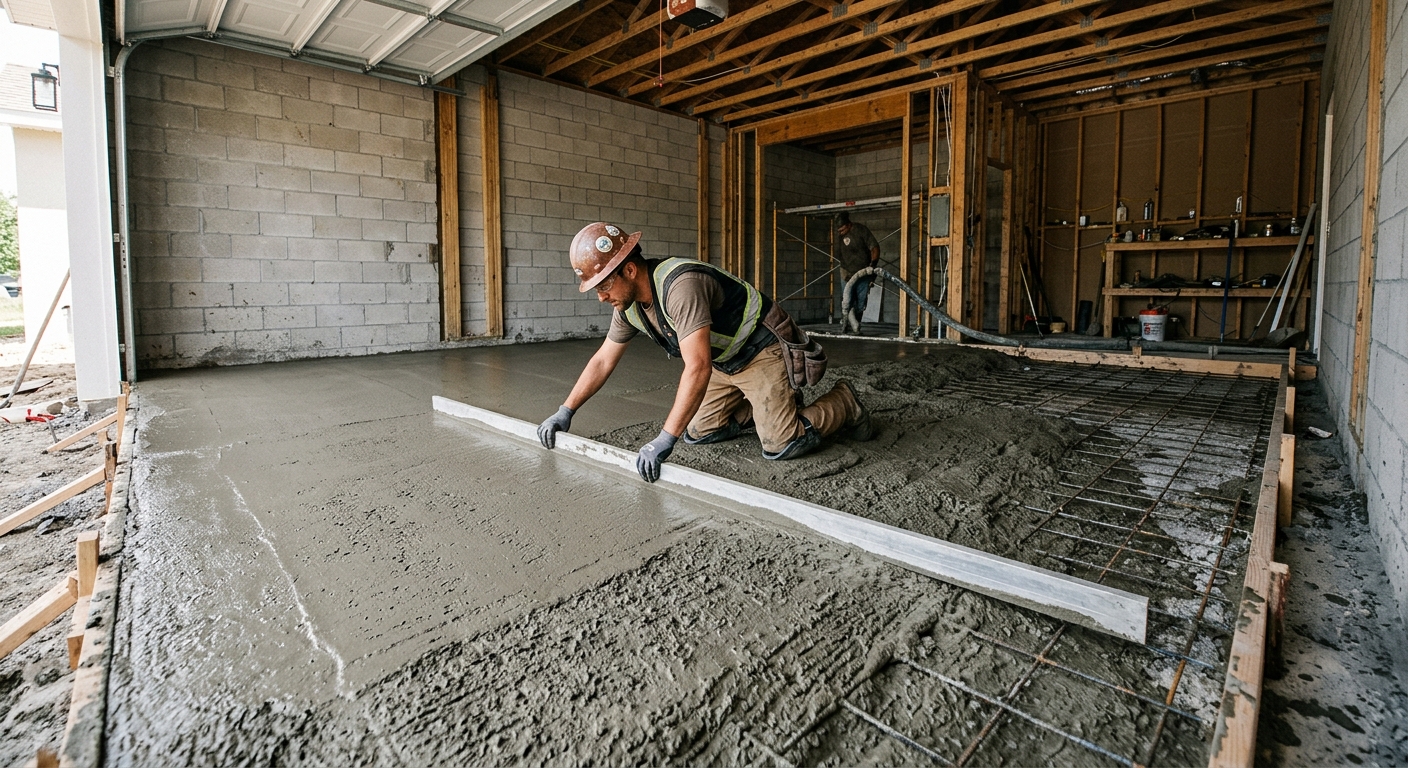
Concrete work in Milton is in high demand because the community’s housing stock is dominated by single-detached homes—56.7% of dwellings are this type (Statistics Canada, 2021 Census). For many homeowners, that translates into regular updates to driveways, patios, walkways, garage slabs, and—on newer builds or renovations—foundation footings. Milton is also a mature market: 18.9% of homes were built before 1981 (Statistics Canada, 2021 Census), and older properties often need concrete repairs where settlement, drainage changes, or aging flatwork have created trip hazards and water issues.
In the Toronto economic region, your quote is shaped by freeze–thaw cycles and frost depth requirements. Exterior flatwork must be built on well-compacted granular base so saturated soils don’t expand and contract against the slab every winter. Structural footings are typically expected to extend at least about 1.2 m (roughly 4 ft) below grade to reduce frost heave risk, and contractors will often plan form height and excavation around that depth.
Weather also affects timing and cost. In Milton, exterior pours are usually concentrated in the warmer months to get reliable curing, and crews have to protect concrete when temperatures drop toward 10 °C or below. That means more planning, longer protective measures, and sometimes different scheduling compared with milder regions.
In neighbourhoods like Hawthorne Village and the Campbellville area where properties frequently have established access routes and mature lots, contractors often see repeat requests for driveway resurfacing, drainage adjustments, and slab replacements. The table below compares common concrete options and typical price ranges so you can benchmark quotes before you get into details.
| Application |
Typical Size |
Key Spec |
Finish Option |
Price Range |
| Concrete driveway (standard broom finish) |
12 ft x 20 ft (240 sq ft) |
Air-entrained mix; compacted granular base; control joints |
Broom finish |
$4,320 – $6,720 |
| Exposed aggregate driveway |
12 ft x 20 ft (240 sq ft) |
Air-entrained mix; proper curing and surface cleaning |
Exposed aggregate (surface retarder) |
$5,760 – $8,640 |
| Stamped concrete driveway or patio |
12 ft x 20 ft (240 sq ft) |
Air-entrained mix; thickness per design; release agent and curing plan |
Stamped patterns (e.g., stone/brick) |
$6,720 – $9,600 |
| Plain concrete patio or walkway |
10 ft x 16 ft (160 sq ft) |
Well-compacted base; adequate drainage; joints where needed |
Float and broom finish |
$2,560 – $4,160 |
| Garage floor (interior slab) |
20 ft x 22 ft (440 sq ft) |
Vapour control/under-slab prep as required; reinforcement as specified |
Light broom finish or trowel finish |
$6,600 – $10,340 |
| Foundation footings (structural, below frost) |
Varies by house; typical lineal length |
Excavation to design frost depth; engineered layout; rebar per drawings |
Structural concrete |
$180 – $300 |
Prices are estimates only and vary by project scope, site access and material selection.
What affects the price of concrete work in Milton
In Milton, it’s common to see price spreads of about 30–50% for the “same” concrete job when you compare bids side by side. The difference usually isn’t the concrete itself—it’s excavation, how the base is built, how reinforcement is handled, how the finish is executed, and what each contractor includes for drainage, disposal, and curing in our freeze–thaw climate.
Every spec is driven by frost depth and freeze–thaw cycles. For structural work, footing depth and excavation matter because frost heave can crack or shift foundation elements. For exterior slabs, contractors typically specify air-entrained concrete so the mix can survive repeated expansion and contraction. Where temperatures dip toward 10 °C or below, crews must manage curing—often with additional protection—so the slab reaches strength properly. De-icing salt in winter also increases the risk of surface scaling and spalling if the mix and finish aren’t planned for durability; sealing is often where value is protected.
Local conditions can raise costs in straightforward ways. For example, a driveway replacement on a slope or in a landscaped yard can require more grading and higher-quality granular base to keep water away from the slab. Older properties (notably the 18.9% built before 1981) may also have buried drainage issues—solving those can be an added line item, but it prevents the “new slab on bad water management” problem. On the other hand, projects on flat lots with easy truck access can lower mobilization and reduce excavation time.
Finish selection matters too. A basic broom-finished driveway may start around $18–$28 per sq ft equivalent in many GTA bids, while decorative options like stamped work can move you into the $24–$40 range once patterns, labour intensity, and extra finishing steps are included. If you’re choosing between a plain patio at roughly $16–$26 and a stamped patio closer to the higher band, the best justification is usually surface appearance plus longevity in high-salt exposure areas.
| Price Factor |
Why It Matters |
Cost Impact |
| Frost line depth |
Determines footing depth and form height |
More excavation increases labour, disposal, and concrete volume |
| Site preparation |
Excavation, grading, compacted granular base |
Better base prep reduces failures but adds materials and machine time |
| Reinforcement |
Rebar or wire mesh requirement |
Material cost plus labour to place and support reinforcement correctly |
| Mix design |
Air-entrainment and compressive strength spec |
Higher-spec mix is more expensive but crucial for freeze–thaw durability |
| Finish type |
Broom vs. stamped vs. exposed aggregate |
Decorative finishes require more labour, tools, and controlled curing steps |
| Pour size and concrete truck access to site |
Influences number of loads and placement method |
Poor access can mean higher labour and possible pump/extra handling |
| Cold-weather curing precautions |
Heating and blankets |
Adds equipment and labour; may shift the schedule in shoulder seasons |
| Control joint pattern and sealing cost |
Manages cracking and protects surfaces from salt ingress |
Proper jointing and sealing are often a small cost compared to repairs |
Permits & regulations in Ontario
In Ontario, whether you need a permit depends on what kind of concrete work you’re doing. Structural concrete work—such as footings, foundation walls, and grade beams—generally requires a building permit and often relies on engineered drawings that municipalities review. Concrete flatwork—like driveways, patios, walkways, and garage slabs—usually does not require a permit unless it affects lot grading, drainage, impervious surface coverage limits, or the municipal right-of-way.
Your best practice in Milton is to confirm requirements before breaking ground. A good way to handle this is to ask the contractor whether they will pull the permit (if required) or verify that you as the homeowner are responsible for it, and to get that responsibility stated in writing.
Also verify the contractor is properly insured and compliant. Here’s a practical step-by-step approach:
- Ask for their liability insurance certificate and confirm the coverage is active for the project dates.
- Confirm they have WSIB/WCB coverage (or the applicable clearance paperwork, depending on contractor status).
- Check the Ontario licence/registration path that applies to their trade activity (and confirm the business name matches the insurance certificate).
- Request a few recent references for similar scope in Milton or the Toronto area and ask to see photos of the base prep and joints.
- Make sure the quote indicates who handles disposal, permit items (if any), and site restoration.
Getting concrete right in Milton's freeze-thaw climate
Concrete failures in Milton almost always trace back to water movement and freeze–thaw stress. The slab and joints experience repeated wetting from spring rain and winter melt, then freezing, which expands water in the base or near the surface. When concrete is placed over poorly compacted fill or when the mix lacks adequate air entrainment, you often see cracking, lifting, or—most commonly on exterior flatwork—spalling and scaling caused by freeze pressure and salt exposure.
To spec the job correctly, focus on five technical controls. First, insist on base preparation: compacted granular sub-base to the right depth for the site conditions so water can’t saturate and expand. Second, require an air-entrained mix for exterior work (commonly 5–7% air content) and a minimum 32 MPa compressive strength unless engineered drawings specify more. Third, manage cracking with control joints sized and spaced to limit random shrinkage cracks. Fourth, plan curing: allow at least 7 days under proper conditions, and when temperatures fall toward 10 °C or below, crews should protect the pour so it gains strength reliably. Fifth, use sealing: apply a penetrating sealer about 28 days after the pour so the surface resists chloride and de-icing salt penetration.
Here’s where price is justified. Upgrading from a basic broom driveway to properly finished exposed aggregate or stamped work can add several dollars per sq ft in the GTA. That’s not “just looks” in Milton—it’s also about surface durability and maintaining a tight, controlled curing and finishing process so the finish doesn’t fail early. If a quote only discusses the surface finish but not the base, air entrainment, joints, and curing plan, it’s usually not the best long-term value even if it looks cheaper at the start.
| Spec |
Why It Matters in Milton |
What to Ask For |
Impact if Skipped |
| Compacted granular base (depth?) |
Reduces pumping and frost-related heave under slabs |
“What is the granular base depth and compaction method for my site?” |
Settlement, cracking, and edge lifting |
| Air-entrained concrete mix (target air %?) |
Protects from freeze–thaw damage and spalling |
“Confirm air content target (typically 5–7%) and mix spec for exterior.” |
Scaling/spalling in winter, shorter lifespan |
| Compressive strength (MPa rating) |
Strength development supports durability under freeze cycles |
“Specify minimum 32 MPa (or engineered requirement) and testing/traceability.” |
Weak surface, increased cracking |
| Control joints (spacing per ACI guidelines) |
Controls where shrinkage cracks form |
“What joint spacing and saw-cut schedule will you follow?” |
Random cracking and difficult-to-repair leakage paths |
| Minimum 7-day curing period |
Ensures proper strength gain before stress from weather |
“How will you protect the slab if temperatures drop?” |
Surface weakness and reduced long-term performance |
| Penetrating sealer (when applied after cure) |
Repels salts and water ingress |
“Will you apply sealer around 28 days post-pour, and what product?” |
Faster scaling and spalling on salted exterior surfaces |
How to choose a concrete work contractor in Milton
Start by verifying contractor credentials the way you would for any major build. In Ontario, you want a contractor who can clearly document liability insurance and WSIB/WCB coverage, and who operates under the appropriate Ontario trade/licensing pathway for the type of concrete work they do. The simplest checks are: (1) request a current insurance certificate and confirm coverage dates align with your schedule; (2) ask for WSIB/WCB clearance paperwork or equivalent documentation; and (3) confirm the business name and address match across the quote, insurance, and any registration references.
For pricing, don’t accept a single “lump sum” number without detail. Get 2–3 itemised written quotes with a breakdown for labour, concrete supply, excavation/base prep, reinforcement, forms, disposal, finishing, joints, and sealing (if included). A quote that only lists “concrete and labour” rarely covers the real cost drivers in the GTA—especially base prep and curing protections during shoulder-season weather.
Pay attention to exclusions: Is permit pull included where required? Is disposal included for demolition material? What about re-grading, restoration of sod/interlock, and protection of nearby landscaping during the pour and curing window? Ask about warranty too—workmanship warranty length, whether it’s tied to conditions (like sealing), and whether product warranties are transferable to you.
Finally, handle payments carefully. In my experience around Milton, you should not pay more than 10–15% upfront. Use a holdback until completion and final cleanup are confirmed. Get the start date and a realistic completion estimate in writing so you’re not guessing when weather delays happen.
- Ask for 3 recent references for similar Milton exterior flatwork.
- Require a written scope: base depth, thickness, joints, finish, sealing plan.
- Confirm air-entrained mix is specified for any exterior slab.
- Check that control joints and sealing are included (or price them clearly).
- Request proof of liability insurance and confirm dates match your project.
- Confirm WSIB/WCB coverage (or clearance documentation where applicable).
- Make sure excavation, disposal, and trucking access requirements are included.
- Ask how they protect curing when temperatures near 10 °C or below.
- Clarify what happens if the weather window shifts (reschedule fees?).
- Get a labour/materials itemisation, not only a total square-foot price.
- Verify the warranty is in writing and states what it covers and for how long.
- Keep payment staged: small deposit, then progressive payments with holdback.
Red flags in Milton: (1) “We’ll match any cheaper price” without explaining base prep, air content, joints, and curing; (2) quotes that omit disposal or site restoration; (3) no written warranty terms for workmanship; (4) unwillingness to show insurance/WSIB/WCB documentation; and (5) no schedule plan for curing in fall/spring temperatures.
Frequently asked questions — concrete work in Milton
How do I compare concrete quotes?
To compare concrete quotes in Milton fairly, match scope first, then compare price. Ask each contractor for the same details: base depth and compaction method, slab thickness, reinforcement (if applicable), joint placement, and whether the mix is air-entrained for exterior work. Many quotes look close until you notice one includes proper granular base prep and another only mentions “concrete and labour.” Also check what’s included for demolition, disposal, and site restoration. If you’re looking at a plain patio or walkway, typical market pricing often sits in the $16–$26 range; stamped options commonly land closer to $24–$40. Use those bands to sanity-check the numbers, but only after verifying specs—durability depends on the freeze–thaw-ready mix, not just the decorative finish.
Can concrete be poured in cold weather in Milton?
Concrete can be poured in colder weather in Milton, but it must be managed correctly to reach strength before the risk of freezing. As a practical rule, contractors plan around when temperatures drop toward 10 °C or lower and use cold-weather curing precautions—insulating blankets, wind breaks, or controlled heating—so the concrete doesn’t freeze while it’s early-age curing. This is one reason shoulder-season pours can cost more: you’re paying for protection, extra crew time, and sometimes scheduling changes. If you’re offered a “cheap” cold-weather pour with no mention of blankets, curing time extension, or temperature monitoring, that’s a concern—durability can suffer even if the slab looks fine at first. Always ask what curing plan they’ll use and how long they’ll protect the pour.
How do I maintain concrete in Milton's freeze-thaw climate?
Maintenance in Milton is mostly about controlling water and protecting the surface from salt. Start with cleanliness: remove leaves and debris so water doesn’t sit against the slab, especially along driveway edges. Avoid heavy scraping with sharp tools that can chip the surface. For exterior flatwork, sealing is a high-value step—many homeowners plan for a penetrating sealer applied about 28 days after the pour, which helps repel de-icing salts. If you have cracks, keep them clean and repair them early so water doesn’t get under the slab. If you’re comparing future costs, it’s usually cheaper to seal and maintain than to replace a failing panel. Given Milton’s freeze–thaw cycles, skipping sealing is one reason you’ll see premature scaling even on jobs that were initially poured correctly.
What causes concrete to spall in Milton winters?
Spalling in Milton winters is most often linked to freeze–thaw damage combined with de-icing salt. When concrete isn’t properly air-entrained for exterior exposure, water gets trapped in the paste and expands during freezing, stressing the surface and causing flakes or chunks to break away (spalling). Another contributor is poor base preparation or drainage: if the slab sits on saturated soil, freeze forces can increase and promote cracking and moisture movement toward the surface. Also, inadequate curing or rushed finishing can leave the top layer weaker than it should be. If you’re budgeting, don’t treat finish upgrades as the main solution—proper mix design and curing are the fundamentals. That’s why credible exterior bids focus on air content, joints, and curing protection, not just whether the driveway looks broom-finished or stamped.
What is rebar and when is it required in Ontario?
Rebar is steel reinforcement embedded in concrete to improve its tensile strength and control cracking, especially in structural elements and slabs designed to carry loads. In Ontario, whether rebar is required depends on the specific application and engineering requirements: interior garage slabs, driveways, and foundation elements may need reinforcement based on thickness, soil support, and intended loads. Structural work like footings and foundation walls typically follows engineered drawings where reinforcement is specified. For exterior flatwork, many contractors include reinforcement (or use alternatives like wire mesh) when the design calls for it or when slab thickness and loading conditions warrant it. The key is not to guess—ask your contractor to reference the thickness and reinforcement plan in the scope, and confirm that they’re following the applicable design and specifications for your project.
How long does a concrete project take in Milton?
Timelines in Milton depend on the scope (demolition vs. new pour), weather, and curing protection needs. For a typical driveway or patio, the work usually includes demolition (if replacing), excavation and base prep, reinforcement setup (if required), forms, the pour, finishing, and then curing. The “pour day” itself is often only a day, but curing and protective staging extend the schedule—especially when temperatures fall toward 10 °C or below. As a planning baseline, many exterior flatwork jobs run several days to about a week on-site including preparation and finishing, while interior slabs can be quicker if access is straightforward. A bigger structural footing foundation schedule will take longer due to excavation depth (below frost) and engineered sequencing. When you get your quote, request a written start date and completion estimate, plus what they’ll do if weather changes.