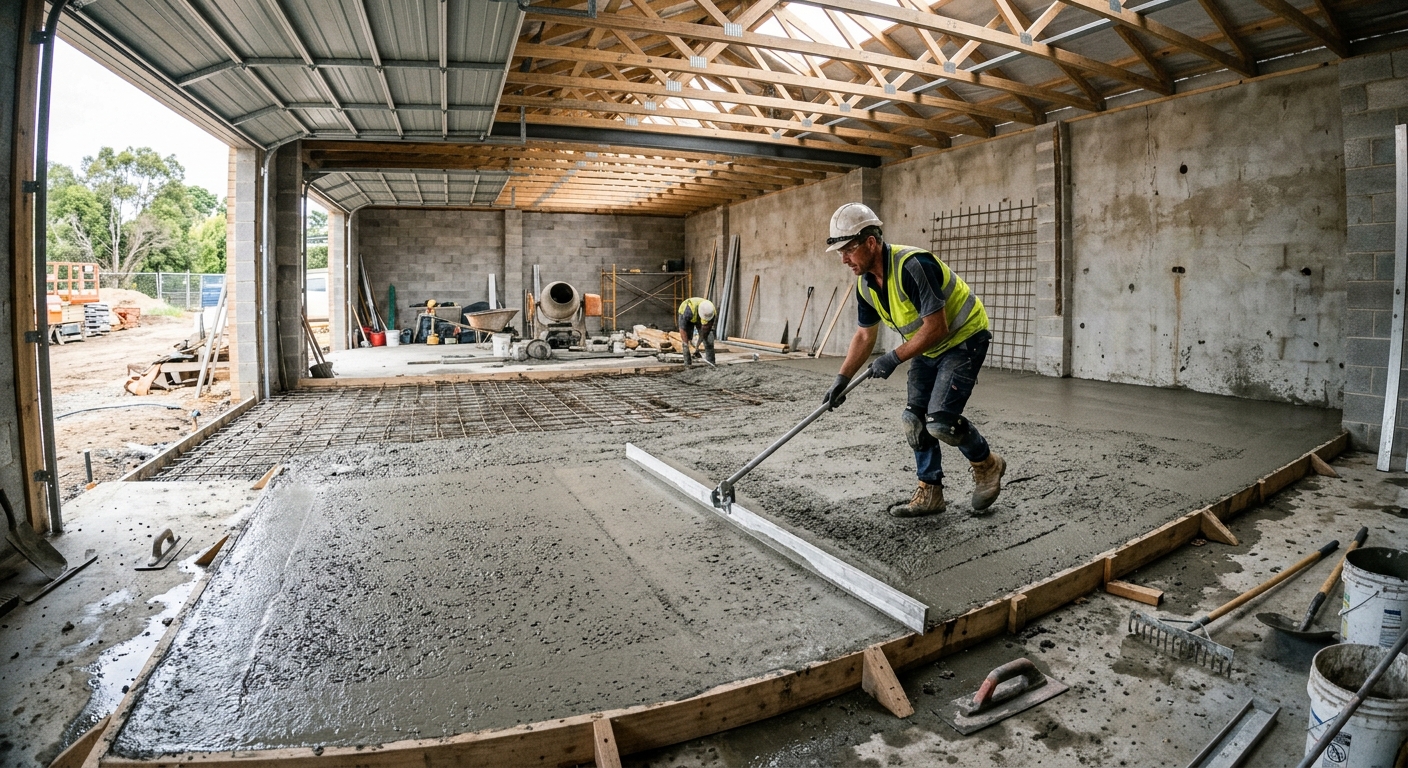
Concrete work options and costs in Madoc
Madoc homeowners typically choose concrete for driveways, patios and walkways because it’s practical, durable and blends well with the area’s mostly single-family housing. In the Madoc area, 98.3% of dwellings are single-detached homes (Statistics Canada, 2021 Census), and the town’s concrete work demand is steady because most properties have direct yard access for forming, gravel base prep, and reinforcement placement. With 47.7% of homes built before 1981 (Statistics Canada, 2021 Census), many projects are retrofits—replacing older cracked driveways, upgrading drainage, or adding new exterior flatwork around existing foundations.
In the Kingston–Pembroke region, pricing usually comes down less to the slab “type” and more to site conditions and the weather window. Frost line depth and repeated freeze-thaw cycles mean footings must be set below frost, exterior slabs need proper air entrainment, and the crew may have to schedule around shoulder-season cold snaps. Labour can also be tighter in shorter warm-weather periods, especially for finish-heavy work like stamping or exposed aggregate.
Concrete is especially in demand in neighbourhoods around Madoc’s more established residential pockets, where driveways and front walkways are frequently refreshed after spring settling and winter spalling. If you’re comparing options, the table below gives typical project pricing bands for Madoc so you can calibrate quotes before you book an on-site measurement.
| Application |
Typical Size |
Key Spec |
Finish Option |
Price Range |
| Concrete driveway (standard broom finish) |
400–600 sq. ft. |
Air-entrained mix, compacted granular base |
Broom finish, basic control joints |
$120–$180 |
| Exposed aggregate driveway |
400–600 sq. ft. |
Vibrated mix with selected aggregate, correct curing |
Exposed stone texture |
$160–$230 |
| Stamped concrete driveway or patio |
300–500 sq. ft. |
Air-entrained mix, tighter finishing tolerances |
Stamping + colouring + sealer |
$160–$280 |
| Plain concrete patio or walkway |
200–400 sq. ft. |
Air-entrained mix, adequate thickness and base |
Float + light broom finish |
$90–$150 |
| Garage floor (interior slab) |
300–500 sq. ft. |
Vapour barrier (where needed), proper thickness |
Steel trowel/smooth finish (as requested) |
$130–$210 |
| Foundation footings (structural, below frost) |
Varies (typical single home: multiple linear feet) |
Below-frost bearing, rebar per engineer, drainage/weep details |
Structural formwork + finishing as required |
$180–$320 |
Prices are estimates only and vary by project scope, site access and material selection.
What affects the price of concrete work in Madoc
In and around Madoc, it’s common to see quote differences of 30–50% for “the same” concrete job because the hidden work drives most of the cost. Two contractors can both quote a driveway, but one may include proper excavation, a compacted granular base sized for the local soil, reinforcement, and winter-curing precautions while the other assumes easier access or a shorter pour schedule. In the Kingston–Pembroke region, weather windows are shorter, and frost and freeze-thaw cycles dictate deeper preparation and careful curing discipline. That affects pricing more than the slab surface finish alone.
Ontario practice typically sets exterior footings around 1.2 m below grade, with colder areas sometimes deeper. For exterior slabs, air-entrained concrete is essential to reduce freeze-thaw damage; without that, spalling and surface scaling can start within a few winters. Also, de-icing salt exposure accelerates the problem, so sealing becomes more than a “nice to have” for many homeowners. When you pour later in the season, contractors often add insulating blankets or controlled heating to protect strength gain—small changes that can add real labour and equipment costs.
In Madoc, the age of housing stock matters too. With 47.7% of homes built before 1981 (Statistics Canada, 2021 Census), many projects involve removing older flatwork, dealing with older drainage patterns, and correcting settlement—often pushing the job toward the higher end of the $120–$180 driveway band or the $90–$150 patio/walkway band. A simple stamped upgrade can also justify a higher range: a stamped driveway or patio often lands closer to the $160–$280 band because it adds colouring, stamping, sealing and tighter finishing control.
| Price Factor |
Why It Matters |
Cost Impact |
| Frost line depth |
Determines footing depth and form height to prevent frost heave |
Can move foundation and footing bids by tens of percent |
| Site preparation |
Excavation, grading, and compacted granular base control settlement |
Higher if soil is poor, wet, or excavation is deeper than expected |
| Reinforcement |
Rebar or wire mesh reduces cracking and improves structural performance |
Adds material and labour; also increases detailing time |
| Mix design |
Air-entrainment and strength spec improve freeze-thaw and salt durability |
Costs more than basic mix; prevents early surface failure |
| Finish type |
Broom vs. stamped vs. exposed aggregate changes labour intensity |
Stamped/exposed typically pushes the job into premium bands |
| Pour size and concrete truck access to site |
Smaller pours or hard access can require extra handling |
Extra crew time and equipment to place/finish concrete |
| Cold-weather curing precautions |
Heating and insulating blankets protect strength gain |
Often adds a noticeable line item in shoulder-season work |
| Control joint pattern and sealing cost |
Joints and sealing reduce random cracking and surface scaling |
Sealer and extra finish steps add cost but improve lifespan |
Permits & regulations in Ontario
In Ontario, the permit and review requirements depend on what concrete you’re building. Structural concrete work—like foundation footings, foundation walls, and grade beams—usually requires a building permit and often engineered drawings that the municipality reviews before construction. That’s because these elements carry loads and connect to drainage, footing elevations, and waterproofing details.
Concrete flatwork (patios, walkways, and most driveways) typically does not require a permit unless it changes lot grading or impacts municipal rules around impervious surface coverage, drainage direction, or work within the municipal right-of-way. Even when a permit isn’t required, the municipality may still have conditions for how water is managed and where changes can be made.
For a Madoc homeowner, the safest approach is to confirm permit need with the local building department before breaking ground, especially if you’re excavating near foundations or adjusting drainage. Also verify the contractor is properly set up: ask for proof of liability insurance and WSIB/WCB coverage. Step-by-step, you can check:
- Contractor licence/registry status using the Ontario public directory for your contractor type (and company name match).
- Certificate of Insurance for general liability (ensure it covers the project location and is current).
- WSIB/WCB clearance letter or account evidence requested by you or the municipality when required.
- References on projects with similar scopes (footings, driveways with air-entrainment, or sealed flatwork).
Taking these steps helps avoid surprises later—especially when frost protection and drainage details are critical in Madoc’s freeze-thaw climate.
Getting concrete right in Madoc's freeze-thaw climate
Concrete fails most often in Madoc because freeze-thaw cycling and de-icing salt combine to push moisture in and out of the slab surface. If the base isn’t prepared to the right depth and compaction level, the slab can settle; if the mix isn’t air-entrained to the right target, water in the concrete can expand during freezing and cause spalling. Exterior flatwork also needs good drainage, correct slopes, and a joint plan that limits random cracking.
To spec the job correctly, focus on five practical items. First is base preparation: compacted granular sub-base sized for local soils and designed so the slab isn’t sitting on unstable materials. Second is mix design: for exterior flatwork, air entrainment is typically in the 5–7% range and a minimum 32 MPa compressive strength is commonly specified for durability-focused work. Third is control joints: spacing and layout should be planned to manage where cracks occur. Fourth is curing: aim for at least 7 days under proper conditions, and be cautious during cold pours—cold slows strength gain and increases early surface damage risk. Fifth is sealing: apply a penetrating sealer after the concrete has cured (commonly around 28 days) to help repel de-icing salts.
What to ask for during quoting: “Will you use air-entrained mix for exterior flatwork, what joint spacing are you planning, and what’s the curing and sealing schedule?” A simple cost example: a plain broom-finished patio may land around the $90–$150 band, while adding stamping and sealing pushes it toward the $160–$280 band. If a contractor tries to cut corners on air entrainment or jointing, that “savings” can cost you more in replacement—especially after the second or third winter.
| Spec |
Why It Matters in Madoc |
What to Ask For |
Impact if Skipped |
| Compacted granular base (depth?) |
Prevents settlement and reduces moisture pumping during freeze-thaw |
Granular sub-base depth and compaction method specified for your soil |
Cracking, heaving, and uneven slabs that telegraph through finish |
| Air-entrained concrete mix (target air %?) |
Creates space for freezing water to expand without breaking concrete |
Air content target for exterior flatwork (commonly 5–7% range) |
High risk of spalling and surface scaling in winter |
| Compressive strength (MPa rating) |
Strength gain supports durability and resistance to wear |
Minimum 32 MPa compressive strength (or higher as specified) |
Premature wear and reduced long-term performance |
| Control joints (spacing per ACI guidelines) |
Manages where shrinkage cracks form |
Planned joint layout and spacing matched to slab dimensions |
Random cracking, moisture ingress, and faster deterioration |
| Minimum 7-day curing period |
Ensures strength development before exposure to traffic and weather |
Protection plan if temps drop (blankets/heating if required) |
Surface damage, weaker concrete, and early scaling |
| Penetrating sealer (when applied after cure) |
Repels salt and water to slow freeze-thaw surface damage |
Sealer application schedule after cure (commonly around 28 days) |
Salt-driven spalling and faster surface deterioration |
How to choose a concrete work contractor in Madoc
When you’re hiring for concrete in Madoc, Ontario, verify licensing, insurance, and worker coverage before you sign. Start by requesting the contractor’s proof of general liability insurance (certificate of insurance showing project/location and coverage limits). Next, ask for WSIB/WCB clearance evidence—this is what protects you if a worker is injured on your site. For licensing, confirm the contractor is properly registered for the work they’re performing, and make sure the legal business name matches what’s on invoices and insurance documents.
Then get 2–3 itemised written quotes, not one lump number. A strong quote separates labour and materials for excavation, granular base prep, forms, reinforcement, concrete supply, finishing, and finishing protection (curing blankets or insulation if weather requires it). Ask whether a permit is included if your scope touches structural elements or lot grading rules, and whether disposal (old concrete removal/haul-off) is included. You want clarity on inclusions and exclusions like de-icing handling, joint sealing, and whether the crew restores landscaping and edges.
Warranty matters too: ask for workmanship warranty length and what it covers (cracks under normal conditions, joint performance, surface defects) and whether product/manufacturer warranties apply to sealer or admixtures. Keep your payment schedule sensible—never pay more than about 10–15% upfront; hold a balance until the job is complete and deficiencies are corrected. Finally, insist on a timeline: start date, concrete delivery schedule, cure/return-to-traffic plan, and completion estimate in writing, because Ontario’s cooling trends can affect strength gain.
- Ask for references in Madoc or nearby Kingston–Pembroke area (similar finish and slab thickness).
- Confirm air-entrained mix for exterior flatwork.
- Ask the contractor to specify granular base depth and compaction.
- Confirm reinforcement details if your driveway needs it (and why).
- Review the joint plan (spacing and where joints will land).
- Ask how they protect pours during cool shoulder-season weather.
- Confirm curing time expectations (minimum 7 days) and how they keep it protected.
- Ask when sealing is applied (often after full cure, commonly around 28 days).
- Get the truck access plan—small sites can add cost via placement method.
- Ensure old concrete removal and haul-off are clearly included or excluded.
- Check that the quote includes site cleanup and edge restoration.
- Confirm warranty terms in writing before paying the first instalment.
Concrete contractor red flags in Madoc: vague specs that don’t mention air-entrainment or jointing; “we always pour later, no need for blankets” promises; skipping base prep details or compaction proof; quotes that are only a single lump sum without breakdown; and refusing to provide insurance/WSIB/WCB documentation when requested.
Frequently asked questions — concrete work in Madoc
How do I maintain concrete in Madoc's freeze-thaw climate?
In Madoc and across Ontario’s freeze-thaw seasons, concrete maintenance is mostly about managing water and de-icing exposure. After your slab is fully cured, a penetrating sealer (commonly applied around the 28-day mark) helps repel moisture and salt, which are major drivers of surface scaling. Use de-icing products carefully—over-salting or sandblasting with abrasive melt can roughen the surface over time. Sweep regularly to remove grit that can grind into the paste. If you see small surface cracks, keep them clean and monitor growth; many issues start from water finding pathways through joints. For homeowners, it also helps to maintain drainage so downspouts and yard runoff don’t puddle on the slab. If you’re replacing older work, remember that homes built before 1981 are more likely to have older drainage patterns that need correction before new concrete is poured (Statistics Canada, 2021 Census).
What causes concrete to spall in Madoc winters?
Spalling in Madoc winters is usually caused by moisture getting into the slab and freezing inside the concrete, combined with salt exposure. If the concrete isn’t air-entrained to the correct target (commonly 5–7% air for exterior flatwork), the freezing water can expand and break off the surface paste. Settlement or poor base compaction also contributes by creating small voids that allow water to pool and penetrate. Another contributor is inadequate curing or opening the slab to traffic too early, which weakens the surface. Even if the finish looks good at first, spalling often shows up after repeated winters, especially where de-icing salts are used frequently on driveways and steps.
If you’re budgeting, that’s why you’ll see driveway pricing around the $120–$180 band when proper specs are included, and why cheaper bids sometimes look good on paper but miss key durability items like air entrainment, joints, or sealing.
What is rebar and when is it required in Ontario?
Rebar is reinforcing steel—typically placed in patterns and tied or supported so it sits at the correct depth inside the concrete. Its job is to control cracking and improve strength where the slab or structure will experience bending or tension forces. In Ontario, whether rebar is required depends on the design: foundation footings and structural elements are often engineered and will specify reinforcement placement. For structural work, engineered drawings and permit requirements commonly drive rebar requirements.
For exterior flatwork like driveways, many Ontario contractors use reinforcement (wire mesh or rebar) when conditions call for it—such as heavy vehicle loads, larger slabs, poor subgrade, or where the design calls for it. The key is that reinforcement should be spaced and supported properly; “throwing mesh in the middle” without cover depth doesn’t perform as intended. When you request a quote in Madoc, ask what reinforcement is planned and why—then confirm the thickness, base compaction, and joint plan match the reinforcement approach.
How long does a concrete project take in Madoc?
The total timeline in Madoc depends on excavation complexity, weather, and finish requirements. A small patio or walkway can often be poured within a day, but you still need adequate curing and protection time before driving or heavy use. In Ontario conditions, workmanship typically targets at least 7 days of curing under proper conditions, and cold or damp shoulder-season weather can extend the “ready for traffic” timeline because strength gain slows down. For driveways, adding base prep, forming, reinforcement, and finishing usually takes longer than a basic slab.
Stamped concrete also requires tighter coordination—colouring, stamping, and timing—so the crew schedules delivery carefully. If your job includes removing old concrete and hauling it away, excavation and disposal can add time and cost.
When you get quotes, ask for a start date and completion estimate in writing, including the concrete delivery day, curing/blanket plan, and when you can return for sealing (often after full cure).
What is a concrete overlay and is it suited to Madoc?
A concrete overlay is a new layer of cementitious material placed over an existing concrete slab after preparation—usually including cleaning, repairs, and sometimes grinding to ensure bond. It can be suited to Madoc in cases where the existing slab is largely stable (not severely heaved, deeply cracked, or structurally failing). Freeze-thaw areas can punish poor prep: if water is already trapped beneath or the old slab is moving, an overlay may crack or debond sooner than expected.
Overlay feasibility is about diagnosing the existing surface and base. If your driveway already shows significant pumping, major settlement, or repeated heaving at joints, replacement is often the better long-term value than trying to cover problems. If the slab is stable, overlays can be a faster option and help you avoid full excavation, but you still need proper drainage and joint management.
Because Madoc homeowners often weigh longevity against cost, overlay quotes should be compared to replacement bands (for example, driveways often fall around the $120–$180 range when replacement is properly spec’d) so you can decide based on durability, not just initial appearance.
How do I seal concrete to protect it in Madoc?
Sealing in Madoc is about protecting against moisture and de-icing salt damage. The most reliable approach is penetrating sealer designed for exterior concrete. Timing matters: apply the sealer after the concrete has fully cured—commonly around 28 days—so you’re sealing a stable, dry surface. Before sealing, the slab must be clean and dry; contractors typically pressure wash and allow it to dry, then confirm surface readiness. Applying sealer too early can trap moisture and reduce performance.
For driveways and patios, sealers help reduce water absorption, which slows salt-driven spalling and freeze-thaw surface scaling. Re-apply based on product guidance and wear conditions—areas near entrances or where heavy snow clearing happens may need more frequent attention.
When you compare quotes in Madoc, ask whether sealing is included and what product type is proposed (penetrating vs. film-forming), plus the application schedule and surface prep steps. This is one reason stamped jobs often sit higher (for example, $160–$280) because colour systems and sealing are integrated into the finish plan.