Concrete work options and costs in Briar Hill-Belgravia
Briar Hill-Belgravia is a classic Toronto neighbourhood where driveways and exterior flatwork take a beating from our humid summers, wet shoulder seasons, and repeated freeze–thaw cycles. With a local population of 14,257 people (Statistics Canada, 2021 Census), the demand is steady—especially around the family-oriented streets near Eglinton Avenue West where many homes are updated over time. In this housing market, many properties are single-detached, which typically means more scope for driveways, patios, and walkways than condo or townhouse settings.
Those upgrades aren’t just a materials choice—they’re a cold-weather durability decision. In the Toronto economic region, structural footings generally must extend at least 1.2 m below grade to manage frost heave, while exterior slabs need air-entrained concrete, properly compacted granular base, and control joints to limit random cracking. Costs can swing meaningfully because Toronto trades are busy in the pour season, and when temperatures drop toward 10 °C or below, contractors often add protection (insulating blankets/heating) to keep concrete curing correctly. In practice, that means two “same-sized” jobs can differ by 30–50% depending on excavation depth, access for the concrete truck, reinforcement needs, and finish complexity.
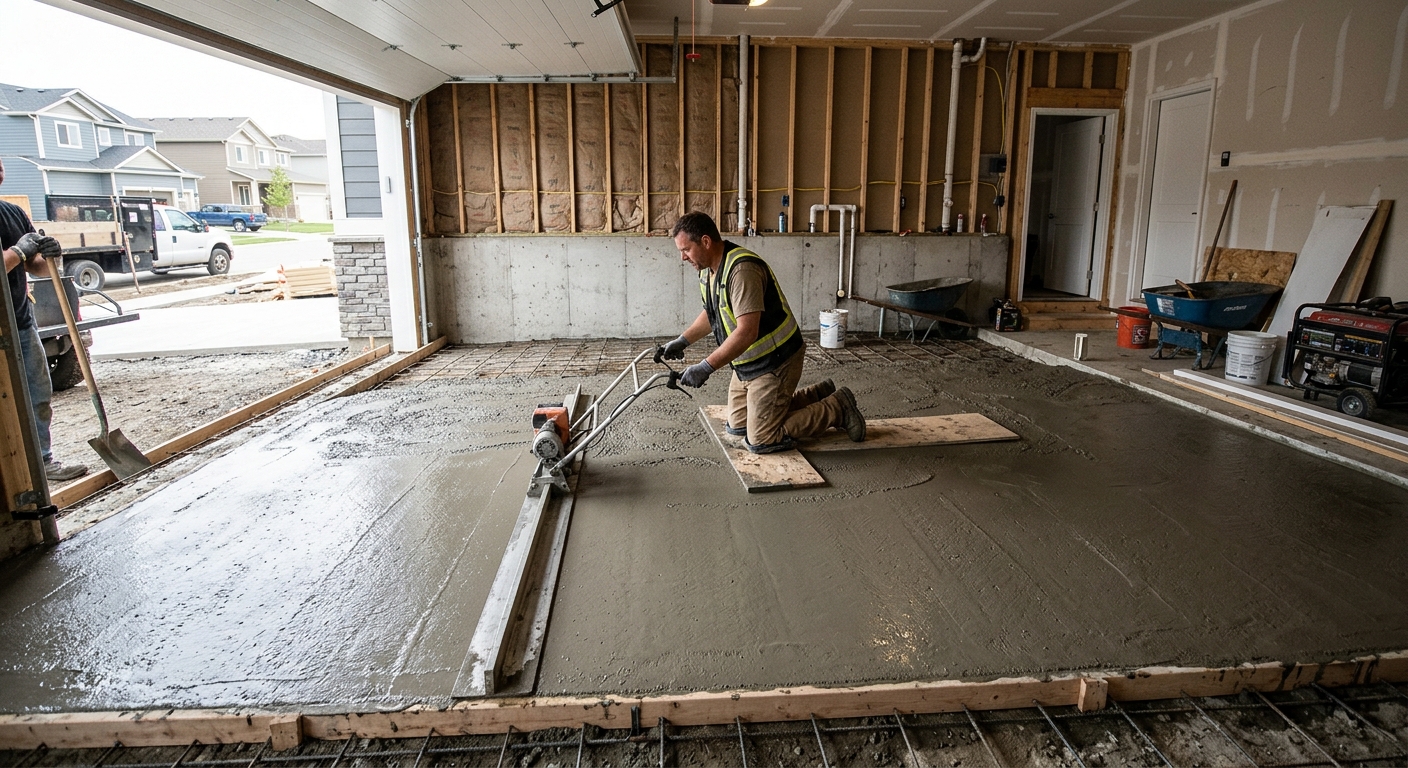
Below are realistic local price ranges so you can compare quotes by option and scope before you book a site visit.
| Application |
Typical Size |
Key Spec |
Finish Option |
Price Range |
| Concrete driveway (standard broom finish) |
400–500 sq. ft. |
4–5 in. slab, compacted granular base, air-entrained mix |
Broom finish + control joints |
$9,000–$13,000 |
| Exposed aggregate driveway |
400–500 sq. ft. |
4–5 in. slab, proper base drainage, air-entrained mix |
Exposed aggregate with sealer-ready surface |
$10,500–$16,000 |
| Stamped concrete driveway or patio |
300–450 sq. ft. |
4 in. slab (often thicker at edges), air-entrained mix |
Stamps + colour hardener/release + border control |
$12,000–$18,000 |
| Plain concrete patio or walkway |
200–350 sq. ft. |
4 in. slab (typical), compacted granular base, drainage slope |
Float/trowel or light broom + joints |
$3,200–$8,000 |
| Garage floor (interior slab) |
300–520 sq. ft. |
4 in. slab, vapour considerations as needed, fibre or mesh option |
Broom finish + curing compound as spec’d |
$5,400–$12,500 |
| Foundation footings (structural, below frost) |
Per linear foot or per foundation area |
Engineered design, below frost depth, reinforcing as required |
Structural concrete only (no decorative finish) |
$180–$300 |
Prices are estimates only and vary by project scope, site access and material selection.
What affects the price of concrete work in Briar Hill-Belgravia
If you get three quotes for what looks like the “same” concrete job in the Toronto area, it’s common to see a 30–50% spread—and most of the time it’s not because one contractor is careless. In Briar Hill-Belgravia, pricing is shaped by how deeply the crew has to excavate, what’s required to reach stable base and drainage, and how the contractor plans for freeze–thaw exposure. Footings must extend below the design frost depth (often around 1.2 m in Ontario) to prevent frost heave, and exterior slabs generally require air-entrained concrete so the freeze–thaw cycle doesn’t break down the surface over time.
Labour rates and scheduling also matter. Ontario’s reliable pour season is shorter than summer-only regions, so crews are booked up during the best weather window. When temps trend down near 10 °C or below, contractors may add cold-weather curing precautions such as insulated blankets or heated enclosures—costs that aren’t obvious until they’re line-itemed. De-icing salt in winter can accelerate spalling if the mix isn’t properly air-entrained, which is why sealing is often recommended for longevity.
Two local examples: (1) if your driveway ties into a sloped entrance and the contractor has to re-grade and remove soft subsoil, excavation and base supply can push the project toward the higher end of a $18,000–$28,000 driveway band; (2) if you want stamped concrete, labour for forms, stamping, and curing control can justify the jump from plain slabs around $16–$26 per sq. ft.-type bands to a more decorative price structure, especially for detailed borders and drainage slopes.
| Price Factor |
Why It Matters |
Cost Impact |
| Frost line depth — determines footing depth and form height |
Deeper frost management requires more excavation and concrete volume |
Higher footing quantities; excavation can add significant labour |
| Site preparation — excavation, grading, compacted granular base |
Unstable sub-base leads to settlement and cracking in winter |
More trucking/materials can shift a quote upward |
| Reinforcement — rebar or wire mesh requirement |
Controls crack widths and improves load capacity |
Extra material + labour for placement and chairs/tie wire |
| Mix design — air-entrainment and compressive strength spec |
Air-entrainment helps survive freeze–thaw cycles |
Correct spec prevents premature spalling; incorrect spec can fail early |
| Finish type — broom vs. stamped vs. exposed aggregate |
Complex finishes need more steps and stricter timing |
Stamped/exposed work typically costs more per sq. ft. |
| Pour size and concrete truck access to site |
Access affects pump needs, placement time, and labour |
Pumping and extra crew time increase total cost |
| Cold-weather curing precautions — heating and blankets |
Proper curing reduces surface scaling and internal weakness |
Additional equipment and labour during late-season pours |
| Control joint pattern and sealing cost |
Joints manage cracking; sealing helps repel salts and moisture |
Sealer and saw-cut timing add line-item cost |
Permits & regulations in Ontario
In Ontario, structural concrete work typically requires a building permit, and for many projects you should expect engineered drawings to be reviewed by the municipality. That includes footings, foundation walls, grade beams, and any structural elements that are part of supporting a house or addition. For concrete flatwork like patios, walkways, and driveways, permits often are not required unless the work changes lot grading, impacts impervious surface coverage limits, or affects municipal right-of-way requirements (for example, ties into a city-owned boulevard/sidewalk area). Because rules can vary by circumstances, confirm with the local authority before breaking ground.
For your Briar Hill-Belgravia project, verify the contractor carries liability insurance and the proper worker coverage (WSIB/WCB). Then, check Ontario licence/authorization details through the appropriate online registry resources for your contractor’s business, and ask for a recent certificate of insurance (COI) showing coverage limits and job-site details. If you’re using a subcontractor, make sure the main contractor remains responsible for the scope and that the COI clearly covers the work being performed.
Step-by-step homeowner checklist: (1) ask for the written scope and permit responsibility in the quote; (2) request COI and proof of clearance for worker coverage; (3) confirm the company legal name and licence details match the paperwork; (4) call or verify in the relevant online registry; (5) ask for references from similar-scale Ontario jobs so you can see how they handle frost-season curing and base preparation.
Getting concrete right in Briar Hill-Belgravia's freeze-thaw climate
Concrete failures in Briar Hill-Belgravia are usually a “system” problem: water meets the wrong mix, base isn’t compacted properly, or curing and finishing happen under the wrong temperature conditions. The biggest winter risk is spalling—surface peeling or scaling—often linked to inadequate air-entrainment and poor durability under freeze–thaw cycling. To spec the job correctly, start below grade with base prep: compacted granular sub-base to the correct depth and a drainage slope so saturated soils don’t expand and contract against the slab.
Next, the mix design: for exterior flatwork, air-entrainment in the range of 5–7% is commonly targeted, and the contractor should specify a minimum 32 MPa compressive strength unless the engineer/engineered drawings require more. Third, control joints must be planned early. Joints limit random cracking by giving the concrete a predictable place to relieve stress. Fourth, curing matters: plan for at least 7 days of curing under proper conditions. If you’re pouring when temperatures drop toward 10 °C or below, ask how they’ll protect and heat/insulate to avoid surface scaling and weak early strength.
Finally, sealing: use a penetrating sealer applied after cure completion—commonly at 28 days post-pour—to help repel de-icing salts and water. A $2,500–$5,000 difference between plain and stamped concrete can be justified if your goal is aesthetics and you’ll still get the same durable base, air-entrained mix, and joint/sealing plan. The cheapest-looking failure is the one that spalls—because repair usually costs more than doing it right the first time.
| Spec |
Why It Matters in Briar Hill-Belgravia |
What to Ask For |
Impact if Skipped |
| Compacted granular base (depth?) |
Prevents settlement and reduces water retention that drives freeze–thaw damage |
“What base thickness will you compact to, and what material will you use?” |
Cracking, rocking slab, and early edge spalling |
| Air-entrained concrete mix (target air %?) |
Air bubbles create space for freezing water, reducing internal pressure |
“What air content range will you deliver for exterior exposure?” |
Higher chance of surface scaling/spalling within a few winters |
| Compressive strength (MPa rating) |
Ensures durability and adequate strength gain for handling and service conditions |
“Confirm minimum 32 MPa (or higher if required) and curing plan.” |
Soft or weak concrete that deteriorates faster |
| Control joints (spacing per ACI guidelines) |
Limits random cracking so joints take the stress instead of the slab surface |
“What joint spacing are you using for my slab dimensions, and when will they be cut?” |
Wider random cracks and moisture pathways |
| Minimum 7-day curing period |
Proper curing reduces permeability and improves long-term durability |
“How do you protect the slab at night and during cool, damp weather?” |
Increased scaling, dusting, and reduced surface hardness |
| Penetrating sealer (when applied after cure) |
Helps repel water and de-icing salts that accelerate freeze–thaw breakdown |
“When will the sealer be applied, and what product system will you use?” |
More water ingress and faster surface deterioration |
How to choose a concrete work contractor in Briar Hill-Belgravia
Start with the basics: in Ontario, confirm the contractor’s licensing/authorization (as applicable to their work) and ensure they carry liability insurance. Ask for a certificate of insurance with job-site coverage and the correct legal business name. Next, verify worker coverage through WSIB/WCB documentation—don’t rely on verbal confirmation. If a contractor can’t provide current proof, move on.
For quotes, get 2–3 itemised written estimates that separate labour and materials (concrete supply, rebar/mesh, granular base, forming, saw cutting, finishing, and sealing). Avoid “lump sum only” quotes because they hide what changes your total when conditions on-site differ. Review scope carefully: what’s included for excavation spoil disposal, trucking distances, forms, and any permit work? If a permit is required for structural elements, confirm who pulls it and what costs are included.
Warranty should be in writing. Ask for workmanship warranty length (for example, crack management and surface defects) and clarify whether the manufacturer’s product warranty (if any) is transferable to you. On payment schedule, don’t pay more than 10–15% upfront. Hold back final payment until clean-up, final inspection, and any sealing work are complete.
Finally, request a firm start date and completion estimate in writing—concrete crews often need weather windows and curing time, so timelines should account for that. In Briar Hill-Belgravia, late-season pours can require additional protection, so your contract should state how cold-weather curing is handled.
- Check proof of liability insurance and worker coverage (WSIB/WCB) before signing.
- Use a written scope with slab thickness, base depth, and reinforcement method.
- Ask for the concrete mix spec: air-entrainment target and minimum compressive strength.
- Confirm whether joints will be cut or formed, and the planned joint spacing.
- Ask how they protect curing if temperatures drop—blankets/heating and timing.
- Confirm excavation depth and base prep—don’t accept “we’ll prep it properly” as a spec.
- Require a disposal plan for excavated soil and excess material.
- Verify concrete truck access or whether pumping will be needed.
- Get finish details in writing (broom, exposed aggregate process, stamp pattern options).
- Clarify sealing: product type and application timing after cure.
- Request references from similar Toronto-area freeze–thaw exterior work.
- Ensure the payment schedule is documented and conservative (10–15% upfront max).
Concrete contractor red flags in Briar Hill-Belgravia: (1) they won’t discuss air-entrainment for exterior slabs; (2) they quote “same price no matter the site” without assessing excavation/base; (3) they start without confirming truck/pump access or drainage slopes; (4) they skip control joints or can’t explain their spacing plan; and (5) they push heavy upfront deposits or won’t provide itemised scope and proof of insurance.
Frequently asked questions — concrete work in Briar Hill-Belgravia
How do I maintain concrete in Briar Hill-Belgravia's freeze-thaw climate?
In Briar Hill-Belgravia, maintenance is mostly about keeping water and de-icing salts off the surface. Start with drainage: keep landscaping from directing water onto your driveway or walkway, and don’t bury downspout discharge near concrete edges. After a pour, give the slab proper cure time, then apply a penetrating sealer at about 28 days post-pour to reduce salt and moisture penetration. In winter, use de-icing methods that are gentle on concrete—avoid over-salting and use sand instead of rock salt when possible. If you notice minor surface scaling, clean the area and consider an approved resurfacing/sealer strategy rather than waiting for larger sections to spall. For budgeting, remember that protecting a $16–$26 per sq. ft.-type patio/walkway is usually cheaper than replacing it after multiple winters.
What causes concrete to spall in Briar Hill-Belgravia winters?
Spalling is usually caused by moisture getting into the concrete and then freezing, expanding, and breaking off the surface. In Ontario’s freeze–thaw exposure, the most common root cause is inadequate air-entrainment, which means there isn’t enough freeze-tolerance within the mix. Base issues also contribute: if the base isn’t properly compacted or drainage is poor, water can sit under or at the slab edges, cycling through winter repeatedly. Another factor is cold-weather curing—if a contractor places concrete when temperatures are dropping toward about 10 °C or below but doesn’t protect it, early strength development can suffer, making surface scaling more likely. Finally, excessive or poorly managed salt application accelerates surface breakdown. If your exterior job was priced at the low end, ask the contractor specifically for mix air content and curing protection evidence—those details matter more than colour or finish.
What is rebar and when is it required in Ontario?
Rebar (reinforcing bar) is steel reinforcement placed inside concrete to improve tensile capacity and help control cracking. In Ontario, whether rebar is required depends on structural design, soil conditions, and the loading the slab or footing must resist. For structural work like foundation footings and grade beams, reinforcement is typically required by engineered drawings and must be placed correctly with adequate cover. For exterior flatwork like driveways, reinforcement requirements are more project-specific: some contractors use mesh or rebar for thicker slabs, large spans, or areas exposed to heavier loads. The key is that reinforcement isn’t “one size fits all,” and GTA freeze–thaw conditions still demand proper base prep and correct concrete mix regardless of reinforcement. If you’re comparing quotes, ask for slab thickness and whether reinforcement is included—especially because foundation/footings often price on a structural basis around the $180–$300 range per unit/linear measure depending on design.
How long does a concrete project take in Briar Hill-Belgravia?
In Briar Hill-Belgravia, the timeline depends on whether you’re doing flatwork (driveway/patio/walkway) or structural concrete (footings/foundation work). For flatwork, the schedule is often: site prep and base work (typically 1–3 days), form/steel placement (half to one day), pour day (usually 1 day), and finishing and edgework (same day). Even after the pour, you should plan for at least 7 days of proper curing before expecting full use. Weather changes the timeline: if night temperatures are cool or rain threatens curing, crews may extend protection time. For structural footings, work is staged: excavation, inspection/coordination, rebar placement, pour(s), then cure and proceed to the next structural step—so it’s commonly longer over several weeks, not days. Ask your contractor to include weather contingencies in writing, especially if you’re targeting a late-season pour in Ontario.
What is a concrete overlay and is it suited to Briar Hill-Belgravia?
A concrete overlay is a new concrete layer placed over an existing slab after preparation (typically grinding, repair of spalls, and bonding surface treatment as required). It can be suited to Briar Hill-Belgravia if the original slab is still structurally sound—meaning there isn’t widespread settlement, deep cracking, or major base failure. Overlays are generally best when the existing concrete is stable and the main issues are surface wear or minor spalling. If the underlying base is failing or the slab is moving, an overlay can crack or debond because it inherits the movement. Freeze–thaw makes correct prep critical; water management and sealing remain important even with an overlay. If you’re considering this option, insist on a site assessment first and ask for how they’ll test for bond readiness and address drainage. Compared with a full replacement—which often starts around driveway bands like $18–$28 in local pricing—an overlay can be cost-effective, but only when the base conditions are right.
How do I seal concrete to protect it in Briar Hill-Belgravia?
To seal concrete in Ontario’s freeze–thaw climate, timing and product choice matter. The common approach is: pour → cure → then apply a penetrating sealer after the slab has cured long enough—often around 28 days post-pour—so the concrete isn’t still releasing moisture. A penetrating sealer helps repel water and de-icing salts, which reduces freeze-driven damage and surface scaling. Before sealing, the surface must be clean and dry; pressure washing with proper drying time is often used, but avoid sealing over contaminants or standing moisture. For exterior surfaces, use a product specifically designed for horizontal concrete and confirm application coverage and recoat intervals. When you compare quotes, don’t treat sealing as an afterthought—ask whether it’s included and who handles it. While plain patios/walkways may land in the $16–$26 style local band, sealing can protect that spend for more winters.