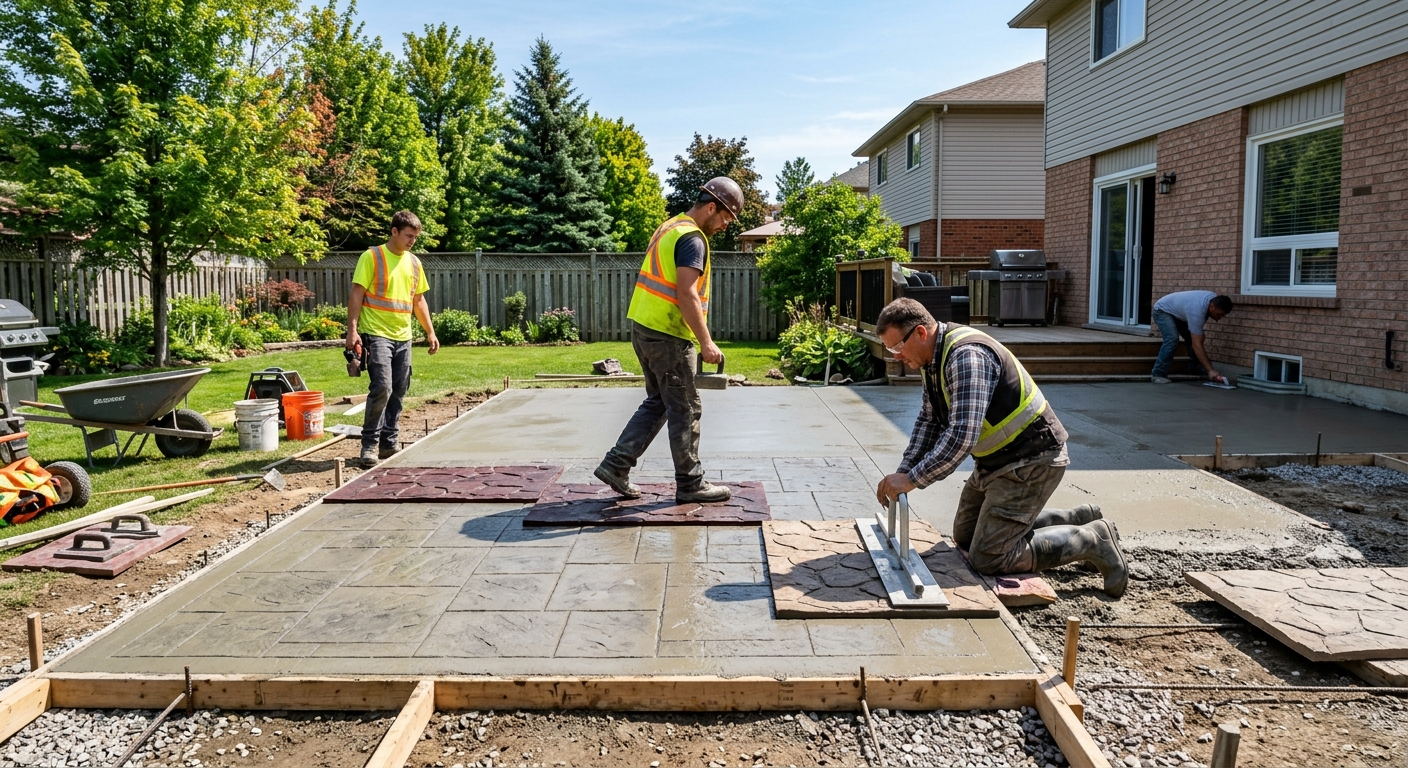
Concrete work options and costs in Dunnville
Dunnville homeowners typically consider concrete for driveways, patios, walkways, garage slabs, and foundation footings—and costs can swing depending on finish level and how cold, wet conditions are handled. With a population of 5,907 (Statistics Canada, 2021 Census), Dunnville’s work is concentrated in neighbourhoods with established homes and active property upkeep, including the west end around Jarvis Street and the older residential pockets near the downtown corridor. In this area, concrete flatwork is especially in demand because it’s durable, easy to maintain, and suits the way families use their outdoor spaces.
In the Hamilton–Niagara Peninsula’s cold, wet Great Lakes corridor, pricing is shaped by frost depth, freeze-thaw stress, and moisture exposure. Footings are designed to extend below frost so the ground can’t heave and push a foundation, and exterior flatwork needs air-entrained mixes plus tighter control joint planning. Contractors also manage a shorter effective pour window (roughly May to October for many exterior pours), and if a project must happen in cooler shoulder weeks, expect heating, insulating blankets, and scheduling premiums.
For scale, a standard broom-finish driveway is usually the most cost-stable option, while decorative choices like stamped concrete add labour and materials. That’s why comparing “similar size” quotes matters: two contractors may quote the same driveway dimensions, yet one includes deeper base prep, reinforcement, and proper mix design for freeze-thaw resistance. Use the ranges below to sanity-check what you should expect before you request an itemised proposal.
| Application |
Typical Size |
Key Spec |
Finish Option |
Price Range |
| Concrete driveway (standard broom finish) |
12 ft × 20 ft (240 sq ft) |
Air-entrained exterior mix; compacted granular base; control joints |
Broom finish |
$4,500–$5,500 |
| Exposed aggregate driveway |
12 ft × 20 ft (240 sq ft) |
Air-entrained mix; bonding timing for exposure; sealed for salt resistance |
Exposed aggregate |
$5,200–$6,800 |
| Stamped concrete driveway or patio |
12 ft × 18 ft (216 sq ft) |
Air-entrained mix; release agent; stencilling; sealing |
Stamped |
$5,500–$7,600 |
| Plain concrete patio or walkway |
10 ft × 12 ft (120 sq ft) |
Proper base; joints to control shrinkage |
Broom / smooth trowel edge |
$1,450–$2,400 |
| Garage floor (interior slab) |
24 ft × 22 ft (528 sq ft) |
Vapour barrier; reinforcement as required; typically less de-icing exposure |
Light broom finish |
$7,500–$11,000 |
| Foundation footings (structural, below frost) |
Example: 60 linear ft of 24 in wide footing |
Excavate below frost; rebar; engineered dimensions |
Reinforced footing |
$3,600–$7,200 |
Prices are estimates only and vary by project scope, site access and material selection.
What affects the price of concrete work in Dunnville
In Dunnville, the same “driveway size” can produce quotes that differ by 30–50% across the Hamilton–Niagara Peninsula and Ontario because concrete pricing isn’t just about the volume of concrete—it’s about how much preparation and frost-resistance detailing goes into the work. A contractor who budgets for a shallow base and average mix design may appear cheaper, but the real risk is freeze-thaw damage and random cracking. Over time, that turns into patching, higher maintenance, or full replacement—none of which homeowners want.
Cold weather design drives most cost variation here. Frost line depth dictates how deep footings must be, and exterior slabs must use air-entrained concrete to survive repeated freeze-thaw cycles. In practical terms, footings are often set below Ontario’s design frost depth (commonly about 1.5–2.4 m depending on soil and location) so the ground can’t lift and stress the foundation. Exterior pours also face a shorter, more variable pour season, roughly May to October, and any cold-weather work can require heating, insulating blankets, and sometimes admixtures—adding labour and equipment costs.
Two examples that commonly move the needle in Dunnville: (1) adding a thicker compacted granular base and proper drainage can increase excavation and stone material costs, but it reduces settlement and improves long-term performance; (2) choosing stamped concrete versus a broom finish can add material and labour, but it’s often worth it visually. For reference, plain concrete driveways tend to land around the $14–$22 per sq ft band, while stamped & decorative options typically run about $22–$35 per sq ft, depending on pattern complexity and site conditions.
| Price Factor |
Why It Matters |
Cost Impact |
| Frost line depth — determines footing depth and form height |
Deeper excavation and taller forms reduce heave risk |
Can add major excavation and rebar costs; often the biggest driver for foundations |
| Site preparation — excavation, grading, compacted granular base |
Proper sub-base prevents settlement and helps manage water |
More stone and labour when soil is soft, wet, or needs removal |
| Reinforcement — rebar or wire mesh requirement |
Controls cracking and improves load capacity |
Rebar ties, chairs, and placement labour can noticeably increase cost |
| Mix design — air-entrainment and compressive strength spec |
Air entrainment is essential for freeze-thaw durability |
Premium materials and stricter batching/time requirements |
| Finish type — broom vs. stamped vs. exposed aggregate |
Finish requires different tooling, timing, and sealing |
Stamped/exposed adds labour; plain broom is usually lowest |
| Pour size and concrete truck access to site |
Longer pours may require staging and pump/extended hose |
Restricted access can add equipment and extra crew time |
| Cold-weather curing precautions — heating and blankets |
Protects strength gain and reduces surface defects |
Short pour windows increase scheduling and equipment charges |
| Control joint pattern and sealing cost |
Joints manage shrinkage; sealing helps resist salt attack |
More layout time and a follow-up product cost (typically after cure) |
Permits & regulations in Ontario
In Ontario, structural concrete work—like foundation footings, foundation walls, and grade beams—typically falls under permit requirements, and it’s common to have engineered drawings reviewed as part of the municipal process. If you’re building new, adding a foundation, underpinning, or changing how the foundation supports the house, assume a permit is needed before any excavation begins. For concrete flatwork such as patios, walkways, and most driveways, permits often aren’t required unless the work affects lot grading, changes drainage in a way that impacts neighbouring properties, or triggers municipal rules about impervious surface coverage and right-of-way considerations.
Before signing anything, ask the contractor to confirm whether a permit is required for your specific scope. Then verify three basics: liability insurance, WSIB/WCB coverage (or the applicable coverage status), and work history on similar-scale jobs. For a homeowner in Dunnville, start with the contractor’s insurance certificate (ask for the latest COI naming you/your property as required), then request proof of clearance/coverage. Also ask who pulls the permit—if one is required—and whether engineering documents are included where applicable.
Finally, verify the contractor’s standing in Ontario using the online registry tools available for trades and contractor registration. If anything is unclear, don’t proceed—ask for documentation in writing before excavation starts.
Getting concrete right in Dunnville's freeze-thaw climate
Concrete failures in Dunnville usually come down to moisture, temperature swings, and poor detailing for the local freeze-thaw cycle. Water gets into the concrete and, as it freezes, it expands—leading to surface spalling and scaling if the mix and curing aren’t right. The key is to spec the system correctly: the base must be compacted to the right depth for frost and drainage; the concrete mix needs air-entrainment; and joints plus curing must be planned to limit random cracking.
For exterior flatwork, I generally look for an air-entrained mix with about 5–7% air content and a minimum 32 MPa compressive strength. Control joints need a spacing pattern that limits shrinkage cracking, and curing should be handled properly—minimum 7 days—so the concrete reaches strength before it’s stressed by cold nights or early de-icing salt exposure. Since Lake Ontario and Lake Erie weather patterns bring damp conditions, sealing is also more than cosmetic: a penetrating sealer applied after full cure helps repel de-icing salts and slows down moisture ingress.
Here’s a practical cost example: if you’re deciding between a plain driveway broom finish and stamped concrete, stamped work may add roughly $2–$13 per sq ft (depending on complexity). On a 200 sq ft driveway, that might be a $400–$2,600 difference. If the goal is long service life rather than maximum curb appeal, the “extra” cost is often justified only where the contractor is also emphasizing base prep, proper joints, and salt-resistant sealing—otherwise you pay more for appearance without better durability.
| Spec |
Why It Matters in Dunnville |
What to Ask For |
Impact if Skipped |
| Compacted granular base (depth?) |
Reduces settlement and manages water so frost doesn’t lift slabs |
Ask for the base thickness and gradation, and confirmation it’s compacted in lifts to spec |
More cracking, uneven surface, and accelerated deterioration |
| Air-entrained concrete mix (target air %?) |
Controls freeze-thaw damage by providing space for ice expansion |
Ask for the air content target (typically ~5–7% for exterior flatwork) and confirmation it’s air-entrained |
Spalling/scaling risk rises significantly in Dunnville’s freeze-thaw cycle |
| Compressive strength (MPa rating) |
Strength affects durability and resistance to wear/salt exposure |
Ask for minimum 32 MPa (or higher if required by your use/loading) |
Surface can wear faster and may fail under stress |
| Control joints (spacing per ACI guidelines) |
Limits random shrinkage cracking and keeps cracks tight |
Ask for joint spacing plan and joint depth/sawcut timing |
Wider, irregular cracks and moisture tracking into the slab |
| Minimum 7-day curing period |
Ensures strength gain before exposure to cold and moisture |
Ask how curing will be protected (blankets/insulation if cooler weather) |
Weak surface and higher defect rates |
| Penetrating sealer (when applied after cure) |
Helps repel de-icing salts and reduces moisture ingress |
Ask for when it’s applied (typically after full cure/around 28 days, per product guidance) |
Faster scaling and spalling during winters |
How to choose a concrete work contractor in Dunnville
Choosing the right concrete contractor in Dunnville is mostly about proof. In Ontario, confirm the contractor’s business registration/eligibility for your type of work, then verify liability insurance and WSIB/WCB coverage. How to check: request a current certificate of insurance (COI) before work starts and ensure the coverage is active and adequate for the job size. For clearance/coverage, ask for WSIB/WCB documentation that shows they’re covered for their workers—don’t accept “we’re registered” without paperwork.
Next, ask for 2–3 itemised quotes—not just a lump sum. You want labour + materials breakdown, including excavation/grading, granular base, reinforcement (if applicable), concrete mix specs, finishing, joints, and sealing. Clarify what’s excluded: are eavestrough downspout connections, drainage corrections, disposal, or permit handling included? If you’re in a neighbourhood where driveways are shared-access or tight off local streets, request details on truck access and whether pumping/extended hose is required.
Warranty matters too. Ask for a workmanship warranty length and whether product warranties apply to the sealer or admixtures. Also confirm the warranty is transferable if you sell the house. For payment, keep it reasonable: never pay more than 10–15% upfront, and hold back part of the payment until the job is complete and cleaned up. Finally, insist on a written start date and completion estimate.
- Ask for proof of liability insurance and WSIB/WCB coverage before signing.
- Get itemised quotes showing base prep, reinforcement, mix type, finishing, and curing protections.
- Confirm whether the quote includes debris haul-away and any required demolition.
- Ask if permits are required for your scope and who pulls them.
- Request concrete mix details (air-entrained for exterior) and minimum strength.
- Confirm rebar/wire mesh placement plan and cover thickness.
- Review joint spacing and whether joints are sawcut or formed (and when).
- Ask how curing will be handled during cool nights or shoulder season.
- Ask for sealing plan (penetrating sealer) and the timing after cure (often around 28 days).
- Check for a clear timeline: start date, pour date, finishing date, and sealing date.
- Verify warranty terms in writing, including what’s covered and for how long.
- Ensure the contract states payment schedule (10–15% max upfront; holdback at completion).
Concrete red flags I see around Dunnville include: quotes that don’t mention air-entrainment for exterior work, no discussion of frost-depth/base prep, “we’ll seal whenever” without a cure-time plan, lack of proof of WSIB/WCB or insurance, and contracts with vague scope (“finish and done”) without joint, reinforcement, and curing details.
Frequently asked questions — concrete work in Dunnville
What is the difference between concrete and cement?
In everyday terms, people say “concrete” and mean the finished slab, but the chemistry is split. Cement is one ingredient—usually Portland cement—that acts as the binding material. Concrete is the full mix: cement plus water plus sand/gravel (aggregates) plus, for exterior work in Dunnville, additives like air-entrainment to help it survive freeze-thaw cycles. That distinction matters when you compare quotes: a low-price mix that isn’t properly air-entrained is a durability risk in Ontario’s Great Lakes weather. When you ask your contractor, confirm the mix is air-entrained for exterior flatwork and meets the specified strength (often 32 MPa minimum) rather than focusing only on the “cement” brand.
How much does concrete work cost in Dunnville?
For Dunnville, typical pricing depends on application and finish. As a quick benchmark for homeowners, a concrete driveway is commonly in the $14–$22 per sq ft band, with decorative options like stamped concrete running closer to $22–$35 per sq ft. Patios and walkways are often $12–$20 per sq ft. Foundations/footings are quoted differently because excavation and structural specs dominate, often landing around the $60–$120 range per unitised scope for footing work. Your quote can also be higher if the site needs extra excavation, if reinforcement is required, or if the pour has to be scheduled during colder weeks (heating, blankets, and curing protection). Always compare like-for-like specs, not only total square footage.
How deep must footings be for Dunnville's frost line?
Footings must be designed to extend below Ontario’s design frost depth to prevent frost heave. In practice across Ontario, that often means roughly 1.5–2.4 m depending on local soil conditions and engineered requirements (your contractor should use the design approach for your specific site). In Dunnville’s cold, wet Great Lakes corridor, we also pay attention to drainage and backfill quality because water management is part of frost performance. If a quote gives a “typical” footing depth without discussing design frost and soils, it’s incomplete. Ask whether the footing depth is per engineering and how they’ll handle excavation in wet conditions, plus whether reinforcement placement and cover meet the spec.
Why does concrete crack in Dunnville and how is it prevented?
Concrete cracks are usually not a sign of “bad concrete,” but of shrinkage and thermal movement—made more noticeable by Dunnville’s winter freeze-thaw and moisture exposure. The main prevention tools are proper base prep, correct mix design, and a deliberate joint strategy. Air-entrainment helps durability against freeze-thaw; compacted granular base helps limit movement from settlement; and control joints (planned spacing and correct timing for sawcut/forming) manage where cracking is allowed to occur. Curing also plays a role: minimum 7 days under the right temperature conditions helps strength development. If you’re seeing random cracks early, it can point to shallow base prep, improper joint spacing, or inadequate curing/temperature protection during the pour.
Stamped vs broom-finish concrete — cost difference?
Stamped concrete generally costs more because it adds pattern layout, release agents, specialized finishing steps, and often more intensive sealing work. In Dunnville, broom-finish driveways often fit the $14–$22 per sq ft band, while stamped & decorative concrete typically lands around $22–$35 per sq ft depending on complexity and site conditions. That premium can be justified when the contractor is also matching the durability specs—air-entrained mix, proper base, reinforcement where needed, and a correct control joint plan. If a contractor offers stamped concrete with “basic” prep, you’re paying extra mainly for appearance, not necessarily for improved long-term performance. Ask for the joint plan, sealing timing, and whether they’ll use curing blankets or other cold-weather protections if pouring near the cooler shoulder season.
When is the best time to pour concrete in Dunnville?
For Dunnville and the Hamilton–Niagara Peninsula, the safest window for most exterior flatwork is the warm part of the year—roughly May to October—because it reduces the need for heating and makes proper curing easier. Late fall and early spring can still work, but the contractor has to plan for cold-weather curing: insulating blankets, temperature monitoring, and sometimes admixtures to protect the pour. Curing is critical because winter swings and moisture can stress early-age concrete. If your project is near a cooler period, ask how they’ll protect the slab during the first week and whether they’ll schedule sealing after cure (commonly around 28 days, based on product guidance). A good contractor will also coordinate truck access and timing so the finish work doesn’t rush in changing temperatures.