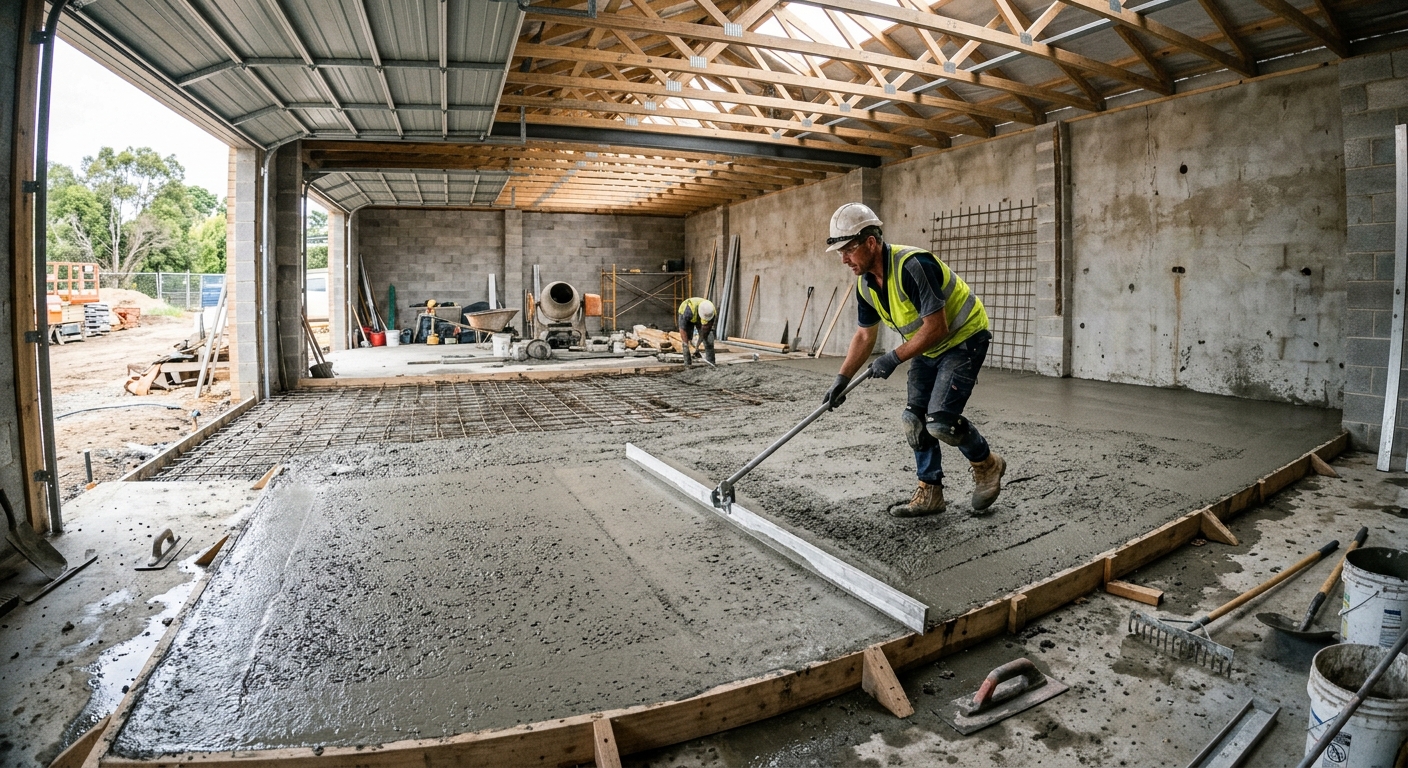
Concrete work options and costs in Cornwall
Cornwall is a solid market for residential concrete, and you’ll see it reflected in the housing stock: with 49.0% of dwellings being single-detached homes (Statistics Canada, 2021 Census), most curbside concrete demand comes from driveways, patios, walkways and the occasional garage floor refresh. Another local factor is how older housing influences repairs and replacement timing—70.4% of homes were built before 1981 (Statistics Canada, 2021 Census), so contractors often find earlier drainage issues, settlement, or mismatched elevations that must be corrected before any new slab or base can be installed.
In Ottawa’s broader concrete market—covering Cornwall and nearby communities—freeze–thaw cycles and a deep frost line push prices up. Footings and exterior slabs must be designed to resist frost heave, which typically means deeper excavation (around 5–6 ft for structural structures in local guidance), more granular base, and more labour at slab edges where damage starts first. Costs also rise because the pour season is shorter; cold weather can slow strength gain, so crews may use heating/blanketing and stricter curing practices. That level of planning can reduce the contractor pool on any given week, especially for exterior work near busier neighbourhood corridors and in areas where truck access is limited.
If you’re shopping for driveway or patio work in the East end / near Brookdale area, demand is often higher simply because many streets already have mature trees and established grades—meaning excavation and base prep take longer. Next, use the comparison table below to benchmark your project against realistic Cornwall price ranges.
| Application |
Typical Size |
Key Spec |
Finish Option |
Price Range |
| Concrete driveway (standard broom finish) |
300–500 sq. ft. |
Air-entrained mix; compacted granular base; control joints |
Broom finish, saw-cut joints |
$5,000 – $12,000 |
| Exposed aggregate driveway |
300–500 sq. ft. |
Air-entrained mix; proper retarder/cleaning; sealed surface |
Exposed aggregate (washed), textured finish |
$7,500 – $16,000 |
| Stamped concrete driveway or patio |
200–450 sq. ft. |
Air-entrained mix; reinforcement as needed; integral colour |
Stamp + colour; sealer recommended for salt protection |
$6,000 – $18,000 |
| Plain concrete patio or walkway |
120–300 sq. ft. |
Air-entrained mix; compacted base; drainage slope |
Broom or smooth trowel edge; light broom for slip resistance |
$2,000 – $7,500 |
| Garage floor (interior slab) |
400–700 sq. ft. |
Vapour barrier (as applicable); slab reinforcement; adequate base |
Float/smooth, light broom, or decorative options if desired |
$6,000 – $16,000 |
| Foundation footings (structural, below frost) |
Varies by foundation plan |
Engineer/structural spec; reinforced, below frost; concrete grade per design |
Standard structural concrete finish (formwork) |
$12,000 – $35,000 |
Prices are estimates only and vary by project scope, site access and material selection.
What affects the price of concrete work in Cornwall
In Cornwall and the Ottawa region, it’s common to see quotes for the “same” concrete job differ by 30–50%. The reason isn’t just concrete cost—it’s the knock-on effect of specs driven by Ottawa-area freeze–thaw conditions and logistics. For example, the frost line depth and repeated freeze–thaw cycles dictate footing depth and slab support. Local guidance in colder parts of Ontario typically lands around 5–6 ft for structural structures, and exterior slabs still need insulation-by-isolation thinking through base prep and drainage. On top of that, exterior concrete must be air-entrained to survive freeze–thaw, and cold-weather curing precautions (heating/blanketing) can add real labour hours and equipment costs during shoulder months.
De-icing salt also accelerates surface spalling if the mix, finishing timing, and sealer plan aren’t right—so a “cheaper” bid can end up costing more later if they skip proper air content, adequate curing, or sealing. You’ll often see quoted concrete at the $16–$25 per sq. ft. band for driveways, while patios and walkways tend to land around $14–$22 per sq. ft.; stamped and decorative work typically steps up into the $22–$35 per sq. ft. range depending on pattern, colour, and thickness.
Local housing age changes the scope too. In older Cornwall neighbourhoods where homes were built before 1981 (Statistics Canada, 2021 Census), it’s typical to uncover poor subgrade drainage or settlement, adding excavation and rebuild of compacted base. A driveway replacement on a lot with soft spots can turn a straightforward “overlay-style” plan into full-depth removal—pushing costs closer to the high end of the driveway band. Conversely, if your existing base is stable and elevations are clean, a plain patio or walkway may stay closer to the lower end of the $14–$22 band.
| Price Factor |
Why It Matters |
Cost Impact |
| Frost line depth — determines footing depth and form height |
Deeper below frost reduces heaving risk in freeze–thaw cycles |
Higher formwork + excavation; can add major labour and materials |
| Site preparation — excavation, grading, compacted granular base |
Concrete fails from the ground up when base is weak or poorly drained |
Soft subgrade removal and thicker base raises cost |
| Reinforcement — rebar or wire mesh requirement |
Controls cracking and supports slabs/edges under movement |
Added steel and placement labour; impacts flatwork durability |
| Mix design — air-entrainment and compressive strength spec |
Air-entrainment is essential for freeze–thaw survival |
Special mix can cost more, but it’s cheaper than premature failure |
| Finish type — broom vs. stamped vs. exposed aggregate |
More steps add time, materials, and curing/sealer planning |
Stamped/exposed work typically moves you toward the $22–$35 band |
| Pour size and concrete truck access to site |
Short pours and restricted access increase labour and may require pumps |
Truck choreography, pump rentals, and extra labour time add up |
| Cold-weather curing precautions — heating and blankets |
Strength gain and finishing windows are sensitive in cold snaps |
Heating/blanks and longer curing monitoring increase bid totals |
| Control joint pattern and sealing cost |
Joints manage shrinkage cracking; sealing helps resist salt scaling |
Sealer and correct joint layout reduce future surface repairs |
Permits & regulations in Ontario
In Ontario, structural concrete work generally needs municipal oversight. Typically, footings, foundation walls, grade beams and any work that changes a structural load path requires a building permit and, in many cases, engineered drawings reviewed as part of the permit process. Concrete flatwork—driveways, patios and walkways—often does not require a permit, unless it affects lot grading, triggers stormwater/impervious surface requirements, impacts municipal right-of-way, or alters drainage in a way the municipality needs to review.
Before breaking ground in Cornwall, you should verify three contractor basics: (1) a liability insurance certificate that matches the work value and (2) WSIB (and any required coverage for workers) and (3) a licence/registration status where applicable for the trade. Concrete contractors may also be members of trade associations, but your baseline checks should be insurance and worker coverage.
Step-by-step for homeowners in Cornwall:
- Ask for the contractor’s certificate of insurance—confirm general liability limits and the project address.
- Request proof of WSIB clearance or coverage for workers who will be on site.
- Verify their business registration and trade credentials through Ontario’s public listings and any applicable registry/licensing resources.
- Get a written scope that states who pulls any permits (if required) and who pays for inspections.
- Ask for references showing similar-scale driveway/slab or footing work in the Ottawa region.
Getting concrete right in Cornwall's freeze-thaw climate
Concrete failures in Cornwall’s winters are usually predictable: the ground expands and contracts with freeze–thaw, water migrates under slabs, and de-icing salt stresses the surface. To spec the job correctly, start with what the slab is sitting on. For (1) base preparation, require a well-compacted granular sub-base to the right depth for local conditions and drainage—especially at edges where heaving starts. Next, (2) mix design: ensure exterior work uses air-entrained concrete (targeting about 5–7% air for exterior flatwork) and a minimum compressive strength spec typically around 32 MPa. For (3) control joints, spacing should be planned to reduce random cracking, and joints must be cut/specified on schedule. (4) curing should be a minimum 7-day period under proper temperature and moisture conditions; in cold snaps, heating/blanketing is not optional if the contractor wants strength and surface integrity. Finally, (5) sealing: a penetrating sealer is typically applied after the slab has cured—often around 28 days post-pour—helping repel de-icing salts.
Here’s a practical dollar example: if a broom-finished driveway in the Cornwall area is quoted near the lower $16–$25 per sq. ft. band, it can still fail early if the contractor uses the wrong air content or rushes curing. You might pay an additional $800–$1,500 for correct mix confirmation, curing blankets, and sealing on a medium-size driveway, but that’s far cheaper than replacing spalled edges or dealing with repeated patching.
When you discuss your project, ask the technical questions that prevent spalling—especially air-entrainment and curing. In a town where mature neighbourhoods and older housing stock are common, the best “value” is the spec that survives Ottawa-area freeze–thaw, not just the lowest initial per-sq.-ft price.
| Spec |
Why It Matters in Cornwall |
What to Ask For |
Impact if Skipped |
| Compacted granular base (depth?) |
Controls frost movement and prevents water pumping under the slab |
Exact base depth and compaction method; drainage slope details |
Settlement, edge cracking, and early lift/heave |
| Air-entrained concrete mix (target air %?) |
Air voids help concrete handle freeze–thaw expansion |
Confirm target air content (typically 5–7% for exterior flatwork) and mix design |
Higher spalling and surface scaling during winter cycles |
| Compressive strength (MPa rating) |
Ensures the slab develops enough strength under cold curing conditions |
Minimum 32 MPa and curing plan based on forecast |
Weak surface durability and faster deterioration |
| Control joints (spacing per ACI guidelines) |
Directs shrinkage cracking where you can repair and manage it |
Proposed joint layout and cut timing (saw-cut schedule) |
Random cracks and water infiltration into base |
| Minimum 7-day curing period |
Cold weather slows hydration and reduces early strength if mishandled |
How they protect against temperature drops; curing blankets/heaters if needed |
Surface damage, reduced strength gain, and scaling risk |
| Penetrating sealer (when applied after cure) |
Helps repel de-icing salts and reduces moisture movement in freeze–thaw |
Type of sealer and application timing (commonly around 28 days after pour) |
Faster salt damage and more frequent patching |
How to choose a concrete work contractor in Cornwall
Choosing the right contractor in Cornwall starts with verification, because concrete quality is as much about process as it is about materials. First, confirm Ontario licensing/registration where applicable, then check insurance and worker coverage. Ask for a current certificate of insurance (general liability) and ensure the project is listed or the certificate can be endorsed to your address. Next, request proof of WSIB coverage or a clearance letter for the workers who will be on site. If a contractor can’t produce these documents quickly, move on—especially in Ontario where you want coverage for injuries and jobsite incidents.
Then get 2–3 itemised written quotes. You want labour and materials broken out—excavation, granular base, reinforcement, concrete supply, finishing, joints, and sealing (if included). Avoid “lump sum only” quotes unless every line item is clearly described and priced. Read exclusions carefully: is permit pulling included when needed, is disposal (spoils/gravel) included, and are site protection/temporary protection items part of the scope?
Warranty matters for concrete work. Ask for workmanship warranty length and whether it’s tied to installation practices (not just “product warranty”). Also confirm if the warranty is transferable to a future homeowner if you sell. For payment, use a schedule that keeps risk controlled—generally no more than 10–15% upfront, with progress payments aligned to milestones. Hold back a portion until the job is complete and clean. Finally, insist on a start date and a completion estimate in writing, because cold snaps in the Ottawa area can change finishing and curing timelines fast.
- Ask who supplies the concrete and request mix details (air content, strength spec).
- Confirm the contractor’s crew and supervision—who does the finishing and jointing?
- Require a written scope that lists excavation depth and granular base thickness.
- Verify rebar/mesh placement and chair supports (not just “we have steel”).
- Get an explicit joint layout plan (where joints go and when they’ll be cut).
- Confirm cold-weather curing procedures (blankets/heating) if temps drop.
- Ask whether sealing is included; if not, get a separate line item for sealer.
- Check site access plan: truck placement, pump needs, and protection for neighbours.
- Look for disposal included vs “haul away extra” surprises.
- Ensure the quote states the finish type exactly (broom, trowel, stamped pattern options).
- Request proof of insurance and WSIB coverage before signing.
- Use a written payment schedule with a completion holdback.
Red flags in Cornwall concrete bids: vague mix specs (“regular concrete”), no mention of air-entrainment for exterior work, quotes that omit control joints or curing steps, rushed schedules with no cold-weather plan, and contractors who ask for large upfront payments without a milestone plan.
Frequently asked questions — concrete work in Cornwall
What is air-entrained concrete and why does it matter here?
Air-entrained concrete has tiny, intentionally created air bubbles in the mix that give water room to expand when it freezes. In Cornwall and the broader Ottawa area, freeze–thaw cycles are frequent, and that repeated expansion–contraction is one reason exterior slabs can spall or scale if the mix isn’t right. For exterior flatwork, most contractors target roughly 5–7% air content so the concrete can better tolerate winter moisture movement. When you compare quotes in Ontario, insist that the contractor specify air-entrainment (and not just “we use concrete from the plant”). If a bid is priced well below typical driveway ranges—say near the low end of the $16–$25 per sq. ft. band—but doesn’t confirm air and curing, the savings can be short-lived.
How do I prepare the base for a concrete slab?
Base prep is what determines whether your slab stays level through Cornwall winters. The goal is a stable, well-drained, compacted granular sub-base at the right depth for frost protection and site conditions. Contractors typically excavate to sound material (removing topsoil/soft spots), then place and compact granular lifts in layers, using proper compaction checks rather than “eyeballing” it. Drainage slope matters too—water should not sit against slab edges. If you’re adding a driveway or walkway, ask how they’ll handle existing grades, soft areas, and any buried downspout discharges. A properly built base can also keep your concrete closer to the expected $14–$22 per sq. ft. band for patios/walkways instead of pushing you into expensive rework after settlement.
How do I compare concrete quotes?
To compare quotes fairly in Cornwall, treat them like technical line-item bids, not just a price comparison. Ask each contractor for an itemised breakdown: excavation, granular base depth, reinforcement (rebar/mesh and placement), concrete mix spec (including air-entrainment for exterior), finishing type, control joint layout, and curing plan. Then check what’s included vs excluded: disposal, permit/inspection responsibility (where applicable), sealing, and whether they’ll heat/blanket for cold weather. A quote that lands near the lower end of the driveway band ($16–$25 per sq. ft.) may look attractive, but if it omits curing precautions or sealing, your “best price” can become the worst value after freeze–thaw cracking. The safest comparison is to ensure each quote is based on the same thickness, same base depth, and the same finish and jointing.
Can concrete be poured in cold weather in Cornwall?
Yes, concrete can be poured in cold weather in Cornwall, but it requires a deliberate cold-weather plan. In Ontario’s Ottawa area, short pour windows and freeze risk mean contractors must protect green concrete so it reaches strength and doesn’t suffer premature damage. That typically means monitoring forecast temperatures, using heaters or insulated enclosures/blankets, and adjusting cure procedures so hydration continues properly. Finishing can also be harder in the cold—timing and protection matter. A contractor should explain how they’ll maintain safe curing conditions for the minimum 7-day period, and what they do if temperatures drop during the night after the pour. If a contractor proposes pouring without any mention of heating/blankets or curing monitoring, treat it as a major quality concern.
How do I maintain concrete in Cornwall's freeze-thaw climate?
Maintenance in Cornwall is about managing water and salt. Start with sealing: a penetrating sealer is typically applied after the concrete cures—often around 28 days post-pour—so de-icing salts and moisture are less likely to penetrate the surface. Use de-icing products responsibly (avoid overuse and heavy stockpiles on one spot), and clear snow promptly so meltwater doesn’t pool at slab edges. Inspect seasonally for small cracks, joint gaps, or spalling at high-traffic and edge areas; early repairs are cheaper than full patch replacements. For driveways and walkways, keep drainage functioning so water doesn’t run under slabs during thaws. If your project was priced near the patio/walkway band ($14–$22 per sq. ft.), proper sealing and joint maintenance helps you realize the long lifespan you paid for.
What causes concrete to spall in Cornwall winters?
Spalling is the chipping or flaking of the concrete surface, and in Cornwall it usually comes from a combination of moisture and freeze–thaw stress. The most common cause is inadequate air-entrainment—without enough protected air voids, water inside the concrete expands as it freezes, breaking down the surface. Salt then accelerates damage by attacking the outer layer, especially where traffic and meltwater concentrate. Base and drainage issues can worsen it too: if water reaches edges or under the slab, freeze–thaw effects intensify. Another contributor is curing problems—if the concrete doesn’t cure properly (especially in cold weather), the surface can be weaker and more vulnerable. When comparing options, make sure the contractor confirms an exterior air-entrained mix, proper curing, and—where appropriate—sealing; these are key to preventing the spalling cycle.