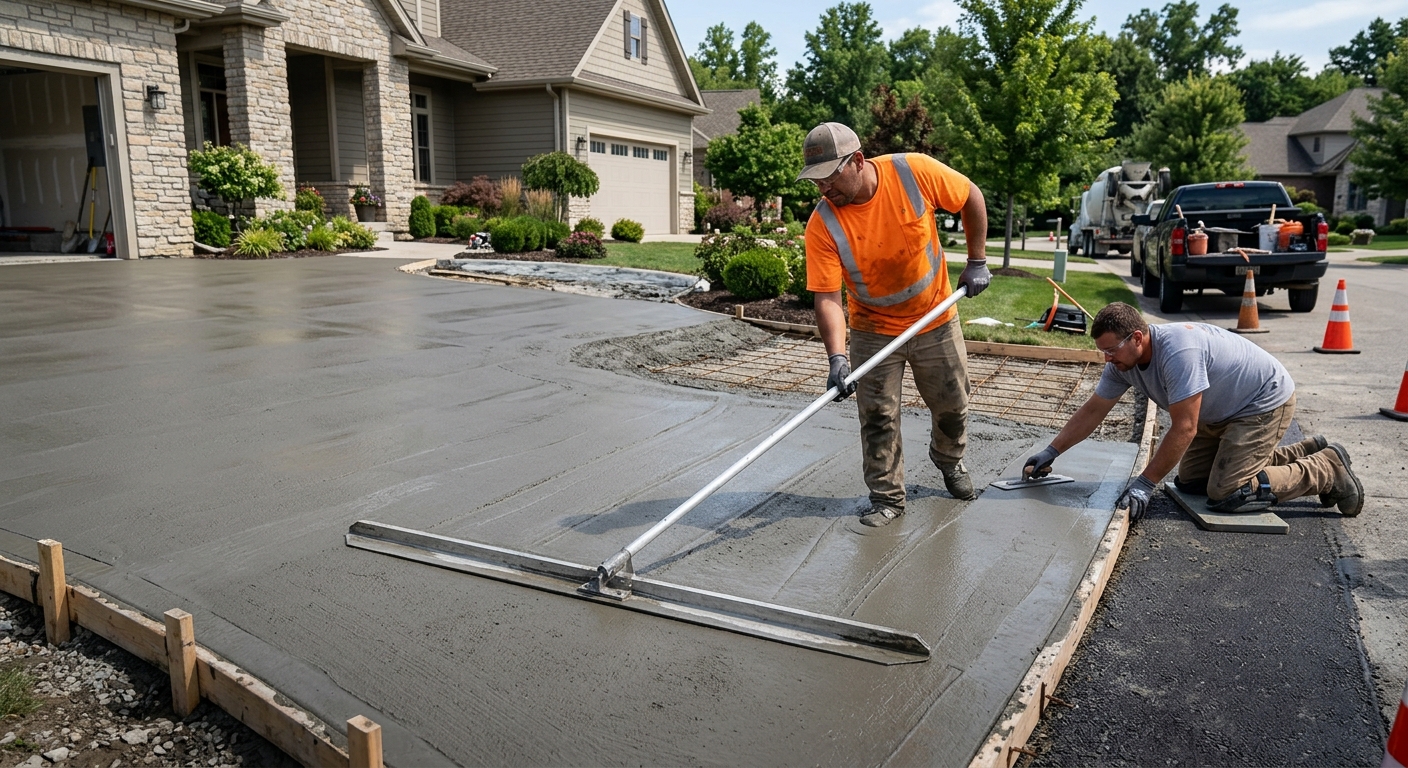
Concrete work options and costs in Brockville
Brockville is a classic Ontario small-city market where homeowners commonly invest in durable concrete for driveways, patios, and foundations—especially because so much of the housing stock is older. In fact, 47.5% of dwellings in the broader local profile are single-detached homes, and 71.6% of homes were built before 1981 (Statistics Canada, 2021 Census). That matters: older properties often have settled soil, dated drainage, and driveway slopes that need correction before we ever place concrete, which drives excavation and base costs.
In the Kingston–Pembroke region, pricing is influenced less by “the slab” and more by site conditions and weather windows. Frost and repeated freeze-thaw cycles mean footings must be set below frost to prevent heave, and exterior flatwork should be air-entrained to reduce spalling. The shorter warm-weather pour season also affects labour and scheduling, so contractors in areas like the west end near Parkview Heights and around the Perth Road corridor often book quickly for spring and early fall work.
The next step is comparing common options side-by-side—so you can see where the price differences come from (excavation, reinforcement, finishing complexity, and delivery distance), then align your selection with how you’ll use the space.
| Application |
Typical Size |
Key Spec |
Finish Option |
Price Range |
| Concrete driveway (standard broom finish) |
400–600 sq. ft. |
Air-entrained exterior mix, compacted granular base |
Broom finish with control joints |
$120–$180 |
| Exposed aggregate driveway |
400–600 sq. ft. |
Air-entrained exterior mix, proper curing |
Exposed aggregate with sealer-ready surface |
$150–$220 |
| Stamped concrete driveway or patio |
300–500 sq. ft. |
Air-entrained exterior mix, integral colouring |
Stamp pattern + colour hardener (or integral) |
$160–$280 |
| Plain concrete patio or walkway |
150–300 sq. ft. |
Air-entrained mix where exterior, compacted base |
Float + broom edge (or lightly textured) |
$90–$150 |
| Garage floor (interior slab) |
400–600 sq. ft. |
Thickness based on use, vapour barrier typically used |
Standard finish, saw-cut joints |
$125–$190 |
| Foundation footings (structural, below frost) |
Per linear foot (typical homes) |
Engineered reinforcement + excavation below frost depth |
Structural concrete grade per drawings |
$180–$320 |
Prices are estimates only and vary by project scope, site access and material selection.
What affects the price of concrete work in Brockville
In Brockville and across the Kingston–Pembroke region, two quotes for what looks like the same concrete job can swing by 30–50% because the “slab” line item hides the heavy drivers: excavation, base prep, reinforcement, forming, delivery distance, and how much finishing detail you request. Even when labour rates are similar, contractors in different parts of Ontario can have different scheduling constraints and concrete delivery costs, and those ripple into the final total.
Start with frost line depth and freeze-thaw cycles. Ontario practice generally requires footings set around 1.2 m below grade (and sometimes deeper depending on design and soil), and exterior flatwork should use air-entrained concrete so the freeze-thaw cycle doesn’t scale the surface. In colder stretches of the region, pours need stronger cold-weather discipline (insulating blankets, temperature control), which adds labour and equipment cost. Salted winters also accelerate surface damage; that’s why sealing—applied after cure—becomes part of a long-term plan.
In Brockville, cost can be higher when you’re regrading an existing driveway for drainage or when the soil is wet and needs undercut and additional granular base. It can be lower on a straightforward, open-access backyard where we can place a plain patio and keep excavation minimal. As a quick reality check: a plain exterior patio or walkway often lands near the $90–$150 range, while stamped work typically pushes toward $160–$280 because colouring, stamping, and sealing add time and materials.
Finally, consider housing age. With 71.6% of homes built before 1981 (Statistics Canada, 2021 Census), many properties have older drainage patterns—meaning contractors often spend more on removal, prep, and base correction before the concrete goes down.
| Price Factor |
Why It Matters |
Cost Impact |
| Frost line depth |
Determines footing depth and required form height |
Higher excavation and concrete volume; can shift structural pricing significantly |
| Site preparation |
Excavation, grading and compacted granular base affect stability |
Wet/rocky sites increase labour and disposal, often driving 15–30% swings |
| Reinforcement |
Rebar or wire mesh depends on loads and slab design |
Adds material and labour; required reinforcement prevents premature failure |
| Mix design |
Air-entrainment and specified strength targets exterior durability |
Better mix costs more but reduces spalling risk in winter conditions |
| Finish type |
Broom vs. stamped vs. exposed aggregate requires different labour and materials |
Stamped/exposed typically lift costs into the higher price bands |
| Pour size and concrete truck access to site |
Access affects placement speed and whether we need pumping |
Poor access can add labour hours or equipment rental |
| Cold-weather curing precautions |
Heating and insulating blankets protect strength gain |
Seasonal adjustments can add noticeable dollars during shoulder months |
| Control joint pattern and sealing cost |
Joints and sealing manage cracking and winter salts exposure |
Proper jointing and sealer support long service life |
Permits & regulations in Ontario
In Ontario, concrete work is treated differently depending on whether it’s part of a structure or simply improving exterior surfaces. Structural concrete—specifically footings, foundation walls, grade beams, and other elements that support the building—requires a building permit, and engineered drawings are often reviewed by the municipality. Concrete flatwork (patios, walkways, and most driveways) typically does not require a permit on its own, unless the work affects lot grading, impervious surface coverage limits, or involves work within or near the municipal right-of-way.
For Brockville homeowners, the safest approach is a quick permit check before excavation—especially if you’re changing drainage, raising/reshaping a driveway, or tying into a foundation. Also verify the contractor’s protections: liability insurance and WSIB/WCB coverage (workers’ compensation). Ask for references on similar-scale concrete projects and confirm the crew can handle excavation, base prep, and curing in Ontario’s temperature swings.
How to verify things step-by-step:
- Check the contractor’s business information on Ontario’s licensing/registry resources (use the exact legal name on the quote/contract).
- Request a certificate of insurance for liability showing current coverage and the correct insured party.
- Ask for proof of WSIB/WCB coverage (or an acceptable coverage status letter).
- Confirm the permit process in writing if the scope touches structural elements or grading/impervious rules.
- Require a written scope and schedule so work isn’t rushed during cool shoulder-season weather.
That verification protects you from delays and ensures the job is built to Ontario expectations.
Getting concrete right in Brockville's freeze-thaw climate
Brockville concrete problems almost always come back to four things: weak sub-base, poor mix selection, inadequate control jointing, and rushed curing. In freeze-thaw conditions, water movement is the enemy—if the base isn’t compacted to the right depth and drainage isn’t addressed, voids form and the slab loses support. If the mix isn’t air-entrained, water can freeze within the paste and expand, leading to surface scaling (spalling) and progressive deterioration.
To spec the job correctly for this Kingston–Pembroke market:
1) Base preparation: install a compacted granular sub-base to the design frost/soil conditions, with proper grading so water doesn’t pond under or next to the slab.
2) Mix design: use air-entrained concrete (typically 5–7% air content for exterior flatwork) and specify a minimum 32 MPa compressive strength unless drawings call for more.
3) Control joints: add saw-cut or formed joints at a spacing that limits random cracking and provides a predictable crack location.
4) Curing: allow at least 7 days of curing under suitable conditions; in cool weather, contractors may need blankets or temperature control so the slab achieves early strength.
5) Sealing: apply a penetrating sealer about 28 days after placement (after proper cure) to repel moisture and de-icing salts.
Ask the contractor how they prevent spalling: what air-entrainment target they use, how joints are laid out, and how curing is protected during Brockville’s shoulder-season temperatures. As a dollar example, upgrading from a basic patio to a stamped driveway isn’t just “pretty”—stamped work often costs about $160–$280 per sq. ft. equivalent for the added colouring and finishing time, while a plain exterior walkway may be closer to $90–$150. If you want durability first (especially if you park vehicles), spend on base prep, mix, and joints before you spend on decorative steps.
| Spec |
Why It Matters in Brockville |
What to Ask For |
Impact if Skipped |
| Compacted granular base (depth?) |
Provides firm support and reduces water-related movement during freeze-thaw |
Base thickness for your site conditions + compaction method |
Settling and cracking; uneven slabs and premature surface failure |
| Air-entrained concrete mix (target air %?) |
Reduces freeze-thaw damage in Ontario winters and during de-icing seasons |
Target 5–7% air content for exterior flatwork |
Higher risk of spalling and scaling within a few winters |
| Compressive strength (MPa rating) |
Ensures structural integrity and strength gain under local curing conditions |
Minimum 32 MPa (or higher if specified) |
Weak early strength, surface wear, and longer-term durability issues |
| Control joints (spacing per ACI guidelines) |
Controls where cracks form as the slab shrinks and expands |
Joint spacing and layout plan before pour |
Random cracking and wider, dirt-trapping fractures |
| Minimum 7-day curing period |
Critical in cool, damp Brockville weather for achieving strength |
How curing will be maintained (blankets/heating if needed) |
Surface damage from early traffic and reduced durability |
| Penetrating sealer (when applied after cure) |
Helps repel water and de-icing salt exposure |
Sealer application timing around 28 days post-pour |
Faster scaling/spalling and more frequent maintenance |
How to choose a concrete work contractor in Brockville
Choosing the right contractor is mostly about proof. In Brockville, your concrete is going to face Ontario freeze-thaw cycles and salted winters, so you want a crew that follows correct specs—not shortcuts. Start with licensing/registration: verify the contractor is properly registered for the work and business name on your quote. Next, confirm liability insurance by requesting an up-to-date certificate of insurance. Then check WSIB/WCB coverage: ask for proof and confirm it covers the crew performing the work.
For quotes, don’t settle for “lump sum with no details.” Get 2–3 itemised written quotes showing labour and materials breakdown (excavation, granular base, reinforcement, concrete supply, finishing, sealing, and any protection for nearby property). Also read exclusions: is disposal included for removed soil and old concrete? Is permit pulling included where required? Is concrete delivery distance accounted for? Are pumps/extra labour required for access?
Warranty matters too. Ask for workmanship warranty length and whether it covers surface scaling, joint failure, or settlement issues. Separate workmanship from manufacturer/product warranties and confirm whether any product warranty is transferable to you as the homeowner.
Payment scheduling should be conservative. Avoid paying more than 10–15% upfront, and use a holdback until the job is complete and cured per schedule. Finally, insist on a written start date and completion estimate so the pour isn’t pushed into unfavourable weather without protection.
- Ask for the air-entrainment target and the concrete compressive strength spec in writing.
- Request base prep details: excavation depth, granular type, and compaction method.
- Confirm reinforcement plan (mesh/rebar) based on the slab’s intended load.
- Require control joint spacing and a joint layout sketch before placement.
- Ask how curing will be protected (especially during cool shoulder-season weather).
- Clarify whether sealing is included and the timing (typically ~28 days after cure).
- Verify liability insurance certificate is current and lists the correct insured party.
- Verify WSIB/WCB coverage for the workers who will be on-site.
- Request references for projects in Brockville or nearby Kingston–Pembroke towns with similar access constraints.
- Ensure the quote states what happens with removal, disposal, and restoration (topsoil, grading).
- Confirm concrete delivery method and whether pumping is included if needed.
- Get everything in writing: scope, schedule, warranty terms, and payment milestones.
Concrete red flags I see too often in Brockville: vague scopes (“we’ll do what’s needed”), no mention of air-entrainment or joint spacing, quotes that don’t account for excavation and base prep, requests for large upfront payments, and contractors who can’t clearly explain curing/curing protection for cool weather.
Frequently asked questions — concrete work in Brockville
How do I seal concrete to protect it in Brockville?
In Brockville and across Ontario, sealing is mainly about repelling water and de-icing salt so freeze-thaw damage doesn’t speed up surface scaling. For exterior flatwork, plan to seal a bit after the slab has fully cured—often around 28 days post-pour—so you don’t trap moisture under the sealer. Use a penetrating sealer meant for concrete (rather than a film-forming coating) and apply it when temperatures and conditions suit the product label.
If your driveway or patio is in constant salt exposure, sealing becomes a smart maintenance step even when the concrete mix is correct. If you’re budgeting, a plain patio or walkway is often in the $90–$150 range, but adding sealing and proper curing discipline can protect that investment for years.
What is the difference between concrete and cement?
People often use the terms interchangeably, but there’s a real difference. Cement is one ingredient—usually Portland cement—that acts as the binder. Concrete is the full mix: cement plus water, sand, stone (aggregate), and sometimes admixtures like air-entrainment for freeze-thaw durability. When contractors talk about using an air-entrained mix for Brockville winters, they’re talking about the concrete mix design, not only the cement.
This matters when you’re comparing quotes: the concrete spec (air content, strength such as 32 MPa minimum for typical exterior flatwork, and curing requirements) is what impacts long-term performance. If a quote focuses only on “cement quantity” or uses vague wording, ask for the actual mix specs and targets. In the Kingston–Pembroke region, those details are especially important because of repeated freeze-thaw cycles and the way salt accelerates surface wear.
How much does concrete work cost in Brockville?
Concrete costs in Brockville depend on scope and site conditions, but you can use local price bands to sanity-check quotes. For example, a plain patio or walkway commonly falls around $90–$150, while standard broom-finish exterior driveways are often closer to $120–$180 once excavation and base prep are included. Stamped work is typically higher—often in the $160–$280 range—because colouring, stamping, tighter finishing tolerances, and sealing add time and materials.
Structural work like foundation footings is priced differently, often in the $180–$320 range per linear-foot equivalent depending on engineered requirements and how deep we must excavate below frost. Because 71.6% of homes in the local profile were built before 1981 (Statistics Canada, 2021 Census), many projects include drainage and prep corrections that can increase costs compared with “easy” installs.
How deep must footings be for Brockville's frost line?
For Brockville, footing depth is driven by frost protection and local design conditions. Ontario practice commonly sets footings around 1.2 m below grade to get below the design frost depth, but your engineered foundation details and soil conditions can push that deeper. The goal is to prevent frost heave by placing the footing in ground that won’t repeatedly freeze and thaw.
When you’re comparing foundation quotes, don’t accept “standard depth” language. Ask whether the footing depth matches the drawings and how the excavation is measured, and whether the contractor plans for proper base and drainage. This is especially important in older neighbourhoods with existing drainage patterns—settled soil and moisture can change how the excavation and base prep need to be handled, affecting both cost and performance.
Why does concrete crack in Brockville and how is it prevented?
Concrete cracks for predictable reasons: shrinkage as it cures, temperature movement, and how the slab is supported by the base. In Brockville’s freeze-thaw climate, cracks can worsen if water gets into them, and de-icing salt can accelerate surface breakdown. The best prevention is not “never crack”—it’s controlling where cracks occur and ensuring the slab is stable.
Proper base preparation and reinforcement support reduce movement. Control joints—placed at appropriate spacing—give the slab a planned crack path. Air-entrainment and correct curing improve durability, reducing surface scaling/spalling during winter cycles. Finally, sealing after cure helps limit water and salt intrusion. If your contractor can’t explain their joint spacing and air-entrainment targets, that’s a strong sign the prevention plan is weak.
Stamped vs broom-finish concrete — cost difference?
Stamped and broom-finish concrete differ mainly in labour and finishing complexity. A broom-finish driveway is relatively straightforward: finish the surface, apply edging, and add saw-cut control joints. That tends to price around $120–$180 for many driveway scopes in Brockville once excavation and base prep are handled.
Stamped concrete requires more steps: colour hardener or integral colouring, stamping mats, careful texturing to keep patterns consistent, and additional sealing. That’s why stamped driveways or patios often land in the higher $160–$280 range. You’ll pay for aesthetics, but you should still expect the same durability fundamentals (air-entrained mix, correct joints, disciplined curing). If the contractor tries to cut durability steps to hold the decorative price, that’s not a bargain—it’s a future repair risk.