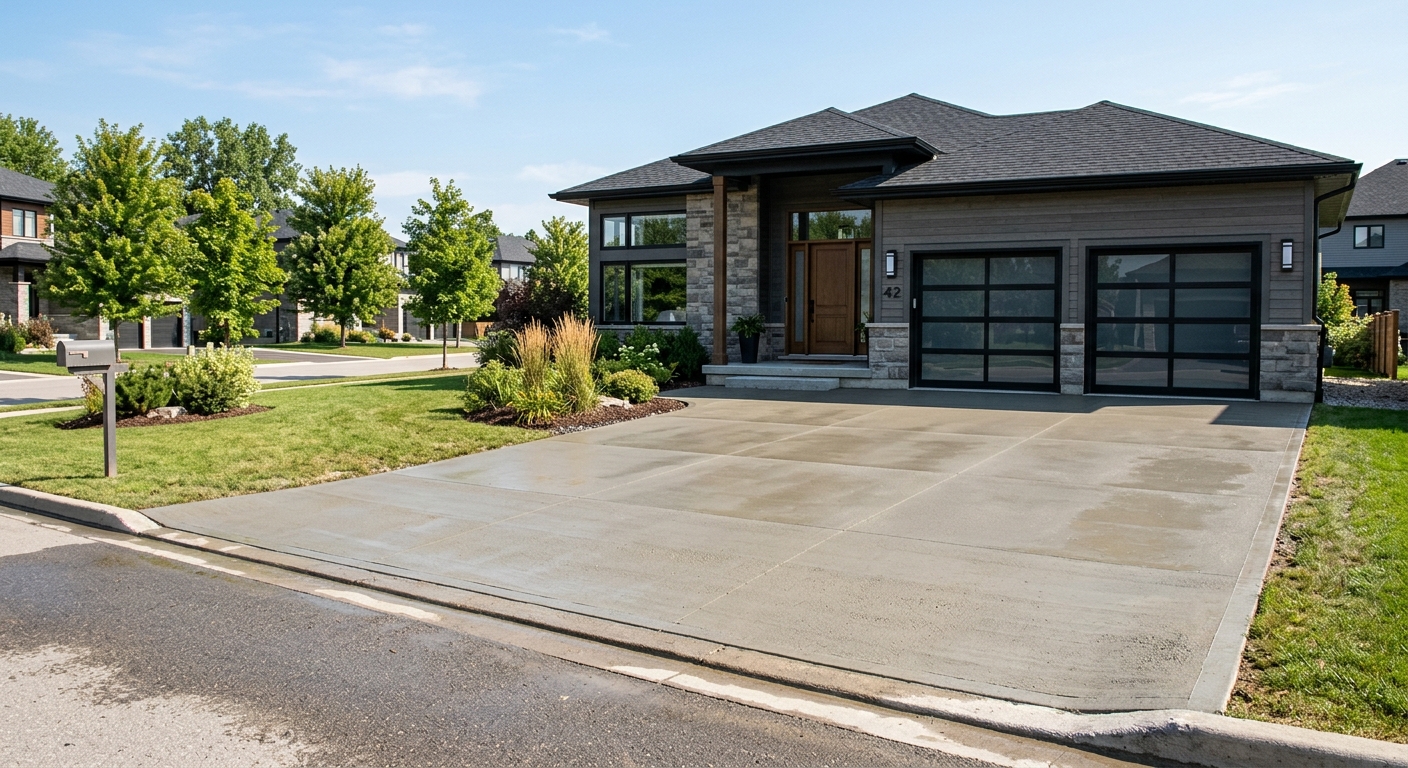
Concrete work options and costs in Delhi
Concrete work in Delhi, Ontario is mainly driven by how exterior flatwork and foundations must hold up through Ontario’s freeze–thaw cycles. With a population of 5,344 (Statistics Canada, 2021 Census), Delhi is a smaller market, so crews often coordinate jobs around the same limited pour windows used across the Toronto economic region. That timing and the availability of experienced finishers can influence pricing and scheduling. In the Toronto area, many homeowners are dealing with long-established neighbourhoods and frequent renovation work, which keeps demand steady for driveways, patios, and walkways—typically one of the first upgrades people notice at curb appeal sites in places like the Westfield and downtown-adjacent areas of Delhi.
When you compare options, the Toronto-market climate matters: contractors in this region design for frost protection (most structural footings extend to at least 1.2 m below grade) and use air-entrained concrete on exterior slabs to reduce spalling during winter. Exterior flatwork also needs solid drainage and well-compacted granular base, because saturated soils can expand and contract each winter against the slab. On top of that, finishing complexity changes the labour hours: a simple broom finish is faster than exposed aggregate or stamped work, and basement/footing work involves excavation, formwork, and inspection-ready installation.
Use the table below to benchmark common project types, then we’ll break down the exact factors that swing quotes so you can compare apples-to-apples.
| Application |
Typical Size |
Key Spec |
Finish Option |
Price Range |
| Concrete driveway (standard broom finish) |
16 ft x 20 ft (320 sq ft) |
Air-entrained mix, compacted granular base, control joints |
Broom (slip-resistant) |
$18,000–$28,000 |
| Exposed aggregate driveway |
16 ft x 20 ft (320 sq ft) |
Air-entrained mix, proper retarder timing, good curing |
Exposed aggregate (washed surface) |
$24,000–$34,000 |
| Stamped concrete driveway or patio |
300–400 sq ft |
Air-entrained mix, release agent, proper curing to reduce surface issues |
Stamp with colour hardener |
$24,000–$40,000 |
| Plain concrete patio or walkway |
300 sq ft (typical) |
Compacted base, drainage pitch, air-entrained exterior mix |
Float + broom |
$16,000–$26,000 |
| Garage floor (interior slab) |
20 ft x 20 ft (400 sq ft) |
Vapour barrier (as required), steel reinforcement/wire mesh, proper thickness |
Plain trowel finish |
$2,800–$6,200 |
| Foundation footings (structural, below frost) |
Typical single-family footings (project-specific) |
Engineered forms/reinforcement, frost-depth setting, inspection-ready build |
Structural concrete work (not decorative) |
$180,000–$300,000 |
Prices are estimates only and vary by project scope, site access and material selection.
What affects the price of concrete work in Delhi
In Delhi, Ontario, quotes for what looks like the same concrete job can vary by 30–50% depending on the hidden details: how deep the base is, how much reinforcement is required, whether cold-weather protection is needed, and how complicated the finishing is. In the Toronto economic region, contractors also price in risk—freeze–thaw cycles are relentless here, and poor drainage or under-spec’d mixes can lead to early cracking and spalling, which triggers rework costs. That’s why you’ll see different line items even when the final “square footage” looks similar.
For exterior pours, frost depth and freeze–thaw cycles dictate the specs. In Ontario, structural footings generally extend at least 1.2 m below grade (often deeper based on soil and design), and all exterior slabs should use air-entrained concrete mixes to survive repeated winter cycles. When temperatures drop toward about 10 °C or below, contractors plan for cold-weather curing precautions—insulating blankets or controlled heating—which adds labour and materials. De-icing salts also accelerate surface scaling, so sealing and surface protection at the right time becomes part of long-term durability.
Cost can go up or down in Delhi for practical reasons. For example, a driveway replacement on a narrow lot often needs extra saw-cutting, haul-off, and a staged pour because truck access is limited. Conversely, a straightforward patio on native-suitable soil with good existing drainage can reduce excavation and base thickness, keeping costs closer to the driveway/slab range of about $18–$28 per sq ft. If you choose decorative stamped concrete or exposed aggregate, expect higher labour and material—often closer to the $24–$40 per sq ft decorative band—because finishing time and crew skill are the difference, not just the concrete.
| Price Factor |
Why It Matters |
Cost Impact |
| Frost line depth — determines footing depth and form height |
Footings must sit below design frost depth to limit frost heave and settlement |
Can swing foundation/footing scope significantly; deeper excavation increases labour and material |
| Site preparation — excavation, grading, compacted granular base |
Proper drainage and base compaction reduce voids that pump under freeze–thaw |
Major driver when soil is soft, saturated, or when new base thickness is required |
| Reinforcement — rebar or wire mesh requirement |
Helps control cracking and supports loads for driveways and structural work |
Extra material + placement time; often increases cost more than homeowners expect |
| Mix design — air-entrainment and compressive strength spec |
Air entrainment improves freeze–thaw durability of exterior concrete |
Higher-spec concrete costs more and needs careful batching/handling |
| Finish type — broom vs. stamped vs. exposed aggregate |
Finish complexity affects labour hours and timing of the process |
Decorative work can move you from basic to premium pricing bands |
| Pour size and concrete truck access to site |
Access affects pumping vs. truck placement, and determines pour speed |
Limited access can require smaller loads, extra crew time, or pump charges |
| Cold-weather curing precautions — heating and blankets |
Temperature affects hydration; poor cure increases cracking/spalling risk |
Adds labour, equipment, and sometimes longer site scheduling |
| Control joint pattern and sealing cost |
Joints control where cracks form; sealing protects against de-icing salt scaling |
Can add cost but often prevents expensive early repairs |
Permits & regulations in Ontario
In Ontario, the rules come down to whether the concrete work is structural and impacts the building’s regulated systems. Structural concrete work—such as foundation footings, foundation walls, and grade beams—typically requires a building permit, and engineered drawings are often reviewed as part of the approval process. For homeowners in Delhi, that means the municipality (via the local building department) expects compliance before excavation and before pours. Concrete flatwork like patios, walkways, and driveways usually does not require a permit by itself, but it can trigger review if it affects lot grading, drainage patterns, or impervious surface coverage limits, or if the work is within a municipal right-of-way.
Before you sign anything, confirm the scope: ask whether your contractor will pull any required permits and whether the engineered design is included where needed. Also verify that the contractor carries liability insurance and WSIB/WCB coverage—this is non-negotiable for a safe, compliant job.
How to check contractor coverage step-by-step:
- Request a certificate of insurance (COI) showing current general liability.
- Verify workers’ compensation coverage (WSIB or WCB registration/clearance as applicable) and ask for proof.
- Confirm the company’s legal standing and contractor credentials through Ontario’s online resources and any trade registry listings the contractor provides.
- Ask for references on similar footing/flatwork projects in Ontario, not just showroom photos.
- Keep everything in writing: what’s included, what’s excluded, and any inspection steps.
Getting concrete right in Delhi's freeze-thaw climate
Delhi’s winter is hard on concrete, and the most common failures are the ones you can prevent with correct specs: surface scaling/spalling from inadequate air entrainment, random cracking from missing or poorly spaced joints, and slab movement caused by a weak or saturated base. In the Toronto area, the repeated freeze–thaw cycle forces concrete to expand and contract repeatedly; if the slab can’t drain and the base isn’t built to handle moisture, you’ll often see early deterioration—especially where de-icing salt is used.
To spec the job correctly, start with (1) base preparation: compacted granular sub-base to the required depth for local soil and frost conditions, with proper grading and drainage pitch. Next, (2) mix design: exterior flatwork should be air-entrained (commonly targeting about 5–7% air content for durable performance) and designed for at least a 32 MPa minimum compressive strength. Then (3) control joints: plan the joint pattern to limit random cracking and align joints with logical sections. (4) curing: aim for at least 7 days of proper curing conditions; in cold snaps, contractors should protect the pour with insulated blankets or heat to keep hydration on track. Finally, (5) sealing: apply a penetrating sealer after cure—often around 28 days post-pour—to repel de-icing salts and water.
A good example of where cost makes sense: if a driveway bid is lower by a few thousand dollars because it uses a thinner base or omits sealing, you may save short-term but pay later for surface repairs. In Toronto-market pricing, the difference between a basic broom driveway and a decorative option can be several dollars per square foot, and that premium is justified when it includes the same durable base, proper joints, and correct air-entrained mix—otherwise decoration just highlights the problem.
| Spec |
Why It Matters in Delhi |
What to Ask For |
Impact if Skipped |
| Compacted granular base (depth?) |
Helps control moisture and movement during Ontario freeze–thaw |
Confirm base depth and compaction requirements based on your soil and frost conditions |
Voids and pumping can cause settlement, cracking, and uneven slab surfaces |
| Air-entrained concrete mix (target air %?) |
Reduces freeze–thaw damage and spalling risk |
Ask for air content target (typically 5–7% for exterior flatwork) |
Accelerated spalling/scaling within a few winters |
| Compressive strength (MPa rating) |
Ensures the concrete reaches the performance needed for loads and durability |
Confirm minimum compressive strength (commonly at least 32 MPa) |
Higher chance of wear, cracking, and premature surface deterioration |
| Control joints (spacing per ACI guidelines) |
Controls where cracks form when concrete shrinks |
Ask for joint spacing plan and where joints will be cut |
Random cracking and wider cracks that admit water |
| Minimum 7-day curing period |
Strength development depends on proper curing, especially in cool weather |
Confirm curing method and protection plan if temps drop |
Lower strength and higher shrinkage cracking risk |
| Penetrating sealer (when applied after cure) |
Repels moisture and de-icing salts that drive surface scaling |
Ask for a penetrating sealer and timing (often around 28 days post-pour) |
More scaling and surface breakdown over winter seasons |
How to choose a concrete work contractor in Delhi
Choosing a concrete contractor in Delhi, Ontario should start with compliance and proof, not just price. In Ontario, verify the contractor’s workers’ compensation coverage (WSIB/WCB) and request a certificate of insurance for general liability. Then confirm their credentials using Ontario’s available online resources, and ask for a clearance/coverage letter or documentation that matches your project’s timing. A reputable crew will also carry themselves like an established business: they’ll provide references, show similar Ontario projects, and answer technical questions about base prep, mix design, and curing.
Next, ask for 2–3 itemised written quotes. You want a breakdown that separates labour and materials (concrete volume, granular base, reinforcement, formwork, saw-cutting/joints, sealing, and disposal/haul-off). Watch for omissions like “concrete only” or vague exclusions. For example, clarify whether permits are included (where required), whether traffic control or driveway removal/restore is part of the scope, and what happens with excess soil.
Warranty matters in concrete because outdoor flatwork is exposed to winter. Ask for the workmanship warranty length, whether a product/manufacturer warranty applies, and whether it transfers to you if you sell the home. For payment scheduling, never pay more than 10–15% upfront, and hold back a portion until the work is complete and cleaned up. Finally, get a start date and completion estimate in writing; Toronto-area pour scheduling can be tight in warmer months.
- Request liability insurance COI and confirm it’s active for the project dates.
- Verify WSIB/WCB coverage with proof (clearance/registration documentation).
- Ask who supplies the concrete and whether air entrainment is specified for exterior work.
- Confirm base depth, compaction method, and drainage pitch in writing.
- Require a joint plan: spacing and where joints will be cut.
- Ask how they’ll handle cold-weather risk (blankets/heating) if temperatures fall.
- Get an itemised quote: labour vs materials vs disposal/haul-off.
- Clarify exclusions (tear-out, grading, sub-base replacement, sealing, waterproofing ties).
- Confirm reinforcement details (wire mesh vs rebar) based on the application.
- Ask about curing and protection time before traffic/load is allowed.
- Confirm whether sealing is included and the expected timing after cure (e.g., after ~28 days).
- Review timeline: a clear start date, pour day window, and completion date.
Concrete red flags I see in Delhi include: quotes that don’t mention air-entrained mix for driveways/patios, “one-size-fits-all” joint spacing, no plan for base compaction and drainage, a contractor asking for large upfront payments, and finishing promises that ignore curing protection when nights cool down.
Frequently asked questions — concrete work in Delhi
How long does concrete take to cure?
In Ontario (including Delhi), concrete has two timelines: it gains strength quickly, but it still continues to hydrate for weeks. You can often walk on a typical residential slab after 24–48 hours, depending on temperature and mix, but that’s not the same as full strength. For most exterior flatwork, contractors plan for at least a 7-day curing period for adequate strength development before stressing the surface, and many durability steps like sealing are scheduled after about 28 days post-pour. With Delhi’s freeze–thaw climate, curing protection matters—if temperatures drop toward 10 °C or below during a pour window, experienced crews use insulated blankets or heating so hydration isn’t interrupted. If you’re comparing quotes, ask what their curing and protection plan is and whether it’s written into the scope.
Do I need a permit for concrete work in Ontario?
In Ontario, the permit requirement mainly depends on what the concrete is doing. Structural concrete like foundation footings, foundation walls, and grade beams typically requires a building permit and may include engineered drawings reviewed by the municipality. For most driveway and patio work in Delhi, a permit usually isn’t needed unless your project affects lot grading, drainage patterns, impervious surface limits, or a municipal right-of-way. The safest approach is to call the local building department before breaking ground and ask what applies to your exact scope. Also confirm with your contractor that they will pull any permits required for structural elements, and that they carry liability insurance and WSIB/WCB coverage—those proofs reduce your risk and help keep inspections on track.
Concrete vs pavers for a patio in Delhi?
Concrete and pavers can both be great in Delhi’s Ontario winters, but they fail differently. Concrete patio slabs need correct base prep and air-entrained mix; when done right, they’re durable and lower in routine maintenance. Pavers offer easier localized repairs—if one unit fails, you may be able to replace a few blocks rather than saw-cutting a whole panel. Price-wise, plain concrete patios commonly fall in the $16–$26 per sq ft band, while pavers often cost more once you factor in excavation, edging, and labour. If your soil is prone to moisture or drainage is tricky, pavers sometimes look appealing, but you still need a well-compacted base for both systems. Ask contractors how they’ll address drainage pitch, jointing, and water management regardless of the material you choose.
How long does a concrete driveway last?
A well-built driveway in Delhi can last 20–30 years or more, but that depends on the details that handle freeze–thaw. The biggest early-life risks are inadequate air entrainment, thin base preparation, poor drainage, and skipping sealing where de-icing salts are used. Ontario’s winter cycles cause expansion and contraction; if water gets underneath or the slab isn’t detailed with proper joints, you’re more likely to see scaling or cracking earlier. A broom-finished driveway typically sits in the $18–$28 range for driveway/slab work in the Toronto economic region, and paying for correct base depth and a control joint plan often costs less than replacing a failed section later. For long life, ask about air entrainment, joint spacing, curing steps, and whether penetrating sealer is included after cure.
What is air-entrained concrete and why does it matter here?
Air-entrained concrete is mixed to include tiny, evenly distributed air bubbles that help the paste tolerate freeze–thaw stress. In Delhi and across Ontario’s Toronto economic region, that durability is critical because repeated winter freezing and thawing can push water pressure through the slab and break down the surface—leading to spalling and scaling. For exterior flatwork, contractors commonly target air contents in the 5–7% range and specify a minimum compressive strength (often at least 32 MPa) so the concrete can perform under both loads and weather. If a quote doesn’t clearly mention air entrainment for your driveway or patio, treat it as incomplete. A small spec difference can prevent big repair costs down the road.
How do I prepare the base for a concrete slab?
Base preparation is where concrete performance is made or lost in Ontario’s climate. For a Delhi slab, contractors should excavate to the proper depth, remove unsuitable material, and install a compacted granular sub-base with correct grading for drainage. The goal is to build a stable, well-drained layer that won’t pump moisture during freeze–thaw cycles. Ask your contractor what base depth they’re using, what granular material is specified, and the compaction method. They should also confirm the slab thickness and reinforcement plan for the application (driveway vs walkway vs interior garage). For exterior pours, air-entrained mix and control joint placement work together with the base—joints limit cracking, but the base prevents movement that widens cracks and allows water in. Get these items confirmed in writing before the pour day.