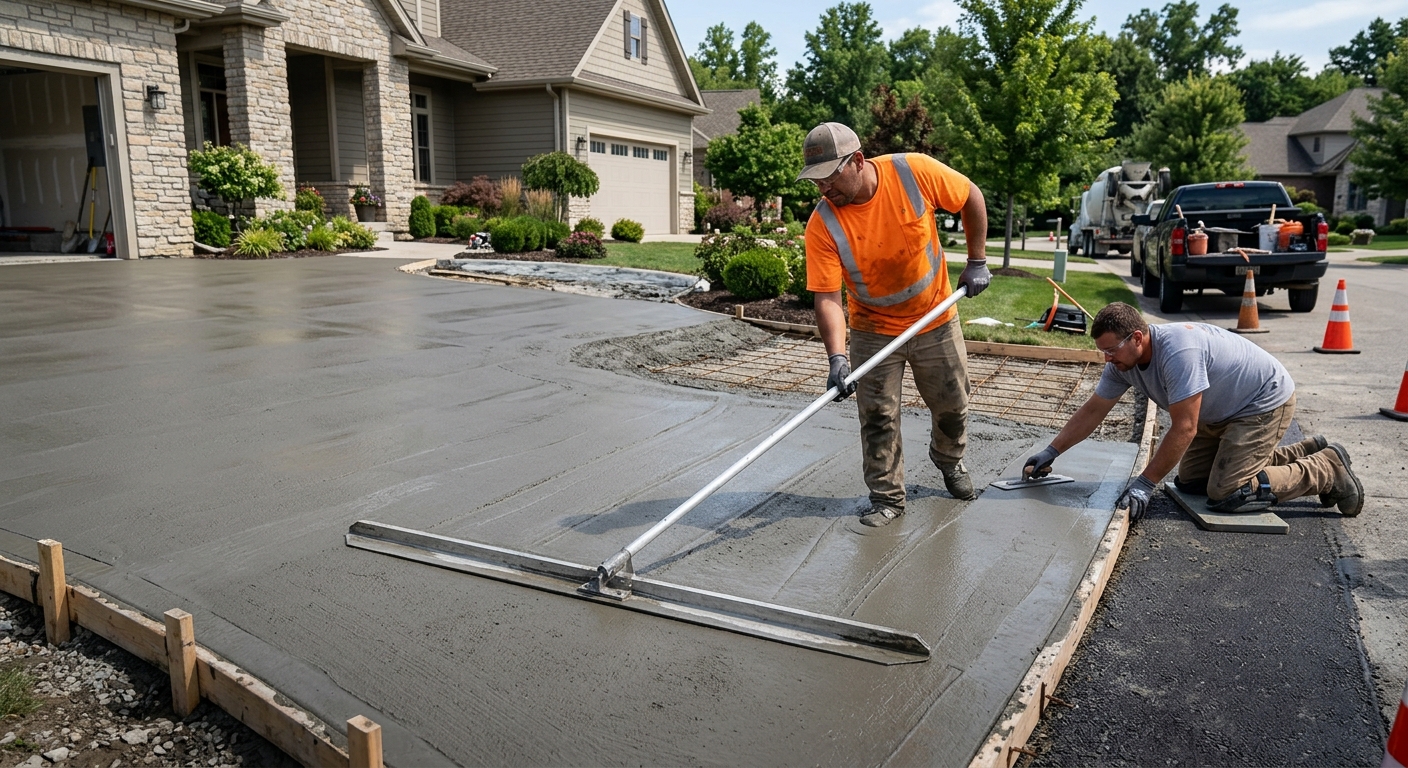
Concrete work options and costs in Tecumseh
Tecumseh homeowners typically choose concrete for driveways, patios, walkways and even interior slabs because the area is largely made up of single-detached homes—81.1% of dwellings in the municipality (Statistics Canada, 2021 Census). With 88.8% of households owning their homes, there’s steady demand for long-lived, low-maintenance surfaces that can handle Southwestern Ontario’s winter conditions. Windsor–Sarnia also has a lot of older housing stock; 40.2% of homes were built before 1981 (Statistics Canada, 2021 Census), and that matters when you’re retrofitting drainage, re-leveling settlement-prone approaches, or matching existing elevations.
In the Tecumseh/Windsor–Sarnia belt, the cold, lake-influenced climate drives cost. Contractors have to design around freeze–thaw cycles: exterior slabs and walks need air‑entrained concrete, base materials must be well-compacted and drained, and footings are typically kept below the frost line to reduce the risk of frost heave. The pour season is effectively shorter, so spring and fall work may require heaters, insulating blankets, or admixtures to protect early-age strength gain. Those steps (and the added labour of saw-cut timing for control joints) are why you can see wider price movement than in milder parts of Ontario.
Concrete flatwork is especially in demand in established neighbourhood pockets with lots of driveway and walkway upgrades—many homeowners in and around Tecumseh’s core-area streets (between schools, parks, and older commercial strips) line up for late-summer replacements before winter weather makes patching difficult. Below is a quick comparison of common options and realistic price bands that contractors in this region tend to apply.
| Application |
Typical Size |
Key Spec |
Finish Option |
Price Range |
| Concrete driveway (standard broom finish) |
16 ft x 36 ft (576 sq. ft.) |
Air-entrained exterior mix, compacted base |
Broom finish + control joints |
$5,500–$15,000 |
| Exposed aggregate driveway |
16 ft x 36 ft (576 sq. ft.) |
Air-entrained mix + aggregate exposure process |
Exposed aggregate with sealer-ready finish |
$8,500–$18,500 |
| Stamped concrete driveway or patio |
12 ft x 24 ft (288 sq. ft.) patio or apron |
Air-entrained mix + integral colour |
Stamp pattern + release + sealer |
$7,500–$22,000 |
| Plain concrete patio or walkway |
10 ft x 16 ft (160 sq. ft.) |
Air-entrained mix + proper drainage |
Float/trowel finish with broom or light broom |
$3,500–$9,000 |
| Garage floor (interior slab) |
20 ft x 22 ft (440 sq. ft.) |
Vapour barrier (if specified) + thickened edges |
Smooth trowel or light broom |
$6,500–$16,500 |
| Foundation footings (structural, below frost) |
Typical house perimeter (engineered depth) |
Rebar + engineered excavation depth below frost |
Structural finish (not decorative) |
$12,000–$35,000 |
Prices are estimates only and vary by project scope, site access and material selection.
What affects the price of concrete work in Tecumseh
In Southwestern Ontario, two contractors can quote the “same” concrete driveway and end up 30–50% apart once you factor in climate-driven specs, excavation depth, and labour availability. In Tecumseh (within the Windsor–Sarnia region), frost and moisture are the big cost drivers. Footings must extend below the design frost depth to reduce frost heave, and exterior slabs need air‑entrained concrete to survive freeze–thaw cycles that can scale and crack surfaces when water finds a path. Because the pour season is shorter, spring and fall placements may require heaters, insulating blankets, or admixtures to manage set and early curing—those protections add direct cost and labour time.
De-icing salts compound the problem. Over time, salt exposure and temperature swings can lead to surface spalling if the mix and finishing aren’t matched to exterior exposure. That’s why sealing is often recommended after the concrete cures, and why contractors who build for durability may price higher than those who treat it as basic flatwork. You’ll also see finish-driven differences: a broom-finish driveway tends to land closer to the lower end of the $5,500–$15,000 driveway band, while stamped or exposed aggregate options commonly move toward the $7,500–$22,000 range due to more labour, materials (colour/release), and production time.
Concrete placement in Tecumseh is further affected by local soil and site conditions. For example, if you’re replacing an older driveway built when many homes predate modern base-drainage practices, you may pay more for excavation, granular base depth, and regrading. On the other hand, if you have easy truck access and the grade is already suitable, you can hold costs nearer the bottom of the patio/walkway band ($3,500–$9,000) because you’re not paying for extra haul time, form complexity, or extended curing logistics.
| Price Factor |
Why It Matters |
Cost Impact |
| Frost line depth |
Determines footing depth and form height |
Deeper excavation and more concrete raise total cost; shallow basements aren’t “good enough” in exterior work |
| Site preparation |
Excavation, grading, compacted granular base |
More hauling, base depth and labour can add significant cost—especially on older or poorly drained sites |
| Reinforcement |
Rebar or wire mesh requirement |
Material and placement labour increase cost, but it reduces long-term cracking and spalling risk |
| Mix design |
Air‑entrainment and compressive strength spec |
Exterior-ready mixes cost more per m³, but they’re essential for freeze–thaw durability |
| Finish type |
Broom vs. stamped vs. exposed aggregate |
Stamped/exposed finishes add labour steps, release/colour materials and curing control |
| Pour size and concrete truck access to site |
How far and how many times crews must place/handle concrete |
Tighter access can require smaller pours, more labour, and time delays |
| Cold-weather curing precautions |
Heating and blankets |
Increases cost during shoulder seasons; protects early-age strength so you don’t lose durability |
| Control joint pattern and sealing cost |
Manages cracking location; sealing helps resist salt/moisture damage |
Proper jointing and optional sealer add line items, but reduce future repairs |
Permits & regulations in Ontario
In Ontario, the rule of thumb is that concrete used as part of the structure requires more oversight than concrete used as surface flatwork. Structural concrete work—like footings, foundation walls, grade beams, and any engineered foundation elements—typically needs a building permit, and engineered drawings are often reviewed by the municipality. Concrete flatwork such as patios, walkways and driveways often does not require a permit by itself, unless the work affects lot grading, drainage design, or impervious surface coverage limits, or ties into municipal right-of-way conditions. Even when a permit isn’t required, you still want the contractor to confirm that your proposed elevations and drainage won’t create water issues for neighbouring properties or your foundation.
Before breaking ground in Tecumseh, verify three things: liability insurance, WSIB/WCB coverage, and the contractor’s ability to produce references on similar-scale concrete jobs. Step-by-step, here’s how homeowners can check:
- Confirm the contractor’s business information and licence status through the appropriate Ontario business registry/search tools (the contractor should provide a licence number if applicable to their work scope).
- Request a current Certificate of Insurance and ensure it lists liability coverage appropriate for concrete/excavation work.
- Ask for proof of WSIB coverage (or a clearance/registration document, depending on how they’re structured) and keep a copy for your records.
- Request references for similar projects—driveways, patios, and any structural concrete—then call or view those sites.
If you’re unsure whether your driveway ties into drainage, grading changes, or foundation repair, call the municipality planning/building desk before work starts. It’s cheaper than correcting drainage problems after the slab is in.
Getting concrete right in Tecumseh's freeze-thaw climate
Concrete fails in Tecumseh most often for four reasons: water is allowed to get under/into the slab system, the mix isn’t designed for freeze–thaw exposure, cracking isn’t controlled, and curing is rushed—especially when temperatures swing in spring and fall. To spec the job correctly for the Windsor–Sarnia market, start with base prep: you need a compacted granular sub-base to the right depth and slope so water drains and doesn’t sit under the concrete. Next, focus on mix design. For exterior flatwork, air‑entrainment is critical (commonly targeting 5–7% air content), and crews should use a minimum 32 MPa compressive strength spec so the concrete can build durability rather than just surface appearance.
Control joints must be laid out intentionally and cut on time to limit random cracking, which is how you prevent paths for meltwater and de-icing salts. After placement, curing matters as much as the initial finish. In Tecumseh’s colder season, curing should be protected for at least 7 days under suitable conditions; in shoulder months, that may include blankets or controlled heat so the surface doesn’t weaken before it’s ready. Finally, consider sealing: applying a penetrating sealer after the concrete reaches cure (often around 28 days) helps repel moisture and salts that contribute to scaling/spalling.
Ask contractors these questions: What air content are you targeting, what’s your 7-day cure plan, and when will joints be saw-cut? A practical cost example: a broom-finished patio might sit in the $3,500–$9,000 band, but skipping air‑entrainment or rushing curing can lead to premature surface scaling—meaning you’ll pay again for repairs sooner, erasing any short-term savings.
| Spec |
Why It Matters in Tecumseh |
What to Ask For |
Impact if Skipped |
| Compacted granular base (depth?) |
Prevents water pooling and supports the slab through freeze–thaw cycles |
Granular base thickness and compaction test/standard |
Settlement, voids under slab, higher cracking and scaling risk |
| Air-entrained concrete mix (target air %?) |
Protects concrete from freeze–thaw damage and surface deterioration |
Air content target (commonly 5–7% for exterior flatwork) |
Spalling/scaling, especially with de-icing salts and moisture exposure |
| Compressive strength (MPa rating) |
Ensures durable strength gain for exterior service conditions |
Minimum 32 MPa rating (or higher if specified) |
Weaker surface, reduced lifespan and higher repair likelihood |
| Control joints (spacing per ACI guidelines) |
Limits random cracking so water can’t follow cracks into the base |
Planned joint spacing, layout method, and timing of saw cuts |
Random cracks, more water ingress, faster deterioration |
| Minimum 7-day curing period |
Early-age curing quality directly affects long-term durability |
Temperature protection plan (blankets/heaters if needed) |
Surface weakness, reduced strength gain, cracking |
| Penetrating sealer (when applied after cure) |
Helps resist de-icing salts and moisture cycling |
Sealer type and that it’s applied after cure (often around 28 days) |
Higher risk of scaling and moisture-driven surface wear |
How to choose a concrete work contractor in Tecumseh
Choosing the right concrete contractor in Tecumseh comes down to proof: proof of coverage, proof of experience, and proof that they build for our freeze–thaw reality. First, verify Ontario licensing and insurance. For liability insurance, ask for a Certificate of Insurance showing active coverage and the correct named insured. For WSIB/WCB, request proof of clearance/coverage documentation—don’t rely on verbal statements. If a contractor can’t provide these documents promptly, move on.
Next, ask for 2–3 itemised written quotes instead of a lump sum. A strong quote breaks down labour (excavation, base prep, forming, finishing, jointing, saw-cut timing, curing protection) and materials (air‑entrained mix, rebar/wire mesh, vapour barrier if applicable, sealer allowance). Check what’s excluded: disposal, trucking/shortage charges, excavation depth surprises, saw-cutting of existing concrete, and whether permits (if required for structural work) are included.
Warranty matters in concrete because failures often show up after several seasons. Ask for the length of workmanship warranty, what it covers (cracking vs. spalling vs. replacement), whether it’s tied to product/manufacturer warranties, and whether that warranty transfers to future homeowners.
Finally, payment schedule: avoid paying more than 10–15% upfront. Holdback after completion is reasonable until final grade, cleanup and sealing (if included) are done. Get a start date and a completion estimate in writing—shoulder-season weather can shift schedules, but a professional contractor will explain how they’ll protect curing if temperatures drop.
- Request insurance Certificate of Liability before signing anything.
- Confirm WSIB/WCB clearance/coverage paperwork is current.
- Ask for 3 nearby references from similar Tecumseh projects.
- Insist the quote specifies air‑entrainment and target compressive strength (e.g., 32 MPa minimum).
- Get the joint plan: spacing and saw-cut timing.
- Verify base preparation details (depth, drainage slope, compaction standard).
- Confirm whether heaters/blankets/admixtures are included for cold nights.
- Check disposal/haul-away is included if excavation is required.
- Clarify truck access limits, pump needs, and any extra labour for placement distance.
- Ask if they include sealing for exterior flatwork and when it’s applied (around 28 days after cure).
- Review warranty terms in writing and what triggers it (materials vs. workmanship).
- Set payment milestones tied to completed stages, not “week one of work.”
Concrete red flags I commonly see with less reliable crews in Tecumseh: they can’t explain air‑entrainment for exterior slabs, they start sawing joints too late (or don’t plan joint spacing), they offer a “one-size-fits-all” thickness without base depth details, they rush curing in shoulder months without protection, and they won’t provide insurance/WSIB paperwork or itemised quotes.
Frequently asked questions — concrete work in Tecumseh
Why does concrete crack in Tecumseh and how is it prevented?
Concrete in Tecumseh cracks mostly because of shrinkage, temperature movement, and moisture movement—not because the crew “did it wrong.” In our Windsor–Sarnia climate, freeze–thaw cycles magnify small issues: if water gets into random cracks or if the base isn’t compacted/drained correctly, freeze action can widen pathways and cause scaling. Prevention is spec-based: proper granular base prep, a mix designed for exterior exposure (including air‑entrainment), and a control joint plan that limits cracking to predictable lines. Also, joint timing matters—saw-cut control joints must be cut on schedule so the slab relieves stress before random cracking starts. Contractors who budget for curing protection in cooler seasons typically reduce early-age cracking as well.
Stamped vs broom-finish concrete — cost difference?
Stamped concrete costs more than broom-finish because the process adds labour steps and materials. Broom-finish driveway work is usually the most straightforward: form, place, strike, finish, then broom texture and jointing—typically aligning with the $5,500–$15,000 driveway band for many residential sizes. Stamped concrete requires integral colour or other colouring, release agents, stamp mats, careful timing, and more finishing attention so pattern edges don’t break down around joints. That’s why stamped driveway or patio projects more commonly land in the $7,500–$22,000 range, especially if access is tight or if regrading and thicker sections are needed. In Tecumseh, because freeze–thaw is tough on surfaces, you still want exterior air‑entrained mix under both finishes for durability.
When is the best time to pour concrete in Tecumseh?
The best window is late spring through early fall when temperatures are stable enough to support curing without heavy protection. In Tecumseh, shoulder-season pours (spring and fall) can still work, but they often require heaters, insulating blankets, or admixtures to maintain early-age temperature and slow down set issues. If crews pour too cold, strength gain can lag and increase the chance of surface scaling or early cracking—especially for exterior slabs exposed to lake-influenced moisture and freeze–thaw cycles. For homeowners, the practical approach is scheduling major driveways and patios when you can get consistent placement-day weather and a plan for the night temperatures after the pour. Concrete contractors who build a documented curing plan are the safest choice.
How long does concrete take to cure?
Concrete curing has two parts: early curing for strength gain and longer curing for durability. For structural or exterior slabs, a minimum cure period of about 7 days is commonly recommended before you subject the slab to heavier stresses, and crews should follow temperature-protection requirements if it’s cool at night. However, many durability-related treatments are timed later. For example, penetrating sealers (recommended for exterior flatwork exposed to de-icing salts) are typically applied after the concrete has properly cured—often around the 28-day mark—so the surface chemistry and moisture condition are right. In Tecumseh’s freeze–thaw climate, proper curing is a major factor in preventing spalling and scaling, so ask your contractor what they’ll do during cold snaps for the first week.
Do I need a permit for concrete work in Ontario?
In Ontario, structural concrete work like footings, foundation walls, and grade beams typically requires a building permit and often engineered drawings reviewed by the municipality. Concrete flatwork such as patios, walkways and driveways usually doesn’t require a permit by itself, but it can if the work affects lot grading, drainage, impervious surface rules, or ties into municipal right-of-way requirements. For homeowners in Tecumseh, the safe path is confirming with the municipality before excavation—especially if you’re changing elevation, adding drainage tie-ins, or working near a foundation where grading decisions affect water flow. Also verify your contractor carries liability insurance and WSIB/WCB coverage, and request proof in writing before work begins.
Concrete vs pavers for a patio in Tecumseh?
Concrete and pavers can both work well in Tecumseh, but they behave differently under freeze–thaw. Concrete patio slabs, when properly built with compacted base, air‑entrained exterior mix and correct control joints, tend to last well and provide a uniform surface. Pavers can look great and offer easy partial replacement if a section fails, but they’re sensitive to base prep and bedding sand/drainage details—if water isn’t managed, frost can move units. In pricing, a basic concrete patio often falls in the $3,500–$9,000 band for many typical residential sizes, while pavers usually come out higher once you account for labour and accurate base/bedding depth. If your priority is predictable long-term performance with fewer seams, concrete is often the better value when specifications are done for our climate.