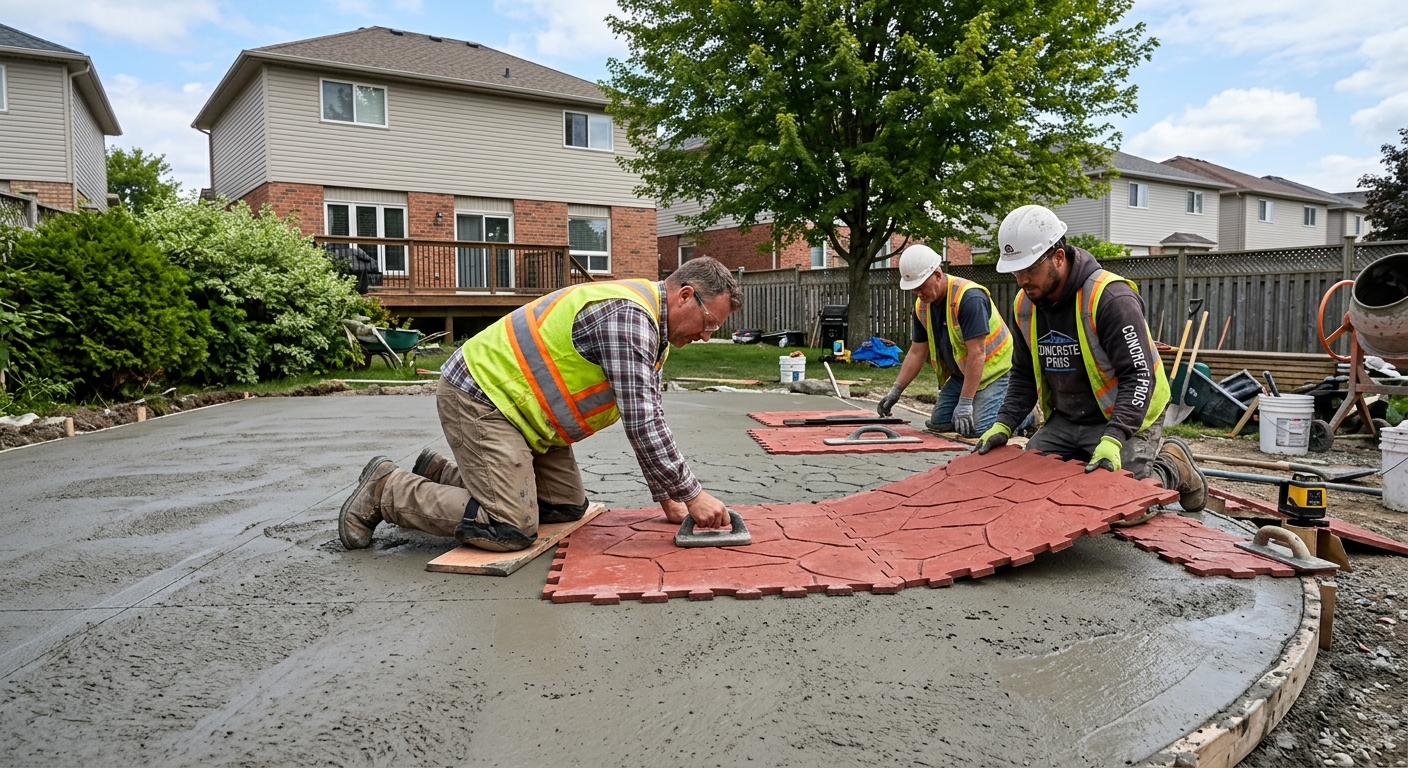
Concrete work options and costs in Mount Pleasant East
In Mount Pleasant East, concrete is a big part of everyday property upkeep—especially for the driveways, patios and walkways that keep homes looking sharp through Toronto-area wet springs and freeze–thaw winters. The area’s market is heavily residential; with 16,775 people recorded in the 2021 Census for Mount Pleasant East (Statistics Canada, 2021 Census), many properties are tied to long-lived housing lots where exterior flatwork matters. And because many neighbourhood streets here are lined with single-detached homes, homeowners commonly plan upgrades like driveway replacements or front-steps and landing repairs to improve drainage and curb appeal.
Toronto-area concrete pricing is shaped by frost depth requirements and repeated freeze–thaw cycles. In practice, that means exterior footings and deeper structural elements are planned to extend below the design frost depth (often at least 1.2 m in Ontario for structural footings). Driveway and slab projects also rely on air-entrained mixes, good granular base prep, and control joints to manage cracking risk. Contractors typically schedule exterior pours for warmer months to protect curing, since concrete strength development slows when temperatures drop toward 10 °C or below. Neighbourhoods near Vaughan-facing commuting corridors and established pockets such as the older residential stretches around local retail strips tend to see strong demand for driveway work, sidewalk/step repairs, and patio refreshes—both because there’s constant turnover and because replacement work is easiest when access lanes and crane/boom options are straightforward.
Below is a homeowner-friendly comparison of common options, typical sizes, and the price bands you’ll most often see from Toronto-tier concrete crews.
| Application |
Typical Size |
Key Spec |
Finish Option |
Price Range |
| Concrete driveway (standard broom finish) |
400–600 sq. ft. |
Air-entrained mix, compacted granular base, control joints |
Broom finish + edges sealed (optional) |
$18,000 – $28,000 |
| Exposed aggregate driveway |
400–600 sq. ft. |
Air-entrained mix, proper curing schedule, base prep |
Exposed aggregate surface + sealer |
$22,000 – $32,000 |
| Stamped concrete driveway or patio |
250–500 sq. ft. |
Air-entrained mix, control joints, integral colour |
Stamped pattern + release/antiquing |
$24,000 – $40,000 |
| Plain concrete patio or walkway |
200–400 sq. ft. |
Air-entrained mix, compacted base, slope + drainage |
Float and broom finish |
$16,000 – $26,000 |
| Garage floor (interior slab) |
400–600 sq. ft. |
Vapour barrier (if required), fibre or mesh, proper curing |
Plain trowel finish (optional broom texture) |
$20,000 – $30,000 |
| Foundation footings (structural, below frost) |
Per project foundation design |
Engineered dimensions, below frost depth, reinforced concrete |
Formed structural concrete |
$180,000 – $300,000 |
Prices are estimates only and vary by project scope, site access and material selection.
What affects the price of concrete work in Mount Pleasant East
In the Toronto economic region, it’s common to see quotes for the “same” concrete job vary by 30–50%. The biggest reason isn’t just the concrete—it’s what’s included in the base build-up, reinforcement, finishing, and the contractor’s ability to pour and cure in a tight seasonal window. Two crews may quote the same square footage, but one might price only surface concrete while the other budgets for proper excavation, granular base compaction, air-entrained mix design, and quality control joints—those items are where freeze–thaw durability is won or lost.
Frost depth and freeze–thaw cycles dictate nearly every spec in this region. Footings for structural work must extend below the design frost depth to prevent frost heave and differential movement, which impacts formwork height and labour time. For exterior flatwork like driveways and patios, contractors typically use air-entrained concrete mixes so the slab survives repeated freezing and thawing. When temperatures drop toward 10 °C or below, concrete curing slows; crews often add cold-weather precautions (insulating blankets, heating or longer schedule buffers), which raises labour and equipment costs. Finally, de-icing salt accelerates surface wear and can lead to spalling if the mix and sealing approach aren’t right—so sealing planning can be a major line item.
In Mount Pleasant East, cost also swings based on local conditions. A driveway replacement with poor drainage or saturated soil after spring rain often requires deeper base replacement before the slab can be poured; that can push pricing closer to the higher side of the $18,000 – $28,000 driveway band. Conversely, a straightforward walkway replacement on well-drained ground may land nearer the $16,000 – $26,000 patio/walkway band. Age of housing stock matters too: older lots frequently have buried asphalt, uneven grades, or undersized drainage routes that increase excavation and regrading—turning a “simple” removal into a longer, more labour-intensive prep phase.
| Price Factor |
Why It Matters |
Cost Impact |
| Frost line depth |
Determines footing depth and form height to prevent frost heave |
Higher excavation and concrete volume can add major structural cost |
| Site preparation |
Excavation, grading, and well-compacted granular base prevent movement |
Often the biggest swing factor for total cost (from minimal to full base rebuild) |
| Reinforcement |
Rebar or mesh helps control cracking and supports load transfer |
Material + install labour; can significantly affect thicker slabs |
| Mix design |
Air-entrainment and strength specs for freeze–thaw durability |
Can raise material cost, but reduces costly failures and patching |
| Finish type |
Broom vs. stamped vs. exposed aggregate changes labour and materials |
Stamped/exposed finishes typically add workmanship time and consumables |
| Pour size and concrete truck access to site |
Access affects how quickly and safely concrete can be placed |
Limited access may require pumps/extra labour, raising cost |
| Cold-weather curing precautions |
Heating/insulating blankets protect strength gain during colder pours |
Schedule buffers and equipment can add noticeable labour/equipment charges |
| Control joint pattern and sealing cost |
Joints manage cracking; sealing helps reduce salt scaling and moisture ingress |
Small area cost, but large impact on long-term surface performance |
Permits & regulations in Ontario
In Ontario, most structural concrete work—think foundation walls, grade beams, footings, and other reinforced elements that support the building—requires a building permit and often engineered drawings that the municipality reviews as part of the building permit process. Concrete flatwork like patios, walkways, and driveways typically does not require a permit on its own, unless it affects lot grading, drainage, or municipal constraints around impervious surface coverage or the right-of-way (for example, if the work encroaches into a boulevard or alters a municipal surface).
For a Mount Pleasant East homeowner, the practical approach is to verify items before concrete ever gets delivered:
1) Ask the contractor whether the permit is required for your specific scope (structural vs flatwork).
2) Confirm liability insurance is current—request a certificate of insurance naming you (or your property entity) where possible as well as the job address.
3) Verify WSIB/WCB coverage (worker coverage). In Ontario, ask for proof of clearance where applicable or documentation that the contractor is registered and insured for workplace risks.
4) Check credentials: look up the contractor’s licence/registration details through the appropriate Ontario contractor registry process (and confirm the company name matches the insurance certificates).
5) Get references on similar-scale jobs in the GTA.
Step-by-step, you’re building a paper trail that protects you if there are defects, delays, or safety issues during removal, forming, reinforcement placement, or curing.
Getting concrete right in Mount Pleasant East's freeze-thaw climate
Concrete fails in Mount Pleasant East mainly when moisture and temperature swings get past the slab system. Freeze–thaw cycles expand water in pores; if the concrete isn’t air-entrained properly, that pressure can show up as surface scaling and eventual spalling. Another common failure is movement: if the base isn’t excavated and compacted to the correct depth for the local soil and drainage conditions, the slab can settle and crack through the wrong locations.
To spec the job correctly for the Toronto market, start with base preparation—use compacted granular sub-base sized and placed for your soil conditions, and ensure proper slope so water sheds away from the slab. For the mix design, ask for air-entrainment (typically 5–7% air content for exterior flatwork) and a minimum 32 MPa compressive strength target so durability is built in from day one. Control joints are also essential: spacing should be planned so shrinkage cracks occur where you intended, not randomly across the driveway. Curing matters as much as placement—plan for at least 7 days of proper curing under the right conditions, and protect the pour if the temperature is trending cold. Finally, use a penetrating sealer applied after the cure window (often around 28 days) to help repel de-icing salts and reduce moisture penetration.
If you’re comparing options, here’s where price differences are justified. Choosing a stamped driveway or patio can come in around $24,000 – $40,000, whereas a standard broom-finished driveway may fit the $18,000 – $28,000 range. The extra cost is usually not just aesthetics—it’s more labour, integral colour/release materials (for stamped work), and time for careful joint layout so the pattern doesn’t hide performance issues. The best “value” comes from matching the finish to a durable mix and base, not from cutting those steps.
| Spec |
Why It Matters in Mount Pleasant East |
What to Ask For |
Impact if Skipped |
| Compacted granular base (depth?) |
Limits settlement and reduces pumping during wet/dry cycles before freeze–thaw |
Confirm the excavation depth and granular type; ask for compaction method and target grade |
Early cracking, rocking slab, and uneven surfaces |
| Air-entrained concrete mix (target air %?) |
Manages freeze–thaw pressure inside the concrete in Toronto winters |
Ask for 5–7% air for exterior flatwork and documented mix design |
Scaling and spalling, especially after winter salt exposure |
| Compressive strength (MPa rating) |
Supports structural and durability needs over time |
Ask for minimum 32 MPa target (and confirm test/cert documentation) |
Surface wear, reduced durability, and faster deterioration |
| Control joints (spacing per ACI guidelines) |
Creates planned crack locations so shrinkage doesn’t fracture randomly |
Ask for joint layout plan and spacing based on slab dimensions |
Random cracking and costly cosmetic/structural repairs |
| Minimum 7-day curing period |
Strength gain depends on time, temperature and protection in changing seasons |
Confirm curing plan; ask about blankets/heating if pouring is near cold weather |
Reduced strength and higher failure risk |
| Penetrating sealer (when applied after cure) |
Helps repel moisture and de-icing salts that drive surface scaling |
Ask when sealer is applied (commonly around 28 days) and which product type |
More salt damage, faster wear, and higher maintenance costs |
How to choose a concrete work contractor in Mount Pleasant East
Choosing the right contractor in Mount Pleasant East starts with verifying Ontario compliance and real jobsite experience. First, confirm licensing/registration status for the company (and ensure the same legal entity appears on your contract and insurance documents). Next, ask for current liability insurance and review the certificate of insurance before work begins. For worker protection, request proof of WSIB/WCB coverage and clear evidence the contractor is registered and in good standing; don’t rely on verbal confirmation. If anything looks outdated or mismatched, treat it as a stop-sign—concrete removal and forming is hazardous work, and protection matters.
Then get 2–3 itemised written quotes—not one lump-sum number. A good quote breaks down labour and materials (excavation/grading, granular base, reinforcement, concrete supply/mix design, forming, finishing, curing protection, joints and sealing, and waste disposal). Read the exclusions carefully: are permits included if needed, is disposal of broken concrete included, and who handles backfill/topsoil restoration? Ask whether saw-cut control joints are included (not just “we’ll cut joints after”).
Warranty should be in writing with clear coverage length for workmanship. Product/manufacturer warranties (like admixtures or sealer materials) may have different terms and may not be transferable, so ask. For payment, avoid large upfront amounts—keep deposits around 10–15% and use progress payments; hold back a portion until the final finish, joint sealing and cleanup are complete. Finally, demand a written timeline with a start date, weather contingencies, and estimated completion date.
- Ask to see similar completed driveway/patio photos in the GTA, not just basements or small sidewalk jobs
- Confirm air-entrainment and minimum strength targets in writing
- Verify base excavation and compaction depth, not just “we’ll prep the area”
- Request a joint layout plan and sealing plan for exterior slabs
- Get details on cold-weather curing protection if work straddles shoulder seasons
- Check that reinforcement is specified for your slab thickness and use case
- Confirm pump vs truck access method (and any added fees)
- Ask who supplies and installs forms, edge restraints, and expansion/compression treatment
- Make sure waste disposal is included or clearly priced
- Review the contract for permit responsibility if structural elements are included
- Set a payment schedule tied to milestones (base complete, pour done, finish/joints completed)
- Ensure cleanup and protection (covering/curing) are included, not “best effort”
Concrete contractor red flags in Mount Pleasant East include: quotes that omit air-entrainment or compressive strength targets, vague language like “we’ll cut joints where needed” without spacing/layout, no mention of granular base depth/compaction, willingness to pour in cold conditions without curing blankets/heating plans, and contractors asking for large upfront payments (or refusing to provide proof of insurance/coverage).
Frequently asked questions — concrete work in Mount Pleasant East
Why does concrete crack in Mount Pleasant East and how is it prevented?
In Mount Pleasant East and across Ontario’s Toronto region, concrete cracking is often driven by shrinkage, settlement, and freeze–thaw movement rather than “bad concrete” alone. When slabs sit on an inadequately prepared base, they can settle slightly over wet springs and then expand/contract seasonally. In winter, moisture trapped near the surface can worsen scaling if the mix isn’t properly air-entrained. Prevention is mostly about specs: a properly compacted granular base, an exterior air-entrained mix (typically 5–7% air), engineered or planned thickness, and a control joint pattern that tells the slab where to crack. Good contractors also plan proper curing time and apply sealing to help reduce salt-driven surface damage. If you’re budget-conscious, a standard driveway at roughly $18,000 – $28,000 can still be very durable—if the prep, joints, and mix are right.
Stamped vs broom-finish concrete — cost difference?
Stamped concrete costs more than broom-finish for two main reasons: extra labour time and extra materials. Stamped work typically includes integral colour, release agents, stamp patterns, careful timing for impression and finishing, plus more detailed joint planning so pattern lines and joints don’t conflict. Broom-finish is generally faster and uses fewer consumables. In Mount Pleasant East, that usually puts broom-finished driveways closer to the $18,000 – $28,000 range, while stamped driveway or patio projects more often land in the $24,000 – $40,000 band depending on area size and removal complexity. The key point: don’t pick finish style first—pick the durability package (base, air-entrainment, joints, and curing) and then choose the aesthetic. A properly built broom-finish driveway can outperform a poorly built “decorative” slab.
When is the best time to pour concrete in Mount Pleasant East?
The best time to pour in Mount Pleasant East is typically during the warmer months when daytime and nighttime temperatures support consistent curing. In the Toronto area, concrete crews prefer scheduling exterior flatwork so that concrete strength gain isn’t slowed by cold snaps. When temperatures trend near 10 °C or below, contractors often need cold-weather curing precautions—insulating blankets, heated enclosures, or additional protection—which increases cost and planning time. Wet fall and spring conditions also affect base drying and access, so many homeowners see the cleanest results when pours are done in late spring through early fall. If your project needs a winter contingency, ask your contractor to explain their curing protection plan in writing and how long they will protect the pour before removing forms and opening the slab to traffic.
How long does concrete take to cure?
Concrete curing has two parts: initial set and strength development. For practical homeowner timing, contractors usually plan for a minimum 7-day curing period under suitable conditions so the slab reaches enough strength for finishing steps and early protection. Full performance continues beyond that; many exterior durability decisions (like sealing for salt resistance) are scheduled after the slab has fully cured—often around 28 days. In Ontario’s freeze–thaw climate, curing protection is especially important because early cold exposure can reduce strength gain and increase surface vulnerability. If you’re comparing quote options in Mount Pleasant East, ask whether the contractor includes curing blankets/heating when weather is cool and whether they protect the slab properly after the pour. Those details are as important as the mix price.
Do I need a permit for concrete work in Ontario?
In Ontario, structural concrete work—such as footings, foundation walls, and grade beams—usually requires a building permit and often engineered drawings that the municipality reviews. Concrete flatwork like patios, walkways, and driveways typically does not require a permit by itself, unless the work affects lot grading, drainage, or municipal constraints (for example, if it impacts impervious surface limits or touches/encroaches into a right-of-way area). For a Mount Pleasant East project, the safest approach is to ask your contractor whether your specific scope requires a permit before removal begins. Also verify the contractor’s liability insurance and worker coverage documentation before starting. If any portion of your plan is structural (or ties into a foundation repair), treat it as permit-required until you confirm otherwise in writing.
Concrete vs pavers for a patio in Mount Pleasant East?
Concrete and pavers can both work well in Mount Pleasant East, but they behave differently through freeze–thaw. A well-built concrete patio uses air-entrained mix, proper base compaction, control joints, and curing—so cracking is managed and the surface is generally consistent. Pavers can be flexible if the bedding is installed correctly, but they can shift if the base isn’t properly compacted or if drainage is poor; settled pavers become uneven and weeds can appear in joints. Price-wise, plain concrete patios/walkways often sit around $16,000 – $26,000 for typical project scopes, while pavers vary widely depending on thickness, edging, and base depth. Choose concrete if you want a seamless surface with joint control and a straightforward maintenance plan; choose pavers if you want easier localized replacement—but be sure drainage and base prep are done to a high standard.