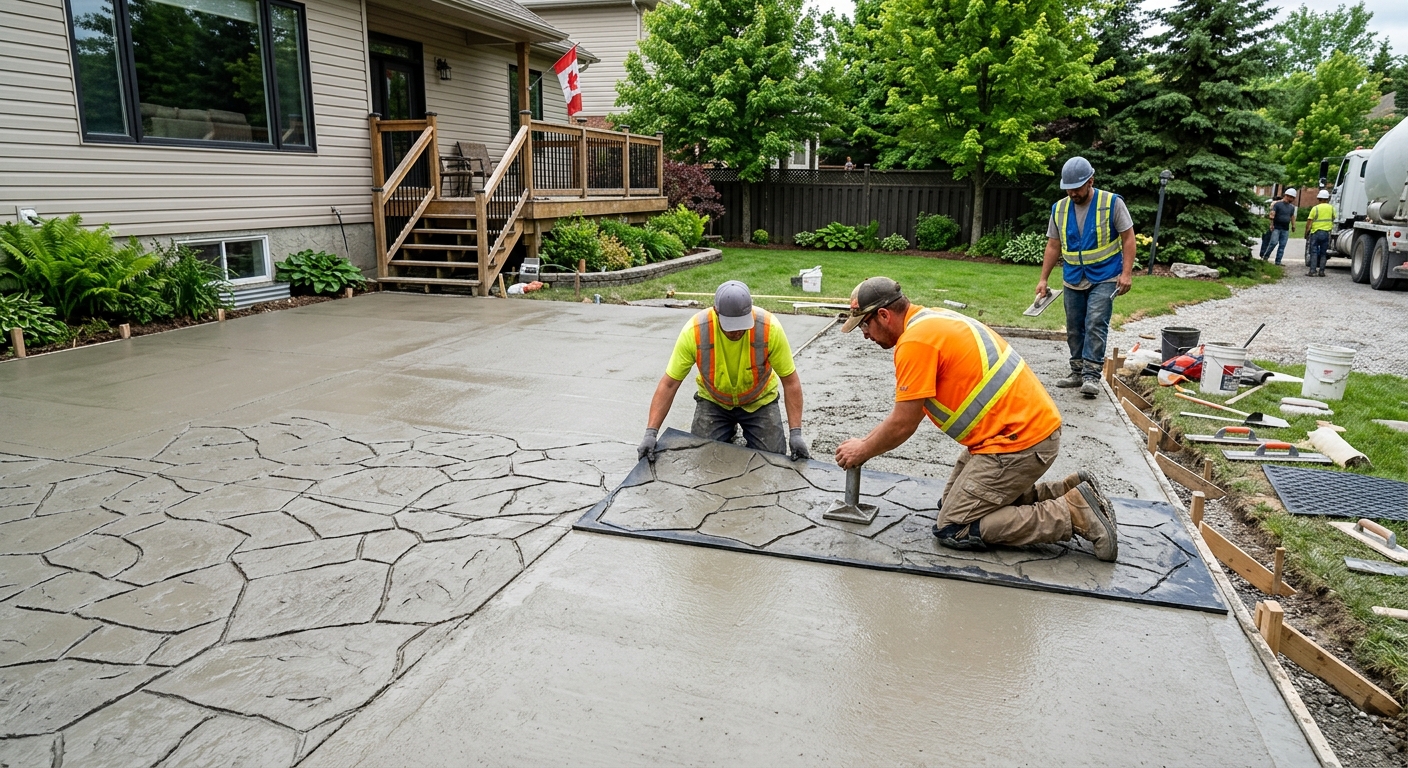
Concrete work options and costs in Niagara
Niagara homeowners often start with concrete because it’s dependable, quick to maintain, and a good match for the area’s housing mix. In Niagara (Statistics Canada, 2021 Census), the population is 31,180, and most local concrete flatwork needs—from driveways to patios and walkways—serve established neighbourhoods and ongoing infill. Many properties here sit on single-detached and townhouse streets where curb access, drainage, and frost protection directly impact both durability and pricing. On top of that, the Hamilton–Niagara Peninsula’s Great Lakes corridor is cold and wet, so freeze-thaw cycles are a real cost driver: we typically design exterior footings and pier foundations to extend below frost, and we specify air-entrained mixes for flatwork. The seasonal labour premium matters, too. Most structural and exterior slabs are scheduled roughly May–October, while winter work requires hoarding, heat, and protective curing—so costs rise when timelines slip.
Concrete contractors are busiest in high-demand pockets like St. David’s Road in Niagara-on-the-Lake and the growing residential areas near the QEW corridor. If you’re pricing a driveway or patio, the biggest swing usually isn’t “concrete” itself—it’s site prep, reinforcing, and the finish package needed to survive moisture, de-icing salts, and thermal movement. Below is a practical cost comparison for common options, then we’ll break down what pushes quotes up or down.
| Application |
Typical Size |
Key Spec |
Finish Option |
Price Range |
| Concrete driveway (standard broom finish) |
400 sq. ft. (about 20 ft x 20 ft) |
Air-entrained mix, compacted granular base, control joints |
Broom finish |
$6,000–$9,000 |
| Exposed aggregate driveway |
400 sq. ft. (about 20 ft x 20 ft) |
Air-entrained mix, properly graded base, careful finishing |
Exposed aggregate (wash/surface retarder) |
$8,000–$12,000 |
| Stamped concrete driveway or patio |
300 sq. ft. (about 15 ft x 20 ft) |
Air-entrained mix, deeper base where required, joints to match pattern |
Stamped pattern + release + seal coat |
$9,000–$13,500 |
| Plain concrete patio or walkway |
200 sq. ft. (about 10 ft x 20 ft) |
Air-entrained mix, drainage slope, joints |
Float/steel trowel + light broom (or broom) |
$2,400–$4,000 |
| Garage floor (interior slab) |
480 sq. ft. (about 20 ft x 24 ft) |
Vapour barrier where needed, fibre or mesh, control joints |
Float finish (option for hardener/sealer) |
$7,200–$10,500 |
| Foundation footings (structural, below frost) |
Per linear foot (typ. 12–24 in width) |
Concrete below frost line, reinforcing steel, formwork |
Structural concrete (engineered requirements) |
$60–$120 |
Prices are estimates only and vary by project scope, site access and material selection.
What affects the price of concrete work in Niagara
In the Hamilton–Niagara Peninsula, it’s common to see the same concrete type priced 30–50% apart once site and specification differences are counted. The region’s cold, wet Great Lakes climate drives deeper frost-protection work and tighter concrete detailing. Exterior slabs and driveways need air-entrained concrete to handle freeze-thaw stress, and that mix requirement is non-negotiable if you want fewer spalls and less surface scaling. Frost line depth and freeze-thaw cycles dictate every foundation and footing spec: in Ontario, footings typically extend below the design frost depth (often roughly 1.5–2.4 m) to reduce frost heave risk and cracking. Even for flatwork that’s “only a driveway,” the base thickness and drainage slope must be built to perform in repeated winter wetting and thawing.
Cold-weather conditions also shorten the practical pour season (roughly May–October for many structural and exterior projects). When a schedule pushes into shoulder seasons or winter, contractors must add heating, insulating blankets, and more careful curing—so labour and equipment costs rise. De-icing salt accelerates surface spalling, which is why sealing matters for exterior flatwork. In practical terms, a standard broom-finished driveway can land in the $14–$22 per sq. ft. band, while an upgraded option like stamped concrete often shifts upward into the decorative range.
Two Niagara examples that move price quickly: (1) a sloped driveway or poor drainage site often requires extra excavation and base, raising costs; (2) a straightforward, level lot with easy truck access can keep your project near the lower end of the driveway band. If you’re replacing older concrete in an older neighbourhood near the core, demolition and haul-away can add a meaningful premium—especially when sidewalks, fence lines, or limited access slow production.
| Price Factor |
Why It Matters |
Cost Impact |
| Frost line depth — determines footing depth and form height |
Exterior foundations must extend below frost to prevent heave and cracking |
Can significantly change excavation and concrete volume for foundations |
| Site preparation — excavation, grading, compacted granular base |
Proper sub-base thickness and drainage keep slabs level through freeze-thaw |
Typically a major swing factor; poor access increases machine time |
| Reinforcement — rebar or wire mesh requirement |
Helps control cracking and supports design loads (driveways, slabs, footings) |
Materials plus labour for placement and chairs/standoffs |
| Mix design — air-entrainment and compressive strength spec |
Air entrainment improves freeze-thaw durability for exterior flatwork |
Higher-spec mixes cost more, but reduce early deterioration |
| Finish type — broom vs. stamped vs. exposed aggregate |
Decorative finishes require more labour, detailing, and sealing |
Often shifts you from standard bands to stamped/exposed pricing |
| Pour size and concrete truck access to site |
Access affects how many loads are needed and how quickly crews can place |
More time on placement and pump/line setup can add cost |
| Cold-weather curing precautions — heating and blankets |
Protects early strength development and prevents surface scaling |
Seasonal labour/equipment premium, especially outside May–October |
| Control joint pattern and sealing cost |
Joints manage shrinkage; sealing helps repel de-icing salt exposure |
Adds line-item cost but reduces costly repairs later |
Permits & regulations in Ontario
In Ontario, permits and engineered reviews usually come into play when the concrete is part of the structure—not just when it’s a surface. Structural concrete work such as footings, foundation walls, grade beams, and other elements that support a building typically requires a building permit, and the municipality often expects engineered drawings for load and foundation details. For concrete flatwork like patios, walkways, driveways, and garage slabs, a permit is often not required by default, unless the work affects lot grading, drainage, impervious surface coverage limits, or the municipal right-of-way.
Step-by-step, here’s how Niagara homeowners can verify a contractor is set up correctly. First, confirm the contractor carries general liability insurance (request an insurance certificate showing active coverage) and ask whether they have WSIB coverage for workers (or the appropriate clearance letter). Second, verify licensing status through the Ontario government’s contractor registry resources—then cross-check that the person you’re hiring matches the insured/registered business name on paperwork. Third, ask for references on similar-scale Ontario projects (not just decorative work—ask about exterior durability and joint/seal practices). Finally, make sure your quote clearly states whether a permit is included (for structural work) and who is responsible for inspections if required.
Getting concrete right in Niagara's freeze-thaw climate
Concrete failures in Niagara most often come from one of five weak links: inadequate base support, poor mix design for freeze-thaw, wrong joint spacing, rushed curing, or no protection from de-icing salts. Start with base preparation: the granular sub-base must be excavated to the right depth for local soil conditions and compacted in lifts so the slab doesn’t settle unevenly. Next is mix design—exterior flatwork should be air-entrained (commonly 5–7% air content) and specified for at least 32 MPa compressive strength. Control joints matter because they’re the “planned cracks” that reduce random cracking; in Niagara, we tighten the joint plan so thermal movement is managed instead of expressed as ugly fractures. Curing is critical here: even in warm days, cold nights can slow strength gain. We plan for at least 7 days of proper curing conditions, and in cooler weather we use blankets or heat protection to avoid surface damage.
Finally, sealing is your defence against salt scaling and premature surface wear. For best performance, apply a penetrating sealer after the concrete has cured—typically 28 days post-pour—so the concrete is strong enough and less vulnerable to moisture trapped beneath the surface. If you’re choosing between stamped and standard, the price difference can be justified when the site is visible year-round (front yards near Niagara-on-the-Lake, for example) and you’re committing to proper joints and sealing. But if your drainage is poor, spending more on appearance won’t fix the underlying durability issue—base and mix always come first.
| Spec |
Why It Matters in Niagara |
What to Ask For |
Impact if Skipped |
| Compacted granular base (depth?) |
Supports the slab through frost and repeated wetting |
Base thickness for your soil + compaction method (lift-by-lift) |
Settlement, uneven cracking, and trip hazards |
| Air-entrained concrete mix (target air %?) |
Reduces freeze-thaw damage and surface spalling |
Air content target (commonly 5–7% for exterior flatwork) and exposure class assumptions |
Scaling, pop-outs, and early deterioration |
| Compressive strength (MPa rating) |
Strength supports durability under winter cycling |
Minimum 32 MPa and pour-day mix documentation |
Lower performance and weaker surface wear resistance |
| Control joints (spacing per ACI guidelines) |
Controls shrinkage and thermal cracking |
Joint spacing plan and sawing schedule |
Random cracks and more water infiltration into base |
| Minimum 7-day curing period |
Ensures strength development despite cold nights |
Protection plan (blankets/heating) if temps drop |
Surface weakness, scaling, and reduced bond strength |
| Penetrating sealer (when applied after cure) |
Repels de-icing salt and moisture exposure |
Apply after proper cure—typically around 28 days post-pour |
More salt damage and faster cosmetic decline |
How to choose a concrete work contractor in Niagara
Choosing the right concrete contractor in Ontario is mostly about checking documentation, reading the scope carefully, and comparing apples-to-apples line items. Start by verifying Ontario licensing where applicable for the trade work being performed, then confirm liability insurance is current (ask for a certificate of insurance naming you as applicable). Next, ensure workers are covered with WSIB/WCB (request proof or clearance letter). If they can’t provide paperwork, that’s your first red flag.
Get 2–3 itemised written quotes instead of a single lump sum. You want a breakdown that separates labour from materials and spells out key specs: base thickness, whether reinforcing is included, the air-entrainment/mix spec, joint plan, and sealing (if it’s included). Read exclusions line-by-line: is demolition included, is disposal included, and what happens with unsuitable soil or unexpected soft spots? For warranties, ask for (1) the workmanship warranty length, (2) any product/manufacturer warranty, and (3) whether warranties are transferable if you sell the home.
Payment schedule matters in Niagara winters: never pay more than 10–15% upfront. Hold back a portion until the full scope is complete and properly cured. Also lock in schedule in writing: request a start date, weather contingency plan, and a realistic completion estimate—many exterior pours are scheduled May–October to avoid costly winter protection.
- Provide proof of insurance and WSIB/WCB coverage before any deposit.
- Show past projects in Niagara with similar frost-exposure conditions (exterior slabs).
- Quote itemises excavation, base, reinforcement, concrete, finishing, joints, and sealing.
- Specify air-entrained mix and minimum compressive strength in the quote.
- Confirm control joint spacing and whether joints are cut vs. tooled.
- Ask who supplies and places the granular base and how it’s compacted.
- Ensure disposal/haul-away is clearly included or excluded.
- Confirm truck access details (waiting time charges can change price).
- Get a written curing and cold-weather protection plan.
- Review warranty length for both workmanship and any coating/sealer product.
- Confirm payment milestones align with inspections and completion.
- Ask for a start date and completion window in writing.
Concrete red flags in Niagara: contractors who won’t discuss air-entrainment and joint spacing, quotes that are “too good” and omit base prep, no written timeline or cure plan (especially for late-season work), no proof of WSIB/insurance, and crews who skip sealing discussions for driveways exposed to de-icing salt.
Frequently asked questions — concrete work in Niagara
When is the best time to pour concrete in Niagara?
The best time to schedule concrete in Niagara is typically late spring through summer—practically, most exterior and structural pours are planned about May–October to reduce cold-weather protection costs and improve finishing conditions. The reason is Ontario’s freeze-thaw environment: cold nights can slow strength gain and increase the risk of scaling or surface damage if curing isn’t protected. If you must pour in shoulder season, a reputable contractor will plan for hoarding, heating, insulating blankets, and often accelerators, which adds cost and can affect finish quality timing. As a benchmark, an exterior driveway budget often sits in the $14–$22 per sq. ft. range in normal conditions; late-season work can push pricing toward the upper end due to added labour and protection. Always ask for the forecast-based pour decision and the curing plan.
How long does concrete take to cure?
Concrete needs two separate “clocks”: curing for strength gain and curing for finish performance. For most residential exterior work in Niagara, we plan for at least 7 days of proper curing under favourable conditions to reach workable strength and reduce early cracking risk. However, concrete continues gaining strength beyond that—so full durability and best sealer performance are generally based on a longer cure window. For protective sealing against de-icing salts, many penetrating sealers are applied around 28 days after the pour, when the concrete is mature enough to accept the treatment. If contractors rush this schedule, you may see surface wear, faster scaling, or reduced sealer effectiveness. When reviewing your Ontario quote, ask what curing method is used (blankets/heating when needed) and confirm the sealer timing is included or scheduled separately.
Do I need a permit for concrete work in Ontario?
In Ontario, permits depend on what the concrete is doing. Structural concrete work—like footings, foundation walls, and grade beams—generally requires a building permit and often engineered drawings reviewed by the municipality. Concrete flatwork such as patios, walkways, and many driveways usually doesn’t require a permit by default, but you should confirm if your project affects lot grading, drainage, impervious surface limits, or the municipal right-of-way. For Niagara homeowners, the easiest way to avoid surprises is to ask the contractor to confirm whether the work triggers a permit and who is responsible for pulling it. In your hiring process, make sure your contractor carries liability insurance and WSIB/WCB coverage, because even “non-permit” flatwork still needs to be installed to Ontario requirements and safety standards.
Concrete vs pavers for a patio in Niagara?
Concrete and pavers can both be durable in Niagara’s freeze-thaw climate, but they fail differently. Standard concrete patios are usually more affordable to install and can be finished with broom texture for consistent traction; air-entrainment and correct jointing are key. In Niagara, plain concrete patios and walkways often fall around the $12–$20 per sq. ft. band (before site-specific variables). Pavers can be an advantage when you want easy, localized repairs after settlement, because individual units can be lifted and reset. Concrete tends to win on seamless look and speed, while pavers win on flexibility and sometimes drainage manageability depending on the base design. If you’re choosing between them, ask both bidders to show their base prep and joint/drainage plan. The better-built option will depend on your site’s slope, soil, and access—not just material preference.
How long does a concrete driveway last?
With correct design in Niagara’s cold, wet Great Lakes environment—below-frost detailing for foundations (where applicable), properly compacted base for the slab, air-entrained concrete for exterior durability, appropriate control joints, and sealing after cure—a driveway can often last 20 years or more before major repairs are needed. The biggest drivers of lifespan are freeze-thaw stress and de-icing salt exposure, which is why sealing and air-entrainment matter so much. If joints are too wide/too sparse or the base is underbuilt, you’ll typically see cracking and spalling earlier. In budgeting, homeowners often choose between a standard broom finish and a decorative upgrade: a broom-finished driveway commonly aligns with the $14–$22 per sq. ft. band, while decorative options like exposed aggregate or stamped concrete cost more and require careful finishing and ongoing maintenance. Ask your contractor about their joint plan and sealing schedule—those details usually predict longevity better than marketing photos.
What is air-entrained concrete and why does it matter here?
Air-entrained concrete is a mix designed to include tiny, microscopic air bubbles. Those bubbles give water somewhere to expand when it freezes, which greatly improves resistance to freeze-thaw damage—exactly what Niagara experiences repeatedly through winter cycles. Without air entrainment, exterior concrete exposed to moisture and de-icing salts can scale, spall, and weaken over time even if it looks fine at first. For Niagara exterior flatwork, contractors should specify an air content target typically in the 5–7% range and confirm the mix meets a minimum compressive strength requirement (often 32 MPa for many residential specs). When you request quotes, don’t accept “regular concrete” as an answer—ask for the mix spec and the protective steps: base prep, joint spacing, proper curing, and sealing timing (commonly around 28 days). This is one of the best ways to prevent early deterioration.