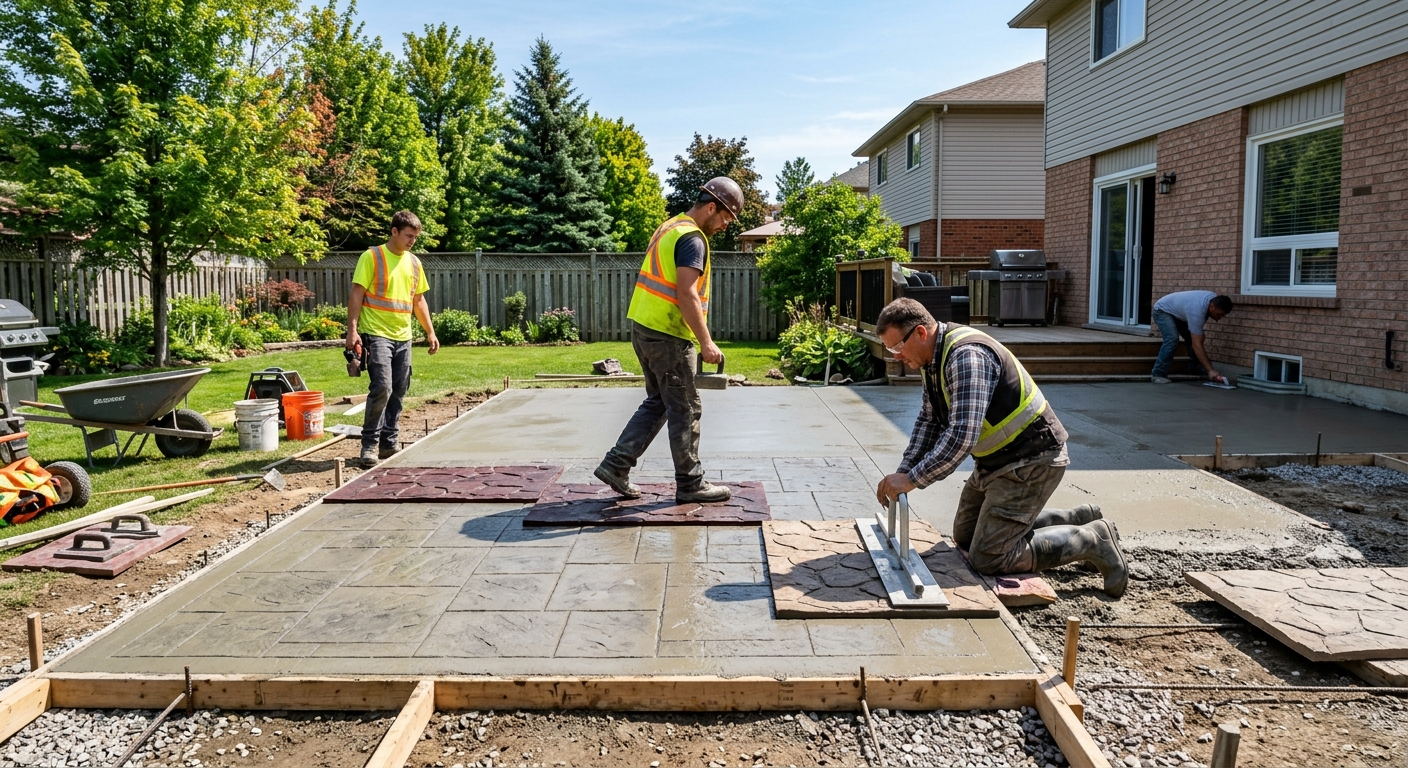
Concrete work options and costs in Markham
Markham homeowners typically choose concrete for driveways, patios and walkways because the local housing stock makes it practical and predictable. In Markham, single-detached homes make up about 56.2% of dwellings, and with 90,545 homeowner households (81.7% of households own), there’s steady demand for exterior flatwork that needs to last through winter. Another big factor is that 18.5% of homes were built before 1981—many of those properties have older drainage patterns, shifting sub-grades, or deteriorating slabs that get replaced rather than patched.
In the Toronto economic region, pricing is shaped by frost depth and freeze–thaw cycles. Local specs commonly require structural footings to extend at least 1.2 m below grade to reduce frost heave and differential movement, and exterior slabs rely on air-entrained concrete plus proper base drainage to resist winter expansion and contraction. Because curing conditions can dip toward 10 °C and below in shoulder seasons, contractors schedule pours in warmer months and use cold-weather protection when needed, which can increase labour time, equipment use and material waste.
Concrete trade availability is also strongest around high-traffic residential corridors—Thornhill and areas near the Markham Road corridor often see multiple simultaneous projects, so access, traffic control, and staging can affect scheduling and cost. Below is a realistic comparison of common options so you can align the quote with the finish you’re actually getting.
| Application |
Typical Size |
Key Spec |
Finish Option |
Price Range |
| Concrete driveway (standard broom finish) |
400 sq. ft. (approx. 20’ x 20’) |
Air-entrained mix; compacted granular base; control joints |
Broomed surface |
$7,200 – $11,200 |
| Exposed aggregate driveway |
400 sq. ft. (approx. 20’ x 20’) |
Air-entrained mix; base prep; proper retarder timing |
Exposed aggregate finish |
$9,000 – $14,000 |
| Stamped concrete driveway or patio |
300 sq. ft. (approx. 15’ x 20’) |
Air-entrained mix; stiffer mix/finishing timing; sealer-ready surface |
Stamp patterns + colour hardener |
$10,000 – $16,500 |
| Plain concrete patio or walkway |
250 sq. ft. (approx. 10’ x 25’) |
Air-entrained mix; slope for drainage; joints |
Plain trowel/steel + broom texture as needed |
$4,000 – $6,500 |
| Garage floor (interior slab) |
480 sq. ft. (approx. 20’ x 24’) |
Vapour barrier and base; control joints; fibre or mesh per spec |
Steel trowel + densifier option |
$8,200 – $13,500 |
| Foundation footings (structural, below frost) |
Per project; typical single house layout |
Excavation and formwork; rebar; concrete to below frost depth |
Structural concrete (not decorative) |
$7,500 – $18,000 |
Prices are estimates only and vary by project scope, site access and material selection.
What affects the price of concrete work in Markham
You can see major quote swings for the “same” concrete job in Markham and across the Toronto economic region—often 30–50%—because the pricing usually isn’t just concrete. Labour time, base excavation depth, reinforcement decisions, truck access, and curing protection all change the total cost. Even for flatwork, one contractor may assume easy access and adequate drainage, while another will budget for sub-base rebuild, deeper frost-appropriate formwork, and additional crews because the soil is wetter or the grading is off.
In Ontario, frost depth and freeze–thaw cycles dictate nearly every structural and exterior spec. Structural footings must extend below the design frost depth (commonly about 1.2 m in the region) to prevent frost heave and differential movement. Exterior slabs and driveways also need air-entrained mixes to survive repeated freeze–thaw, and colder months compress the reliable pour season—so contractors add heating, insulating blankets, and more careful curing management. Surface durability matters too: de-icing salt can accelerate spalling if the mix air content and finishing aren’t right, which is why sealing is often recommended.
Local conditions in Markham commonly push costs upward in a few predictable ways. If your driveway tie-in requires removal of older, poorly draining slabs, excavation and base replacement can add days of work—often turning a standard driveway cost near the $7,200 – $11,200 range toward the higher end. Conversely, a straightforward patio on stable, well-draining soil can stay closer to the $4,000 – $6,500 band.
As a quick benchmark, remember that 18.5% of homes built before 1981 were likely constructed before today’s drainage expectations—so older properties more often need regrading and thicker, better-compacted granular base than newer builds.
| Price Factor |
Why It Matters |
Cost Impact |
| Frost line depth — determines footing depth and form height |
Deeper footings reduce frost heave risk and protect foundations and adjacent slabs |
Can add significant excavation and formwork time (often the largest structural cost driver) |
| Site preparation — excavation, grading, compacted granular base |
Proper base prevents pumping, settlement, and premature cracking |
Small grade issues can add $1,000+; major base rebuild can raise costs materially |
| Reinforcement — rebar or wire mesh requirement |
Controls cracking and improves load capacity when specified for the use-case |
Materials and labour can shift pricing by hundreds to thousands |
| Mix design — air-entrainment and compressive strength spec |
Air-entrainment is critical for freeze–thaw durability; strength impacts long-term performance |
Typically moderate per cubic metre, but affects surface longevity and rework risk |
| Finish type — broom vs. stamped vs. exposed aggregate |
Different finishing methods require different crews, timing, and materials |
Stamped/exposed usually increases cost more than plain broom finishes |
| Pour size and concrete truck access to site |
Access affects labour hours, chute reach, and batching logistics |
Hard-to-reach sites can require extra equipment and crew time |
| Cold-weather curing precautions — heating and blankets |
Protects early-age concrete when temperatures trend near or below about 10 °C |
Often increases labour/material costs and pushes schedule |
| Control joint pattern and sealing cost |
Joints manage shrinkage cracks; sealing helps repel de-icing salts |
Adds a line item, but can prevent costly surface failures |
Permits & regulations in Ontario
In Ontario, structural concrete work generally needs a building permit and often engineered drawings reviewed through the municipal process. That means work such as foundation footings, foundation walls, grade beams, and other load-bearing concrete elements typically require permits. For Markham homeowners, that usually applies when you’re doing anything that changes the structure of the home or supports the building—think underpinning, new foundation work, or major foundation repairs tied to load transfer.
Concrete flatwork such as driveways, patios, sidewalks and walkways usually does not require a building permit, unless your project affects lot grading, drainage, impervious surface limits, or any municipal right-of-way/permit requirements for work near the curb or municipal road allowances. Because rules can vary depending on whether you’re tying into existing grades or changing water flow toward neighbouring properties, you should always confirm with the local authority before breaking ground.
Before hiring, verify the contractor carries liability insurance and has appropriate WSIB/WCB coverage. Step-by-step, homeowners in Markham should: (1) ask for the contractor’s certificate of insurance showing they are insured for the work and named risks; (2) request WSIB/WCB clearance or proof of coverage (or an exemption letter where applicable); (3) confirm they have the relevant Ontario licence/registration for their business type (many concrete contractors also perform excavation/landscaping, which may involve additional licensing); and (4) check references for similar-scale jobs with freeze–thaw exterior flatwork in the GTA.
If you’re seeing a quote that includes “concrete only” with no mention of permits, drainage, or required engineering, ask questions before signing.
Getting concrete right in Markham's freeze-thaw climate
Concrete problems in Markham are usually climate-driven. Freeze–thaw cycles pull moisture into the concrete and base; if the base isn’t compacted correctly or the mix isn’t designed with enough air, water can expand during freezing and break the surface. The result is often scaling or spalling, especially where de-icing salt hits. The fix is to spec the job for Toronto-area conditions, not generic specs from other regions.
For exterior slabs, start with base preparation: excavate to the proper depth and install a compacted granular sub-base that supports the slab and promotes drainage away from the concrete. Next, mix design: specify air-entrained concrete with a target air content of about 5–7% for exterior flatwork in this climate, and require a minimum 32 MPa compressive strength unless the engineer calls for more. Then control cracking with a joint plan—control joints placed at reasonable spacing to limit random shrinkage cracking patterns.
Curing is where many failures are born. Plan for a minimum 7-day curing period under suitable conditions; if the schedule pushes into cooler weather, reputable crews use curing blankets, and they manage surface protection so concrete doesn’t freeze too early. Finally, apply a penetrating sealer 28 days after the pour to help repel de-icing salts and reduce moisture ingress.
To see why options differ: a stamped patio may cost more than plain broomed concrete, but it can be worth it if your base, joints, and sealer plan are included. For example, moving from a plain patio around $4,000 – $6,500 to a stamped option in the $10,000 – $16,500 range is usually justified when you’re paying for colour, stamp labour, extra finishing steps and careful protection—not just the “look.”
Ask direct questions about air-entrainment, joint spacing, curing protection, and sealing timing to avoid spalling caused by inadequate air content and poor early-age protection.
| Spec |
Why It Matters in Markham |
What to Ask For |
Impact if Skipped |
| Compacted granular base (depth?) |
Reduces settlement and prevents water from staying under the slab during wet fall/spring |
Granular sub-base type and compaction requirements; excavation depth based on soil and intended slab thickness |
Can lead to rocking, cracking, and premature failure in the freeze–thaw cycle |
| Air-entrained concrete mix (target air %?) |
Helps concrete tolerate freeze–thaw expansion without damaging surface paste |
Target air content of about 5–7% for exterior flatwork; confirm mix design on the quote/spec sheet |
Higher risk of scaling and spalling from winter moisture and salt exposure |
| Compressive strength (MPa rating) |
Improves durability and long-term performance under traffic and seasonal movement |
Minimum 32 MPa (or higher if specified); confirm the strength class in writing |
Surface wear, increased cracking potential, and reduced service life |
| Control joints (spacing per ACI guidelines) |
Controls where cracks form so they’re predictable and manageable |
Joint spacing plan and where joints will align with existing features |
Random cracking that’s harder to repair and more likely to allow water ingress |
| Minimum 7-day curing period |
Early-age strength gain is temperature-sensitive during Ontario shoulder-season conditions |
How curing is managed; whether blankets/heating are used when temperatures drop |
Lower strength and surface damage; increased risk of early cracking/spalling |
| Penetrating sealer (when applied after cure) |
Repels moisture and de-icing salts that accelerate deterioration |
Type of sealer and application timing—typically 28 days after the pour |
Faster moisture penetration and more aggressive winter scaling |
How to choose a concrete work contractor in Markham
Choosing the right concrete contractor in Markham is mostly about proof: proof of coverage, proof of experience with freeze–thaw exterior flatwork, and proof that their scope is complete. Start by verifying Ontario licensing/registration for the contractor’s business and trade coverage. Then verify liability insurance—ask for a current certificate of insurance—and make sure the policy covers the scope you’re hiring them for (excavation/footings where applicable, plus concrete placement and site restoration).
Next, check WSIB/WCB status. Have the contractor provide documentation or a clearance letter showing coverage (or an exemption letter where applicable). Don’t rely on verbal assurances. For additional peace of mind, request references on similar-scale jobs in the GTA (driveways, patios, and exterior flatwork that faced winter conditions).
When you get quotes, insist on 2–3 itemised estimates rather than one lump sum. A good quote breaks labour and materials for excavation, granular base, reinforcement, concrete supply, finishing, joints, sealing, and cleanup/disposal. Pay attention to inclusions and exclusions: Is permit support included if needed? Is disposal of concrete and excess soil included? Who handles saw-cutting, joint sealing prep, and surface protection? A contractor who can’t clearly answer those questions is often hiding cost gaps that show up later as change orders.
Warranty matters too. Ask for the workmanship warranty length and whether it includes problems related to poor joints/cure. Confirm the product/manufacturer warranty details and whether it’s transferable. Keep payment terms conservative—never pay more than 10–15% upfront, and hold back a portion until the job is complete and defects are addressed. Finally, demand a written start date and completion estimate.
- Provide the quote with slab thickness assumptions, not just “concrete per sq. ft.”
- Confirm air-entrainment and minimum strength (ask for mix spec wording).
- Ask how they handle drainage: base build-up and slope direction.
- Verify control joint plan (locations and spacing) and whether joints will be saw-cut or formed.
- Check whether rebar, wire mesh, or fibre is included (and where).
- Confirm curing method and what happens if temperatures drop during the first week.
- Ask for sealing: timing (often 28 days) and sealer type.
- Get disposal/restoration details (topsoil replacement, sod/seed, clean-up).
- Ensure truck access plan is included (where pumps/chutes are used, if required).
- Confirm insurance and WSIB/WCB coverage before signing.
- Use itemised labour/materials pricing to compare apples-to-apples.
- Require a written warranty and a clear process for warranty call-backs.
Concrete red flags in Markham include: missing air-entrainment details, vague curing promises (“it’ll be fine”), no joint plan, quotes that exclude disposal or base rebuild but still assume perfect sub-grade, and payment schedules that ask for most money upfront before forms and base prep are verified.
Frequently asked questions — concrete work in Markham
What is air-entrained concrete and why does it matter here?
Air-entrained concrete is designed to include microscopic air bubbles in the mix. Those tiny voids give expanding water a place to go when temperatures swing below freezing, which is exactly what Markham sees during winter nights and repeated freeze–thaw events. Without adequate air, the cement paste is more likely to deteriorate at the surface first, leading to scaling or spalling—often worst near the edges where water and de-icing salt concentrate. In the Toronto area, that’s why reputable crews specify an air-entrained mix for exterior flatwork and include proper base drainage. When you compare quotes, look for wording that confirms air-entrainment and exterior mix design. A typical plain patio might land around $4,000 – $6,500, but the contractor’s mix spec is what protects that price from turning into rework.
How do I prepare the base for a concrete slab?
Base preparation is the foundation of a long-lasting slab in Ontario. For Markham projects, a contractor should excavate to the required depth, remove topsoil/soft material, and install a compacted granular sub-base in lifts to reach the correct density. The granular base should support the slab and allow water to drain away, which helps prevent moisture from accumulating under the concrete during wet spring and fall weather. The contractor should also address grading/slope so surface water doesn’t pond. If you’re replacing an old driveway or patio, ask whether they will remove the existing slab and rebuild the base or simply pour over compromised material—pouring over unsuitable base often shortens the slab’s service life. Good preparation is part of why exterior work in the GTA costs more than “basic concrete,” even when the decorative finish difference seems small.
How do I compare concrete quotes?
In Markham, comparing quotes means comparing scope and specs, not just the final number. Ask for an itemised breakdown that includes excavation, granular base (depth and compaction), reinforcement, concrete supply, finishing method, saw-cut or formed control joints, and whether sealing is included. Confirm the mix design: exterior air-entrainment and minimum compressive strength. Also check curing provisions—if temperatures fall toward about 10 °C or below during the first week, the contractor should describe blankets/heating or other protection. Finally, review exclusions: disposal, trucking limitations, barrier/traffic control, and any permit-related costs if your work affects grading or right-of-way areas. As a practical reference, a broom-finished driveway often falls within $7,200 – $11,200, while a stamped patio option can range higher (for many projects, think $10,000 – $16,500). If one quote is far below those bands without clear base/joint/curing details, it’s usually missing something.
Can concrete be poured in cold weather in Markham?
Concrete can be poured in cold weather in Markham, but only with the right protection and curing controls. When air temperatures drop and the first days after the pour are at risk, concrete can lose strength development or be damaged by early freezing. That’s why GTA contractors typically concentrate exterior pours in warmer months, and they add cold-weather measures when schedules slip—insulating blankets, wind protection, and sometimes low-heating strategies around the pour area. You should ask what temperature triggers their plan, how they’ll protect forms and sub-base, and how they’ll manage curing for at least the first week. A contractor who says they can “pour anytime” without discussing curing protection is a risk. If a quote is priced for a summer pour but the job will land in colder conditions, the cost can legitimately increase due to additional materials and labour for proper curing.
How do I maintain concrete in Markham's freeze-thaw climate?
Maintenance in Markham is about limiting water and salt exposure, and keeping the slab’s drainage working. First, don’t let water pond: keep slopes correct, and make sure downspouts and eavestrough discharge aren’t spilling directly onto the slab. Second, use de-icing products carefully; harsh salt overuse can still accelerate surface wear even on well-built exterior concrete. Sealing matters: if your patio or driveway has been properly cured, a penetrating sealer applied around 28 days post-pour can help repel moisture. For maintenance, re-check seal performance every few years and plan re-sealing if water stops beading or if you see a roughening texture. Also address small cracks early—non-structural hairline cracks are common, but letting water run into wider cracks can worsen freeze–thaw damage. If your home is in an older neighbourhood with 18.5% of housing built before 1981, you may also need periodic grading checks because older drainage patterns can change as soils settle.
What causes concrete to spall in Markham winters?
Spalling in Markham usually comes from moisture getting into concrete and then expanding as it freezes—damage concentrates where de-icing salt and water meet the surface. The most common root causes are inadequate air-entrainment, poor finishing/curing, and inadequate base drainage that keeps the slab saturated. When the air content is too low, freeze–thaw pressure breaks down the cement paste, and the surface flakes or pops off. Another frequent contributor is skipping or mismanaging curing in the early period—if concrete hasn’t reached sufficient strength before temperature drops, surface durability is compromised. Control joints also matter: if joints aren’t planned and spaced correctly, random cracking allows water pathways. In exterior walkways and driveways, tie-ins to existing grades that create ponding can accelerate spalling. If you’re deciding between options, remember the real value isn’t just finish; it’s whether the contractor’s spec supports the freeze–thaw cycle—especially in Ontario winters where salt use is common.