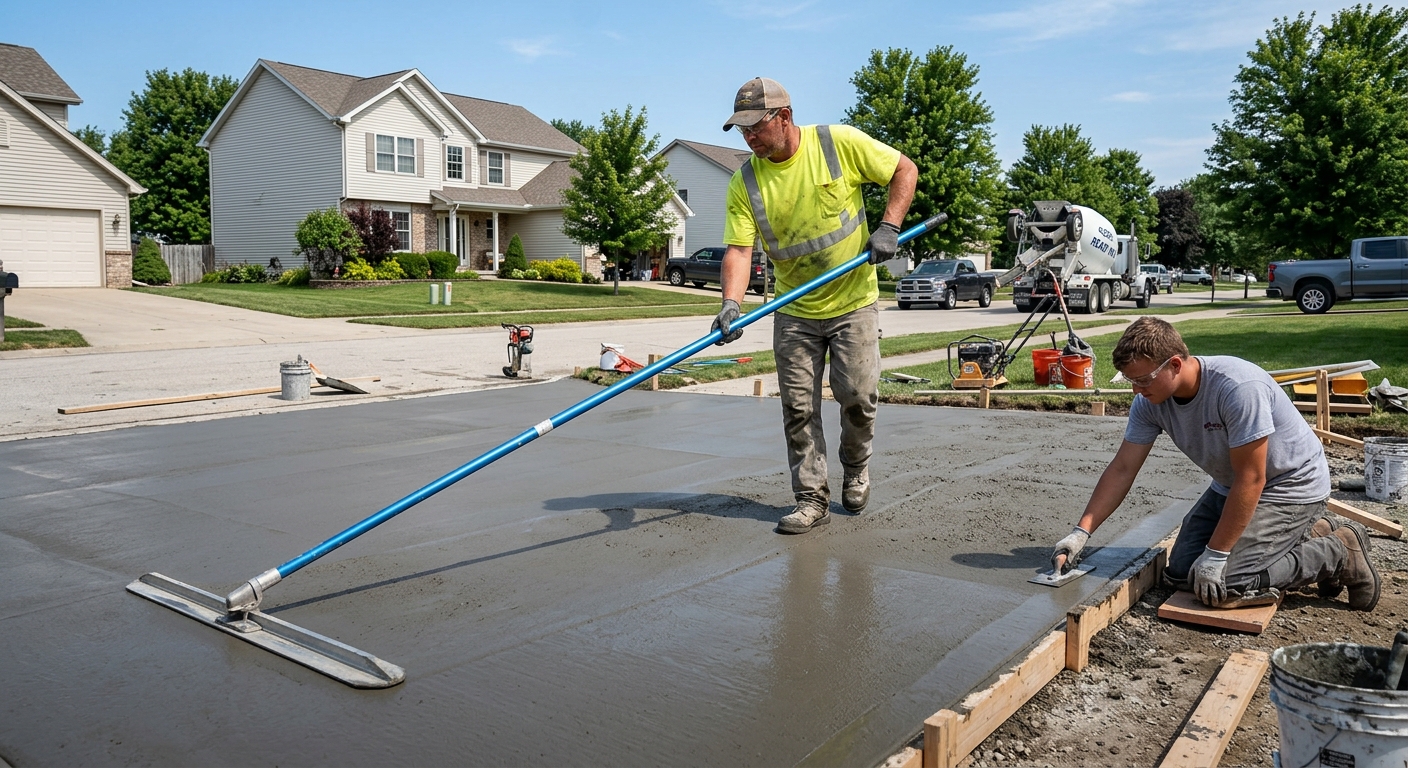
Concrete work options and costs in Willowdale West
Willowdale West is where many families want clean, low-maintenance concrete—whether that’s a refreshed driveway, a new patio for backyard evenings, or straight-line walkway access in front of the house. With Willowdale West sitting at 16,936 residents (Statistics Canada, 2021 Census), the demand is steady year-round, and concrete flatwork is especially common in neighbourhood pockets where detached homes and longer lots are the norm—exactly the kind of properties that see driveways, patios, and garage slabs upgraded during renovation cycles. Toronto’s market also means competitive crews on schedule, but climate still sets the rules: frost depth and freeze–thaw cycles drive deeper preparation for structural work and tougher exterior specifications.
In the Toronto economic region, exterior pours are usually planned for the warmer part of the year to support reliable curing. When temperatures drop toward 10 °C or below, contractors often need added protection (insulating blankets, sometimes temporary heat) and longer curing discipline to hit strength targets without early damage. That’s why two bids for the same footprint can differ: one crew may be budgeting for the right base, air-entrained mix, and curing time, while another is closer to a “quick pour.”
In Willowdale West—particularly around older established streets near the Bathurst/Sheppard corridor—flatwork tends to be in high demand because many homes are older and see recurring issues like settlement, surface scaling, or worn-out steps. Below is a practical range of what homeowners typically budget for common concrete jobs in this area, then we’ll break down the biggest cost drivers next.
| Application |
Typical Size |
Key Spec |
Finish Option |
Price Range |
| Concrete driveway (standard broom finish) |
300 sq. ft. |
Air-entrained mix, compacted granular base, control joints |
Broom finish |
$5,400 – $8,400 |
| Exposed aggregate driveway |
300 sq. ft. |
Air-entrained mix, wash/retarder process, proper curing |
Exposed aggregate |
$7,200 – $11,100 |
| Stamped concrete driveway or patio |
250 sq. ft. |
Air-entrained mix, colour integral, release agent, sealing-ready |
Stamp pattern + colour |
$6,000 – $10,000 |
| Plain concrete patio or walkway |
200 sq. ft. |
Air-entrained mix, proper sub-base, edge restraint |
Float/steel + light broom |
$3,200 – $5,200 |
| Garage floor (interior slab) |
400 sq. ft. |
Vapour barrier (if specified), 25–50 mm topping as needed, joints |
Plain interior finish |
$6,500 – $10,400 |
| Foundation footings (structural, below frost) |
Varies by house |
Structural concrete, rebar, excavate to frost depth, engineered requirements |
Formed footings |
$3,600 – $6,000 |
Prices are estimates only and vary by project scope, site access and material selection.
What affects the price of concrete work in Willowdale West
In Willowdale West and across the Toronto region, quotes for the “same job” can vary by about 30–50% because the hidden work isn’t the concrete—it’s everything beneath and around it. The big variables are excavation conditions, base thickness and compaction, reinforcement requirements, mix design (especially air-entrainment for exterior), and whether the contractor is truly budgeting for curing and protection during cool or damp shoulder-season weather. In a dense market like Toronto, scheduling and labour availability can also swing costs; a crew that can pour and cure correctly may charge more, but you’re usually paying for the specifications that hold up to freeze–thaw.
For Ontario, frost protection dictates footing depth and form height. Exterior slabs and walkways also need air-entrained mixes to manage freeze–thaw cycles and reduce risk of spalling. When temperatures fall toward 10 °C or lower, proper cold-weather curing precautions (insulating blankets and protection planning) add cost, and that’s often where “low bids” get risky. Finally, de-icing salt accelerates surface wear; that’s why sealing and surface protection are repeatedly recommended after cure.
Two common examples from Willowdale West: (1) Driveways with poor drainage or saturated subgrade usually require thicker compacted granular base and additional drainage detailing, which can move a driveway budget from the lower end of the concrete driveway range to the upper end. (2) Stamped concrete may cost around the $24–$40 per square foot band, but when the homeowner is replacing a larger, visible patio (and wants long-term curb appeal), the added cost can be justified compared with plain flatwork in the lower patio band of $16–$26. Housing stock matters too—older properties often have settlement, previous patching, or irregular grades, and that preparation time can change the price by thousands.
| Price Factor |
Why It Matters |
Cost Impact |
| Frost line depth — determines footing depth and form height |
Footings must extend below design frost depth to prevent frost heave and differential movement |
Higher excavation and material; major swing for structural work |
| Site preparation — excavation, grading, compacted granular base |
Concrete fails when base is under-compacted or too thin for the soil and drainage conditions |
Often 10–25% of the job cost depending on access and soil |
| Reinforcement — rebar or wire mesh requirement |
Helps control cracking and supports loads (especially garage slabs and exterior drive lanes) |
Adds material and labour; more for heavier loading |
| Mix design — air-entrainment and compressive strength spec |
Air-entrainment protects against freeze–thaw damage; strength targets support long-term performance |
Usually modest per-yard but crucial for exterior durability |
| Finish type — broom vs. stamped vs. exposed aggregate |
More labour and process steps increase cost and timing needs |
Can add several dollars per sq. ft. (or more) for decorative work |
| Pour size and concrete truck access to site |
Access limits can force smaller placements, more labour, and extra coordination time |
Can meaningfully raise labour and equipment cost |
| Cold-weather curing precautions — heating and blankets |
Ensures strength gain and reduces early-age damage when nights cool down |
Higher for shoulder-season pours; may add line items |
| Control joint pattern and sealing cost |
Jointing manages shrinkage cracking; sealing helps reduce salt-driven surface deterioration |
Often low material cost but additional labour and timing |
Permits & regulations in Ontario
In Ontario, the key rule of thumb is: structural concrete usually needs a building permit, while most simple flatwork does not. For homes in Willowdale West, work such as footings, foundation walls, and grade beams is typically considered structural and generally requires a building permit and, in many cases, engineered drawings reviewed by the municipality. By contrast, concrete driveway replacements, patios, and walkways commonly do not require a permit unless the project affects lot grading, stormwater/drainage considerations, impervious surface coverage limits, or municipal right-of-way (for example, work that ties into municipal sidewalk/curb areas). Always confirm with the local authority before breaking ground.
Before hiring, verify the contractor’s compliance and credibility. Step 1: ask for their liability insurance certificate—your contractor should be able to name you (or your property entity) as an additional insured where appropriate. Step 2: confirm their WSIB/WCB coverage (as applicable) so you’re not exposed if a worker is injured on your property. Step 3: check references on similar-scale projects in the GTA (driveways, patio removals, and foundation-related concrete typically show whether they know the freeze–thaw details). Step 4: verify licensing through the appropriate Ontario business/contractor listing, and request the contractor’s company information exactly as it appears on registry documents.
Done right, these steps reduce risk—especially important in a climate where poor base prep or early-age curing can turn into cracking or scaling within a few winters.
Getting concrete right in Willowdale West's freeze-thaw climate
Concrete failure in Willowdale West most often comes down to one thing: water. In freeze–thaw conditions, moisture that penetrates the surface and base expands as it freezes, and that can lead to cracking, scaling, and eventual spalling. To spec the job correctly, you want (1) base preparation done to the right depth and compaction level for local soil and frost performance, not “whatever fits,” (2) an exterior mix design that includes air-entrainment to resist freezing damage, (3) a control joint pattern that anticipates shrinkage, (4) curing that protects concrete long enough to reach early strength, and (5) sealing at the right time to slow de-icing salt and water attack.
For exterior flatwork, air-entrained concrete is typically targeted at about 5–7% air content, with a minimum compressive strength spec of 32 MPa for typical residential applications. Control joints should be laid out to limit random cracking—spacing that’s too wide is a common reason homeowners see diagonal cracks after the first couple of winter seasons. Curing should be a minimum of 7 days under proper conditions; if you pour in cooler shoulder-season weather, crews often need protection so temperatures don’t stall strength gain. Then, apply a penetrating sealer after full cure—commonly around 28 days post-pour—so water and salts have less chance to reach the concrete pores.
Here’s a practical cost example: if a homeowner is choosing between plain patio work at roughly $16–$26 per sq. ft. and a decorative stamped option closer to $24–$40, the upgrade is worth it when the contractor also gives you the right foundation and jointing plan. If the base prep is cut to “save money,” the decorative finish won’t prevent failure—spalling from inadequate air-entrainment and poor curing is still the most expensive problem because it often requires removal and replacement.
| Spec |
Why It Matters in Willowdale West |
What to Ask For |
Impact if Skipped |
| Compacted granular base (depth?) |
Ensures drainage and reduces frost-related movement under the slab/flatwork |
Base depth tied to the soil and local frost performance; “compacted in lifts” and drainage confirmed |
Settlement and slab movement; cracking and premature scaling |
| Air-entrained concrete mix (target air %?) |
Protects against freeze–thaw damage from water trapped in concrete |
5–7% air content for exterior flatwork and confirmation on mix ticket |
Spalling and surface breakdown in a few winters |
| Compressive strength (MPa rating) |
Supports durability and prevents early-age strength failures |
Minimum 32 MPa spec for exterior residential work (as applicable to your design) |
Greater risk of cracking, scaling, and wear under traffic/salt |
| Control joints (spacing per ACI guidelines) |
Manages shrinkage cracking so cracks appear where you expect, not randomly |
Joint layout plan, spacing, and whether joints will be saw-cut at the right time |
Random cracking; difficult and costly cosmetic/structural repairs |
| Minimum 7-day curing period |
Strength gain depends on curing conditions, especially during cool Ontario nights |
Written curing method (protection blankets if needed) and curing duration |
Reduced strength and higher early-age cracking risk |
| Penetrating sealer (when applied after cure) |
Helps repel water and de-icing salt intrusion during Toronto winters |
Apply after full cure (commonly around 28 days) with a product suited to exterior concrete |
Faster surface deterioration and staining; more winter repairs |
How to choose a concrete work contractor in Willowdale West
Choosing the right concrete contractor in Willowdale West is mostly about verification and clarity. Start with licensing/registration: confirm the contractor’s Ontario business details match what they provide in writing. Next, verify liability insurance—request a certificate of insurance and check the coverage is active for the time window of your project. Then confirm workers’ compensation coverage (WSIB/WCB as applicable) so any jobsite injury doesn’t become your financial problem. A reputable crew will provide these documents quickly, without pressure.
For pricing, get 2–3 itemised written quotes. You want a labour-and-materials breakdown (demolition, excavation, base material, concrete supply, reinforcement, finishing, joints, sealing, and disposal), not a single “lump sum” with vague inclusions. Scrutinize exclusions: is permit pulling included where required? Is dump/trucking disposal included for removed concrete? Are you paying extra for rebar, steel saw-cutting, or sealing if weather delays occur? Ask for the schedule: a start date and a completion estimate should be in writing.
Warranty matters in concrete because freeze–thaw is unforgiving. Ask for a workmanship warranty length and whether product/manufacturer warranties apply to materials like sealers and admixtures—and whether anything is transferable if you sell the home. Payment structure should stay conservative: never pay more than 10–15% upfront; use a holdback until the job is complete and surface protection is verified.
- Ask for a written scope that lists excavation, base thickness, and compaction method.
- Confirm air-entrained mix is included for exterior work and that it’s documented.
- Require a control joint plan (spacing and how joints will be cut/scheduled).
- Get details on reinforcement (where rebar/wire mesh is used and spacing/placement).
- Clarify curing protections for cold or damp days (blankets/heating if needed).
- Check whether sealing is included and when it will be applied (commonly after cure).
- Confirm disposal/trucking for removed concrete and debris is included.
- Verify permit responsibility (which tasks require a permit and who pulls it, if needed).
- Ask for proof of liability insurance and WSIB/WCB clearance before work starts.
- Request references for similar GTA concrete flatwork and ask about winter performance.
- Ensure the quote includes protection of landscaping and driveway access during construction.
- Use a payment schedule with a holdback until final inspection and cleanup.
Concrete red flags in Willowdale West: (1) no discussion of air-entrainment for exterior slabs; (2) skipping granular base thickness and compaction details; (3) vague jointing (“we’ll just finish it”) with no plan or spacing; (4) pouring without a curing/protection plan when nights are cooling; and (5) only offering a lump-sum quote without disposal, reinforcement, or sealing inclusions.
Frequently asked questions — concrete work in Willowdale West
What is a concrete overlay and is it suited to Willowdale West?
A concrete overlay is a thin new concrete layer installed over an existing slab (sometimes with surface grinding, bonding agent, and—depending on system—reinforcement or a bonding mat). In Willowdale West, overlays can be a good option when the existing concrete is still structurally sound and the problem is mainly cosmetic or minor wear. It’s not a fix for widespread settlement, deep spalling, or areas where the slab has lifted due to inadequate base or freeze–thaw movement. Because Ontario’s winters are tough on moisture and de-icing salt, overlay systems must be installed with proper surface preparation and a plan for water control. If you’re comparing budgets, a plain patio or walkway rebuild can land around $16–$26 per sq. ft., while overlays can be “in between” depending on surface prep and system choice. The right move is to have a contractor assess cracking pattern, drainage, and whether the slab has underlying movement.
How do I seal concrete to protect it in Willowdale West?
Sealing helps by reducing how easily water and de-icing salts penetrate the concrete surface—important in Willowdale West because freeze–thaw cycles punish saturated surfaces. The best practice is timing: let the concrete cure fully first, then apply a penetrating sealer after cure—often around 28 days post-pour—so the product can bond into the pores rather than trapping moisture. Before sealing, the surface should be clean and dry; contractors typically pressure wash and remove laitance/contaminants. Use the right product for exterior use and traffic levels. Also note that sealing isn’t a replacement for correct mix (air-entrainment) and base prep; if those are wrong, sealing can’t stop spalling driven by moisture intrusion. If your contractor includes sealing, ask what product type they’ll use and whether they’ll document the application date for maintenance planning.
What is the difference between concrete and cement?
Concrete is the final building material—cement plus aggregates (sand and gravel), water, and often admixtures (like air-entrainment for exterior durability). Cement is only one ingredient: the “binder” that reacts with water to form the solid matrix. In Ontario, when contractors talk about freeze–thaw performance, they usually mean the concrete mix design—especially air-entrainment and adequate curing—rather than cement alone. A contractor can use the right cement, but if they omit or reduce air-entrainment for exterior work, you can still get surface scaling and spalling in a few winter cycles. Likewise, a strong cement content doesn’t compensate for poor drainage and weak sub-base preparation. When reviewing quotes in Willowdale West, ask for the mix ticket details (air content and strength spec) and confirm it’s an exterior-appropriate mix for your slab or driveway.
How much does concrete work cost in Willowdale West?
Concrete pricing in Willowdale West depends on the type of work and how much preparation is needed. For typical homeowners, a new concrete driveway often budgets roughly $18–$28 per sq. ft. for standard-to-better exterior work, while patios and walkways commonly fall around $16–$26 per sq. ft. Decorative options climb into the $24–$40 per sq. ft. band for stamped or higher-end finishes because they require more labour and process control. Foundation footings are quoted differently; structural concrete work is typically estimated by the structural scope, and footings themselves are often in the $180–$300 range per unit/set depending on engineering, excavation, and reinforcement needs. Your final cost can swing if the site has poor drainage, requires deeper base, or needs cold-weather curing protection. The best way to confirm your budget is to request itemised quotes that show excavation, base, reinforcement, mix, and finishing/sealing inclusions.
How deep must footings be for Willowdale West's frost line?
In Ontario, structural footings generally must extend below the design frost depth to prevent frost heave and differential movement. While the exact depth depends on the engineering design and geotechnical conditions, the common practical guidance contractors use for Ontario is that footings are typically at least around 1.2 m below grade (often deeper depending on site conditions and the design). Willowdale West gets repeated freeze–thaw effects, so the goal is to keep the foundation in a zone that won’t experience enough freezing to lift or crack the structure. Your engineer or foundation design will specify the actual footing dimensions and depth, and the contractor should follow that drawing rather than guess. If you see bids that treat footing depth as optional or “standard for the street,” that’s a serious concern—foundation depth affects excavation size, concrete volume, and formwork, and it must be correct to Ontario design expectations.
Why does concrete crack in Willowdale West and how is it prevented?
Cracking is common in concrete if shrinkage and movement aren’t controlled—especially in Ontario where freeze–thaw cycles and moisture play a big role. In Willowdale West, exterior flatwork cracks often come from a combination of water infiltration, inadequate base prep, lack of proper jointing, and concrete that isn’t air-entrained for the exposure. Freeze–thaw can worsen small cracks by allowing water in and out of the slab repeatedly, leading to scaling and, eventually, spalling. Prevention starts with correct base preparation (compacted granular base that supports drainage), using an exterior-rated air-entrained mix, and placing control joints at a planned spacing so cracking happens where it’s intended. Curing also matters: concrete needs time and protection to gain strength—especially when temperatures cool toward 10 °C or below. Finally, sealing after full cure reduces water and salt penetration. Ask your contractor for the joint plan and the mix ticket information, not just the finish.