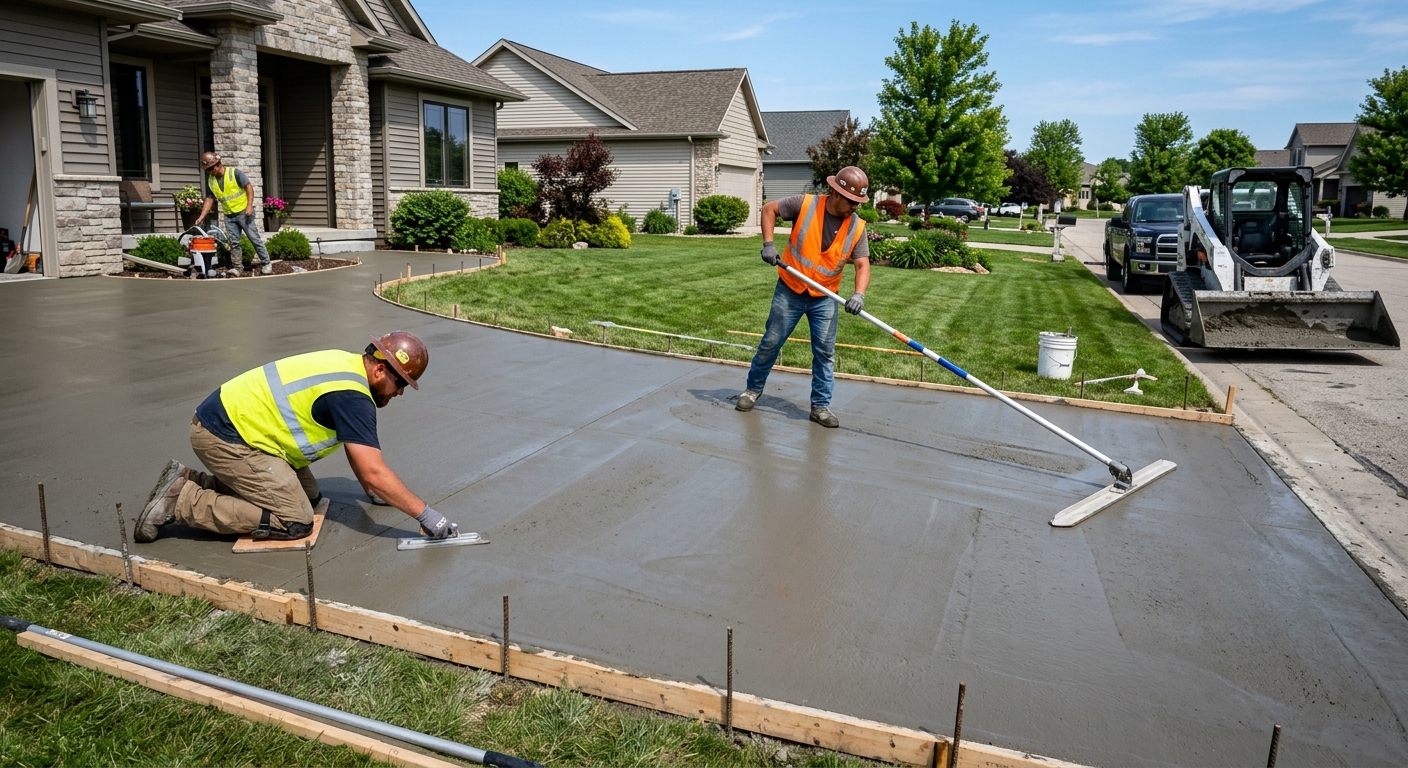
Concrete work options and costs in Dearborn
Concrete work in Dearborn is a practical upgrade for homeowners, especially where patios, walkways and driveways sit through Toronto-region freeze–thaw cycles year after year. Dearborn’s smaller local population (1,605 people as of the 2021 Census) means many concrete crews in the Toronto economic region are booked through a wider service radius, so scheduling and material availability can affect timelines and—indirectly—cost. Most homes that benefit from exterior flatwork look like the common GTA housing pattern: single-detached and townhouse drive/entry areas that take regular traffic, salt, and winter moisture. That climate exposure is why your “same size” job can price differently depending on the specs a contractor proposes.
In the Toronto economic region, exterior concrete costs are strongly driven by frost-depth requirements and the need for well-prepared base drainage. Ontario building practice generally requires structural footings to extend below design frost depth (with many projects targeting about 1.2 m below grade), and exterior slabs typically use air-entrained concrete to resist freeze–thaw damage. Contractors also concentrate most exterior pours in the warmer months to manage curing; when temperatures drop toward 10 °C or below, crews often need extra protection to reach proper strength and reduce surface scaling risk. If your property in areas like the Dearborn Village / Meadowvale-style residential pockets has tight access for a pump or limited truck staging, labour and setup can add to the quote. With that in mind, here are realistic cost ranges for common options, leading into a clearer apples-to-apples comparison.
| Application |
Typical Size |
Key Spec |
Finish Option |
Price Range |
| Concrete driveway (standard broom finish) |
300–500 sq. ft. |
6 in (150 mm) slab, compacted base, air-entrained mix |
Broomed, edged, control joints |
$4,500–$9,000 |
| Exposed aggregate driveway |
300–500 sq. ft. |
6 in (150 mm) slab, wash exposure, strong base drainage |
Exposed aggregate, often with sealer |
$7,000–$13,500 |
| Stamped concrete driveway or patio |
250–450 sq. ft. |
6 in (150 mm) slab, air-entrained mix, colour hardener |
Stamp pattern with release and optional borders |
$6,000–$16,500 |
| Plain concrete patio or walkway |
120–300 sq. ft. |
4 in (100 mm) slab, compacted granular base |
Float + broom finish, edges and joints |
$2,000–$7,800 |
| Garage floor (interior slab) |
300–600 sq. ft. |
4–5 in slab, vapour barrier (if needed), steel reinforcement |
Light broom / trowel finish, optional membrane |
$5,500–$14,000 |
| Foundation footings (structural, below frost) |
Varies (per linear foot) |
Engineered footing width/thickness, below frost depth |
Unfinished concrete with formwork |
$180–$300 |
Prices are estimates only and vary by project scope, site access and material selection.
What affects the price of concrete work in Dearborn
In Dearborn and across the Toronto economic region, quotes for the “same” concrete job can land 30–50% apart because contractors price the underlying specs differently: base depth and compaction, reinforcement, mix design, finishing method, protection for curing, and the amount of excavation/formwork required. Even when two bidders use the same slab thickness on paper, one may include adequate drainage and air-entrainment (critical in freeze–thaw climates), while another may not. The result is a better-looking slab that lasts—or a surface that scales and spalls sooner, costing you repairs later.
Frost depth and freeze–thaw cycles dictate every structural decision here. Footings generally must extend below Ontario’s design frost depth (commonly around 1.2 m in many regional practices) to reduce frost heave and differential movement. For exterior slabs—driveways, patios and walkways—Toronto contractors typically specify air-entrained concrete mixes to survive repeated winter cycling. Costs also rise when crews face a shorter reliable pour season: when temperatures drop toward 10 °C or below, cold-weather curing precautions (insulating blankets, heaters, longer protection time) add labour and equipment. De-icing salt accelerates spalling risk, which is why sealing is often recommended as part of a durable exterior package.
In practice, a Dearborn property with heavy clay or poor drainage usually needs deeper excavation and more granular base. That can push a simple walkway from the low end of the $16–$26 per sq. ft.-type band into the mid range once proper base and drainage are included. Conversely, a straight-access driveway with good existing subgrade may land closer to the low $18–$28 driveway/sq. ft. range. Where your home sits matters too: older properties may have outdated drainage patterns near the curb, meaning additional grading or weeping-tile tie-ins before the slab can perform.
| Price Factor |
Why It Matters |
Cost Impact |
| Frost line depth — determines footing depth and form height |
Deeper excavation and forms increase time and material use |
Often +10–25% on foundation/footing scopes |
| Site preparation — excavation, grading, compacted granular base |
Proper base prevents pumping and limits freeze–thaw movement |
Can shift exterior flatwork by 15–35% |
| Reinforcement — rebar or wire mesh requirement |
Controls cracking and improves load distribution |
Typically +5–15% depending on slab type |
| Mix design — air-entrainment and compressive strength spec |
Air voids reduce freeze–thaw damage; strength affects durability |
Small line item, but can change total cost by 5–20% |
| Finish type — broom vs. stamped vs. exposed aggregate |
Labour intensity and material steps vary significantly |
Stamped/exposed can add roughly 25–60% over broom-finish |
| Pour size and concrete truck access to site |
Smaller pours cost more per yard; limited access may require pump |
Often +5–25% with restricted access or scheduling constraints |
| Cold-weather curing precautions — heating and blankets |
Protects curing when temperatures fall toward 10 °C or below |
Can add 8–20% if the schedule lands near shoulder seasons |
| Control joint pattern and sealing cost |
Joints manage shrinkage; sealing helps against salt scaling |
Typically +2–10% but improves longevity |
Permits & regulations in Ontario
In Ontario, structural concrete work generally requires municipal oversight. Footings, foundation walls, and grade beams—anything that forms part of the structural system—normally require a building permit and, in many cases, engineered drawings reviewed by the municipality. Concrete flatwork such as patios, walkways and driveways typically does not require a permit by default, but it can if the work affects lot grading, drainage, or impervious surface coverage rules, or if it touches municipal right-of-way areas (like boulevards or designated sidewalk/drive access points). Before you sign, confirm the permit requirement with the local authority so you’re not left with a compliance gap after the pour.
For contractors in Dearborn, also verify they’re properly insured. A legitimate concrete company should carry liability insurance and have proper WSIB/WCB coverage for their workers. Step-by-step, a homeowner can:
- Ask for the contractor’s certificate of insurance (COI) and confirm the policy is active for your project.
- Request WSIB clearance/coverage details (and confirm workers are covered).
- Verify the contractor’s licence/registration status using the Ontario government online resources relevant to their trade activities.
- Ask for references on similar-scale work (driveways, patios, or structural footings) completed within the last few seasons.
- Confirm whether a permit pull is included in the quote if the scope is structural or affects grading.
Taking these steps up front protects you when frost-depth excavation and inspection schedules are involved.
Getting concrete right in Dearborn's freeze-thaw climate
The most common ways concrete fails in Dearborn’s Toronto-region freeze–thaw climate are spalling and surface scaling from inadequate air-entrainment, poor base drainage that allows water to expand under the slab, and curing problems when temperatures drop during the pour window. The fix is not just “better finishing”—it’s proper specification across the build-up: (1) base preparation, (2) mix design, (3) control joints, (4) curing, and (5) sealing after the concrete has reached cure.
First, insist on a compacted granular sub-base sized to your local soil conditions and frost exposure. Second, ask for an air-entrained mix; for exterior flatwork, contractors often target about 5–7% air content to manage freeze–thaw durability. Third, control joints should be spaced to limit random cracking patterns as the slab shrinks. Fourth, curing should be protected—minimum 7 days under proper conditions—because in colder snaps, concrete can look “set” while still not achieving the strength needed for long-term durability. Fifth, sealing matters in GTA winters with salt: a penetrating sealer is typically applied after the cure period (commonly around 28 days post-pour) so water and de-icers don’t penetrate as easily.
If you’re comparing options, this is where price differences make sense. A stamped patio priced at roughly $24–$40 per sq. ft.-type bands usually costs more than broom-finish, but the labour for formwork, stamping prep, and joints is justified when your goal is both appearance and controlled cracking. On the other hand, paying extra for decorative finishes without proper base drainage and joint spacing is where homeowners often overpay and still end up with premature surface defects.
| Spec |
Why It Matters in Dearborn |
What to Ask For |
Impact if Skipped |
| Compacted granular base (depth?) |
Water management and frost resistance depend on base depth/compaction |
Confirm excavation depth, granular type, and compaction targets |
Settlement, pumping, and rapid cracking |
| Air-entrained concrete mix (target air %?) |
Freeze–thaw durability relies on controlled air voids |
Ask for target air content (commonly 5–7% for exterior) |
Spalling and surface scaling in winter |
| Compressive strength (MPa rating) |
Strength affects wear resistance and finishing/curing performance |
Request minimum 32 MPa (or project-specified rating) |
Lower durability and increased early deterioration |
| Control joints (spacing per ACI guidelines) |
Joints steer shrinkage cracking into predictable locations |
Get joint spacing plan and saw-cut timing |
Random cracking that looks worse and may widen |
| Minimum 7-day curing period |
Cold/shoulder-season pours need protection to reach strength safely |
Confirm curing method, coverage, and temperature protection |
Weak surface, curling, and higher failure risk |
| Penetrating sealer (when applied after cure) |
Repels water and de-icing salts that drive spalling |
Ask for application timeline (often around 28 days post-pour) |
Faster salt damage and more stains |
How to choose a concrete work contractor in Dearborn
Start by confirming the essentials for Ontario work. Ask for proof of liability insurance (with policy dates that cover your project) and verify WSIB/WCB coverage so you’re not responsible for injury-related costs. Next, get 2–3 itemised written quotes rather than a quick lump sum. A good quote breaks down labour and materials—concrete supply/transport, excavation and base granular materials, reinforcement, formwork, finishing, curing protection, and sealing if included. This is especially important in the Toronto region because base prep and curing protection can swing the total even when slab size is identical.
Read the scope carefully for exclusions: Is site disposal included (topsoil removal, haul-away)? Are site conditions like unlevel subgrade or poor drainage included, or will the contractor treat them as “change orders”? Will a permit be pulled if structural concrete is involved? For warranties, insist on a workmanship warranty term (how long they stand behind cracking/spalling) and clarify whether product/manufacturer warranties apply to any membranes, sealers, or admixtures. Payment should be conservative: avoid paying more than 10–15% upfront; hold back a portion until the job is completed and walkthrough corrections are addressed. Finally, ask for a written start date and completion estimate, because in Dearborn’s shoulder-season weather, delays can affect curing quality.
- Verify Ontario licensing/registration status applicable to the contractor’s concrete scope.
- Request COI (liability) and confirm limits appropriate for your project size.
- Confirm WSIB/WCB coverage and get clearance details in writing.
- Ask for 3 references on similar Toronto freeze–thaw exterior work.
- Insist on an itemised quote: excavation/base/rebar/mix/finishes/cure/seal.
- Confirm air-entrained mix and minimum strength in the proposal details.
- Ask who handles permit pulls if grading or structural work triggers permits.
- Clarify whether saw-cut timing and joint pattern are included.
- Ask about curing protection if temperatures drop toward 10 °C or below.
- Confirm disposal/haul-away costs are included or excluded.
- Review warranty language for crack coverage and surface spalling limits.
- Set payment milestones tied to inspection points, not just “progress.”
Concrete contractor red flags in Dearborn include: refusing to provide COI/WSIB proof, quoting stamped or exposed aggregate without detailing base depth and joint spacing, offering blanket warranties with vague terms, starting excavation without confirming drainage and access, and “cheapening” the mix by not mentioning air-entrainment and strength.
Frequently asked questions — concrete work in Dearborn
Stamped vs broom-finish concrete — cost difference?
In Dearborn (Ontario), the cost difference is usually driven by labour intensity and finishing steps. A broom-finish driveway or walkway is typically priced in the standard exterior flatwork bands—about $18–$28 for driveway/similar scopes and $16–$26 for patios/walkways depending on size and base prep. Stamped concrete generally lands higher because you’re paying for extra prep, colour hardener/release materials, custom stamping and often more careful joint planning. If your base and drainage aren’t right, stamped concrete won’t last any longer than plain—so compare quotes for excavation, granular base, air-entrained mix and curing protection, not just the finished surface look. A well-done broom finish can outperform a poorly built decorative pour in freeze–thaw cycles.
When is the best time to pour concrete in Dearborn?
The safest window for quality in the Toronto economic region is late spring through summer, when daytime temps are consistently warm and crews can maintain proper curing. Contractors try to avoid pouring when temperatures are likely to drop toward 10 °C or below, because curing slows and surface scaling/spalling risk increases if protection isn’t used. In Ontario, even “small” delays can matter: if the weather turns quickly, reputable crews plan insulation blankets/heating and extend protection time so the concrete reaches adequate strength. If you’re scheduling work in Dearborn, aim for a planned pour date with weather backups, and ask your contractor how they handle cold nights, especially for exterior flatwork like driveways, patios and walkways.
How long does concrete take to cure?
Concrete takes time to develop strength. A common baseline is that you should protect the slab for at least 7 days under proper curing conditions, but that doesn’t mean it’s fully “finished” in the sense homeowners often expect. For sealing—important in Dearborn winters with salt—many contractors apply penetrating sealer after cure, often around 28 days post-pour. Also note that curing depends on temperature and how well the slab is protected; cold-weather curing precautions can be necessary if conditions cool. Your contractor should provide a curing plan that matches your pour date and forecast. If you see a proposal that treats curing as “spray and forget,” ask how they’ll maintain temperature and moisture during the early days.
Do I need a permit for concrete work in Ontario?
It depends on the scope. In Ontario, structural concrete work—footings, foundation walls, and grade beams—typically requires a building permit and often engineered drawings reviewed by the municipality. For exterior flatwork like patios, walkways and driveways, permits are usually not required unless the work affects lot grading, impervious surface coverage limits, drainage, or touches municipal right-of-way areas. In Dearborn, confirm with the local authority before breaking ground, especially if excavation is deeper than expected or if you’re changing how water flows from the house. No matter the scope, you should also verify the contractor carries liability insurance and has WSIB/WCB coverage, so you’re not exposed to risk during the project.
Concrete vs pavers for a patio in Dearborn?
Concrete and pavers can both work well in Dearborn’s freeze–thaw climate, but they fail differently. Concrete patios rely on correct base prep, air-entrained mix, adequate thickness and control joints; when those are right, concrete can provide long-term durability with fewer seams. Pavers can be easier to repair spot-by-spot if individual units heave or settle, but they still need proper base drainage and compacted granular layers to prevent shifting. Cost-wise, a plain concrete patio/sidewalk-type project often falls within around $16–$26 per sq. ft.-type bands depending on size and prep, while pavers commonly cost more due to materials and labour—though quotes vary widely by design and base requirements. Choose based on your priorities: clean, monolithic look and fewer joints (concrete) versus flexible replacement and design variety (pavers).
How long does a concrete driveway last?
A properly built concrete driveway in the Toronto region can last decades, but performance hinges on frost-protection fundamentals: correct footing/exterior slab spec, compacted granular base, air-entrained concrete, proper drainage and joint planning. In Dearborn winters, de-icing salts increase spalling risk, so sealing (often after cure around 28 days post-pour) can materially help. The biggest “early failure” causes are water trapped beneath the slab, inadequate air content, and control joints that are too wide-spaced—leading to random cracking and surface deterioration. If you’re comparing quotes, look for base prep details, the air-entrainment mention, and whether cold-weather protection is included when pours push into cooler periods. If those are absent, the driveway may not reach its full life potential.