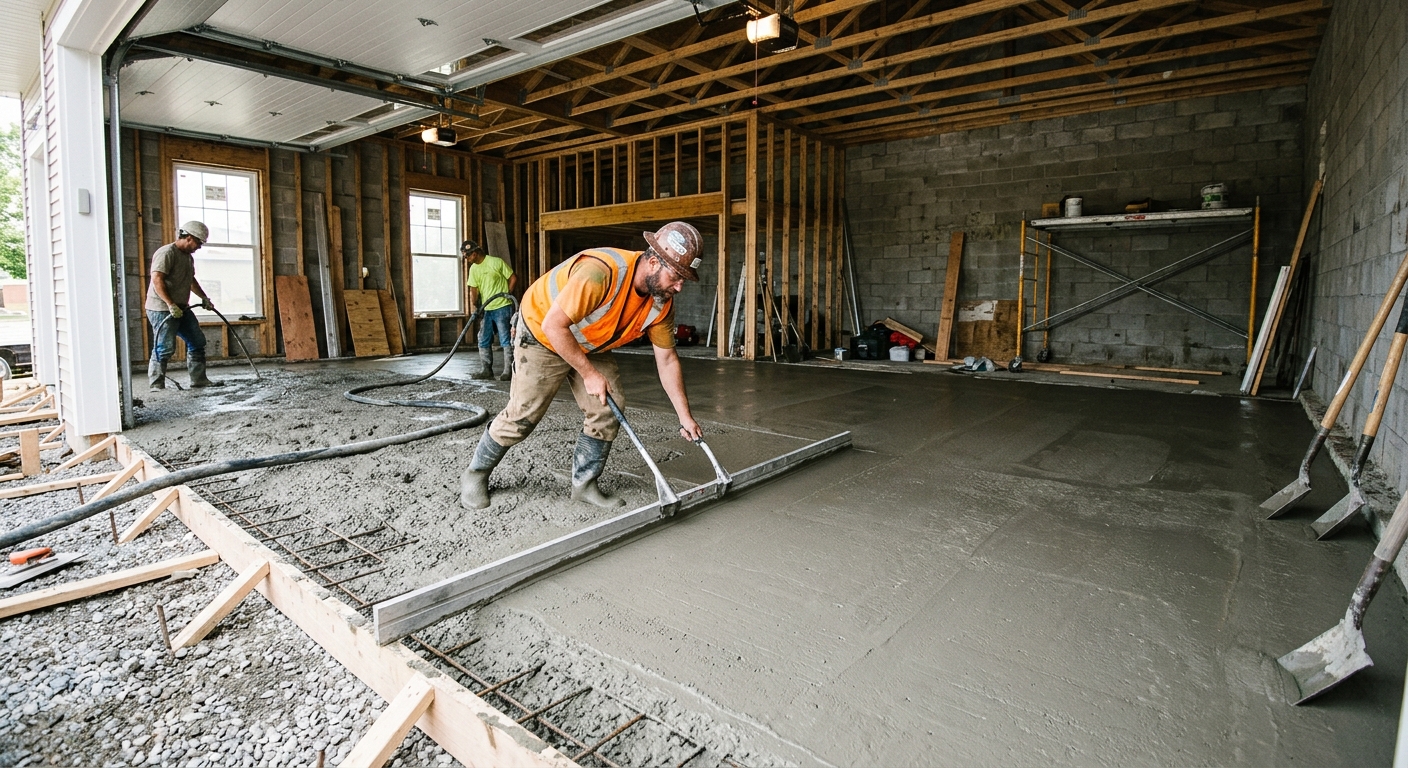
Concrete work options and costs in Blair Road
In Blair Road, Ontario, most homeowners are thinking about concrete because it’s the practical surface for driveways, patios, walkways, and garage slabs in a neighbourhood where single-detached homes are common. With a local population of 9,289 (Statistics Canada, 2021 Census), you’ll see steady demand for contractors who can handle exterior flatwork seasonally—especially around the established residential pockets that push traffic toward Mississauga Road and the broader Toronto commuting corridor.
Concrete pricing here is shaped by Toronto-area freeze–thaw cycles and required footing depth. Most structural footings must extend to about 1.2 m (roughly 4 ft) below grade to reduce frost heave and differential movement, which increases excavation, forms, and engineering time on foundations. For exterior slabs and driveways, local crews typically use air-entrained mixes, thicker sections where soil is weaker, and a control-joint plan to manage cracking in repeated winter cycles. The humid shoulder seasons (wet fall/spring) also affect how crews prepare sub-base and protect curing concrete—important when temperatures drift toward 10 °C or lower.
That’s why the same project can feel “simple” but still varies by 30–50% between quote crews: site access, base thickness, reinforcement, finishing complexity, and curing protection all change the labour and materials. Use the cost ranges below as your comparison baseline, then ask each contractor to show their mix design, base depth, and joint/sealing plan before you sign.
| Application |
Typical Size |
Key Spec |
Finish Option |
Price Range |
| Concrete driveway (standard broom finish) |
400–600 sq. ft. |
Air-entrained exterior mix; compacted granular base; control joints |
Broom finish |
$6,000–$12,500 |
| Exposed aggregate driveway |
400–600 sq. ft. |
Air-entrained mix; proper curing and surface retarder |
Exposed aggregate |
$8,500–$15,500 |
| Stamped concrete driveway or patio |
300–500 sq. ft. |
Air-entrained mix; thickness sized to soil and drainage; release agent; joints planned |
Stamped pattern + colour |
$9,000–$18,500 |
| Plain concrete patio or walkway |
200–400 sq. ft. |
Compacted base with drainage slope; joints as required |
Plain broom or smooth finish |
$3,200–$9,800 |
| Garage floor (interior slab) |
400–600 sq. ft. |
Minimum thickness per design; proper vapour/ground prep |
Broom finish |
$6,500–$14,500 |
| Foundation footings (structural, below frost) |
Varies by home footprint |
Excavation to frost depth; rebar as specified; engineered forms |
Reinforced concrete footings (utility-grade formwork) |
$18,000–$36,000 |
Prices are estimates only and vary by project scope, site access and material selection.
What affects the price of concrete work in Blair Road
In Toronto’s economic region, you can see noticeably different bids for the same concrete job—often 30–50%. The “why” is usually not the concrete itself; it’s the hidden scope: how deep the base is, how much excavation is needed, whether reinforcement is added, and how the contractor protects the pour during curing. In Blair Road, that difference is amplified by freeze–thaw cycles, which dictate almost every specification. Structural footings need to extend below the design frost depth (Ontario commonly 1.2 m and often deeper depending on soil and exposure) to prevent frost heave and differential movement. For exterior slabs and driveways, local contractors typically specify air-entrained mixes so the concrete can survive repeated freeze–thaw.
Cold-weather curing precautions also move the needle on cost. When temperatures fall toward 10 °C or below, crews may use insulated blankets, curing covers, or temporary heating—extra labour and equipment that a low bid might omit. De-icing salt in the GTA accelerates surface wear and spalling risk, so sealing and good surface finishing matter for long-term durability.
Two Blair Road examples: (1) a driveway replacement on clay-heavy areas often requires deeper, more thoroughly compacted granular base and sometimes additional reinforcement—pushing the project toward the higher end of the driveway band (concrete driveways are typically $18,XXX – $28,XXX per the local rate range). (2) a small walkway on a well-drained lot with easy truck access can stay closer to the lower end—while stamped concrete, because of added labour, forms, and finishing time, typically runs above standard broom-finish work (with stamped & decorative concrete commonly $24,XXX – $40,XXX in the local tier).
Also, housing stock matters: many older lots have older drainage patterns and tight side-yard access. More regrading, hauling, and disposal can add thousands even if the square footage stays the same.
| Price Factor |
Why It Matters |
Cost Impact |
| Frost line depth — determines footing depth and form height |
Footings must sit below design frost to prevent heave and cracking from movement. |
Higher excavation and formwork can add $2,000–$8,000+ depending on depth and soil. |
| Site preparation — excavation, grading, compacted granular base |
Proper base prevents settlement and helps drainage away from the slab. |
Less compaction or insufficient base can save short-term, but proper work often adds $1,500–$6,000. |
| Reinforcement — rebar or wire mesh requirement |
Rebar and/or mesh control cracking and improve load performance. |
Materials and placement labour commonly add $800–$3,500. |
| Mix design — air-entrainment and compressive strength spec |
Air-entrained concrete manages freeze–thaw damage in exterior GTA conditions. |
Upgraded mix and spec compliance often adds $300–$1,200. |
| Finish type — broom vs. stamped vs. exposed aggregate |
Complex finishes require extra stages (surface retarder, stamping, washout, colouring). |
Finish complexity can raise totals by roughly $2,000–$8,000+ for mid-size jobs. |
| Pour size and concrete truck access to site |
Access affects pumping needs, rigging, and labour time. |
Pump/placement logistics can add $500–$3,000 depending on distance and access. |
| Cold-weather curing precautions — heating and blankets |
Durability depends on curing under suitable temperatures and protection from rapid cooling. |
Can add $800–$4,000 if the job slips into colder periods. |
| Control joint pattern and sealing cost |
Joints reduce random cracking; sealing helps repel moisture and de-icing salt damage. |
Typically adds $250–$1,500, but prevents bigger failures later. |
Permits & regulations in Ontario
In Ontario, structural concrete work—such as footings, foundation walls, and grade beams—usually requires a building permit, and engineered drawings are often reviewed as part of the permit process. Concrete flatwork like driveways, patios, and walkways typically does not require a permit by itself, but it can trigger permitting if the work affects lot grading, changes stormwater/erosion drainage, or conflicts with municipal requirements around impervious surface coverage or work within municipal right-of-way.
For Blair Road homeowners, the best approach is to confirm with the local authority before you break ground—especially if you’re changing drainage, tying into existing foundations, or building a new entry with significant elevation changes. Also verify your contractor carries liability insurance and has the required workplace coverage (WSIB/WCB) before any excavation starts.
Step-by-step: verify contractor licence, insurance, and coverage
- Licence/registration: ask for the contractor’s business details, then search Ontario’s online registries for the appropriate corporate/business information.
- Certificate of insurance: request a current COI showing liability coverage limits; check the policy’s effective dates and whether you are listed as additional insured (where applicable).
- WSIB/WCB clearance: ask for a clearance letter or proof of coverage for the period of the job.
- References: ask for 2–3 similar projects (same concrete type and similar footing depth/base conditions).
- Written scope: confirm in writing that the quote includes site prep, base depth, reinforcement, curing protection, and disposal as applicable.
This reduces surprises—and protects you if something goes wrong during excavation or concrete placement.
Getting concrete right in Blair Road's freeze-thaw climate
Concrete fails in Blair Road mainly because winter moisture and freeze–thaw expand against the slab and base. If the sub-base is too thin, poorly compacted, or lacks proper drainage slope, water stays under the slab and freezes. When that happens repeatedly, you can get settlement, lift, and eventual spalling (surface flaking) and cracking. The fix is not just “more concrete”—it’s correct specification: (1) base preparation with properly compacted granular sub-base to the right depth for local soil and frost exposure, with drainage directed away; (2) a durable mix design—air-entrained concrete with about 5–7% air for exterior flatwork and a minimum target of 32 MPa compressive strength; (3) a control-joint plan sized to limit random cracking; (4) curing that lasts at least 7 days under suitable conditions; and (5) sealing after the cure to repel de-icing salt and reduce moisture absorption.
In Toronto’s market, crews often pour exterior concrete in the warmer months to manage curing reliably. If you’re scheduling late-season work, ask how they’ll protect the pour if temperatures drop toward 10 °C or below—heating and insulated blankets can cost more, but they’re often cheaper than replacing a slab early.
Dollar example: if a standard broom-finish driveway estimate lands near the lower end of the local driveway tier (around $18,XXX – $28,XXX), but the “cheap” option doesn’t include adequate base thickness, reinforcement, or curing protection, you might spend less at day one and then pay later for patching and re-surfacing. Conversely, the incremental cost for proper air-entrainment and correct base prep is usually justified because it directly addresses spalling and freeze–thaw damage—the problems GTA homeowners hate most.
| Spec |
Why It Matters in Blair Road |
What to Ask For |
Impact if Skipped |
| Compacted granular base (depth?) |
Stable, well-drained base reduces settlement and frost-related movement. |
“What is the base depth and compaction test method?” |
Uneven cracking, rocking slab, early failure around edges. |
| Air-entrained concrete mix (target air %?) |
Freeze–thaw durability depends on controlled air voids in exterior concrete. |
“Confirm air content target (typically 5–7%) and exposure class for exterior.” |
Spalling and scaling within 1–3 winters. |
| Compressive strength (MPa rating) |
Strength affects long-term performance under loads and winter stress. |
“What minimum MPa do you specify at 28 days (e.g., 32 MPa)?” |
Soft, damage-prone surface and faster wear. |
| Control joints (spacing per ACI guidelines) |
Joints guide cracking to predictable lines, reducing random failures. |
“What joint spacing and saw timing do you use for this slab thickness?” |
Uncontrolled cracks, widened joints, water intrusion. |
| Minimum 7-day curing period |
Proper curing builds strength and reduces shrinkage cracking risk. |
“How do you protect against cold nights and wind during curing?” |
Lower strength, surface weakness, premature deterioration. |
| Penetrating sealer (when applied after cure) |
Sealing helps repel moisture and de-icing salt, improving durability. |
“Will you apply sealer after full cure (commonly around 28 days) and what product do you use?” |
More scaling and moisture-related staining/spalling. |
How to choose a concrete work contractor in Blair Road
Choosing the right contractor in Blair Road is mostly about verification and clarity. Start with Ontario compliance: ask for their liability insurance certificate (ensure it’s current and includes adequate limits), then request proof of WSIB/WCB coverage for workers. How to check: verify the policy dates and coverage on the COI, and ask for a WSIB/WCB clearance document showing the correct coverage status for the period your job is scheduled. If a contractor won’t provide these documents up front, treat that as a red flag.
Next, get 2–3 itemised written quotes—not just a lump sum. You want separate lines for labour, concrete supply, reinforcement, excavation/base prep, finishing, sealing, and disposal. Carefully compare what’s excluded: is demolition included? Is the proper base depth included? Are control joints and sealing included in the price, or “optional extras” later?
For warranty, confirm both workmanship (how many months/years for cracking/spalling and what conditions apply) and any manufacturer/product warranty. Ask whether warranties are transferable if you sell your home. For payment, never pay more than about 10–15% upfront; hold back a portion until completion and clean-up. Finally, get a firm start date and completion estimate in writing—GTA exterior work often depends on temperature and curing windows, so timing matters.
- Provides COI (liability) with current effective dates.
- Shows WSIB/WCB clearance or proof of coverage.
- Quotes include base depth and compaction method, not “we’ll prep it properly.”
- Lists concrete thickness and reinforcement (rebar/mesh) in writing.
- Specifies air-entrainment for exterior flatwork.
- Includes control joint spacing and when saw-cutting will occur.
- Explains curing protection plan for cool nights.
- Includes disposal/haul-away for removed concrete and spoils (if required).
- Confirm sealing scope: product type and timing (commonly after cure).
- Provides a detailed timeline with inspection/curing milestones.
- Uses a written scope with exclusions highlighted.
- Offers workmanship warranty terms in plain language.
Concrete-specific red flags for Blair Road: quotes that don’t mention air-entrainment for exterior slabs; base prep described vaguely without depth/compaction; missing reinforcement details on driveways; no plan for cold-weather curing if the pour date slips into cooler temperatures; and crews asking for large upfront deposits or refusing to provide insurance/WSIB documentation.
Frequently asked questions — concrete work in Blair Road
Why does concrete crack in Blair Road and how is it prevented?
Concrete cracks in Blair Road mainly because of movement: water in the ground freezes and expands during freeze–thaw cycles, and slabs also move slightly as they shrink and expand with temperature swings. If the base is uneven or drainage is poor, cracks start earlier and can become wider. Prevention is a spec and workmanship issue. For exterior flatwork, contractors should use air-entrained concrete and design for durability, then add control joints at proper spacing to “tell” the slab where to crack. A proper compacted granular base and correct thickness reduce settlement that turns hairline cracks into bigger problems. Sealing after full cure also helps repel moisture and de-icing salt, lowering spalling risk.
When you compare quotes, look beyond the finish price—broom-finished driveways can fall in the local range of $18,XXX – $28,XXX, but the real difference is usually base prep, reinforcement, joints, and curing.
Stamped vs broom-finish concrete — cost difference?
Stamped concrete costs more than broom-finish because it requires additional labour and steps: form/release materials, careful timing, imprinting, colouring, and extra attention to surface texture so it doesn’t look blotchy after curing. Broom-finish is a simpler process and is typically more budget-friendly for driveways and walkways. In the Toronto area, both options still require air-entrainment for freeze–thaw durability and a joint plan, but the decorative process adds time and material. That’s why stamped & decorative concrete typically runs higher—commonly around $24,XXX – $40,XXX in the local tier—depending on square footage, pattern complexity, and colour package.
In Blair Road, if you’re replacing a driveway and want curb appeal, stamped can be worth it. Just make sure the contractor doesn’t “save” on base depth or skip sealing; otherwise, decorative concrete can fail just like plain concrete.
When is the best time to pour concrete in Blair Road?
The best time to pour concrete in Blair Road is when daytime temperatures are consistently warm and night-time cooling is manageable. In the GTA, contractors typically plan exterior pours in the warmer months because curing is more reliable, and you avoid the expensive cold-weather measures that may be needed when temperatures drop toward 10 °C or below. Even if concrete can be placed in cooler weather, you may need heating, insulated blankets, and stricter protection to ensure the slab reaches the intended strength and durability.
If your schedule is flexible, aim for late spring through early fall, and confirm the contractor’s curing and protection plan in writing. For foundation work, permitting and scheduling often govern timing more than temperature, but curing protection is still important.
How long does concrete take to cure?
Concrete curing depends on temperature and mix design, but for most residential flatwork and slabs you can think in stages. Initial set happens within hours, but strength development continues for days. A common requirement is a minimum curing period of about 7 days under proper conditions before you do heavier handling or remove forms (where applicable). Full design strength is typically evaluated at about 28 days. Sealing is also usually done after the slab has sufficiently cured—often around the 28-day mark—so the sealer can bond and repel moisture effectively.
In Blair Road’s freeze–thaw climate, curing is not optional: if the contractor rushes through with poor protection during cool evenings, you can see surface weakness, scaling, and early deterioration. That’s why a quote should include curing protection steps and joint timing.
Do I need a permit for concrete work in Ontario?
In Ontario, structural concrete work typically needs a building permit. That includes items like footings, foundation walls, and grade beams, and it may require engineered drawings reviewed by the municipality. For concrete flatwork such as patios, walkways, and driveways, permits are usually not required solely because you’re pouring concrete—but permits can become necessary if the work affects lot grading, changes drainage patterns, or involves municipal right-of-way or impervious surface considerations.
Because requirements can vary based on how the concrete ties into the property and drainage, the safest path in Blair Road is to check with the local authority before breaking ground—especially if you’re lowering/raising grade, changing slope, or building near drainage features.
Concrete vs pavers for a patio in Blair Road?
Concrete and pavers both work well for patios, but they behave differently with moisture and freeze–thaw. Pavers can be excellent for aesthetics and are easier to repair locally if a section shifts—however, they depend on a properly installed base, edge restraints, and jointing sand drainage details. Concrete provides a more uniform, monolithic surface, and when it’s properly designed with air-entrainment, joints, and good drainage slope, it can last a long time with fewer visible seams.
In cost terms, plain concrete patio work often lands in the local tier of $16,XXX – $26,XXX depending on size and prep, while stamped concrete generally runs higher due to added finishing steps. If your priority is low maintenance and a clean, modern look, concrete is a strong choice. If you expect frequent grading changes or want the option of replacing small sections, pavers can be advantageous.