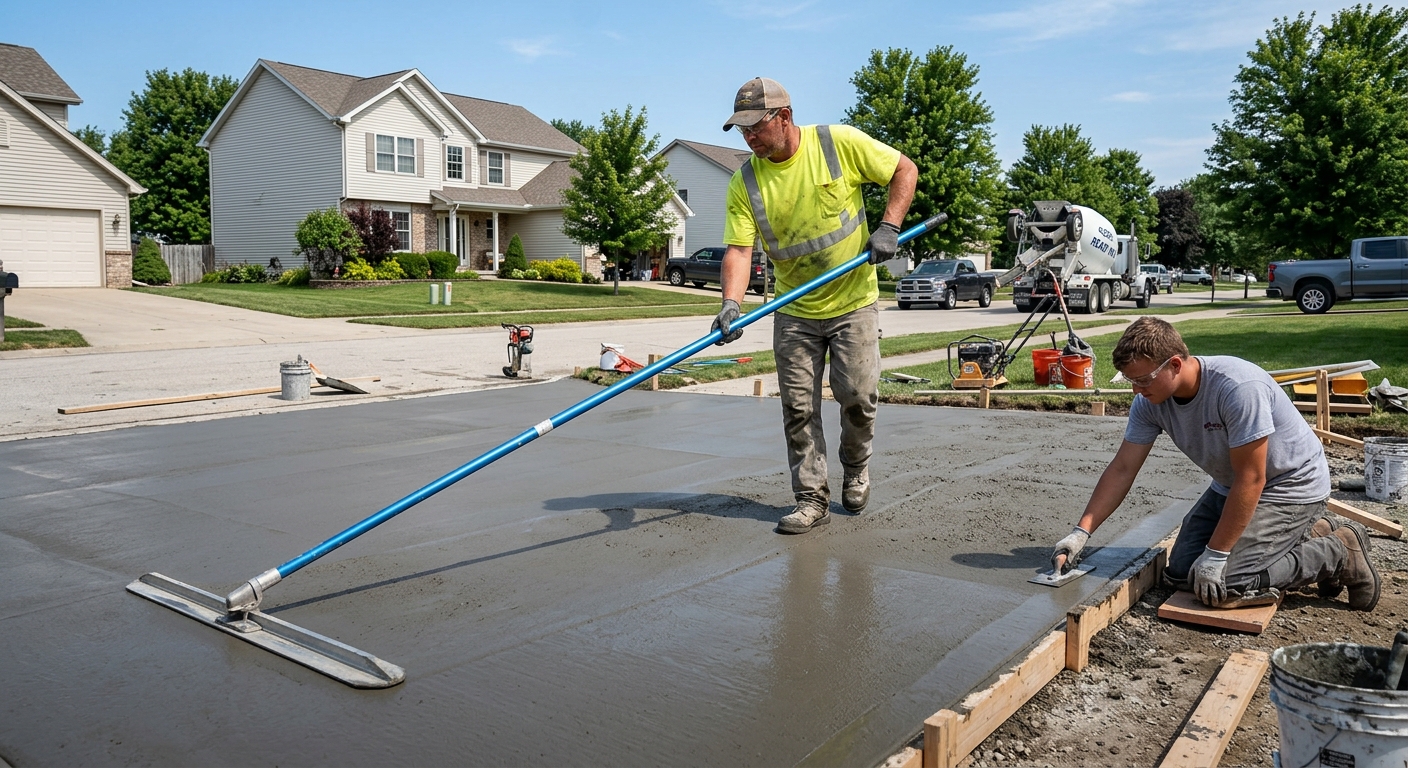
Concrete work options and costs in Delaware
Delaware, Ontario is a small community in the Toronto economic region, and it’s the kind of place where practical, long-lasting concrete flatwork matters: driveways for daily use, patios for summer entertaining, and walkways that stay level through the seasons. The local housing mix leans heavily toward residential properties where these projects are common—though Delaware’s total population is just 2,521 (Statistics Canada, 2021 Census), the surrounding Toronto demand keeps crews busy, particularly in late spring and early fall.
In this part of Ontario, concrete pricing is closely tied to freeze–thaw conditions and the required frost depth. Structural footings typically need to extend at least 1.2 m below grade to reduce frost heave and movement, while exterior slabs and flatwork must be properly built with drainage and air-entrained mixes. That’s why you’ll often see labour and material costs clustering within local bands: for basic driveway work, many Toronto-area quotes land around the $18–$28 range, while patios and walkways commonly fall near $16–$26 depending on base prep and finish.
Contractors also plan pour schedules around temperatures—once conditions drop toward 10 °C or below, curing becomes harder to manage, so crews may add insulation blankets or heating to protect strength gain. In Delaware, trades are especially in demand around more-established residential pockets near main-access routes where homeowners want year-round access without settling or spalling. If you’re comparing options, the table below gives a practical look at typical sizes and finish-driven cost ranges for common jobs.
| Application |
Typical Size |
Key Spec |
Finish Option |
Price Range |
| Concrete driveway (standard broom finish) |
12 ft x 24 ft (288 sq ft) |
Proper granular base + air-entrained mix for exterior exposure |
Broom finish |
$18,000–$28,000 |
| Exposed aggregate driveway |
12 ft x 24 ft (288 sq ft) |
Air-entrained mix, controlled exposure, good curing |
Exposed aggregate |
$22,000–$34,000 |
| Stamped concrete driveway or patio |
12 ft x 20 ft (240 sq ft) |
Reinforcement where needed + air-entrained exterior mix |
Stamped (matt finish with sealer) |
$25,000–$40,000 |
| Plain concrete patio or walkway |
10 ft x 16 ft (160 sq ft) |
Compacted base + drainage considerations |
Float/screed + light broom |
$16,000–$26,000 |
| Garage floor (interior slab) |
20 ft x 22 ft (440 sq ft) |
Vapour barrier (if required) + fibre or mesh depending on spec |
Steel-trowel finish (slight broom at edges) |
$3,700–$6,800 |
| Foundation footings (structural, below frost) |
Per 24 ft x 30 ft foundation footprint |
Engineered layout; excavation to frost depth; typical rebar work |
Structural concrete only |
$180,000–$300,000 |
Prices are estimates only and vary by project scope, site access and material selection.
What affects the price of concrete work in Delaware
In the Toronto economic region, it’s common to see quotes for the “same” concrete project vary by 30–50%. The main reasons aren’t just the concrete—they’re the specs that protect against Ontario’s freeze–thaw cycle. Frost depth drives footing depth and formwork height, and air-entrained concrete is typically required for exterior exposure so the slab survives repeated expansion and contraction. On top of that, local availability matters: when the pour season narrows (because temperatures drop and curing becomes harder to manage), crews and concrete trucks get scheduled tightly, which can affect unit pricing.
For Delaware homeowners, the most visible cost differences often show up between flatwork finishes. A standard broom-finish driveway can land near the $18–$28 band, but switching to stamped or more decorative work can push you toward the $24–$40 range because of labour intensity, stamp tooling, colour/texture control and higher sealer requirements. Foundation work is another area where variability jumps: structural footings need excavation and reinforcing “to spec,” and that’s why foundation/footing pricing often sits around the $180–$300 band depending on complexity and engineered reinforcement requirements.
Local soil and drainage are huge. If your site has saturated clay or poor surface grading, crews may need extra excavation and thicker granular base to keep water from pooling against the slab—this can add cost but usually prevents premature scaling. A practical example: if you’re adding a 240 sq ft stamped patio, the stamped finish may cost a few thousand more than plain concrete, but that delta is often justified when the job includes proper base compaction, reinforcement, and sealing to protect against de-icing salts and early surface spalling.
| Price Factor |
Why It Matters |
Cost Impact |
| Frost line depth — determines footing depth and form height |
Footings must extend below design frost depth to limit frost heave and differential movement |
Higher excavation + taller forms can add thousands |
| Site preparation — excavation, grading, compacted granular base |
Poor base and drainage lead to settlement and slab cracking in freeze–thaw conditions |
Can swing cost widely depending on soil removal and base thickness |
| Reinforcement — rebar or wire mesh requirement |
Helps limit cracking and supports load distribution for driveways and garage slabs |
Material + labour increases, especially for thicker slabs |
| Mix design — air-entrainment and compressive strength spec |
Air-entrainment supports freeze–thaw durability; strength targets support long-term performance |
Quality specs may raise material cost, but reduce failure risk |
| Finish type — broom vs. stamped vs. exposed aggregate |
Decorative finishes increase labour, timing control and curing/sealer requirements |
Often shifts jobs between plain ($16–$26) and decorative ($24–$40) bands |
| Pour size and concrete truck access to site |
Access affects how crews place, consolidate and finish concrete efficiently |
Hard access can add labour hours and equipment costs |
| Cold-weather curing precautions — heating and blankets |
Ensures adequate strength gain when temperatures drop; protects against surface damage |
Heaters/blankets and protective labour increase the budget |
| Control joint pattern and sealing cost |
Jointing controls shrinkage and cracking locations; sealing helps repel salts |
Added line items, but often prevents early spalling and maintenance |
Permits & regulations in Ontario
In Ontario, structural concrete work generally needs the right permits and review. Footings, foundation walls, and grade beams are part of the building structure, so homeowners typically need a building permit—and engineered drawings may be required depending on the foundation type and design. For concrete flatwork (patios, walkways and standard driveways), permits are often not required by default, unless the work affects lot grading, alters impervious surface coverage limits, or impacts municipal right-of-way considerations. The safest approach is to confirm with the local authority before any excavation or removal begins.
For licensing and coverage, a Delaware homeowner should verify three things before signing: (1) liability insurance, (2) WSIB/WCB coverage, and (3) that the contractor is operating legally for the type of work. Step-by-step, start by asking the contractor for a current certificate of insurance naming you (or your property) appropriately as required by contract. Next, request proof of WSIB/WCB clearance or account details; reputable Ontario crews will provide this quickly. Finally, you can verify professional licensing/registration status and any disciplinary notes using Ontario’s online contractor/builder registry resources relevant to the trade category, then compare that info to the company legal name on the quote.
Also ask for references on similar-scale jobs in your area and confirm the quote includes specifics: engineered foundation details where applicable, disposal/cleanup, and whether protection of landscaping and nearby structures is included.
Getting concrete right in Delaware's freeze-thaw climate
Concrete failures in Delaware’s freeze–thaw climate usually trace back to water, inadequate air-entrainment, poor base preparation, or rushed curing. When water gets into surface pores or tiny cracks, it freezes, expands, and gradually spalls the surface. That’s why the “right” spec here is more than just pouring concrete: you need a properly compacted granular base sized to support the slab and prevent pumping during wet spring and freeze conditions. For exterior flatwork, specify air-entrained concrete with a target air content of about 5–7% and use a minimum 32 MPa compressive strength so the mix performs under cold cycling.
Control joints are another key failure-preventer. They give concrete a planned path to crack as it shrinks, rather than letting random cracks wander through the finish. Curing also matters: plan for a minimum 7-day curing period under suitable conditions, and if temperatures are dropping, crews should use cold-weather curing precautions like insulating blankets or properly managed heating. After the slab cures, apply a penetrating sealer (typically after 28 days) to repel de-icing salts that can accelerate scaling.
If you’re deciding between plain and decorative work, the price jump isn’t automatically “worth it.” For example, moving from a standard broom-finish patio to stamped concrete often puts you into the $24–$40 style range, but it’s only justified if the quote also includes the base prep, joint plan, and sealing schedule. Decorative finishes highlight defects—so the spec quality is what actually protects your money over 10+ winters.
| Spec |
Why It Matters in Delaware |
What to Ask For |
Impact if Skipped |
| Compacted granular base (depth?) |
Prevents settlement and reduces water retention under slabs during wet/freeze cycles |
State granular base thickness and compaction method for your soil type |
Uneven settling, cracked edges, and early failure of flatwork |
| Air-entrained concrete mix (target air %?) |
Improves freeze–thaw durability by providing room for ice expansion |
Ask for a 5–7% target air content for exterior exposure |
Higher risk of spalling and scaling from winter cycling |
| Compressive strength (MPa rating) |
Supports long-term load capacity and surface integrity |
Confirm minimum 32 MPa design strength |
Surface wear, scaling, and reduced performance in demanding conditions |
| Control joints (spacing per ACI guidelines) |
Controls where shrinkage cracking occurs, limiting random cracking through finishes |
Request joint layout and spacing suited to slab dimensions |
Random cracks, water ingress, and more frequent repairs |
| Minimum 7-day curing period |
Curing strength gain directly affects durability in freeze–thaw weather |
Ask how curing will be protected if temps drop (blankets/heating if needed) |
Reduced strength, soft surfaces, and faster deterioration |
| Penetrating sealer (when applied after cure) |
Repels moisture and de-icing salts that drive scaling and spalling |
Confirm sealer application after cure—typically around 28 days |
Higher chance of salt-related surface damage and shorter lifespan |
How to choose a concrete work contractor in Delaware
Choosing the right contractor in Delaware (Ontario) starts with verifying coverage and legitimacy. First, ask for their certificate of insurance showing current liability coverage; if they won’t provide it, pause. Next, confirm WSIB/WCB coverage. In Ontario, you can ask for a clearance letter or proof of account status—experienced contractors typically include this without delays. Then, verify the contractor is correctly registered for their trade category and that the legal name on the quote matches the insured business entity.
Get 2–3 itemised written quotes instead of lump sums. You want line items that separate excavation and hauling, granular base, reinforcement, concrete supply, finish labour, protection, and sealing—especially for exterior flatwork. Ask what’s included for permits (if any apply), disposal of excess material, and restoration of landscaping/grass. A good quote also specifies thickness and reinforcement for driveways and garage slabs, and engineered details for foundation footings where required.
Warranty is often where homeowners get surprised. Ask for the workmanship warranty length, whether it covers cracking/spalling related to finishing and joints, and whether any manufacturer warranty on concrete/sealer products is included and transferable. For payment, keep deposits modest—never more than 10–15% upfront—and hold back a portion until final grading, cleanup, and sealer/work protection are complete. Finally, demand a start date and completion estimate in writing so the pour schedule aligns with curing temperatures.
- Ask for insurance certificate and confirm it’s current.
- Confirm WSIB/WCB clearance letter or proof of coverage status.
- Request at least three itemised quotes (labour + materials).
- Verify footing depth and engineering for structural work.
- Confirm air-entrained mix and target air content for exterior pours.
- Ask for granular base thickness and compaction standards.
- Require a control joint plan (locations and spacing).
- Confirm curing protection plan for cold snaps.
- For exterior work, ask when sealer will be applied (after cure, not immediately).
- Check whether disposal/hauling and site cleanup are included.
- Use a written schedule: start date, pour day, finishing day, and cure/sealer timing.
- Keep payment staged with a holdback until final walkthrough.
Concrete red flags in Delaware: quotes that won’t state slab thickness or joint spacing; “cheap” exterior pricing that doesn’t explicitly mention air-entrained concrete; no plan for curing/blankets when temperatures drop; deposits higher than 15% without a clear timeline; and contractors who can’t show photos or references from similar Toronto-area freeze–thaw projects.
Frequently asked questions — concrete work in Delaware
How do I seal concrete to protect it in Delaware?
In Delaware, Ontario, sealing is mainly about protecting the surface from moisture and de-icing salts that drive winter scaling and spalling during freeze–thaw cycles. After the pour, give the concrete time to cure—plan on about 28 days before sealing for exterior flatwork so the sealer can bond properly and the surface is ready. For best results, choose a penetrating sealer made for exterior concrete, apply when the weather is dry and stable, and follow the manufacturer’s coverage rate. Also confirm your contractor includes surface cleaning and preparation (pressure washing if appropriate) so the sealer doesn’t trap dirt. If your quote only mentions “sealer included” but not the product type or timing, ask for those details—this is where durability is won or lost.
What is the difference between concrete and cement?
Concrete is the finished material you see and build with; cement is one of the ingredients inside concrete. In practical homeowner terms in Ontario, “concrete” includes cement paste plus fine and coarse aggregates (sand and stone), water, and often admixtures like air-entraining agents for exterior flatwork. Those admixtures matter in Delaware because freeze–thaw cycling is hard on surfaces—air-entrainment helps the concrete tolerate ice expansion. When you’re comparing quotes, don’t just ask “What concrete?”; ask about the mix design: minimum compressive strength (commonly 32 MPa for durability specs), and whether the exterior mix is air-entrained. A good contractor will describe the mix and curing plan, not just the brand of cement.
How much does concrete work cost in Delaware?
Concrete costs in Delaware usually land inside the Toronto economic region bands, but the final number depends on base prep, thickness, reinforcement, finish type and access. For example, a standard concrete driveway often falls around the $18–$28 per sq ft band for typical exterior work (your total can still vary with size and upgrades). Plain patios and walkways often come in around the $16–$26 band, while stamped and decorative styles are commonly higher—frequently within the $24–$40 range because they require more labour and careful timing. If you’re looking at foundation/footings, structural below-frost concrete is typically priced as a separate scope and commonly aligns with the $180–$300 band depending on the engineered layout. Always compare itemised quotes so you’re not comparing “skim finish” work to properly spec’d exterior durability work.
How deep must footings be for Delaware's frost line?
In Ontario, structural footings typically need to extend at least 1.2 m below grade to reduce frost heave and differential movement. The exact depth is tied to design frost conditions and your foundation/engineered requirements, so it’s not something you should guess at from a general rule. In the Toronto economic region, that “about 1.2 m” guidance is commonly reflected in building practice for footings, and structural work is normally tied to approved drawings and municipal review. If a quote proposes a shallower footing without engineering support, that’s a major quality concern. For a homeowner, the best approach is to confirm whether your foundation is being designed/engineered for local frost exposure and that excavation will be carried out to that verified depth—especially in soils that hold water.
Why does concrete crack in Delaware and how is it prevented?
Concrete cracks in Delaware mainly due to shrinkage, temperature swings, and freeze–thaw movement—plus water infiltration when drainage or jointing is poorly planned. In exterior flatwork, random cracking can turn into surface spalling if water gets into fissures and then freezes. Prevention starts with proper base preparation and thickness, plus using air-entrained concrete for exterior durability. Next, control joints must be placed intentionally with a spacing pattern that matches slab dimensions, so cracking happens in predictable locations. Finally, curing needs protection for adequate strength gain; cold snaps can interrupt curing and weaken the surface. Sealing after proper cure (often around 28 days) adds protection against de-icing salts that accelerate damage. If you want fewer cracks, ask your contractor to show the joint layout and the curing/sealing schedule—those are the big levers.
Stamped vs broom-finish concrete — cost difference?
Stamped concrete usually costs more than broom-finish because it’s labour-intensive and requires tight control of timing, texture, and finishing steps. In Delaware, broom-finish driveways and simple exterior flatwork often fall within the $18–$28 band, while stamped concrete projects commonly land in the $24–$40 range depending on size, reinforcement needs, and sealer specifications. The difference isn’t just the “pattern”—it’s also that decorative work needs consistent base prep, proper joint planning, and careful curing so the finish doesn’t degrade or reveal defects sooner. If your stamped quote is only slightly higher, ask what’s included: base thickness, reinforcement, joint spacing plan, air-entrained mix confirmation, and the exact sealer timing. In freeze–thaw Ontario, those specs matter as much as the look.