Concrete work options and costs in Gananoque
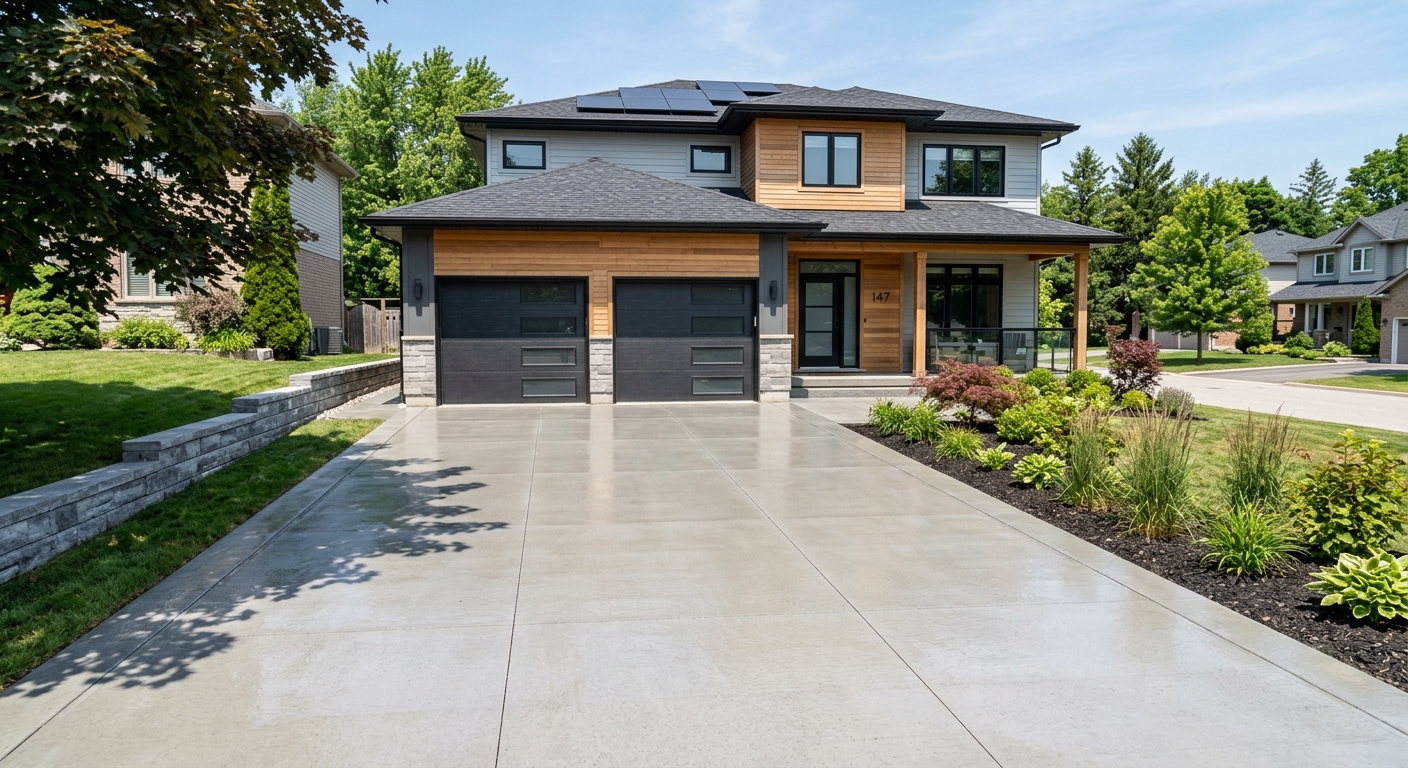
In Gananoque, concrete decisions usually come down to finish type, site access, and the weather window for getting concrete placed and cured safely. With 52.7% of local dwellings being single-detached homes (Statistics Canada, 2021 Census), driveways, patios, walkways, and exterior steps are the most frequent projects we see—especially around neighbourhoods like Heritage Heights and the areas near the waterfront where slopes and drainage matter. Gananoque sits in the Kingston–Pembroke region, and that translates to a frost-and-thaw cycle that puts real stress on footings, edges, and exterior slabs. It’s also a shorter pour season compared to the very warm stretches farther south, so scheduling and concrete protection (blankets/heaters during cool shoulder-season weather) often adds labour.
That’s why two homeowners can get very different quotes for the “same” driveway: one site might need deeper granular base, extra reinforcement, or more excavation to reach competent soil, while another may have easy truck access and well-draining ground. Exterior flatwork also needs an air-entrained mix and a tight joint plan to reduce cracking and spalling from repeated freeze-thaw and de-icing salt. For decorative options, stamped and exposed-aggregate work costs more because it takes tighter finishing tolerances and extra finishing steps like colour, texturing, and sealing.
Use the ranges below as a baseline for budgeting in Gananoque, and then we’ll refine your number once we confirm dimensions, sub-base depth, reinforcement, and access.
| Application |
Typical Size |
Key Spec |
Finish Option |
Price Range |
| Concrete driveway (standard broom finish) |
16 ft x 20 ft (320 sq. ft.) |
Air-entrained exterior mix; compacted granular base; control joints |
Broom finish |
$2,700–$4,200 |
| Exposed aggregate driveway |
16 ft x 20 ft (320 sq. ft.) |
Air-entrained mix; proper cure window for exposure; sealed after cure |
Exposed aggregate |
$4,000–$5,800 |
| Stamped concrete driveway or patio |
12 ft x 16 ft (192 sq. ft.) |
Air-entrained mix; integral colour; release agent control |
Stamped + coloured |
$3,100–$5,300 |
| Plain concrete patio or walkway |
10 ft x 12 ft (120 sq. ft.) |
Air-entrained mix; compacted base; broom or float finish |
Plain concrete |
$1,350–$1,950 |
| Garage floor (interior slab) |
20 ft x 20 ft (400 sq. ft.) |
Vapour barrier; compacted base; mesh where required |
Plain power-trowel/steel trowel |
$3,800–$6,300 |
| Foundation footings (structural, below frost) |
Per linear foot basis (typical 40–60 ft total) |
Excavate to frost; engineered rebar; correct bearing and drainage |
Structural concrete/steel placement |
$7,200–$14,500 |
Prices are estimates only and vary by project scope, site access and material selection.
What affects the price of concrete work in Gananoque
In Kingston–Pembroke, it’s common to see 30–50% swings on pricing for the “same” concrete task, even when homeowners compare similar square footage. The main reason is that most cost drivers aren’t in the slab or footing volume—they’re in what has to happen before concrete is ever poured: excavation, gravel base prep, reinforcement, formwork, disposal, and truck access. Climate discipline adds another layer. Gananoque’s freeze-thaw cycle demands footings set below frost and exterior slabs built with air-entrained concrete and drainage details to limit water movement under the slab.
Ontario contractors typically design footing depths around 1.2 m below grade, and for colder sites you may see deeper excavation depending on soil and design frost assumptions. Exterior concrete also needs the right air content; if the mix isn’t air-entrained, freeze-thaw cycles and de-icing salts can accelerate surface scaling and spalling. Because the pour season is shorter in Ontario, contractors often spend more on crew scheduling, protection (insulating blankets/heaters), and managing cold damp conditions that slow strength gain—especially if you’re working near shoulder-season temperatures.
Two practical Gananoque examples: a driveway on heavier clay or a low spot near the Bay of Quinte exposure may require deeper granular base and sub-drain work (raising your cost into the foundation/footings and driveway prep line items). Meanwhile, a straightforward re-slab at an existing level grade with easy access can land closer to the lower end of the driveway bands. If you’re budgeting, plain patio/sidewalk work often tracks closer to the concrete patio/walkway range of $90–$150 per sq. ft., while stamped designs follow tighter tolerances and finish steps—more like $160–$280 per sq. ft. for stamped & decorative concrete.
Local housing age matters too. With 72.1% of homes built before 1981 (Statistics Canada, 2021 Census), many upgrades are retrofit jobs—utility crossings, older drainage patterns, and patchwork removals that increase labour and disposal. That’s where your final number can jump, even when the visible concrete looks similar.
| Price Factor |
Why It Matters |
Cost Impact |
| Frost line depth |
Footings must extend below design frost to prevent heave |
Higher excavation and form height can add major labour and equipment time |
| Site preparation |
Proper grading and compacted granular base reduce settlement |
Extra excavation, haul-away, and compaction supplies increase cost |
| Reinforcement |
Rebar/wire mesh improves performance over soil movement and loads |
Material + labour for tying supports and chairs |
| Mix design |
Air-entrainment and specified strength improve durability in freeze-thaw |
Higher-spec concrete and delivery planning |
| Finish type |
Broom vs stamped vs exposed aggregate changes labour and finishing time |
Stamped/exposed typically moves you toward the upper decorative band |
| Pour size and concrete truck access to site |
Smaller access or staging limits can require extra labour or smaller loads |
May increase pump/extra handling or delay scheduling |
| Cold-weather curing precautions |
Heating and insulating blankets protect early strength gain |
Added equipment and labour to meet curing targets |
| Control joint pattern and sealing cost |
Joints reduce random cracking; sealing protects against de-icing salt damage |
More saw cutting time and materials for penetrating sealer |
Permits & regulations in Ontario
In Ontario, structural concrete work typically requires a building permit because it can affect the safety and load capacity of the home. In practice, that usually includes footings, foundation walls, grade beams, and any other structural foundation elements. Municipalities often require engineered drawings for structural components, and they may review the plan details before work begins. For concrete flatwork—such as driveways, patios, walkways, and steps—a permit is often not required unless the work changes lot grading, impacts impervious surface coverage rules, or affects municipal right-of-way/sidewalk conditions. Before breaking ground in Gananoque, it’s smart to confirm with the local authority whether your specific project triggers any permit or inspection requirement.
Also verify your contractor is properly insured and set up to legally work on your site. Step one is to ask for their certificate of insurance (liability) and proof of WSIB/WCB coverage (where applicable). Step two is to request their clearances/registration documents or any evidence they can provide for your job scope. Step three is to check their business details and licensing through Ontario’s public directories (the contractor’s legal name should match the paperwork), and then ask for references from similar-scale foundation or flatwork projects in the Kingston–Pembroke area. A reputable concrete contractor will be comfortable answering questions about curing methods, air-entrainment, and how they handle shoulder-season conditions—because compliance and durability go together.
Getting concrete right in Gananoque's freeze-thaw climate
Concrete failures in Gananoque usually come from water problems and early-age weaknesses. The freeze-thaw cycle expands water in pores, which is why exterior slabs need a correctly air-entrained mix, stable base preparation, and a disciplined joint + curing plan. In older Gananoque properties (72.1% built before 1981, Statistics Canada, 2021 Census), drainage and soil conditions are often less predictable, so the base build-up and edge drainage details can make or break a driveway or walkway.
Start with (1) base preparation: compacted granular sub-base to the right depth for local soil and anticipated frost movement. If the base is too shallow or poorly compacted, the slab flexes and joints open, which accelerates cracking. (2) mix design: for exterior flatwork, specify air-entrainment typically in the 5%–7% range and a minimum 32 MPa compressive strength. (3) control joints: place joints to limit random cracking—proper spacing is critical because concrete will crack anyway, but you want it to crack where joints are planned. (4) curing: plan for at least 7 days of curing under reasonable conditions. Pouring during cool, damp periods without adequate protection slows strength gain and increases surface damage risk if traffic comes early. (5) sealing: apply a penetrating sealer about 28 days after the pour (when fully cured) to reduce water and de-icing salt penetration.
If you’re comparing options: a broom-finished patio may land closer to the $90–$150 per sq. ft. patio/walkway band, while stamped work adds cost for colour, stamping tools, and tighter finishing tolerances. That higher spend is justified when you want reduced visual maintenance and a consistent texture—just make sure the underlying specs (air, base, joints, curing) are still met. Skipping those technical pieces to “save a bit” is how spalling shows up after the first couple of winters.
| Spec |
Why It Matters in Gananoque |
What to Ask For |
Impact if Skipped |
| Compacted granular base (depth?) |
Helps prevent settlement and cracking from freeze-thaw movement |
Base depth and compaction method (and proof of granular material) |
Uneven support, hairline cracks, and joint failure |
| Air-entrained concrete mix (target air %?) |
Reduces freeze-thaw scaling and spalling on exterior surfaces |
Specified air-entrainment range (typically 5%–7% for exterior) |
Early surface scaling, spalling, and faster deterioration |
| Compressive strength (MPa rating) |
Supports structural and surface durability targets |
Minimum 32 MPa (or higher as specified) |
Slower/weak strength development and surface wear |
| Control joints (spacing per ACI guidelines) |
Controls where shrinkage cracking happens |
Joint spacing plan and saw-cut timing |
Random cracking and water infiltration into slab edges |
| Minimum 7-day curing period |
Improves strength gain and surface durability in cool damp stretches |
Curing plan (blankets/heating if needed) and traffic restrictions |
Surface softening, scaling, and premature damage |
| Penetrating sealer (when applied after cure) |
Repels de-icing salt and water—important for Ontario winter exposure |
Confirm sealer type and timing around 28 days post-pour |
Higher water/salt penetration and faster spalling risk |
How to choose a concrete work contractor in Gananoque
Choosing the right concrete contractor in Gananoque is mainly about confirming they can deliver the specs that matter—especially air-entrainment, base prep, reinforcement, joints, and curing discipline in freeze-thaw weather. Start by verifying Ontario business licensing information through public listings (use their legal company name, not just a trade name). Then request proof of liability insurance: your contractor should provide a certificate of insurance showing they carry coverage for the type of work they’re doing. Finally, ask for WSIB/WCB clearance (where applicable) so you know their workers are covered if there’s an incident on your site.
Next, get 2–3 itemised written quotes, not one-page lump sums. Ask for a breakdown that separates labour (excavation/forming/finishing), materials (concrete, rebar/mesh, granular base), and any extras (haul-away, dewatering, saw-cutting, sealer, and protection for cool weather). Read the scope carefully: what’s included for removal of old concrete, disposal, grading to match existing elevations, and whether permits/inspections (if required for structural work) are included. A clear written warranty should cover workmanship and define the timeframe and remedies. Also ask if product/manufacturer warranties apply and whether they’re transferable to you.
Payment schedules matter: never pay more than about 10–15% upfront. Hold back a portion until the work is complete and finished to spec. Lastly, demand a start date and completion estimate in writing—concrete in this region is schedule-sensitive due to shoulder-season temperature swings.
- Provide a project schedule with weather-protection steps for cool/damp days.
- List concrete mix details including air-entrainment and strength target.
- Confirm base depth and compaction requirements in writing.
- State whether reinforcement is included (mesh/rebar, chairs, overlap method).
- Include a joint plan (spacing, saw-cut timing, and sealing after cure).
- Specify finishing method (broom vs stamped vs exposed aggregate) and texture consistency.
- Clarify disposal and haul-away costs for old concrete and excess soil.
- Describe truck access, staging, and how they’ll handle tight locations.
- Give an allowance or exact line item for sealing (if exterior).
- Offer a written workmanship warranty and define what’s covered.
- Use a contract with measurements, thicknesses, and exclusions listed.
- Keep references for similar Gananoque-area jobs, not just photos.
Concrete red flags I commonly see in Gananoque: contractors who can’t explain air-entrainment or joint spacing, quotes that ignore base depth and compaction, starting pours in cold conditions without insulation/heating plans, vague warranties with no remedy details, and contractors asking for large upfront payments before any form/base work begins.
Frequently asked questions — concrete work in Gananoque
How do I seal concrete to protect it in Gananoque?
In Gananoque (Ontario), sealing is one of the best defences against de-icing salts and the water that drives freeze-thaw deterioration. For most exterior flatwork, we wait until the concrete is fully cured—typically about 28 days—then apply a penetrating sealer rather than a surface film. Penetrating products help repel water within the pores without trapping moisture. Before sealing, the surface should be clean and dry (no paint overspray, no dust, and no standing moisture). If you seal too early or over damp concrete, the sealer can fail prematurely. Budget-wise, sealing is usually a smaller add-on compared to the pour itself; for example, a plain patio in the $90–$150 per sq. ft. band is often cheaper than stamped work, but sealing is still worth it for both types.
What is the difference between concrete and cement?
In everyday speech, people say “cement” and “concrete” interchangeably, but there’s a difference. Cement is a component—essentially the binder powder—that reacts with water to form paste. Concrete is the full material system: cement paste plus aggregates (sand and stone), water, and often admixtures for air-entrainment, strength, or workability. For Ontario freeze-thaw performance around Gananoque, the concrete mix design is what matters most: the air-entrainment target and strength requirements help reduce scaling and spalling. When you talk to contractors, ask about the concrete mix (air content and compressive strength), not just the brand of cement. If you’re pricing exterior work, the finish (broom vs stamped) can move costs toward the $160–$280 per sq. ft. stamped & decorative range, but the durability starts with the concrete—not the cement marketing.
How much does concrete work cost in Gananoque?
Concrete costs in Gananoque depend on site conditions, base prep, access, and finish complexity. As a practical baseline, driveway and slab work usually sits in the $120–$180 per sq. ft. concrete driveway/slab band, while patios and walkways often price in the $90–$150 per sq. ft. range. Stamped and decorative concrete typically costs more—often $160–$280 per sq. ft.—because it adds colouring, stamping, and tighter finishing tolerances. Foundation/footings fall in the $180–$320 range per unit (often calculated per linear foot for structural scope). In Gananoque’s older housing stock (72.1% built before 1981, Statistics Canada, 2021 Census), retrofit work like removing old slabs, adjusting drainage, and tying into existing grades can raise costs even when the visible dimensions seem the same.
How deep must footings be for Gananoque's frost line?
Footing depth is driven by frost protection requirements and engineered foundation design, not a one-size number. In Ontario, common practice is to set footings around 1.2 m below grade to get below the design frost depth, with deeper excavation sometimes required based on soil conditions and local assumptions. In Gananoque, where freeze-thaw cycles are a constant, the goal is to prevent frost heave and keep the foundation stable year after year. For any structural work, you should rely on the project’s engineering drawings or local requirements, since footing depth can vary with soil bearing capacity, drainage, and building loads. If a contractor provides a footing quote without talking about frost depth and how they’ll excavate to spec, that’s a problem—because shallow footings are where long-term cracking and movement begin.
Why does concrete crack in Gananoque and how is it prevented?
Concrete cracks in Gananoque mainly because it shrinks as it cures and expands/contracts with temperature changes, and because water and freeze-thaw pressure act at edges and joints. Even well-built slabs will crack—good practice is to control where cracks occur. Prevention starts with the base: properly graded and compacted granular base reduces movement. Next is the mix: exterior work should use air-entrainment to limit freeze-thaw damage. Then comes the control joint plan—joints are intentionally placed and saw-cut timing is managed to direct cracking into joints instead of random locations. Finally, curing discipline matters; in cool damp periods, early-age damage can worsen later cracking. If you’re sealing, do it after full cure (often around 28 days) to reduce salt and water infiltration. A properly built broom-finished driveway in the $120–$180 per sq. ft. band can still crack if joints and curing are ignored—so specs matter as much as price.
Stamped vs broom-finish concrete — cost difference?
Stamped concrete typically costs more than broom-finish because it’s not just a different texture—it’s a more labour-intensive finishing system. Stamped work usually includes integral colour (or coloured hardeners), the use of release agents, carefully timed stamping, and additional steps to keep the pattern crisp and consistent. Broom-finish is simpler: the concrete is placed, screeded, finished, and edged, then broomed for traction. In Gananoque, that finish difference is reflected in the market ranges: stamped and decorative concrete generally runs about $160–$280 per sq. ft., while standard driveway/slab pricing is often $120–$180 per sq. ft. In a retrofit home context (many properties built before 1981, Statistics Canada, 2021 Census), the site prep cost can dominate either option—so the smartest comparison is to price the same base depth, reinforcement, joints, and curing plan, then compare only the finishing add-ons.