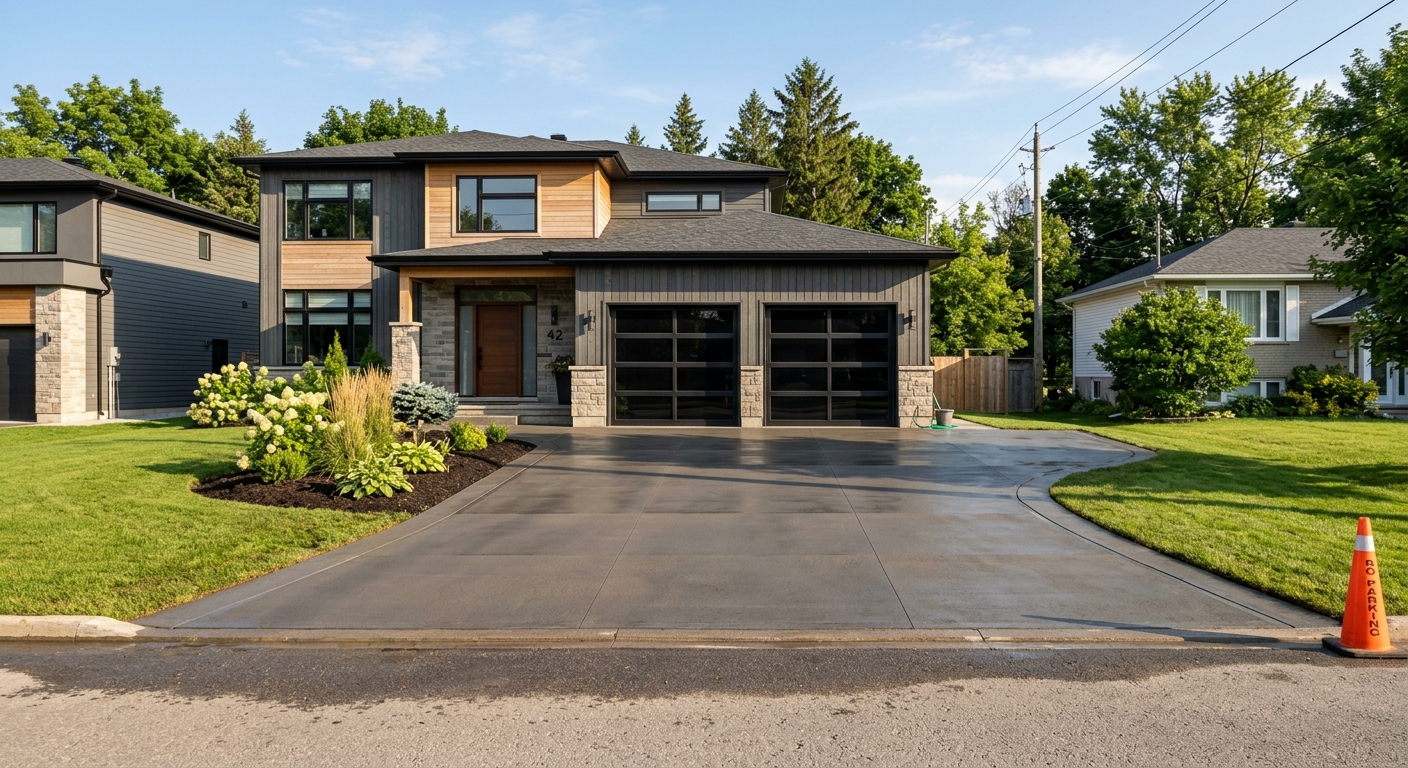
Concrete work options and costs in Brant
Brant homeowners have plenty of concrete options—from practical broom-finished driveways to decorative patios—but the best value usually comes down to matching the finish to how the slab will perform in Brant’s cold, wet Great Lakes corridor. With 80.9% of local dwellings being single-detached houses, most projects are for driveways, walks, and patios that see heavy moisture exposure and seasonal freeze-thaw stress. Also, about 87.7% of households are owner-occupied (Statistics Canada, 2021 Census), so many customers are planning long-term exterior improvements rather than quick repairs.
In the Hamilton–Niagara Peninsula market, pricing is shaped by the fact that frost depth typically pushes foundation and pier work to roughly 4 ft or deeper, and exterior slabs are designed with air-entrained mixes and tighter control joints to manage shrinkage and thermal movement. Pour seasons here are shorter (commonly May–October), so contractors rely on careful scheduling and sometimes cold-weather precautions for shoulder-season work. That means the labour and protection costs can move noticeably from one quote to the next, especially for larger pours or sites with truck access constraints—something you often see around established areas like the Paris and Burford corridors in Brant County.
Use the ranges below as a baseline for budgeting, then we’ll break down exactly what makes quotes move up or down in Section 2.
| Application |
Typical Size |
Key Spec |
Finish Option |
Price Range |
| Concrete driveway (standard broom finish) |
24 ft x 10 ft (240 sq. ft.) |
Air-entrained exterior mix, control joints |
Broom finish |
$3,360–$5,280 |
| Exposed aggregate driveway |
24 ft x 10 ft (240 sq. ft.) |
Air-entrained mix, proper retarder & curing |
Exposed aggregate |
$4,080–$6,000 |
| Stamped concrete driveway or patio |
20 ft x 12 ft (240 sq. ft.) |
Base prep & colour system, air-entrained exterior mix |
Stamped pattern + integral colour |
$5,280–$8,400 |
| Plain concrete patio or walkway |
12 ft x 12 ft (144 sq. ft.) |
Air-entrained mix, saw-cut joints |
Plain/smooth trowel or broom edge |
$1,728–$2,880 |
| Garage floor (interior slab) |
20 ft x 22 ft (440 sq. ft.) |
Vapour barrier where needed, steel reinforcement per design |
Float & trowel finish |
$3,520–$7,040 |
| Foundation footings (structural, below frost) |
Typical single home: 60–90 linear ft |
Engineered size/steel, below-frost excavation, air where specified |
Structural concrete + forming |
$3,600–$10,800 |
Prices are estimates only and vary by project scope, site access and material selection.
What affects the price of concrete work in Brant
In Brant and the broader Hamilton–Niagara Peninsula, it’s common to see quotes for the “same” concrete job vary by 30–50%. The reason usually isn’t the finish—it’s the build quality hidden under it: excavation depth, base thickness, drainage, reinforcement, mix design, and how much protection is required for cold-weather concrete curing. Even when two contractors quote the same square footage, they may be using different specs to manage the region’s freeze-thaw exposure and moisture movement.
Every exterior pour is influenced by frost depth and freeze-thaw cycles. In Ontario, footings must extend below the design frost depth to prevent frost heave and cracking, and exterior slabs should use air-entrained concrete mixes to survive repeated temperature swings. The colder schedule also affects the calendar: exterior work is typically planned roughly May–October, and shoulder-season or winter work often needs heating, insulated blankets, and sometimes accelerators—each adds cost. De-icing salts in winter can also accelerate surface spalling if the mix and curing aren’t done correctly, which is why good contractors build in the right materials from the start.
Here are a few real-world examples of what changes the number in Brant: a driveway with poor drainage (low spots that hold water) usually needs extra granular base and slope corrections before concrete goes down; a wider driveway in an older neighbourhood (where the grade is uneven and utilities are harder to locate) may mean more excavation and more trucking time; and a stamped or exposed aggregate finish carries additional labour—often justified because the base prep and colour/finishing steps must be consistent. As a reference point, a plain broom-finished driveway might land around the $14–$22 per sq. ft. band, while stamped concrete commonly sits higher within the $22–$35 per sq. ft. range depending on pattern and site difficulty.
| Price Factor |
Why It Matters |
Cost Impact |
| Frost line depth |
Determines footing depth and form height |
Deeper excavations and more concrete/steel typically add $60–$120+ per linear ft for footing work depending on design |
| Site preparation |
Excavation, grading, compacted granular base |
Unstable soils or extra base thickness can raise total costs by 10–25% |
| Reinforcement |
Rebar or wire mesh requirement |
Improper reinforcement may reduce cost short-term but risks early cracking; proper steel typically adds material/labour |
| Mix design |
Air-entrainment and compressive strength spec |
Exterior air-entrained mixes and specified strength can add a modest material premium but reduce failure risk |
| Finish type |
Broom vs. stamped vs. exposed aggregate |
Stamped/exposed usually increases labour and material handling, often pushing projects from $14–$22/sq. ft. toward $22–$35/sq. ft. |
| Pour size and concrete truck access to site |
Smaller pours are slower; tight access may require pumps or extra labour |
Access issues can add a noticeable mobilization premium |
| Cold-weather curing precautions |
Heating and blankets |
Shorter pour seasons mean more protection/time; can add 5–20% depending on conditions |
| Control joint pattern and sealing cost |
Manages shrinkage and thermal movement; sealing protects surface |
Skipping correct jointing and sealing can lead to spalling and early replacement |
Permits & regulations in Ontario
In Ontario, structural concrete work generally needs a building permit, and it’s often based on engineered drawings that municipalities may review as part of the permit process. That typically includes concrete that’s supporting the structure, such as foundation footings, foundation walls, and grade beams. In many Brant-area projects, a permit package also ties to inspections for excavation, rebar placement, and concrete placement.
Concrete flatwork—driveways, sidewalks, walkways, and patios—often does not require a permit by default. However, it can trigger permitting or approval if it affects lot grading, drainage patterns, impervious surface coverage limits, or the municipal right-of-way (for example, work near a driveway apron). Because municipalities can interpret grading/drainage rules differently, you should confirm requirements with the local authority before breaking ground.
Before hiring, verify the contractor carries liability insurance and WSIB/WCB coverage. Here’s how a Brant homeowner can check step-by-step: (1) ask the contractor for their certificate of insurance showing liability coverage and effective dates; (2) request a WSIB/WCB clearance letter or proof of registration/coverage; (3) confirm the contractor’s licence information through the Ontario online contractor/regulated search pathways your contractor references; and (4) match the quote to the scope—especially what’s included like excavation depth, reinforcement details, and drainage work. If anything is unclear, get it in writing before the first pour.
Getting concrete right in Brant's freeze-thaw climate
Concrete failures in Brant usually come from one of five weak links: inadequate base preparation, incorrect mix design, poor reinforcement (or none when required), wrong control joint spacing, or rushed curing. In the Hamilton–Niagara Peninsula’s cold, wet corridor, moisture gets into the slab edge areas and cycles through freeze-thaw. That’s why specification matters as much as finish appearance. If you want a slab that lasts, spec it for durability—not just looks.
Start with base preparation: use a compacted granular sub-base to the correct depth for local soils and frost movement, and ensure proper grading/drainage so water doesn’t pond. Next, mix design: for exterior flatwork, air-entrainment is essential—commonly in the 5–7% air range—and the mix should meet a minimum compressive strength target (often at least 32 MPa for standard exterior applications). Then control joints: spacing should be planned to limit random cracking and to give the slab a controlled crack path. Curing is non-negotiable: minimum 7 days under proper conditions, and if cold weather is a factor, curing blankets/heating are used to prevent early freeze damage. Finally, sealing: apply a penetrating sealer after cure (commonly around 28 days post-pour) to help repel de-icing salts and reduce surface deterioration.
Ask these technical questions before you sign: “What air content do you design for?” “What’s the proposed joint spacing?” “How thick is the granular base and what compaction standard do you use?” “How do you protect the pour if temperatures drop at night?” This is how you avoid the classic spalling problem caused by inadequate air-entrainment.
As a dollar example, if a driveway quote differs by about $1,000 because one contractor includes proper air-entrained exterior mix and a thicker compacted granular base, that’s usually money well spent in Brant—because repairs after freeze-thaw damage often cost more than the difference between options.
| Spec |
Why It Matters in Brant |
What to Ask For |
Impact if Skipped |
| Compacted granular base (depth?) |
Reduces pumping and moisture movement under freeze-thaw cycles |
Base thickness, compaction method, and grading/drainage plan |
Settling, cracking, and premature edge breakdown |
| Air-entrained concrete mix (target air %?) |
Improves freeze-thaw durability in Brant’s winter conditions |
Target air content (commonly 5–7% for exterior flatwork) |
Increased risk of spalling and surface scaling |
| Compressive strength (MPa rating) |
Ensures the slab achieves designed structural performance |
Minimum MPa and whether mix is strength-targeted |
Soft/weak concrete that wears and cracks faster |
| Control joints (spacing per ACI guidelines) |
Controls where cracks form during shrinkage and thermal movement |
Proposed joint layout and saw-cut timing |
Random cracking that can widen and leak moisture |
| Minimum 7-day curing period |
Allows strength gain and reduces early freezing damage risk |
Curing plan (temperature protection, blankets/heating if needed) |
Surface weakness and reduced durability |
| Penetrating sealer (when applied after cure) |
Helps resist de-icing salts and moisture penetration |
Sealer type and timing after cure (commonly around 28 days) |
Faster scaling and spalling from salt exposure |
How to choose a concrete work contractor in Brant
Choosing the right concrete contractor in Brant is mostly about verification and clarity. First, confirm Ontario licensing where applicable for the contractor category you’re hiring, and request proof of liability insurance. Ask for their WSIB/WCB coverage documentation (often provided as a clearance letter or proof of registration). If a contractor can’t provide these documents promptly, treat it as a red flag—concrete work is labour-intensive, and you want coverage for both people and property on site.
Next, get 2–3 itemised written quotes. A solid quote breaks down labour and materials (concrete supply, reinforcement, formwork, excavation, granular base, finishing, and any drainage work). Look for what’s excluded: permit pulls, disposal of excavated material, saw-cutting, sealing, and protection during curing. If the difference between quotes is simply “we’ll pour concrete,” that’s not comparable—ask them to specify the base thickness, reinforcement approach, and finish type.
Warranty matters too: confirm workmanship warranty length, product/manufacturer warranty (if any), and whether warranties are transferable to a future owner. For payment schedule, never pay more than about 10–15% upfront; keep a holdback until the job is complete and deficiencies are addressed. Finally, require a start date and a completion estimate in writing, especially in this region where the pour season window affects scheduling.
- Ask for certificate of liability insurance with active dates and coverage limits.
- Request WSIB/WCB clearance or proof of coverage before work starts.
- Confirm the contractor’s Ontario registration/licence details relevant to the scope.
- Use 2–3 itemised quotes with labour and materials line items (not a single lump sum).
- Ensure the quote states base depth and compaction approach for the slab.
- Require exterior specs: air-entrained mix and control joint plan.
- Clarify reinforcement: where rebar/wire mesh is used and at what spacing/coverage.
- Confirm curing approach (blankets/heating if near cold thresholds).
- Check whether sealing is included and when it will be applied after cure.
- Verify drainage and grading work is included if the site has low areas.
- Ask who handles permit pull (if needed) and whether any municipal fees apply.
- Set a payment schedule with a meaningful holdback until finish and cleanup are complete.
Red flags in Brant include: quotes that don’t specify base thickness or air-entrainment, “too-good-to-be-true” pricing compared with typical bands (for example $14–$22/sq. ft. for standard driveway work), vague wording like “we’ll do reinforcement if needed,” pressure to pay most of the amount upfront, and crews that can’t explain their curing and jointing plan.
Frequently asked questions — concrete work in Brant
How do I compare concrete quotes?
Start by comparing the specs, not just the total price. In Brant and the Hamilton–Niagara Peninsula, exterior durability hinges on base preparation, air-entrained mix design, reinforcement (when required), control joint spacing, and curing. Ask each contractor for an itemised breakdown: granular base depth and compaction, concrete thickness, rebar/wire mesh details, finish type, and whether sealing is included. If one quote includes proper exterior air-entrainment and longer curing protection, it may cost more but reduce spalling risk in winter. As a budgeting anchor, standard driveway work often falls in the $14–$22 per sq. ft. range, while stamped concrete commonly prices higher (about $22–$35 per sq. ft.). Finally, confirm access/disposal details and whether permit pulls apply to your scope.
Can concrete be poured in cold weather in Brant?
Yes, but it’s not as simple as “pour and hope.” In Brant’s Great Lakes corridor conditions, cold weather can freeze fresh concrete before it reaches early strength, which increases the chance of weakness, scaling, and long-term durability issues. Reputable Ontario contractors schedule outside of deep cold where possible (often targeting the May–October window), but if you’re near cold thresholds, they should provide a cold-weather curing plan: heated enclosures/hoarding where needed, insulation blankets, and approved admixtures/accelerators as appropriate. You should also ask how they monitor temperatures at placement and during curing. A solid quote will mention protection and curing time, not just the concrete price.
How do I maintain concrete in Brant's freeze-thaw climate?
Maintenance is mostly about protecting the surface from moisture and de-icing salts. Plan to apply a penetrating sealer after cure—commonly around 28 days post-pour—so the concrete is better at repelling salts and water. During winter in Brant, use de-icing products carefully: heavier salt use and abrasive clearing can accelerate surface scaling, especially if the slab was improperly air-entrained. Keep an eye on drainage—if water ponds near the slab edge, that’s where freeze-thaw damage starts. Clean spills and avoid letting organic materials sit on the surface. If you see early spalling, address it promptly; small repairs can prevent water infiltration that worsens freeze-thaw cracking over multiple seasons.
What causes concrete to spall in Brant winters?
Spalling is often the symptom of freeze-thaw damage caused by moisture getting into the concrete and then expanding when temperatures drop. The most common root causes are inadequate air-entrainment (which prevents proper freeze-thaw pressure relief), poor curing (allowing early damage before strength develops), and weak surface protection. In the Brant/Hamilton–Niagara market, freeze-thaw cycles plus de-icing salts are a hard combination—so contractors should use an air-entrained exterior mix (commonly 5–7% air content for exterior flatwork), correct jointing to control cracking, and curing/temperature protection. If sealing is skipped or delayed, salt water can migrate into micro-cracks and worsen scaling. If your existing slab is failing, the repair approach should match the cause—sometimes it’s a spec issue, not just a surface issue.
What is rebar and when is it required in Ontario?
Rebar (reinforcing steel) is used to help concrete resist cracking and distribute loads, especially in structural elements. Whether it’s required depends on the design—engineered foundation and certain slab applications typically call for rebar, mesh, or both, based on soil conditions, loads, and member thickness. In Ontario, structural concrete such as footings and foundation walls is usually designed to meet specific requirements, and that’s where reinforcement is commonly specified. For interior slabs like garage floors, reinforcement may be used depending on expected loads and thickness, while exterior flatwork might use wire mesh or steel fibers depending on design and local practice. Ask your contractor to reference the design/spec and describe exactly where the steel goes—spacing and cover matter as much as whether it’s present.
How long does a concrete project take in Brant?
Timing depends on the scope and the season. For example, a typical broom-finished driveway or patio might take a few days for forms, base prep, and the pour day, plus additional time for curing protection and sealing (if included). The actual concrete placement is usually fast, but prep is where quality is built: excavation, compacting granular base, setting forms, and planning drainage. In Brant’s cold, wet Great Lakes corridor, curing and temperature protection can extend the overall schedule—especially in shoulder months. Structural work like foundation footings also includes excavation and inspection steps, so it can take longer overall even if the concrete pour itself is brief. As you plan, ask your contractor for a written timeline with a start date and completion estimate, and confirm whether winter/shoulder-season protection is included.