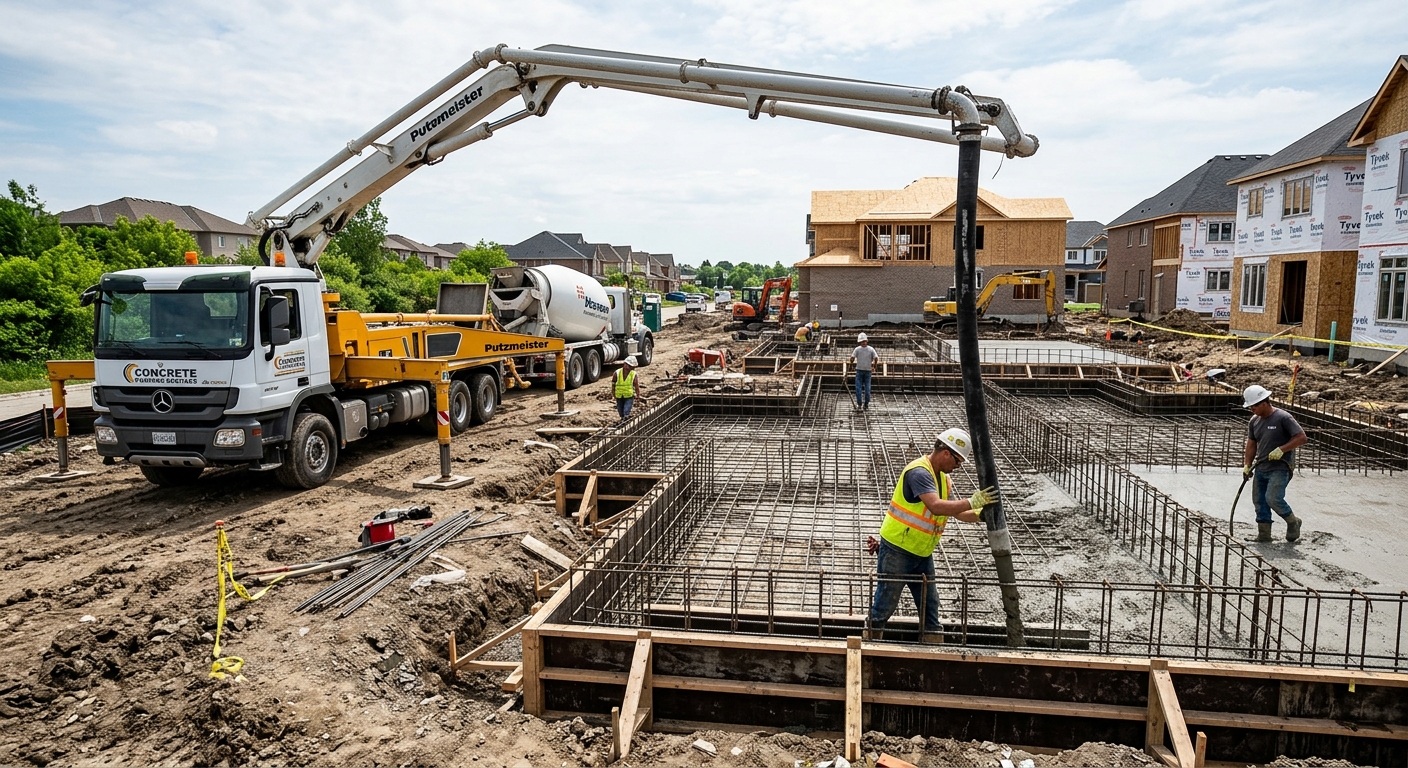
Concrete work options and costs in Rosemount
Concrete work in Rosemount is usually about managing two things at once: a clean, level surface for daily life and a durable system that can handle Ontario’s freeze–thaw cycles. With a population of 5,610 (Statistics Canada, 2021 Census), the area draws steady demand for driveway and flatwork replacements as households upgrade ageing homes and rework entrances. In practice, Rosemount’s concrete contractors often get most inquiries from established residential pockets where outdoor surfaces—driveways, patios and walkways—wear faster due to traffic, moisture, and winter salt. That’s especially common in older neighbourhoods where lot grading and drainage were set before today’s stricter expectations for long-term durability.
In the Toronto economic region, frost depth and freezing cycles drive the design: structural footings typically need to extend at least 1.2 m below grade so the ground doesn’t heave and push on concrete. Exterior slabs also need air-entrained concrete and well-planned control joints to limit random cracking. At the same time, the GTA’s pour season is practical but time-sensitive—contractors concentrate exterior work into warmer months because curing is harder when temperatures hover near 10 °C or below. Wet fall and spring can also slow excavation and base prep, which affects schedule and labour availability in the season.
If you’re comparing options, the fastest way to reduce surprises is to match the finish and specs to the climate. Use the table below as your starting point for typical pricing in Rosemount, then we can tighten numbers after we review site access and your preferred finish.
| Application |
Typical Size |
Key Spec |
Finish Option |
Price Range |
| Concrete driveway (standard broom finish) |
~20 ft x 10 ft (200 sq. ft.) |
Air-entrained mix, compacted granular base, control joints |
Broom finish + saw cuts |
$18,000–$28,000 |
| Exposed aggregate driveway |
~20 ft x 10 ft (200 sq. ft.) |
Air-entrained mix, proper finishing timing, jointing plan |
Exposed aggregate + sealer |
$22,000–$34,000 |
| Stamped concrete driveway or patio |
~20 ft x 10 ft (200 sq. ft.) |
Air-entrained mix, thicker placement where required, joint pattern |
Stamped pattern + colour hardener |
$24,000–$40,000 |
| Plain concrete patio or walkway |
~12 ft x 10 ft (120 sq. ft.) |
Well-drained base, air-entrained mix, joints |
Light broom or smooth trowel |
$2,000–$3,900 |
| Garage floor (interior slab) |
~22 ft x 20 ft (440 sq. ft.) |
Vapour barrier (as needed), fibre or mesh, proper sub-grade |
Broom finish |
$8,500–$16,000 |
| Foundation footings (structural, below frost) |
Varies by foundation size |
Excavation, reinforcement, concrete pour below frost depth |
Structural concrete (no decorative finish) |
$180,000–$300,000 |
Prices are estimates only and vary by project scope, site access and material selection.
What affects the price of concrete work in Rosemount
In the Toronto economic region, it’s common to see quotes for the same basic project vary by 30–50%—even for driveways or patios—because the “hidden” parts of concrete work (excavation, granular base, drainage, reinforcement and how the contractor manages curing) aren’t visible until demolition and prep are done. Two contractors can both say “200 sq. ft. driveway,” but one might include a proper granular base and air-entrained mix while the other leaves out items like reinforcement or adequate jointing plans. Then freeze–thaw cycles punish the shortcut.
For Rosemount, frost depth and freeze–thaw cycles dictate every structural decision. Footings for structural foundations typically must extend at least 1.2 m below grade to prevent frost heave and differential movement. For exterior slabs and flatwork, contractors generally use air-entrained concrete so the mix can survive repeated freezing. Cold-weather curing precautions—insulating blankets, heaters or adjusted scheduling—also add cost because concrete needs time and appropriate conditions to reach strength. De-icing salt accelerates surface damage, so sealing is a cost-effective “insurance” step for many driveway and walkway plans.
Local site conditions can also swing cost. If your driveway replacement involves bringing in extra granular base due to soft subgrade, expect higher labour and material spend. Conversely, if you have easy truck access off a wider frontage in a neighbourhood with flatter grade, you may keep costs closer to the typical $18–$28 driveway band. Finishes matter too: stamped work can land in the $24–$40 decorative range, but the cost is justified when you’re aiming for a full aesthetic upgrade—not just patching a worn surface.
| Price Factor |
Why It Matters |
Cost Impact |
| Frost line depth — determines footing depth and form height |
Deeper placement increases excavation, rebar, and concrete volume |
Higher for structural jobs; drives formwork and concrete quantities |
| Site preparation — excavation, grading, compacted granular base |
Proper base reduces settlement and prevents water pumping under slabs |
Can add or reduce major labour/material costs based on soil condition |
| Reinforcement — rebar or wire mesh requirement |
Controls cracking and supports load where it matters |
Material and labour increases; savings if correctly sized instead of overbuilt |
| Mix design — air-entrainment and compressive strength spec |
Exterior freeze–thaw durability depends on air-entrainment and strength targets |
Higher-spec mixes cost more, but reduce early spalling and repairs |
| Finish type — broom vs. stamped vs. exposed aggregate |
More labour and set-up time for stamping/finishing details |
Decorative options typically add premium versus broom finish |
| Pour size and concrete truck access to site |
Smaller pours may still need multiple trips; tight access increases labour time |
Truck access issues can raise labour and coordination costs quickly |
| Cold-weather curing precautions — heating and blankets |
Maintains proper curing temperature near/under 10 °C |
Adds rental/labour; can be avoided by scheduling in warmer windows |
| Control joint pattern and sealing cost |
Joints manage crack locations; sealing helps against de-icing salt damage |
Costs modestly upfront, often reduces costly surface repairs later |
Permits & regulations in Ontario
In Ontario, whether you need a permit depends on what kind of concrete work you’re doing and how it affects the structure or the site. Structural concrete work—think footings, foundation walls, and grade beams—generally requires a building permit, and municipalities often expect engineered drawings or design confirmation for structural elements. For flatwork such as driveways, patios and walkways, a permit is often not required when it doesn’t change major site grading, impervious surface limits, or the municipal right-of-way. That said, the safe approach is to confirm with the local authority before any excavation, especially if your project changes drainage patterns or slopes toward neighbouring lots.
Before breaking ground in Rosemount, verify the contractor’s coverage and credibility. Step one is licensing: search the Ontario contractor licensing registry status (where applicable for the trade) and confirm the company name matches the quote. Step two is liability insurance—ask for a current certificate of insurance showing adequate coverage and the insured entity. Step three is WSIB/WCB coverage: request proof of clearance or active coverage (commonly provided as a clearance letter or account confirmation, depending on the contractor’s setup). Finally, ask for references tied to similar-scale projects in the Greater Toronto area so you’re matching the same freeze–thaw requirements and curing practices.
Clear documentation up front usually costs less than redoing work later when inspections or insurance requirements come up.
Getting concrete right in Rosemount's freeze-thaw climate
Concrete fails in Rosemount’s climate most often because of water and ice management. When the base isn’t compacted properly or drainage is poor, water migrates under and around the slab, expands as it freezes, and slowly breaks the concrete bond at the surface. Another major failure is spalling from insufficient air-entrainment—repeated freeze–thaw cycles expand water trapped inside the concrete, scaling the surface over time. To spec the job correctly for Toronto-area conditions, focus on five areas: base preparation, mix design, control joints, curing and sealing.
First, base prep needs a properly compacted granular sub-base sized for local soil and frost conditions. If you skimp on thickness or compaction, you can get settlement and cracking within the first winters. Second, use an air-entrained mix—typically about 5–7% air content for exterior flatwork—with a minimum 32 MPa compressive strength. Third, plan control joints to limit random cracks: spacing should be consistent and tied to slab geometry. Fourth, curing matters: plan for a minimum 7-day curing period under appropriate conditions; when temperatures drop toward 10 °C or below, the contractor should provide protection (insulating blankets/heating) so strength develops. Fifth, seal with a penetrating sealer after cure—commonly applied 28 days post-pour—to repel de-icing salts.
As for dollars: a broom-finished driveway might align with the $18–$28 driveway band. If you upgrade to stamped concrete to match your home’s design, you’re often moving toward the $24–$40 decorative band. That premium can be justified when you’re doing a full replacement and want longevity plus curb appeal—but it’s wasted if joints, base prep, and air-entrainment aren’t handled correctly first.
| Spec |
Why It Matters in Rosemount |
What to Ask For |
Impact if Skipped |
| Compacted granular base (depth?) |
Prevents water pooling and reduces frost-related movement |
Documented base depth and compaction testing method |
Settlement and early cracking/spalling risk rises |
| Air-entrained concrete mix (target air %?) |
Durability against freeze–thaw scaling and freeze expansion |
Target 5–7% air content for exterior flatwork |
Surface scaling and spalling can appear after winters |
| Compressive strength (MPa rating) |
Strength gain supports load and reduces brittle failure |
Minimum 32 MPa specified for the intended exposure |
Higher chance of cracking and premature deterioration |
| Control joints (spacing per ACI guidelines) |
Controls where cracks form during drying and thermal stress |
Joint layout tied to slab size/shape; saw-cut timing plan |
Random cracking and wider cracks that invite water ingress |
| Minimum 7-day curing period |
Cold spells slow strength gain in Toronto-area conditions |
Protection plan if curing temperatures approach 10 °C |
Weaker concrete surfaces; increased surface damage |
| Penetrating sealer (when applied after cure) |
Helps repel de-icing salts used across Ontario winters |
Apply after cure, commonly around 28 days post-pour |
Salt scaling accelerates and stains/roughness develop faster |
How to choose a concrete work contractor in Rosemount
Choosing a concrete contractor in Rosemount is mostly about verifying three things: competence, coverage, and clarity of scope. Start with Ontario requirements and documentation. Ask for their licensing information applicable to their trade and confirm their company details match the quote. Next, request a certificate of liability insurance; it should show they’re covered for construction activities at your address. Finally, confirm WSIB/WCB coverage—ask for a current clearance letter or proof of active coverage. If a contractor can’t provide these quickly, that’s a major risk signal.
Then get 2–3 itemised written quotes. You want labour and materials broken down (demo/excavation, base prep, rebar/mesh, concrete supply, finish labour, joints, curing protection, sealing and disposal). Avoid “lump sum only” quotes that don’t show what’s included. Read the scope line by line: is the permit pull included if structural work requires it? Is disposal/haul-away included? What’s the plan for drainage and base depth? These details directly tie to freeze–thaw performance.
Look for realistic warranty terms. A good workmanship warranty should cover cracking/spalling within a defined period, and the contractor should clearly explain any product/manufacturer warranty coverage if admixtures or specialty materials are used (and whether it’s transferable if you sell the home). For payments, never pay more than 10–15% upfront; hold back until the job is complete and any punch-list items are resolved. Finally, ask for a start date and a completion estimate in writing—GTA exterior pours are often scheduled tightly around temperatures, so timing is part of the spec.
- Provide proof of liability insurance (certificate with your project address if possible).
- Provide WSIB/WCB clearance or active coverage proof before work begins.
- Submit a written scope: demolition, excavation, base depth, reinforcement, concrete mix, joints, finish and sealing.
- Include disposal/haul-away details for removed concrete and excess soil.
- Confirm air-entrained mix specification and exterior curing plan for cold nights.
- Ask for control joint layout and saw-cut timing.
- Verify base prep includes compaction method (and whether compaction testing is done).
- Request an itemised quote with line-by-line pricing (labour vs materials).
- Ensure the quote states whether sealer is included and when it’s applied (after cure).
- Check warranty length and what it covers (workmanship vs materials) in plain language.
- Use a payment schedule that holds back until completion and punch list items are done.
- Confirm schedule feasibility: pour date window and protection plan if temperatures drop.
Concrete contractor red flags in Rosemount: (1) no clear mention of air-entrainment or control joints, (2) vague base prep details (no base depth or compaction plan), (3) asking for a large deposit before any site work starts, (4) refusing to provide insurance/WSIB proof, or (5) promising “no cracking” outcomes without addressing drainage and joint spacing.
Frequently asked questions — concrete work in Rosemount
Why does concrete crack in Rosemount and how is it prevented?
Concrete cracks are normal—especially in exterior flatwork—because slabs move with drying shrinkage and temperature changes. In Rosemount and the wider Toronto area, freeze–thaw cycles add pressure when water gets into hairline cracks and freezes. The best prevention is a full system, not a single fix: correct granular base preparation and drainage, an exterior air-entrained mix for durability, and a control joint layout that tells the concrete where to crack. Proper curing (typically at least 7 days) matters too, particularly when temperatures dip near 10 °C. If you’re pricing a driveway, you can expect broom-finish projects often land around the $18–$28 band, but the crack-resistance depends more on base, joints and mix than on whether it’s “cheap” or “premium.”
Stamped vs broom-finish concrete — cost difference?
Stamped concrete typically costs more because it requires extra set-up, more finishing labour, and usually added steps like colour hardeners and specialized stamping mats. In the Rosemount market, broom-finished driveways and basic flatwork commonly align with the $18–$28 driveway band, while stamped decorative concrete usually falls into the $24–$40 range depending on pattern complexity, thickness requirements, and how many transitions or edges you have. That cost can be worth it when you’re doing a full replacement and want a consistent curb-appeal upgrade. However, stamped doesn’t eliminate cracking risk—if air-entrainment, joint spacing, and curing protection are missing, you can still get spalling and random cracking. Always compare quotes on specs first, then finish.
When is the best time to pour concrete in Rosemount?
The best time is during the warmer, stable part of the year when curing conditions are predictable. In the Toronto region, contractors usually concentrate exterior pours in the warmer months because freeze–thaw exposure starts once temperatures swing, and curing needs adequate time and temperature. When temperatures drop toward 10 °C or below, concrete may require additional protection like insulating blankets or heating to achieve proper strength gain. Practically, that means scheduling in late spring through early fall often reduces cold-weather add-ons and helps keep finish quality consistent. If you must pour near colder weather, ask the contractor for a written cold-weather curing plan and how they’ll manage protection. Doing it right may affect price slightly, but it’s far cheaper than repairs after the first harsh winter.
How long does concrete take to cure?
Concrete curing happens in stages. In most Rosemount exterior flatwork projects, contractors plan for a minimum 7-day curing period under proper conditions so the slab gains early strength and can be finished/handled safely without damage. Full performance takes longer—often about 28 days for many durability and sealer-related timelines. That’s why penetrating sealer is commonly applied around 28 days post-pour: it needs the concrete to be cured enough for consistent absorption and better resistance to de-icing salts. If weather turns colder, the contractor may extend curing or protect the slab with blankets/heaters to maintain safe temperature conditions. Ask your contractor to state the curing and protection measures in writing, not just “we’ll pour and it’ll be fine.”
Do I need a permit for concrete work in Ontario?
In Ontario, it depends on what you’re building. Structural concrete work such as footings, foundation walls and grade beams typically requires a building permit, often with engineered drawings reviewed by the municipality. Concrete flatwork—driveways, patios and walkways—often does not require a permit when it doesn’t significantly change lot grading, impervious surface coverage limits, or the municipal right-of-way. However, if your project affects drainage patterns or site grading, you should confirm before digging. For Rosemount homeowners, the safest process is: ask the contractor what permit (if any) applies, confirm with the local authority, and ensure the job is covered by proper insurance and WSIB/WCB proof. A good contractor will guide you instead of guessing.
Concrete vs pavers for a patio in Rosemount?
Both can be great, but they suit different priorities. Concrete patios are often more predictable in cost and provide a monolithic surface when joints and base prep are done correctly. In Rosemount, plain concrete patios and walkways frequently land in the $16–$26 style band for typical projects, while decorative concrete can move higher. Pavers can be attractive if you want design flexibility and the ability to lift/repair individual stones later—but pavers still require excellent base preparation and proper slope/drainage to prevent heaving and weed growth. In freeze–thaw Ontario conditions, the “winner” is usually the system: correct compacted base, reliable drainage, and a plan that manages water. If you want the simplest long-term maintenance plan, concrete often wins; if you want modular repair potential, pavers can be worth considering—provided the contractor specs the base and edge restraint properly.