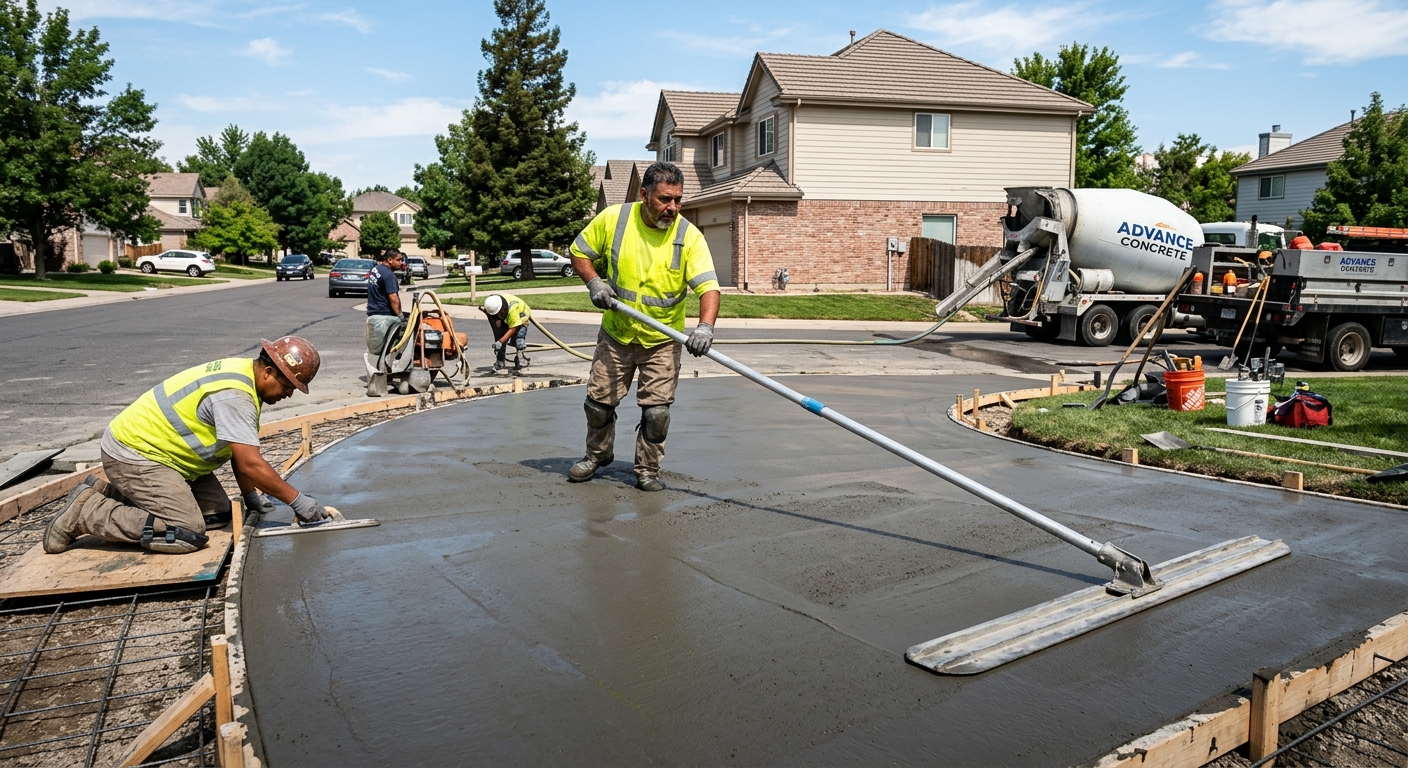
Concrete work options and costs in Nepean
Nepean homeowners typically consider concrete for driveways, patios, walkways and, for new builds or additions, for footings and foundation elements. With Nepean part of the Ottawa region—serving a city population around 180,000 (Statistics Canada, 2021 Census)—there’s steady demand from growing neighbourhoods where flatwork and foundation work move quickly. In many areas, the most common concrete projects are attached and single-detached housing improvements, since homeowners want durable exterior surfaces that can handle snow, slush and repeated freeze–thaw stress.
Ottawa-area pricing is higher than milder parts of Ontario because the frost line is deep and the ground cycles between frozen and thawed conditions. That drives more excavation and a thicker, well-compacted granular base, plus air-entrained mixes designed to survive freeze–thaw. Exterior slabs also need tighter control joint planning at the edges, where spalling risk is highest. On top of that, the pour season is shorter; cold snaps can limit finishing windows and require heating/blanketing for proper curing, which adds labour and equipment costs.
In Nepean—especially around family-heavy pockets like Barrhaven and Stittsville—contractors often see fast scheduling for driveways and backyard walkways after spring thaw or before winter shutdowns. If you’re comparing options, the finish choice can be the difference between a long-lasting “set-and-forget” slab and one that needs frequent patching. Below is a practical snapshot of typical sizes and what each finish usually includes, so you can benchmark quotes before you call for measurements.
| Application |
Typical Size |
Key Spec |
Finish Option |
Price Range |
| Concrete driveway (standard broom finish) |
400–600 sq. ft. |
Air-entrained mix, compacted base, control joints |
Broom finish, optional edge trowel |
$6,400 – $13,500 |
| Exposed aggregate driveway |
400–600 sq. ft. |
Air-entrained mix, proper retarder/separation, curing |
Exposed aggregate with sealer |
$8,500 – $15,500 |
| Stamped concrete driveway or patio |
250–500 sq. ft. |
Air-entrained mix, integral colour, joint layout |
Stamped pattern with sealer |
$7,000 – $17,500 |
| Plain concrete patio or walkway |
120–300 sq. ft. |
Granular base, drainage consideration, control joints |
Float/smooth finish with broom/scored edges |
$1,700 – $6,600 |
| Garage floor (interior slab) |
300–550 sq. ft. |
Vapour barrier where needed, compacted base, fibre or mesh |
Float finish, hardener/steel trowel option |
$5,200 – $11,500 |
| Foundation footings (structural, below frost) |
Typical home footing system |
Engineered rebar, specified concrete strength, below frost excavation |
Structural finish per engineer/spec |
$12,000 – $28,000 |
Prices are estimates only and vary by project scope, site access and material selection.
What affects the price of concrete work in Nepean
In Nepean, two quotes for “the same” concrete job can differ by 30–50% because the real cost drivers aren’t just the concrete itself—they’re the ground prep, the mix design, and the labour needed to finish and cure correctly in Ottawa’s colder freeze–thaw environment. A driveway may look simple, but the subsurface performance determines whether you see heaving, scaling or cracking in a few winters. That’s why one contractor’s “standard” proposal can fall short on specs, while another includes the base thickness, air content, joint layout and curing steps that prevent failures.
Specifically, the deep frost line dictates footing depth and drives form height for structural work. In Ontario, footings are typically designed to extend below the local design frost depth (often in the 1.5–2.4 m range for Ontario projects), and every exterior slab needs air-entrained concrete mixes to survive freeze–thaw cycles. Ottawa’s shorter pour season also means cold-weather precautions are more common—think insulating blankets and controlled curing—so costs rise versus warmer southern areas. Finally, de-icing salt accelerates surface spalling when concrete isn’t properly protected; that’s why sealing is a practical part of an exterior plan, not a luxury add-on.
Examples from Nepean: (1) A lot with poor drainage or clay that holds water usually requires additional base and drainage grading, which adds labour before the first truck arrives. (2) A tight access driveway in Barrhaven where we need smaller equipment or more manual handling often costs more even at the same square footage. (3) If you’re choosing between a broom-finished driveway around the region’s $16–$25 per sq. ft. band and an exposed aggregate option that often lands higher in the $22–$35 per sq. ft. decorative band, the difference is usually justified by additional process steps, not just the surface look.
| Price Factor |
Why It Matters |
Cost Impact |
| Frost line depth |
Determines footing depth and form height |
More excavation and deeper pours can increase structural costs significantly |
| Site preparation |
Excavation, grading, compacted granular base |
Proper base prep is labour-heavy; poor access raises costs further |
| Reinforcement |
Rebar or wire mesh requirement |
Steel placement time and material supply affect the total |
| Mix design |
Air-entrainment and compressive strength spec |
Correct freeze–thaw performance can add material cost but reduces future repairs |
| Finish type |
Broom vs. stamped vs. exposed aggregate |
Decorative finishes include extra labour for colour, stamping, retarder/exposure steps |
| Pour size and concrete truck access to site |
Placement speed and distance to grade |
Long carry distances or limited access can add labour and affect scheduling |
| Cold-weather curing precautions |
Heating and blankets |
Often required in late fall/early spring; adds equipment and labour hours |
| Control joint pattern and sealing cost |
Manages shrinkage/thermal movement and protects against salt scaling |
Good jointing and sealing reduce early surface deterioration |
Permits & regulations in Ontario
In Ontario, structural concrete work—especially anything tied to the stability of a home—typically requires a building permit and often engineered drawings reviewed by the municipality. That includes foundation footings, foundation walls, and grade beams, plus most structural reinforcement changes. For concrete flatwork like driveways, patios and walkways, permits are usually not required as long as the work doesn’t meaningfully change lot grading, drainage, or conflict with impervious surface coverage rules or municipal right-of-way requirements. Even then, you may need approval if you’re altering swales or touching curb/sidewalk areas—so confirm before you break ground.
To verify your contractor in Nepean step-by-step, start by asking for their proof of liability insurance and a certificate that lists your address as a beneficiary where applicable. Next, check that they carry WSIB coverage (if they have employees), and request a clearance letter or current status documentation. For licensing, Ontario commonly uses trade/company registration frameworks and contractor accountability—so don’t rely on verbal assurances: ask for the exact business registration details they operate under and keep a copy of their documents. Finally, request references on similar-scale Ottawa-area projects (driveways with air-entrained mixes and frost-aware base prep, or structural foundation work with engineered reinforcement).
Getting concrete right in Nepean's freeze-thaw climate
Concrete failures in Nepean are usually preventable, and most come down to three things: (1) base and drainage, (2) mix durability for freeze–thaw, and (3) curing and protection during cold, wet swings. Start with the base preparation: excavate to the planned depth and place a properly graded, well-compacted granular sub-base. In a deep-frost region, insufficient base thickness or inadequate compaction increases movement, leading to settlement and cracking at slab edges. Next, specify the mix design: for exterior flatwork, air-entrainment is critical—commonly 5–7% air content—and the concrete should meet at least 32 MPa compressive strength (or the engineer’s higher value for structural work). Without the correct air system, freeze–thaw will attack the surface and you’ll see scaling and spalling sooner.
Then plan control joints early. Joint spacing should be tight enough to guide cracking to predictable lines and prevent random cracks. Finally, curing matters more in Ottawa than in warm areas: you need at least 7 days of curing under suitable conditions, and in cold snaps that may mean heating/blanketing to protect early strength gain. After the cure, apply a penetrating sealer (typically about 28 days post-pour) to repel water and reduce de-icing salt-driven surface damage.
Ask these questions to avoid the most common failure: “What air content are you targeting for this exterior slab, and how will you maintain curing temperature?” If you’re choosing between a basic broom-finish driveway and a decorative option, consider a realistic dollar justification: a stamped driveway may cost roughly $22–$35 per sq. ft. in this region, and the added cost can be worth it if your contractor is still doing the same frost-safe base, correct air-entrained mix, proper jointing and sealing. Decorative costs should not replace structural basics—they should be layered on top of them.
| Spec |
Why It Matters in Nepean |
What to Ask For |
Impact if Skipped |
| Compacted granular base (depth?) |
Reduces movement during freeze–thaw and prevents edge heaving |
Confirm excavation depth, granular type, and compaction requirements |
Settlement, cracking, premature lifting and joint failure |
| Air-entrained concrete mix (target air %?) |
Protects against freeze–thaw scaling and spalling |
Ask for target air content (commonly 5–7% for exterior flatwork) |
Surface deterioration, scaling and spalling within a few winters |
| Compressive strength (MPa rating) |
Improves overall durability and strength gain in cold conditions |
Minimum 32 MPa (or higher as engineered/spec’d) |
Weaker concrete that can crack or wear faster under traffic and salt |
| Control joints (spacing per ACI guidelines) |
Controls where shrinkage/thermal cracks occur |
Ask for proposed joint spacing and sealing plan |
Random cracking patterns and water ingress at edges |
| Minimum 7-day curing period |
Allows strength development before early freeze or drying stress |
Ask how curing will be protected if temperatures drop |
Reduced strength, surface weakness and early scaling |
| Penetrating sealer (when applied after cure) |
Repels water and reduces salt-driven surface damage |
Confirm application around 28 days post-pour (conditions permitting) |
Faster water/salt penetration and higher spalling risk |
How to choose a concrete work contractor in Nepean
Choosing the right contractor in Nepean comes down to verification and clarity. First, confirm Ontario compliance by checking liability insurance—ask for a current certificate of insurance—and whether they carry WSIB coverage if they employ workers. If they provide sub-trades, ask how responsibility is handled and request proof for those parties as well. Next, keep a record of their business registration information and ask for written details that match what’s on the documents. Then, get 2–3 itemised written quotes—ideally with a breakdown of labour, concrete supply, base prep/excavation, reinforcement (if included), saw cutting/jointing, finishing, disposal, and sealing.
When you read the scope, don’t just look at the final number. Ask what’s excluded: is old concrete removal and disposal included, what’s the allowance for landscaping restoration, and is permit coordination included where required for structural work? For warranty, look for a clear workmanship warranty period and specify whether it covers cracking related to workmanship or just surface imperfections. Also ask about any manufacturer/product warranty and whether it transfers if you sell the home.
For payment scheduling, a practical rule is to keep upfront payments around 10–15% and hold back a portion until the job is complete and deficiencies are addressed. Finally, request a written timeline with start date and completion estimate—winter interruptions are common in Ottawa-area work, so you want expectations in place early.
- Ask for air-entrainment and minimum strength specs in writing for exterior slabs.
- Confirm the granular base depth and compaction method (not just “prepared base”).
- Require a joint layout plan (where joints go, spacing, and if joints will be sealed).
- Get a curing and cold-weather plan if temperatures will drop during the pour period.
- Verify liability insurance certificate is current and matches the contractor’s legal name.
- Verify WSIB status/clearance letter if they employ workers.
- Request WSIB/COI coverage for key sub-trades if reinforcement or excavation is subcontracted.
- Ensure quotes list disposal/hauling of demolition materials if removal is part of the job.
- Ask whether saw cutting timing is included (late cutting can increase random cracking).
- Confirm the finish method (broom vs. stamped vs. exposed aggregate) and the sealer type.
- Check payment terms: avoid large upfront amounts; hold back until final walkthrough.
- Get the project schedule in writing, including weather-related contingencies.
Concrete red flags I see in Nepean include: quotes that don’t mention air-entrainment for exterior slabs, base prep described vaguely without depth/compaction, control joints omitted or “optional,” no clear curing plan in cold snaps, and change orders that appear because concrete truck access/disposal wasn’t discussed upfront.
Frequently asked questions — concrete work in Nepean
How do I seal concrete to protect it in Nepean?
In Nepean and across the Ottawa region, sealing is mainly about reducing water and salt intrusion that can lead to spalling during freeze–thaw cycles. For exterior flatwork (driveways, patios, walkways), you’ll typically apply a penetrating sealer after the concrete has cured—commonly around 28 days post-pour, assuming weather and surface dryness allow proper absorption. Ask your contractor to clean the surface first (no sealer over dusty or contaminated concrete) and to recommend a sealer suited for de-icing salts. If you’re comparing options, remember exterior broom-finished driveways often land around the region’s $16–$25 per sq. ft. band, while decorative finishes can be higher—yet sealing performance is still the key protection step regardless of finish.
What is the difference between concrete and cement?
In common talk, people use “concrete” and “cement” interchangeably, but they’re not the same. Cement is one ingredient—the binder powder—while concrete is the complete engineered mix made from cement, water, sand, coarse aggregate (stone), and often admixtures such as air-entrainment. In Nepean’s freeze–thaw climate, the difference matters because the durability you want in exterior slabs comes from the entire concrete mix design, not just the cement type. That’s why a good contractor specifies air-entrained concrete (commonly 5–7% air for exterior flatwork) and a strength rating like 32 MPa. If a quote talks only about “cement” without air/strength/cure details, it’s a red flag.
How much does concrete work cost in Nepean?
Concrete costs in Nepean vary mostly by excavation/base prep, thickness, reinforcement, finish type, and weather-related curing steps. As a quick benchmark for exterior work, driveways in the Ottawa area commonly fall around the $16–$25 per sq. ft. range for broom-finished concrete, while decorative work like stamped concrete and exposed aggregate is often higher (the decorative band is roughly $22–$35 per sq. ft.). If you’re doing a simple patio or walkway, the regional pricing band is often about $14–$22 per sq. ft. Structural work like foundation footings is priced differently because it’s deeper, engineered, and reinforcement-heavy, and it must sit below frost. For accurate budgeting, you’ll need a measured scope—square footage plus access and removal/disposal.
How deep must footings be for Nepean's frost line?
In Ontario, footing depth is determined by the design frost depth and local site conditions, and it should be confirmed by an engineer or by the structural design documents for your project. As a general guideline used in Ontario: footings are typically designed to extend below the design frost depth, often in the 1.5–2.4 m range (depending on the specific location and soil). Nepean is part of the colder Ottawa region, so frost protection is a real cost driver: deeper excavation and taller forms are common, and the extra work helps prevent frost heave that can crack foundations over time. If you’re building or adding structural walls, ask the contractor to reference the engineered footing sizes and depths—don’t accept “it’s probably deep enough.”
Why does concrete crack in Nepean and how is it prevented?
Concrete commonly cracks from shrinkage, thermal movement and, in freeze–thaw regions like Nepean, moisture and temperature cycling that stresses edges and joints. Most cracking can be managed rather than eliminated by doing the “boring” basics well: compacted granular base to the correct depth, air-entrained exterior mixes, properly planned control joints (so cracks occur at intended locations), and sufficient curing time. In Ottawa-area weather, premature drying or weak early strength can make surface cracking and scaling more likely. De-icing salts then worsen it when water penetrates through cracks. Prevention comes from specs: air content (commonly 5–7% for exterior), joint layout, and curing/blanketing when cold weather hits. Sealing after curing helps too.
Stamped vs broom-finish concrete — cost difference?
Stamped concrete costs more than broom-finish because it includes extra materials and labour: integral or surface colour, stamping mats/roller setup, more careful finishing timing, and usually a decorative sealer. In Nepean’s Ottawa market, broom-finish driveway work often fits the $16–$25 per sq. ft. band, while decorative concrete (including stamped) commonly lands closer to the $22–$35 per sq. ft. band. That cost gap is usually justified when the contractor is still meeting frost-safe fundamentals—air-entrained mix, correct base prep, and a joint plan. If a quote prices stamped concrete only for the “look” but cuts back on base depth, air content or curing, you may save upfront and pay later with spalling or premature surface wear.