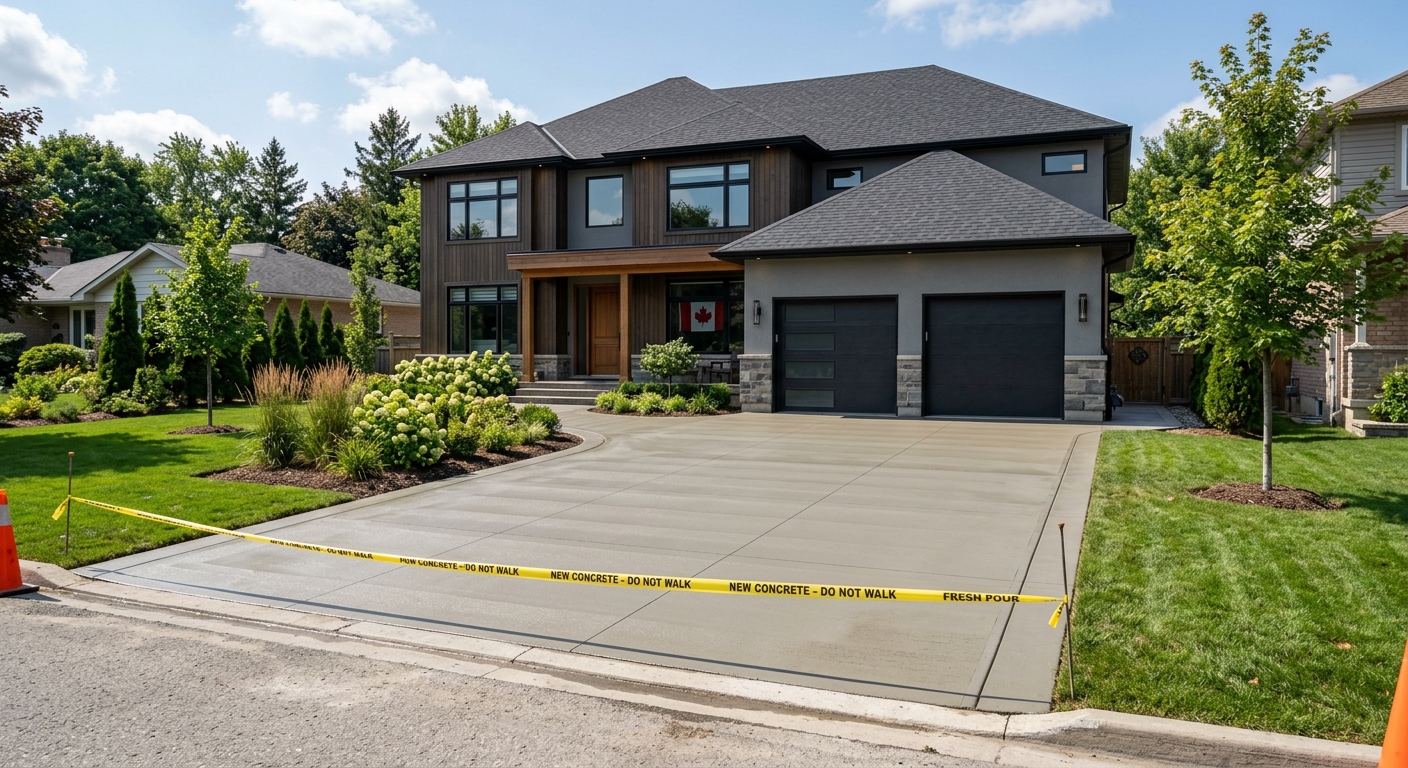
Concrete work options and costs in Wexford/Maryvale
In Wexford/Maryvale, homeowners usually start their concrete plans with one of three things: a new driveway, a patio/walkway upgrade, or foundation/footing work tied to a renovation or addition. This area is a large, established residential pocket within the Toronto economic region, and it’s the kind of community where concrete flatwork gets real use—especially for the many family homes that support everyday driveway and backyard traffic. With a population of 27,917 as of the 2021 Census (Statistics Canada, 2021 Census), there’s steady demand for experienced crews, and you’ll often see projects clustered around Spring and Fall landscaping season when soil work and access are easier.
Toronto-area concrete costs are shaped heavily by frost depth and freeze–thaw cycling. In practice, most structural footings need to sit at least about 1.2 m (roughly 4 ft) below grade to reduce frost heave and differential movement, and exterior slabs need an air-entrained mix plus proper base drainage to handle wet cycles. When temperatures drop toward about 10 °C or below, curing management becomes more labour-intensive—crews may need insulated blankets or other cold-weather precautions to protect strength gain and surface durability. That’s one reason you’ll see contractor availability and pricing fluctuate during the pour season in the GTA.
In Wexford/Maryvale, concrete demand is particularly common around the Eldorado Park / Wexford neighbourhood area where lot grades, garages, and backyard egress paths are frequent sources of calls. From there, the best way to compare options is using the price bands below—then tightening specs like base depth, reinforcement, and finish to match your yard conditions.
| Application |
Typical Size |
Key Spec |
Finish Option |
Price Range |
| Concrete driveway (standard broom finish) |
400–600 sq ft |
Air-entrained exterior mix, compacted granular base, control joints |
Broom-finish, saw-cut joints |
$18,000–$28,000 |
| Exposed aggregate driveway |
400–600 sq ft |
Proper mix + consistent aggregate exposure, drainage-friendly base |
Exposed aggregate (washed/surfaced aggregate) |
$22,000–$34,000 |
| Stamped concrete driveway or patio |
250–500 sq ft |
Reinforcement as required, air-entrained mix for exterior exposure |
Stamp pattern + colour integral or surface stain |
$24,000–$40,000 |
| Plain concrete patio or walkway |
150–350 sq ft |
Compacted granular base, edge forms, control joints |
Broom or light broom (non-slip) |
$16,000–$26,000 |
| Garage floor (interior slab) |
300–600 sq ft |
Vapour barrier if needed, fibre or mesh depending on use |
Plain float / trowel (sealed optional) |
$9,000–$18,000 |
| Foundation footings (structural, below frost) |
Per linear foot / typical replacement scopes |
Designed depth to local frost requirements, reinforcing, formwork, concrete pour |
Structural concrete (not decorative) |
$180,000–$300,000 |
Prices are estimates only and vary by project scope, site access and material selection.
What affects the price of concrete work in Wexford/Maryvale
In Wexford/Maryvale, it’s normal to see two quotes for “the same” concrete job land 30–50% apart across the Toronto region and Ontario. The difference usually isn’t just the concrete—it’s the details that protect the slab and footing from Toronto’s winter behaviour. Frost depth and freeze–thaw cycles dictate every structural decision: exterior footings must extend below the design frost depth (commonly around 1.2 m in Ontario), and every exterior slab should use air-entrained concrete to survive repeated expansion and contraction. On top of that, colder spells mean a shorter reliable pour season and more cold-weather curing precautions when temperatures fall toward about 10 °C or below; that can add labour for blankets, thermal management, and tighter scheduling.
De-icing salt also accelerates surface spalling if the concrete isn’t specified and finished correctly. That’s why sealing is a practical cost driver—especially for driveways and steps that see winter grit and frequent foot traffic. The finish also changes material and labour: a stamped driveway typically costs more than broom-finish, and exposed aggregate usually sits in between depending on accessibility and the prep required.
In Wexford/Maryvale specifically, local grading and drainage conditions can raise costs when yards are low or soils stay wet. If your subgrade needs rework, you’re paying for additional excavation, hauling, and a deeper compacted granular base—core reasons a driveway or patio can trend toward the higher end of the $18–$28 driveway band or the $16–$26 patio/walkway band. Conversely, a straightforward, flat access route with good existing drainage can keep you closer to the lower end. For foundation and footing scopes, the spec complexity can be larger still—structural work often runs within the $180–$300 footing band once you factor in reinforcement, excavation, and formwork for below-grade concrete.
| Price Factor |
Why It Matters |
Cost Impact |
| Frost line depth — determines footing depth and form height |
Deeper, properly supported footings reduce frost heave and settlement |
Higher excavation and formwork can add major cost |
| Site preparation — excavation, grading, compacted granular base |
Good base and drainage prevent pumping, voids, and uneven settlement |
Extra hauling/compaction can push pricing up |
| Reinforcement — rebar or wire mesh requirement |
Controls cracking and supports structural integrity under load |
Material + labour for placement and ties |
| Mix design — air-entrainment and compressive strength spec |
Air voids help concrete survive freeze–thaw without scaling |
Air-entrained supply may cost more but reduces failures |
| Finish type — broom vs. stamped vs. exposed aggregate |
Different tooling, curing steps, and surface processing requirements |
Stamps and aggregates typically increase labour and materials |
| Pour size and concrete truck access to site |
Long carries or restricted access increases labour time and logistics |
May require smaller batches or additional workforce |
| Cold-weather curing precautions — heating and blankets |
Ensures proper strength gain and finish durability as temperatures drop |
Can add setup costs during shoulder seasons |
| Control joint pattern and sealing cost |
Joints manage shrinkage cracking; sealing helps repel salt moisture |
Often modest cost compared to repair risk |
Permits & regulations in Ontario
In Ontario, structural concrete work typically needs municipal involvement, while many exterior flatwork projects are straightforward—but the “what” matters. In general, structural concrete such as foundation walls, grade beams, footings, and any new load-bearing foundation elements requires a building permit, and engineered drawings are often reviewed by the municipality depending on scope. For concrete flatwork—driveways, patios, sidewalks and walkways—a permit is usually not required when the work stays within standard grading/coverage expectations and doesn’t significantly affect lot grading, drainage, or impervious surface limits. If your proposal changes how water sheds toward neighbouring properties or alters the approved grading, that’s when reviews and conditions can come into play.
For a homeowner in Wexford/Maryvale, a good process is: (1) confirm the exact work category with your contractor before you book the pour; (2) request the permit status in writing—who pulls the permit and what is included; and (3) verify the contractor’s insurance and compliance. Step-by-step, you can check: licensing/registration (ask for their Ontario contractor details and verify via the appropriate online registry resources), liability insurance (get a current certificate of insurance showing your property/interest if applicable), and WSIB/WCB coverage (request proof and clearance documentation where used/available). Then ask for references on similar-scale Ontario jobs with freeze–thaw exposure.
Always confirm permit expectations with the local authority before demolition or excavation—especially where footings or drainage routing are involved.
Getting concrete right in Wexford/Maryvale's freeze-thaw climate
Concrete fails in Wexford/Maryvale when the slab or foundation can’t accommodate winter movement. The biggest culprits are insufficient base preparation, missing or incorrect mix design, and poor curing/protection during cold snaps. Toronto-area freeze–thaw cycles and de-icing salt increase the risk of scaling and spalling, so the specs should be built around durability—not just appearance.
To “spec it right,” start with the base: a well-compacted granular sub-base to the right depth for local soil and frost protection, with drainage routes planned so water doesn’t saturate the base. Next is mix design: exterior flatwork should use air-entrainment (typically 5–7% air) and a minimum 32 MPa compressive strength spec so freeze–thaw isn’t destructive. Then plan control joints: the spacing and depth should limit random cracking by giving the concrete a place to shrink. Curing matters too—aim for at least 7 days of proper curing conditions, and in cold weather you may need blankets or other protection to keep strength development on track. Finally, apply penetrating sealer about 28 days after the pour (when it’s fully cured) to repel moisture and help manage salt exposure.
Here’s where dollars make sense. If you’re deciding between a basic broom finish driveway and a more durable option, spending the extra on correct air-entrainment and base prep often prevents early repairs that can cost as much as the original improvement. For example, if a driveway is quoting in the $18–$28 band, the “cheap” version usually trims specs; the “right” version justifies costs by reducing the likelihood of spalling and lifting that would push you into rework expenses far beyond the upfront difference.
| Spec |
Why It Matters in Wexford/Maryvale |
What to Ask For |
Impact if Skipped |
| Compacted granular base (depth?) |
Provides frost protection and stops water-driven movement |
Base depth, granular material type, compacted to spec; confirm drainage plan |
Uneven settlement, pumping, early cracking |
| Air-entrained concrete mix (target air %?) |
Air voids relieve freeze–thaw pressure and reduce scaling |
Target air content for exterior flatwork (typically 5–7%) stated in the mix details |
Higher spalling risk, especially with de-icing salt |
| Compressive strength (MPa rating) |
Strength gain supports durability and load resistance |
Minimum 32 MPa spec and planned cure timeline |
Surface wear, reduced long-term performance |
| Control joints (spacing per ACI guidelines) |
Controls shrinkage cracking into planned locations |
Joint spacing, saw-cut timing, sealant plan if required for exterior exposure |
Random cracks and accelerated moisture intrusion |
| Minimum 7-day curing period |
Proper curing supports strength development before freeze risk |
What curing conditions are used; cold-weather plan if temps drop |
Weak surface, increased cracking and scaling |
| Penetrating sealer (when applied after cure) |
Helps repel salt and moisture from freeze–thaw exposure |
Confirm sealer type and application timing (about 28 days post-pour) |
Faster deterioration and staining; more maintenance needed |
How to choose a concrete work contractor in Wexford/Maryvale
Choosing the right contractor matters as much as the concrete itself—because in Wexford/Maryvale, small shortcuts show up as early cracking, spalling, and uneven settling after the first couple winters. Start by verifying Ontario compliance. Ask for their contractor details and check licensing/registration through the appropriate online registry resources (and/or any publicly listed status). For insurance, request a certificate of liability insurance that’s current and ask whether your property is named/covered as needed. Then verify WSIB/WCB coverage by requesting proof of coverage and, where available, clearance documentation. Don’t accept “we’re covered” without paperwork.
Next, require 2–3 itemised written quotes instead of lump-sum numbers. You want a breakdown for labour and materials: excavation and hauling, granular base, reinforcement, concrete supply with air-entrainment and strength spec, finishing labour, joints/sealing, and any permit/disposal responsibilities. Carefully review exclusions: is grinding/levelling included, are site protection measures included, is snow removal needed before curing, and who pays for concrete waste or equipment return?
Warranty is another key differentiator. Ask for a workmanship warranty length for finishing and joints, and separate the product/manufacturer warranty for any sealers or specialty systems (and whether it’s transferable to future owners). Finally, manage payment. For concrete, a common safeguard is to keep upfront payments to 10–15%, then schedule the remainder tied to measurable milestones (forms/base, pour completion, and finishing/cleanup). Get a written timeline with start date and completion estimate.
- Provide mix details: air-entrainment %, min 32 MPa (exterior)
- State concrete thickness and reinforcement requirements up front
- Confirm compacted base depth and granular material type
- Describe drainage handling where the slab meets grass/low spots
- Show joint spacing plan and cut timing for control joints
- Confirm cure protection plan if temps approach 10 °C or below
- Identify whether sealing is included, excluded, or an add-on
- Include disposal/hauling: spoils removal, clean-up, and trucking
- List equipment approach and how they manage concrete truck access
- Provide proof of liability insurance and WSIB/WCB coverage
- Offer references for similar Toronto/GTA freeze–thaw exterior work
- Write warranty terms and what they cover (cracks/joints/spalling)
Concrete red flags in Wexford/Maryvale include: quoting without discussing base depth or drainage, avoiding discussion of air-entrainment and freeze–thaw durability, offering a very low price with no reinforcement or unclear joint plan, asking for large upfront payments before base and formwork are done, and failing to provide insurance/WSIB/WCB proof or written scope exclusions.
Frequently asked questions — concrete work in Wexford/Maryvale
How do I seal concrete to protect it in Wexford/Maryvale?
In Wexford/Maryvale, sealing is one of the best “small-cost” steps to protect exterior concrete from wet cycles, de-icing salt, and freeze–thaw damage. The key is timing: wait until the slab is fully cured, typically about 28 days after the pour, then apply a penetrating sealer designed for exterior concrete (not just a surface film). Before sealing, the surface needs to be clean and dry—power washing and allowing drying time are usually essential. Ask your contractor what sealer type they use and whether they test for moisture or prep properly. If your concrete is new, properly sealed driveways and patios generally hold up longer against salt spalling than unsealed surfaces, especially along edges where water collects. If you’re budgeting, sealing is usually far cheaper than repair—think of it as protecting your $18–$28 driveway investment instead of replacing it after the first winter.
What is the difference between concrete and cement?
People use “concrete” and “cement” interchangeably, but they aren’t the same. Cement is a powder (the binder) that reacts with water to create paste. Concrete is the final engineered building material made from cement plus water, sand, gravel (or other aggregates), and sometimes admixtures like air-entrainment for freeze–thaw durability. In Ontario’s Wexford/Maryvale climate, the cement paste is only part of the durability equation—what really protects your slab is the whole concrete recipe, especially air-entrainment for exterior flatwork. That’s why you’ll hear contractors talk about mix design and air content (often 5–7% air) and not just the word “cement.” When you get quotes, ask for the mix spec and whether the concrete is air-entrained for the job—this is the difference between “it looks fine today” and “it survives winter.”
How much does concrete work cost in Wexford/Maryvale?
Concrete pricing in Wexford/Maryvale varies by thickness, base prep, reinforcement, and the finish you choose. For common exterior projects, you’ll typically see driveway work land around $18,000 – $28,000 depending on size and prep, while patios and walkways are often in the $16,000 – $26,000 band. Stamped concrete usually costs more because of extra labour and materials; you can expect stamped driveway or patio scopes around $24,000 – $40,000. Foundation footings are a different category entirely because they’re structural and require below-grade excavation and reinforcement; those scopes commonly run in the $180,000 – $300,000 range. Toronto-area freeze–thaw cycles and colder curing conditions can also increase costs when crews need extra protection to keep concrete developing strength properly. The best way to get an accurate number is an itemised quote that clearly states base depth, mix spec, and joint/sealing scope—not just a single lump sum.
How deep must footings be for Wexford/Maryvale's frost line?
In Ontario, footing depth is driven by the design frost depth requirement—part of why concrete specs can’t be “one size fits all.” For typical Toronto-area homes, structural footings are often required to extend at least about 1.2 m (roughly 4 ft) below grade to reduce frost heave and differential movement. That depth is below the local frost line considerations so the soil movement from freeze–thaw cycles doesn’t push the foundation unevenly. If you’re doing foundation work in Wexford/Maryvale—especially for additions or repairs—your drawings and permit requirements should confirm the exact footing depth based on the engineered design. Don’t rely on a neighbour’s depth as a rule for your specific soil and structure. Always ensure the contractor confirms the designed footing depth, reinforcing schedule, and how water management is handled during and after excavation.
Why does concrete crack in Wexford/Maryvale and how is it prevented?
Concrete cracking in Wexford/Maryvale is usually normal shrinkage meeting real-world winter movement—unless the job is properly detailed. Freeze–thaw cycles and moisture expansion can widen cracks, so prevention is about controlling where cracking happens and keeping water out. The main tools are: correct base prep (compacted granular sub-base with drainage), an air-entrained exterior mix (to reduce spalling from freeze–thaw), and a planned control joint pattern so the slab relieves shrinkage in predictable locations. Proper curing matters too—at least 7 days under suitable conditions—and during cold weather you may need curing blankets to protect strength gain. Sealing (after cure, often around 28 days) helps repel salt moisture that can degrade surfaces. If a contractor skips air-entrainment or uses an incorrect joint plan, you often see random cracking and spalling sooner. Asking whether they use an air-entrained mix and what joint spacing they follow will prevent most early failures.
Stamped vs broom-finish concrete — cost difference?
Stamped concrete typically costs more than broom-finish because it requires additional labour for moulding/stamping, and often extra steps for colouring and texture control. In Wexford/Maryvale, a broom-finished driveway or similar plain exterior flatwork often sits around $18,000 – $28,000 depending on size and base prep, while stamped driveway or patio projects commonly fall into $24,000 – $40,000. That higher band isn’t just for “look”—stamped work is more sensitive to curing timing, surface flatness, and joint planning so the pattern doesn’t telegraph weaknesses or crack poorly. If your goal is durability for winter traffic and de-icing salt, the most important spec differences are still base prep, air-entrainment, joint design, and curing protection. Stamped is worth the cost when you want curb appeal and you’re willing to maintain sealing; broom-finish is usually the better value if performance and budget predictability are your priorities.