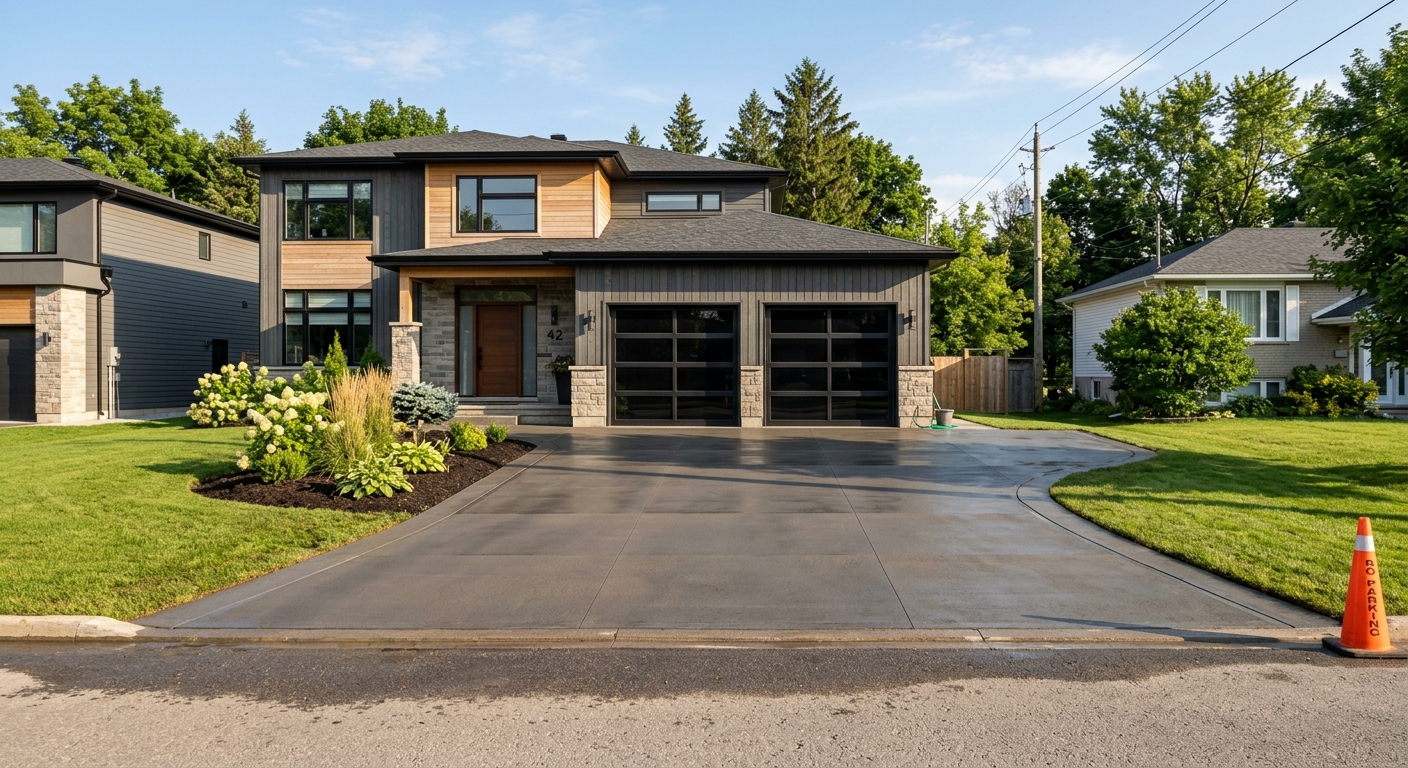
Concrete work options and costs in Bobcaygeon
Concrete work in Bobcaygeon is all about timing, drainage, and durability—especially with freeze–thaw swings that are hard on exterior slabs. With a 2021 population of 3,576 (Statistics Canada, 2021 Census), you don’t have the same level of contractor competition you’d see in larger GTA pockets, so availability and scheduling can affect your quote. This matters because the primary concrete-demand in town is tied to single-family living and the ongoing upkeep of driveways, patios, and walkways for existing homes, plus occasional new builds around established streets.
In the broader Toronto economic region, costs are shaped by frost depth requirements and the Ontario Building Code approach to preventing frost heave. For structural work, footings generally need to extend at least about 1.2 m (roughly 4 ft) below grade, which drives excavation, forming, and material amounts. For driveways and flatwork, Toronto-area contractors typically use air-entrained mixes, proper granular base, and control joints designed to manage cracking during repeated freeze–thaw. Even though Bobcaygeon is not coastal, humid, wet shoulder seasons mean curing protection and surface sealing are more critical than many homeowners expect.
In town, exterior pours are often in higher demand near the downtown core and along corridors with older housing stock—people commonly want replacements after years of settlement, scaling, or spalling. The price differences usually come down to base prep quality, reinforcement details, and finishing choice—so the table below compares typical options you’ll see in local estimates.
| Application |
Typical Size |
Key Spec |
Finish Option |
Price Range |
| Concrete driveway (standard broom finish) |
320–480 sq. ft. |
Air-entrained mix, compacted granular base, control joints |
Broom finish, standard edges |
$5,800–$11,500 |
| Exposed aggregate driveway |
320–480 sq. ft. |
Air-entrained mix, proper curing, wash/retard finish process |
Exposed aggregate finish, consistent stone exposure |
$7,800–$14,500 |
| Stamped concrete driveway or patio |
200–400 sq. ft. |
Air-entrained mix, integral colour, release system, joints |
Stamp pattern + integral colour (or two-tone options) |
$7,200–$16,000 |
| Plain concrete patio or walkway |
120–300 sq. ft. |
Compacted base, control joints where needed, drainage slope |
Float/straightedge with broom or light texture |
$2,000–$7,500 |
| Garage floor (interior slab) |
300–600 sq. ft. |
Vapour barrier (as specified), fibre or mesh as required, standard curing |
Light broom finish, saw-cut joints |
$4,900–$12,500 |
| Foundation footings (structural, below frost) |
Per linear foot / typical small foundation walls |
Excavation to design depth, compacted bedding, rebar/formwork, engineered spec |
Reinforced concrete footings (not decorative) |
$180–$300 |
Prices are estimates only and vary by project scope, site access and material selection.
What affects the price of concrete work in Bobcaygeon
Across Toronto and much of Ontario, you can see the “same” concrete job priced 30–50% apart once contractors account for the details that control long-term performance. A broom-finished driveway may look straightforward, but the cost swings when the excavation goes deeper for frost protection, when the base needs to be rebuilt due to poor soils, or when crews must manage a late-season pour to protect curing. In the Toronto economic region, availability can also tighten in peak weeks, which means more scheduling pressure and higher mobilization costs for smaller towns like Bobcaygeon.
The biggest driver is frost depth and freeze–thaw cycles. Structural footings must extend below the design frost depth (often in the 1.5–2.4 m range in Ontario depending on location and design), and exterior slabs still need a well-compacted granular base so water won’t saturate and expand the soil against the concrete. For exterior flatwork, air-entrained concrete is standard to handle the repeated freeze–thaw cycle. When temperatures trend toward 10 °C or lower, contractors may need cold-weather curing precautions such as insulated blankets and sometimes heat—labour and materials add cost, and it shortens the safe pour season.
Two examples from Bobcaygeon: if your driveway sub-base has soft, wet spots or existing concrete is heaving, the contractor may need extra excavation and replacement, which pushes you toward the higher end of the driveway band (like the $18–$28 range). If you choose stamped concrete or exposed aggregate, you’re paying for colour, release agents, finishing time, and extra careful jointing—often justified when you want a longer-lasting “curb appeal” finish rather than simply replacing slab thickness.
| Price Factor |
Why It Matters |
Cost Impact |
| Frost line depth — determines footing depth and form height |
Deeper excavation increases concrete volume, rebar, and forming time to prevent frost heave |
Can add major labour and equipment cost; often the largest variable on foundations |
| Site preparation — excavation, grading, compacted granular base |
Poor base leads to settlement, voids, and early cracking or scaling |
Improved base prep shifts you toward the higher end of concrete flatwork pricing |
| Reinforcement — rebar or wire mesh requirement |
Controls crack width and helps slabs/footings resist movement and loads |
Extra material + labour; moderate to significant increase on bigger pours |
| Mix design — air-entrainment and compressive strength spec |
Air-entrainment improves freeze–thaw durability; strength spec affects material and placement |
Costs more per yard, but reduces risk of spalling and early failure |
| Finish type — broom vs. stamped vs. exposed aggregate |
Decorative finishes require more steps, skilled finishing, and careful timing |
Stamped/exposed work typically moves you from “plain” bands into premium bands |
| Pour size and concrete truck access to site |
Tight access can add pumping, smaller loads, and longer wait times |
Can raise mobilization and labour cost even if slab dimensions stay the same |
| Cold-weather curing precautions — heating and blankets |
Maintains proper curing temperature when nights cool quickly in Ontario |
Adds labour, rentals, and material handling; increases total job cost |
| Control joint pattern and sealing cost |
Joints manage cracking; sealing helps reduce water and de-icing salt damage |
Often affordable relative to repairs, but increases line items on estimates |
Permits & regulations in Ontario
In Ontario, structural concrete work typically requires a building permit, and many municipalities also expect engineered drawings or stamped structural details to be reviewed before construction. That means footings, foundation walls, grade beams, and other load-bearing concrete elements generally fall under permit requirements. For concrete flatwork—like patios, walkways, and driveways—permits are usually not required unless your project affects lot grading, drainage, impervious surface coverage limits, or municipal right-of-way requirements (for example, driveway work that touches municipal boulevards or curb/sidewalk interfaces). Because rules can vary by site and plan, the practical step is to confirm with the local authority in advance of you ordering concrete or digging.
For contractor compliance, you should verify three things before signing anything: (1) liability insurance, (2) WSIB/WCB coverage (or the applicable coverage proof for the contractor’s work), and (3) contractor readiness to do the job safely and professionally. Here’s a homeowner-friendly step-by-step approach:
- Ask the contractor for a Certificate of Insurance showing liability limits and the correct insured entity.
- Request proof of WSIB/WCB coverage (a clearance letter or account status document).
- Confirm the permit responsibility in writing: who pulls the permit if structural work is required.
- Check for references on similar-scale projects in Ontario (especially exterior flatwork subject to freeze–thaw).
- Verify the scope matches what you discussed—no “assume it’s included” language for disposal, forms, or base restoration.
Getting concrete right in Bobcaygeon's freeze-thaw climate
In Bobcaygeon and the wider Toronto region, concrete failures are usually about water and temperature. The most common issues homeowners see are cracking from movement, and spalling/scaling caused by poor air-entrainment or water saturation under the slab. Freeze–thaw repeatedly expands and contracts pore water in and around the concrete. To spec the job correctly, you want the full system working together: base preparation, the right mix, controlled cracking through joints, proper curing, and sealing after cure.
First, base prep: a compacted granular sub-base to the right depth for the local soil and drainage is non-negotiable. Second, mix design: for exterior flatwork, air-entrainment is typically targeted around 5–7% air so the freeze–thaw cycle doesn’t break down the cement paste. Contractors should also place concrete to a minimum 32 MPa compressive strength (or the project spec/engineered design when higher is required). Third, control joints: they guide where cracks will form, preventing random cracking across the driveway or walkway. Fourth, curing: plan for at least 7 days of proper curing conditions; when nights cool fast toward the lower teens and approach 10 °C, cold-weather protection may be necessary. Fifth, sealing: use a penetrating sealer applied after cure (commonly around 28 days) to help repel de-icing salt and reduce water uptake.
A real-world cost justification: if a plain patio quote is around the $16–$26 per sq. ft. band but the contractor offers to cut corners on base depth or skip sealing, you might save a few hundred dollars up front. In our climate, that’s often not a fair trade—repairs or early resurfacing can quickly exceed the initial savings.
| Spec |
Why It Matters in Bobcaygeon |
What to Ask For |
Impact if Skipped |
| Compacted granular base (depth?) |
Prevents water saturation and movement under the slab during freeze–thaw |
Base depth and compaction method (including drainage slope and subgrade prep) |
Settlement, voids, cracking, and early scaling/spalling |
| Air-entrained concrete mix (target air %?) |
Allows expansion in freeze–thaw cycles without damaging the paste |
Air content target around 5–7% for exterior flatwork |
Higher risk of spalling and surface scaling after a few winters |
| Compressive strength (MPa rating) |
Supports strength and durability for the climate and loads |
Minimum 32 MPa (or higher if your design requires) |
Reduced durability and higher likelihood of cracking under stress |
| Control joints (spacing per ACI guidelines) |
Creates planned crack locations instead of random cracks |
Joint layout and spacing plan based on slab size and reinforcement |
Random cracking, uneven appearance, and more water infiltration |
| Minimum 7-day curing period |
Ensures concrete gains strength before it’s exposed to cold nights and moisture |
Protection plan for cold or wet conditions; curing duration confirmed |
Lower early strength and increased surface damage risk |
| Penetrating sealer (when applied after cure) |
Reduces water and de-icer salt absorption during Bobcaygeon winters |
Sealer type and timing (typically after about 28 days cure) |
Faster deterioration and more staining/scaling on the surface |
How to choose a concrete work contractor in Bobcaygeon
Start by verifying Ontario compliance the right way: ask for proof of liability insurance, WSIB/WCB coverage, and the contractor’s correct legal business name. For Ontario licensing, don’t rely on a handshake—ask for documentation and confirm the contractor is in good standing for the work they’re doing. Then check the certificate of insurance: it should include your project address or demonstrate the insurer’s coverage is valid for the contractor’s operations. For WSIB/WCB, request a clearance letter or account coverage status so you’re not left holding risk if something goes wrong on site.
Next, get 2–3 itemised written quotes. You want labour + materials broken out (concrete supply, rebar/mesh, granular base, forms, finishing labour) rather than a single lump-sum number. Pay attention to exclusions: Is concrete removal included? Is disposal included? Is permit work included where required? Does the quote include saw-cut joints, sealing, and any cold-weather curing protection? The best bids clearly state what you get and who provides what.
Warranty matters too. Ask for the workmanship warranty length and whether it’s tied to the concrete finish, joints, and sealing steps. For payment scheduling, avoid paying more than 10–15% upfront; hold back enough to ensure completion and corrective work. Finally, insist on a written start date and realistic completion estimate—especially if the pour window is tightening due to weather.
- Confirm liability insurance and WSIB/WCB proof before work starts.
- Use itemised quotes: concrete, base, rebar/mesh, forms, disposal, sealing.
- Ask how they handle poor soil or soft subgrade areas.
- Require a written base depth and compaction method.
- Confirm air-entrainment and target mix specs for exterior work.
- Ask about joint layout (spacing and saw-cut timing).
- Get curing and cold-weather protection details in writing.
- Verify finish steps: broom vs. stamped sequencing and timing.
- Ask whether they use a penetrating sealer and when it’s applied.
- Confirm equipment access plans (truck route, pumping if needed).
- Make sure cleanup and debris haul-away are included.
- Request references from similar Bobcaygeon-area exterior projects.
In Bobcaygeon, four common red flags I see are: (1) quotes that don’t mention granular base depth or compaction, (2) no plan for air-entrained concrete on exterior slabs, (3) no written curing/protection approach for cool nights, and (4) vague scope language that leaves disposal, sealing, or jointing out of the agreement.
Frequently asked questions — concrete work in Bobcaygeon
Why does concrete crack in Bobcaygeon and how is it prevented?
Concrete can crack in Bobcaygeon even when it’s installed correctly—what matters is controlling where cracks happen and keeping water out. In Ontario’s freeze–thaw climate, repeated expansion and contraction can stress slabs, especially if the base is not properly compacted or if drainage lets water sit beneath the concrete. Prevention starts with a well-prepared granular base, correct slab thickness for the use, and a concrete mix designed for exterior exposure (including air-entrainment). Next, use a control joint pattern so cracking occurs at planned locations rather than random points. Finally, curing and sealing help reduce early surface damage from moisture and de-icing salts. If you’re budgeting, a plain patio may land around the $16–$26 band, but skipping base prep or sealing usually costs more later through repairs.
Stamped vs broom-finish concrete — cost difference?
Stamped concrete costs more than broom-finish because it involves extra steps: integral colour or dyes, release agents, mould/stamp work, and tighter scheduling to get the texture right before the concrete sets. In the Toronto region, exterior durability still hinges on the same foundation—compacted granular base, air-entrained mix, proper jointing, and cure protection—so you shouldn’t treat the decorative finish as “just cosmetic.” As a homeowner example, a stamped driveway or patio typically sits in the premium range (often around the $24–$40 per sq. ft. pricing band for decorative work), while broom-finished driveways usually fall in the standard concrete driveway band (commonly $18–$28 per sq. ft.). The best value is choosing decorative finish where appearance matters most (front entry walks or a focal patio), and keeping simpler broom finish elsewhere.
When is the best time to pour concrete in Bobcaygeon?
The best time in Ontario is usually late spring through early fall, when daytime temperatures stay comfortably above the range where curing becomes difficult. In the Toronto economic region, contractors plan pours around stable weather because curing quality drops when temperatures fall toward 10 °C or below—especially with humid, wet shoulder-season conditions. If you pour too late or during persistent cold nights, you may need heating, insulated blankets, and extra crew time, which increases cost and can affect schedule. Practically, that means booking early if you want a driveway or patio done in the main pour window. For your quote, ask what temperature triggers cold-weather protection and how the contractor will manage curing continuity. A good contractor will also schedule finishing and jointing steps so you don’t get weak surface performance.
How long does concrete take to cure?
Concrete gains strength over time, and “cure time” can mean two things: initial hardening and achieving sufficient strength for durability. For most flatwork in Ontario, contractors plan for at least 7 days of proper curing conditions before expecting normal exposure, but full strength development generally takes longer. Temperature and moisture conditions matter a lot in Bobcaygeon—wet weather, cold nights, and wind can slow the process. That’s why reputable crews protect the surface after placement, especially when temperatures start dropping. If your job includes sealing, ask about timing: penetrating sealers are commonly applied after the concrete has cured thoroughly (often around 28 days) so the sealer can bond and repel water and de-icing salts effectively.
Do I need a permit for concrete work in Ontario?
Often, you don’t need a permit for basic concrete flatwork like patios, walkways, and driveways in Ontario, as long as it doesn’t change grading/drainage in a way that affects lot requirements or municipal right-of-way rules. However, structural concrete work—such as footings, foundation walls, and grade beams—generally requires a building permit and often engineered drawings reviewed by the municipality. In Bobcaygeon, the safest approach is to ask the contractor to confirm whether your specific scope triggers a permit. Before any digging, verify who is responsible for the permit pull (homeowner or contractor) and confirm in writing. Also verify compliance basics: contractor liability insurance and WSIB/WCB coverage should be provided before work begins.
Concrete vs pavers for a patio in Bobcaygeon?
Concrete and pavers both work well for patios, but they fail differently in Bobcaygeon’s freeze–thaw climate. Concrete relies on a monolithic slab designed for air-entrainment, curing, and joint control; it typically offers a cleaner, more seamless surface and can be cheaper for larger simple shapes (plain patios often fall in the $16–$26 band). Pavers move differently—because individual units can shift if the base isn’t built and compacted correctly, leading to uneven surfaces over time. For many homeowners, the choice comes down to appearance and maintenance: pavers can be easier to replace piece-by-piece, while concrete (especially if sealed) provides a consistent surface with fewer visual seams. If you want decorative look, stamped concrete can be a middle ground versus full paver installs, but be sure both options include a properly compacted base and drainage plan.