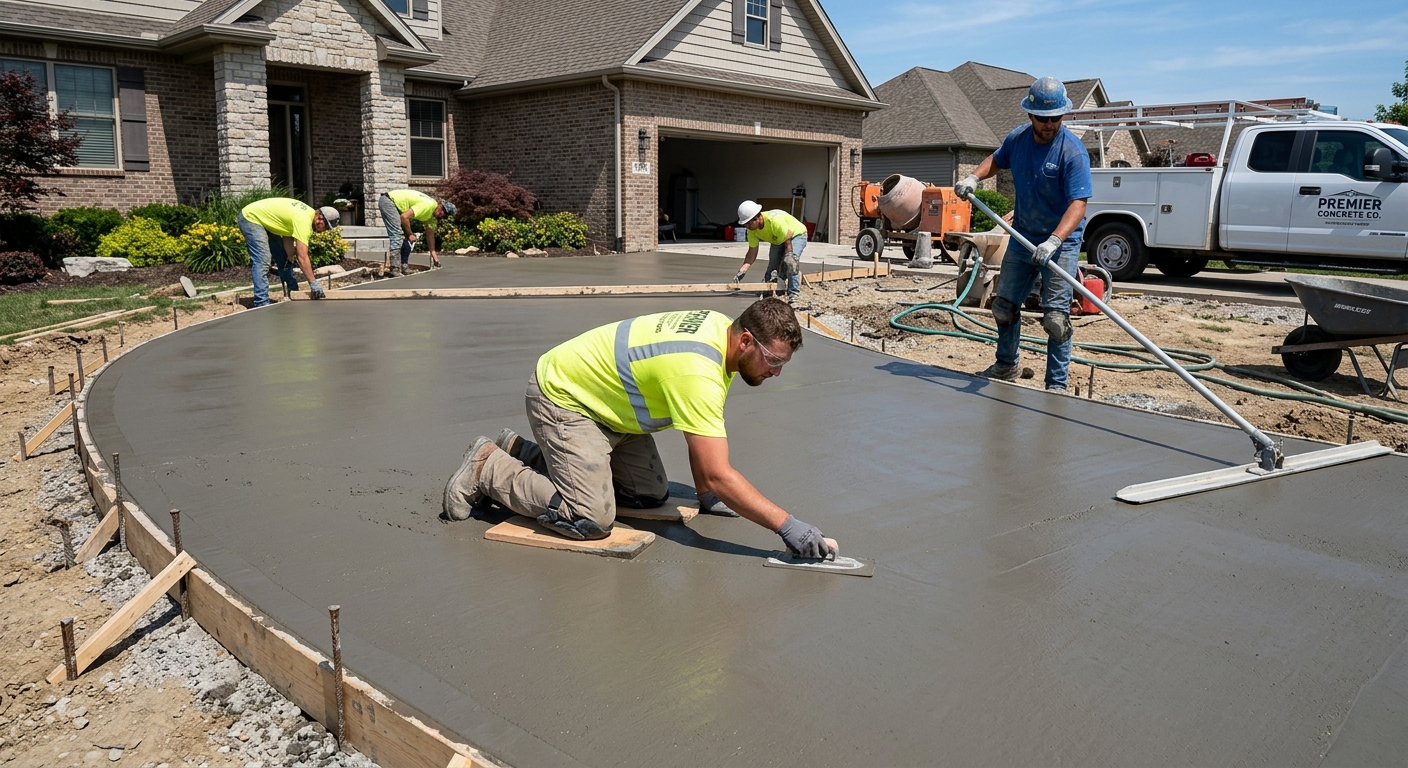
Concrete work options and costs in Oshawa
Oshawa homeowners typically compare several concrete options before booking a contractor—mainly because the look you want (broom, exposed aggregate, stamped) and the ground conditions you’re dealing with can change the price quickly. Oshawa is a strong market for driveway and flatwork: about 55.5% of dwellings in the city are single-detached homes, and the homeowner base remains large (42,750 homeowner households, representing 64.2% of households). That matters because concrete flatwork is most often tied to detached driveways, patios and walkways.
In the Toronto economic region, pricing is strongly influenced by frost depth and the freeze–thaw cycle. Most structural footings must extend below the design frost depth, and local crews plan around Ontario’s shorter reliable pour season for exterior work. When temperatures trend near 10 °C or below, contractors need stronger cold-weather protection (and longer, safer cure times) so you don’t get weak surface strength or premature scaling. Oshawa projects are also commonly concentrated in older neighbourhoods and established lots—like Eastdale—where 58.6% of homes were built before 1981 and you often see older driveways and drainage patterns that need correction before concrete is poured.
Below is a practical comparison of common jobs and the key specs that drive the cost. Use the table to anchor your budget, then match the “Key Spec” items to what your site actually needs (base depth, reinforcement, jointing, and finish).
| Application |
Typical Size |
Key Spec |
Finish Option |
Price Range |
| Concrete driveway (standard broom finish) |
24' x 10' (240 sq. ft.) |
Air-entrained mix, compacted granular base, control joints |
Broom finish |
$4,320–$6,720 |
| Exposed aggregate driveway |
24' x 10' (240 sq. ft.) |
Air-entrained mix, wash/exposure process, curing care |
Exposed aggregate |
$5,040–$7,680 |
| Stamped concrete driveway or patio |
20' x 12' driveway/patio (240 sq. ft.) |
Air-entrained mix, proper release, joint pattern coordination |
Stamped pattern (templates/seals) |
$5,760–$9,600 |
| Plain concrete patio or walkway |
16' x 10' (160 sq. ft.) |
Granular base and drainage, control joints |
Plain/smooth or light broom |
$2,560–$4,160 |
| Garage floor (interior slab) |
20' x 20' (400 sq. ft.) |
Vapour/insulation plan as needed, reinforcement, proper curing |
Broom finish or smooth trowel (as requested) |
$6,000–$10,000 |
| Foundation footings (structural, below frost) |
Typical house footing package |
Engineered design, excavation, forms, waterproofing coordination |
Rebar cage + structural concrete |
$8,000–$15,000 |
Prices are estimates only and vary by project scope, site access and material selection.
What affects the price of concrete work in Oshawa
In Oshawa and the wider Toronto region, quotes for the “same” concrete project can differ by about 30–50% because the hidden work is rarely identical. Two driveways can both measure 24' x 10', but one lot may need deeper excavation, more base material, additional reinforcement, and drainage corrections—especially where old drainage directs meltwater toward the slab. Labour costs also shift with schedule pressure in peak season, and crews prioritize projects that fit truck access and curing windows.
Concrete is also extremely climate-dependent here. Frost depth and freeze–thaw cycles dictate nearly every spec: footings typically need to extend below the design frost depth (Ontario commonly targets about 1.5–2.4 m depending on location and soil conditions) to prevent frost heave and differential movement. For exterior slabs and driveways, contractors specify air-entrained concrete so the surface survives repeated freeze–thaw cycles. When cold weather approaches, the pour season shortens and cold-weather curing precautions (insulation blankets, heat management, longer protections) add cost and can push the schedule into a more expensive time window.
In Oshawa, older housing stock (58.6% built before 1981) often means more excavation and stump/utility relocation work than newer subdivisions. A common example: if your driveway base is weak, upgrading compacted granular base can move a broom-finish driveway from the lower end of the $18–$28/sq. ft. band to the higher end—but it can prevent the “edge heave” repairs that cost more later. Likewise, switching from plain to stamped or exposed finishes moves you from the $16–$26/sq. ft. patio/walkway range up into the $24–$40/sq. ft. stamped band, which is justified when the design element (and joint strategy) is planned from day one.
| Price Factor |
Why It Matters |
Cost Impact |
| Frost line depth — determines footing depth and form height |
Footings must extend below design frost depth to prevent heave and movement |
Higher excavation and forming can add significant cost to structural work |
| Site preparation — excavation, grading, compacted granular base |
Correct base depth prevents settling and keeps slabs stable through freeze–thaw |
Extra trucking and base material can shift pricing upward fast |
| Reinforcement — rebar or wire mesh requirement |
Controls cracking and improves load capacity for driveways and slabs |
Materials and labour can add a meaningful percentage to the job |
| Mix design — air-entrainment and compressive strength spec |
Air-entrainment helps manage freeze–thaw; strength supports long-term durability |
Better mixes often cost more but reduce early surface failure |
| Finish type — broom vs. stamped vs. exposed aggregate |
Finishes require different labour time and materials, plus curing coordination |
Stamped/exposed finishes generally cost more than plain broom |
| Pour size and concrete truck access to site |
Access controls whether trucks can deliver directly to the pour zone |
Limited access can increase labour and time (or require pumping) |
| Cold-weather curing precautions — heating and blankets |
Protects early-age strength development as temperatures drop |
Adds gear, labour, and schedule protections; can increase total cost |
| Control joint pattern and sealing cost |
Joints reduce random cracking; sealing helps resist de-icing salt scaling |
Proper jointing and sealing add line-item costs but extend service life |
Permits & regulations in Ontario
In Ontario, structural concrete work typically requires a building permit and may require engineered drawings reviewed by the municipality. This includes foundation footings, foundation walls, and grade beams (and any structural concrete tied to the building frame). Concrete flatwork—like driveways, patios, and walkways—usually does not require a permit on its own. However, you should confirm if your project affects lot grading, stormwater drainage, impervious surface limits, or the municipal right-of-way (for example, if you’re doing work near an approach or sidewalk area).
Before breaking ground in Oshawa, verify your contractor carries the right protections and documentation. Step-by-step:
- Ask for their liability insurance certificate (you want the COI showing current coverage and the correct business name).
- Confirm they have coverage for WSIB where applicable (some firms may use clearances/coverage evidence—ask for proof).
- Request references for similar footing or flatwork scopes in Ontario and ask what failed (if anything) and how it was corrected.
- For structural work: confirm the permit pull process is included and who is submitting the paperwork—your contractor should coordinate it.
- Use your own due diligence: check any relevant provincial/online business registry listings for the contractor’s legal business identity, then match that to the COI.
If you’re unsure whether your exact scope triggers a permit, ask for the project scope in writing (what is being demolished, what depth is being excavated, and whether drainage changes are involved) and confirm with the local authority before the first saw cut.
Getting concrete right in Oshawa's freeze-thaw climate
Concrete failures in Oshawa almost always trace back to one of five things: weak base support, poor drainage, inadequate air-entrainment, missing or poorly planned control joints, and curing/sealing shortcuts. In a Toronto freeze–thaw environment, water gets into micro-cracks, expands when it freezes, and gradually pushes the surface apart. That’s why base prep isn’t optional here—exterior slabs need a well-compacted granular sub-base at the right depth so saturated soil doesn’t move against the concrete every winter.
To spec the job correctly, start with the mix and the plan: contractors should use air-entrained concrete (commonly aiming for about 5–7% air content for exterior flatwork) and a minimum 32 MPa compressive strength for typical residential exterior applications. Then insist on a control joint layout that limits random cracking (joint spacing depends on slab geometry and thickness). Curing matters just as much: plan for minimum 7 days of protection under appropriate conditions. In colder stretches, you may need blankets/heating so the concrete gains strength rather than freezing early. Finally, apply a penetrating sealer after curing—typically at around 28 days—to improve resistance to de-icing salts and moisture intrusion.
When you compare options, use the “cost vs. longevity” logic. For example, if exposed aggregate is within your budget, it costs more than a plain broom finish, but the extra work is often justified when the contractor also does proper base prep and correct drainage. If base prep is skipped, even the best finish won’t stop freeze–thaw-driven edge lifting and scaling.
| Spec |
Why It Matters in Oshawa |
What to Ask For |
Impact if Skipped |
| Compacted granular base (depth?) |
Stable support prevents movement and edge heave during freeze–thaw |
Confirm excavation depth, granular type, and compaction method |
Settling, cracking, and water pooling that accelerates deterioration |
| Air-entrained concrete mix (target air %?) |
Air voids help manage freeze–thaw stress and reduce spalling risk |
Ask for target air content (typically 5–7% for exterior flatwork) |
Surface scaling/spalling within a few winters, especially with salt |
| Compressive strength (MPa rating) |
Strength development supports durability and load performance |
Ask for minimum 32 MPa (typical residential spec) and verification |
Soft or weak concrete can crack and wear prematurely |
| Control joints (spacing per ACI guidelines) |
Controls where cracks form as the slab shrinks/expands |
Request joint spacing and timing (saw-cut vs. formed) |
Random cracking that is harder and more expensive to repair |
| Minimum 7-day curing period |
Cold Toronto-season temperatures slow early strength gain |
Ask about protection plan if temps drop near 10 °C or below |
Reduced strength and higher risk of surface defects |
| Penetrating sealer (when applied after cure) |
Repels moisture and helps resist de-icing salt damage |
Confirm sealer type and that it’s applied after cure (often ~28 days) |
Faster scaling and spalling on exterior surfaces |
How to choose a concrete work contractor in Oshawa
Choosing a concrete contractor in Oshawa is mostly about reducing risk: weather protection, correct base prep, and durable mix design. Start with Ontario compliance and coverage checks. Ask for their liability insurance certificate and confirm the coverage term is current and matches the contractor’s legal name. Then verify WSIB coverage evidence for workers (or applicable clearance/coverage proof). For bigger scopes involving structural work, ask how the permit process will be handled and whether engineered details are included.
Next, get 2–3 itemised written quotes rather than one lump-sum. You want a line-by-line breakdown showing labour and materials (excavation and base, rebar/wire mesh, concrete supply, forming, finishing, curing, sealing, and disposal). If a contractor won’t itemize, it’s harder to compare apples to apples—especially in a market where site conditions and schedule timing can swing cost. Also read the scope carefully: what’s included or excluded for permit pulls, grading/drainage adjustments, and disposal of excess soil.
Finally, protect yourself with payment and warranty terms. A reasonable schedule generally keeps upfront payments to about 10–15%, with a holdback until the job is complete and defects are addressed. Get a clear start date and completion estimate in writing, and ask for a workmanship warranty length plus whether manufacturer warranty applies to product materials (and whether it’s transferable if you sell your home).
- Provide COI for liability insurance before work begins.
- Confirm WSIB coverage evidence (ask for proof, not just “we’re covered”).
- Get at least three references for similar Oshawa projects (driveways, patios, or footings).
- Use itemised quotes (base prep, reinforcement, concrete mix, finishing, curing, sealing, disposal).
- Confirm whether control joints are included (pattern and timing).
- Ask for cold-weather protection plan if the pour could overlap cooler days.
- Require a written pour-day plan: truck access, manpower, and curing protection materials.
- Check whether sealing is included and when it will be applied (after cure).
- Ask how drainage will be handled so water doesn’t pond against the slab.
- Confirm reinforcement specs for your loading needs (driveway vs. walkway).
- Clarify warranty duration and what “warranty work” covers in writing.
- Set a payment holdback until cleanup and final finishing are complete.
Concrete red flags in Oshawa include: quotes that omit base depth/compaction details, no clear mention of air-entrainment for exterior work, unusually fast schedules that don’t account for curing protection, reluctance to provide COIs/WSIB proof, and vague scopes that don’t specify jointing, sealing, and drainage grading.
Frequently asked questions — concrete work in Oshawa
What is the difference between concrete and cement?
In Oshawa, people often use the words interchangeably, but they’re not the same. Cement is the powdered ingredient (usually Portland cement) that acts as a binder. Concrete is the full material made by mixing cement with water, sand, and gravel/stone (aggregate), plus sometimes additives like air-entrainment for freeze–thaw durability. For exterior flatwork—driveways, patios, and walkways—the air-entrained component is critical because Oshawa experiences repeated winter freeze–thaw and de-icing salt exposure. When you compare quotes, ask what mix design is being used (air content and strength), because the “cement” alone doesn’t determine how well the finished concrete will survive Ontario winters.
How much does concrete work cost in Oshawa?
Concrete pricing in Oshawa depends heavily on thickness, base preparation, reinforcement, and how much finishing you choose. As a benchmark for the Toronto economic region, residential exterior concrete is commonly budgeted around $18–$28 per sq. ft. for a concrete driveway/slab and $16–$26 per sq. ft. for a patio or walkway, with stamped/decorative pours often running higher. If you choose stamped concrete, expect pricing closer to $24–$40 per sq. ft. because it requires extra labour for stamping and colour hardeners/sealers. The biggest cost swings come from excavation and granular base upgrades, not just the visible finish. If your lot drainage is poor (common in older areas), contractors may also need additional grading work, which can move the final total up even if the surface area stays the same.
How deep must footings be for Oshawa's frost line?
For structural footings in Ontario, the key is that they must extend below the design frost depth to prevent frost heave and differential movement. In practice, many Ontario projects target roughly 1.5–2.4 m below grade depending on site and the engineered design. Because soil type, groundwater, and the specific foundation system matter, you should rely on the building permit/engineer requirements for your lot—not a generic number. If a quote shows shallow footings “to save cost,” it’s a major durability risk in Oshawa’s freeze–thaw climate. For new foundations or structural repairs, confirm that the contractor is coordinating engineered drawings and permit requirements, and that excavation depth and footing dimensions match those documents.
Why does concrete crack in Oshawa and how is it prevented?
Concrete cracks in Oshawa mostly because it’s a rigid material that shrinks as it cures and expands/contracts through temperature changes. In a freeze–thaw cycle, moisture can enter tiny paths and worsen stress at weak points. The most common prevention approach for exterior flatwork is a combination of (1) proper base preparation so the slab doesn’t settle, (2) correct air-entrainment to reduce freeze–thaw damage (spalling/scaling risk), and (3) a planned control joint pattern to tell the concrete where cracks should occur. Contractors also need to handle curing properly—minimum cure protection (often at least 7 days) and extra measures when temperatures drop. Sealing after the cure period adds protection against moisture and de-icing salts, which can accelerate surface breakdown. When you get quotes, ask what joint spacing they use and whether air-entrained mix is included.
Stamped vs broom-finish concrete — cost difference?
Stamped concrete costs more than broom-finish because the process is more labour-intensive and requires specialized materials and careful finishing timing. In Oshawa, the pricing difference shows up most clearly when you compare decorative finishes to standard broomwork. For example, a driveway in the $18–$28 per sq. ft. range for standard concrete is typically a broom-finish baseline, while stamped concrete often sits in the $24–$40 per sq. ft. band due to stamping, colour integration, and added sealing/finishing steps. You can justify the upgrade when you want curb appeal and you’re also getting correct freeze–thaw specs (air-entrainment, proper base, and good jointing). If the contractor is cutting corners on drainage or joint layout, the appearance won’t last—so always compare specs, not just the finish name.
When is the best time to pour concrete in Oshawa?
The best time to pour concrete in Oshawa is during the warmer months when temperatures stay high enough for proper curing and finishing. In the Toronto region, contractors generally try to concentrate exterior pours in the warmer part of the year because curing becomes harder when temperatures trend toward cooler conditions (especially near 10 °C or below). If a pour is scheduled late in the season, good crews use cold-weather curing precautions such as insulation blankets and heating to protect early-age strength gain. That protection increases cost, but it’s necessary for durability through winter freeze–thaw cycles. For planning, consider your driveway/patio schedule in the spring or early fall with weather buffers. Also ask your contractor about their curing-and-protection plan for the specific forecast window, not just “we’ll do it in good weather.”