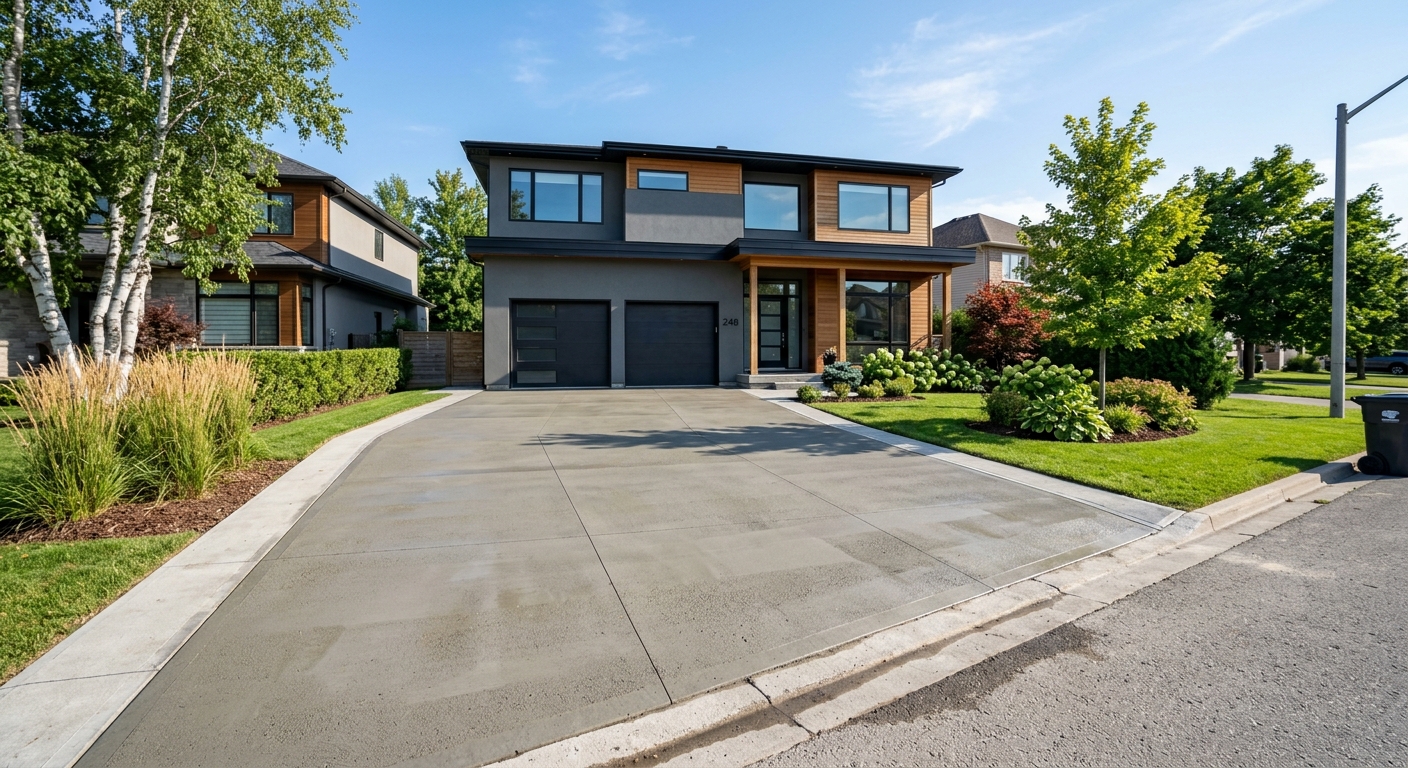
Concrete work options and costs in Espanola
Espanola is a small Northern Ontario community where a lot of driveways, patios and basement steps get hit hard by winter slush, de-icing salt and freeze–thaw. With about 80.7% of dwellings being single-detached homes, homeowners commonly need durable flatwork that can handle heavy vehicles and seasonal expansion. The local housing stock is also older—79.0% of homes were built before 1981—which means many projects start with repairs, re-grading, or replacing worn-out slabs and settlement-prone walkways rather than pouring new concrete on virgin soil. (Statistics Canada, 2021 Census).
Pricing here is influenced by Northeast Ontario weather patterns and the operational reality of scheduling concrete crews around cold snaps. Even when a pour date looks “warm enough,” surface freezing at night can shorten setting time and increase risk of scaling, so crews plan for cold-weather protection, longer curing and tighter quality control. Site access matters too: in neighbourhoods with older lanes and narrower approaches, excavation, formwork and truck placement can take longer, and that’s reflected in the quote.
In Espanola, concrete demand is especially steady around the residential areas near Centre Street and along the main corridors that connect to the downtown core, where driveways and steps are frequently resurfaced to improve curb appeal and traction. If you’re budgeting for concrete flatwork, the table below gives realistic ranges for common scopes—then you can match the spec (base depth, reinforcement, air-entrainment, finish) to your actual site conditions.
| Application |
Typical Size |
Key Spec |
Finish Option |
Price Range |
| Concrete driveway (standard broom finish) |
400–600 sq. ft. |
Air-entrained exterior mix, compacted granular base, welded wire where required |
Broom finish + control joints |
$18,000–$28,000 |
| Exposed aggregate driveway |
400–600 sq. ft. |
Air-entrained exterior mix, proper base drainage, aggregate selection |
Exposed aggregate + seal-ready surface |
$22,000–$34,000 |
| Stamped concrete driveway or patio |
300–500 sq. ft. |
Air-entrained exterior mix, integral color, release agent + curing attention |
Stamp pattern + sealed finish |
$12,000–$20,000 |
| Plain concrete patio or walkway |
200–350 sq. ft. |
Air-entrained exterior mix, compacted base, expansion allowance at house |
Light broom finish or smooth float |
$3,000–$9,000 |
| Garage floor (interior slab) |
300–500 sq. ft. |
Minimum 32 MPa mix, vapor considerations if required, saw-cut joints |
Float finish + sealer optional |
$6,500–$14,000 |
| Foundation footings (structural, below frost) |
Approx. 60–180 linear ft. (project-dependent) |
Engineered excavation depth, rebar cage, air content as specified for exposure |
Typical structural concrete |
$55,000–$90,000 |
Prices are estimates only and vary by project scope, site access and material selection.
What affects the price of concrete work in Espanola
Even when two homeowners ask for “the same” concrete driveway, quotes across Northern Ontario can easily diverge by 30–50% once you account for frost protection, base build-up, reinforcement and finish systems. In practice, the driveway is never just concrete—it’s excavation, compacted granular base, drainage details, air-entrainment, curing and (often) sealing. In older Espanola neighbourhoods, it’s common to find utility conflicts, soft subgrade and removed topsoil that has to be rebuilt properly before any concrete is poured.
Frost line depth and freeze–thaw cycles dictate every spec. For exterior work in Ontario, footings must extend below the design frost depth to prevent frost heave and slab cracking; that requirement drives excavation depth, form height and backfill. Exterior slabs also need air-entrained concrete mixes to survive repeated wetting and freezing, and colder conditions often mean a shorter workable window—so crews may use curing blankets, insulated protection and admixtures to keep the slab reaching strength. De-icing salt then becomes a durability factor: without an air-entrained mix and proper sealing, surfaces can spall over time.
Here are a few local ways cost can rise or fall in Espanola:
- Base prep scope: If your driveway needs full-depth granular replacement instead of a simple patch, costs move toward the higher end of the $18,000–$28,000 driveway band.
- Decorative finishes: Stamping or exposed aggregate adds labour and material (forms and finishing steps), often pushing projects into the $25,000–$40,000 decorative concrete pricing mindset for comparable surface areas.
- Cold-weather curing: If a pour is pushed into shoulder-season weather, protection and longer curing can add meaningful labour and equipment time.
Your home’s age matters too. With 79.0% of homes built before 1981, many sites have settled drive approaches and older drainage patterns, which means more grading and prep than a “new build” style pour. (Statistics Canada, 2021 Census).
| Price Factor |
Why It Matters |
Cost Impact |
| Frost line depth |
Determines footing depth, excavation volume and formwork height |
Higher when deeper excavation and engineered details are required |
| Site preparation |
Excavation, grading, compacted granular base and drainage bedding |
Big swing if soft soils or poor drainage are found |
| Reinforcement |
Rebar or wire mesh reduces movement-related cracking risk |
Adds labour and material; required for larger slabs or heavy loads |
| Mix design |
Air-entrainment and target compressive strength for freeze–thaw durability |
More cost than generic mixes; critical for exterior flatwork longevity |
| Finish type |
Broom vs. stamped vs. exposed aggregate changes labour and materials |
Decorative finishes typically increase total project cost |
| Pour size and concrete truck access |
Smaller access paths can require wheelbarrowing, plywood, or multiple trips |
Costs rise when access limits pumping and increases labour time |
| Cold-weather curing precautions |
Heating/blankets protect setting concrete and reduce freezing damage |
Adds equipment and labour, especially for shoulder-season pours |
| Control joint pattern and sealing cost |
Joints direct cracking; sealing helps resist salt scaling on exterior slabs |
Often increases line items but lowers long-term repair risk |
Permits & regulations in Ontario
In Ontario, the rules depend on what you’re building and whether the concrete is structural or simply flatwork. Structural concrete work—such as footings, foundation walls, and grade beams—typically requires a building permit, and municipalities often expect engineered drawings or stamped design where required by the scope. Concrete flatwork like patios, walkways and most driveway pours usually does not require a building permit, unless it triggers issues like altering lot grading, creating or expanding impervious surface beyond municipal limits, or affecting the municipal right-of-way/sidewalk area. When in doubt, confirm with Espanola’s local authority before work starts.
For your contractor, don’t just ask “are you insured?”—verify coverage in writing. Step-by-step: (1) request their Ontario business details and proof they’re an insured contractor for the job scope; (2) ask for a Certificate of Insurance that shows liability limits appropriate for concrete removal and excavation; (3) confirm WSIB (and/or the appropriate coverage for their operations) so you’re not left holding the cost if someone is injured; (4) request references from similar-size projects around Northern Ontario; and (5) ask who pulls the permit (if one is required) and whether engineering is included.
Finally, always check what’s in the contract: disposal, excavation limits, and protection of landscaping/sidewalks are where misunderstandings—and added costs—often show up.
Getting concrete right in Espanola's freeze-thaw climate
Concrete failures in Espanola are almost always tied to moisture movement, inadequate base support, and freeze–thaw damage at the surface. The most common issues I see are spalling and scaling (often blamed on “old concrete,” but usually caused by insufficient air-entrainment and poor curing), plus random cracking from missing or poorly located control joints. To spec the job correctly, focus on five pieces: base prep, mix design, joints, curing and sealing.
1) Base preparation: The slab needs a compacted granular sub-base to the right depth for your soil and local frost conditions. If the base is thin or poorly compacted, settlement and pumping under freeze–thaw become likely.
2) Mix design: For exterior flatwork, air-entrainment matters. A typical target is 5–7% air content for freeze–thaw durability, along with a minimum 32 MPa compressive strength (or higher if specified). This is the difference between a driveway that survives years of salt and one that flakes and scales early.
3) Control joints: Saw cuts and joint spacing should be planned to manage shrinkage and temperature movement rather than letting cracks wander.
4) Curing: You should plan for at least 7 days of proper curing conditions. If it’s cold at night, protection may be needed to prevent early freezing.
5) Sealing: Apply a penetrating sealer after the cure period—commonly around 28 days post-pour—so water and salt don’t get easy access to the concrete pores.
A dollar example: it’s usually not worth skipping proper sealing on a decorative patio. If your patio is trending toward the $15–$25 per sq. ft. band, a quality penetrating sealer line item is often a small fraction of total cost—but it can meaningfully reduce salt-driven deterioration.
| Spec |
Why It Matters in Espanola |
What to Ask For |
Impact if Skipped |
| Compacted granular base (depth?) |
Supports the slab through wetting, loading and winter movement |
Base depth and compaction method; drainage plan where needed |
Settlement, rocking and cracking, especially after freeze–thaw cycles |
| Air-entrained concrete mix (target air %?) |
Helps concrete resist freeze–thaw scaling and internal damage |
Target air content (typically 5–7% for exterior flatwork) and documented mix design |
Spalling and surface scaling accelerate under road salt exposure |
| Compressive strength (MPa rating) |
Ensures the slab reaches design strength before traffic and winter stress |
Minimum 32 MPa (or higher if specified in engineering/design) |
Weaker concrete that abrades, cracks and scales sooner |
| Control joints (spacing per ACI guidelines) |
Controls where shrinkage cracks will form |
Joint spacing and saw-cut timing; allowance around house contacts |
Random cracking pattern and higher repair likelihood |
| Minimum 7-day curing period |
Strength gain depends on protected temperature and moisture |
Curing plan (including cold-weather blankets if needed) |
Early freezing damage, reduced durability and weaker surface |
| Penetrating sealer (when applied after cure) |
Reduces water and salt intrusion that drives scaling |
Penetrating sealer application after cure (commonly around 28 days) |
More salt-driven spalling and higher maintenance cost |
How to choose a concrete work contractor in Espanola
Choosing the right contractor in Espanola comes down to proof, not promises. Start by verifying Ontario-specific compliance: ask for their Ontario business information and confirm they carry appropriate liability insurance for excavation and concrete removal work. Then verify WSIB coverage for their employees so you’re protected if there’s an injury on-site. If they subcontract labour, ask for documentation showing those subcontractors are also covered. You can also request an up-to-date certificate of insurance and keep it on file with your contract.
Next, get 2–3 itemised written quotes where labour and materials are broken down—this is the only way to compare “like for like.” Look for base preparation depth, reinforcement type (wire mesh vs. rebar, if applicable), concrete mix type (including air-entrainment), and curing/protection measures for cold nights. Also confirm exclusions: disposal, permitting (if required), trucking and concrete access logistics can change your final cost.
Warranty matters too. Ask for a workmanship warranty length, whether materials have a manufacturer warranty, and whether that warranty transfers to you if you sell the home. For payment, a safe approach is never more than 10–15% upfront; hold back payment until the job is complete and any finishing touches are done. Finally, insist on a written timeline that includes a start date and a completion estimate based on weather conditions.
- Provide proof of liability insurance with adequate limits for excavation work.
- Provide WSIB clearance/coverage documentation for the crew.
- Quote includes excavation depth and granular base compaction details.
- Concrete mix is specified (air-entrainment and minimum strength).
- Reinforcement is spelled out (mesh/rebar where required).
- Control joint spacing and saw-cut plan are included in writing.
- Curing method is included (blankets/insulation for cold nights if needed).
- Sealing is clarified: product type and when it’s applied (after cure).
- Disposal of removed concrete and excess soil is included or clearly excluded.
- Truck access plan (and charges if access changes) is written into scope.
- Weather contingency plan for shoulder-season pours is provided.
- Payment schedule and holdback amount are clearly stated.
Red flags in Espanola include: quotes that don’t mention air-entrainment for exterior slabs, no detail on base prep depth or compaction, “lump sum only” estimates without reinforcement/joint/cure specs, no written curing/protection plan for cold weather, and pressure to pay the majority upfront or before finishing and cleanup.
Frequently asked questions — concrete work in Espanola
What is a concrete overlay and is it suited to Espanola?
A concrete overlay is a new concrete layer poured or placed over an existing slab (often with preparation like grinding/roughening, bonding agent, and crack/edge treatment). In Espanola and across Ontario, overlays can be suited to driveways and patios when the existing concrete is still structurally sound—no widespread base failure, severe settlement, or deep heaving. If the old slab is moving or the base is pumping with freeze–thaw, an overlay can mask the problem temporarily while it fails again. A proper assessment is key: we look for delamination, active cracks, and drainage issues before recommending an overlay. If you’re budgeting, compare overlay pricing to replacement; where decorative work is desired, stamped finishes typically cost more, so it’s often better to fix the base and pour correctly from the start. If your current driveway is close to replacement cost ranges like the $18,000–$28,000 driveway band, a full replacement is sometimes the more durable long-term choice.
How do I seal concrete to protect it in Espanola?
In Espanola, sealing is about reducing water and salt intrusion so freeze–thaw doesn’t accelerate spalling and scaling. The right approach is usually a penetrating sealer for exterior flatwork (rather than a thick film) because it helps repel moisture while still allowing the concrete to breathe. Timing matters: you typically apply penetrating sealer after the concrete has fully cured—commonly around 28 days post-pour—so you’re not sealing in excess moisture. Before sealing, surfaces must be clean and dry; we often recommend pressure washing to remove dust and contaminants, and any minor surface repairs should be completed first. Ask your contractor which sealer product they use, how many coats are applied, and whether they recommend re-application intervals based on traffic and de-icing exposure. When properly sealed, a basic broom-finished patio or driveway holds up far better against Northeast winters and regular salt use.
What is the difference between concrete and cement?
Concrete is the finished construction material you see and drive on; cement is one component inside concrete. Cement is the binder that reacts with water to create the paste that holds everything together. Concrete also includes aggregates (sand and gravel or crushed stone) and water, plus sometimes admixtures for air-entrainment, workability and strength gain. In Ontario’s exterior freeze–thaw conditions, the concrete mix design is the important part: air-entrainment (often 5–7% air content for exterior flatwork) helps concrete resist damage from repeated freezing and thawing. So when contractors talk about “the concrete mix,” they’re really specifying the total concrete recipe—including cement content, air entrainment and performance targets like minimum 32 MPa compressive strength. If you’re comparing quotes in Espanola, ask for the mix spec, not just “it’s regular concrete.” That’s where durability is won or lost.
How much does concrete work cost in Espanola?
Concrete pricing in Espanola depends on the application, surface area, access, base prep, reinforcement needs and the chosen finish. For a driveway poured with a standard broom finish, homeowners in our area typically see budgets aligned with the $18,000–$28,000 driveway range for common sizes. Plain patios and walkways usually fall into a lower band, often around $15–$25 per sq. ft. depending on excavation depth and finishing, while stamped or decorative concrete generally costs more because of additional materials and labour. Garage floors are usually priced per project based on thickness and finish. If you’re comparing quotes, be sure they include the same base preparation scope and cold-weather curing provisions—those line items are major drivers of the difference between a “cheap” pour and one that holds up through winter. For foundations, structural footings below frost depth commonly come with separate engineered requirements, often reflecting typical footing ranges of $55,000–$90,000 depending on the linear footage and site conditions.
How deep must footings be for Espanola's frost line?
Footing depth is determined by the design frost depth used by your engineer and municipality requirements for your exact site. In general terms for Ontario, exterior structural foundations are designed so footings extend below the frost depth to prevent frost heave from pushing or lifting the foundation. The frost depth used in design is why foundation work can’t be “guessed”—soil type, groundwater and building loads all affect final specifications. Practically, what you’ll notice in Espanola is that excavations for footings and grade beams often become the largest cost and equipment time portion of a foundation pour, because deeper excavation requires more labour, backfill and careful forming. Your contractor should provide the excavation depth and confirm it matches the approved drawings. If someone gives you a foundation quote without referencing the engineered frost depth or drawings, that’s a serious concern.
Why does concrete crack in Espanola and how is it prevented?
Concrete cracks for reasons that become more visible in Espanola because of freeze–thaw cycling, temperature swings and moisture movement. The biggest causes are shrinkage during curing, thermal expansion and contraction, and movement where the base isn’t properly compacted or drainage is poor. Cracking can also worsen if air-entrainment and sealing are missing, because freeze–thaw damage weakens the surface over time. Prevention starts long before finishing: use the correct mix for exterior exposure (air-entrainment), build a properly compacted granular base, and design control joints to manage where cracks will form. Control joints should be placed at the right spacing and saw-cut timing so shrinkage cracks happen where you planned. Finally, curing needs protection—cold nights can interrupt strength gain. If you’re choosing between options, remember that a decorative finish doesn’t replace structural basics; the durable part is the base, mix design and joint plan, not only the stamp or colour.