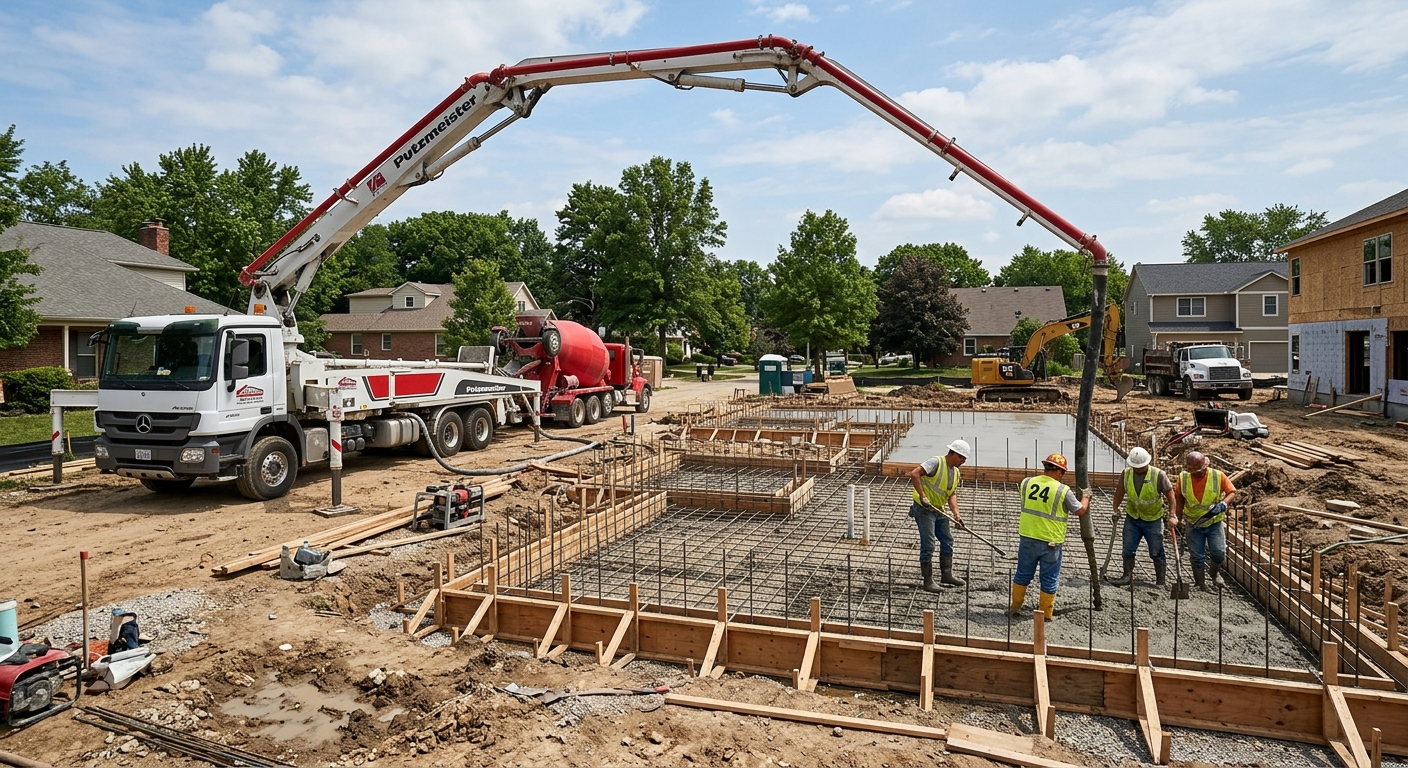
Concrete work options and costs in Ingersoll
In Ingersoll, concrete is one of the most practical upgrades for the 13,693 residents who rely on durable exterior surfaces through Southwestern Ontario winters. With 71.2% of dwellings being single-detached homes, most homeowners’ projects land on driveways, patios, walkways, garage slabs, and—when it’s time—foundation footings. The market is steady, and with 4,170 homeowner households (76.3% of households own), there’s consistent demand for new flatwork and replacement of older concrete.
In the London economic region, pricing is strongly shaped by frost depth requirements and freeze–thaw cycles. Footings for garages, additions, and heavier slabs typically need to extend below the local frost line to reduce frost heave and future settlement, which drives excavation depth, forming height, and concrete volume. For exterior flatwork, contractors commonly use air-entrained concrete mixes and pay close attention to base drainage and joint layout to manage thermal cracking. Scheduling also matters: colder nights can shorten the reliable pour season, and curing protection (blankets/heating in some cases) can add labour.
In Ingersoll’s north end and around the downtown core where streets are busier, tight access and municipal-style sidewalks/approaches can increase site prep time and truck coordination. That’s why it’s smart to compare options—not just total price—before you book a date. Below is a practical cost comparison to help you line up quotes and scope discussions.
| Application |
Typical Size |
Key Spec |
Finish Option |
Price Range |
| Concrete driveway (standard broom finish) |
300–500 sq ft |
4 in slab, compacted granular base, control joints |
Broom finish + curing |
$15,000–$25,000 |
| Exposed aggregate driveway |
300–500 sq ft |
Scrub/expose method, proper curing to avoid surface scaling |
Exposed aggregate finish |
$20,000–$32,000 |
| Stamped concrete driveway or patio |
200–450 sq ft |
Air-entrained mix for exterior durability |
Stamped pattern + release + seal |
$22,000–$40,000 |
| Plain concrete patio or walkway |
150–350 sq ft |
4 in typical thickness, compacted base, joints as needed |
Float/trowel or broom + light broom texture |
$12,000–$22,000 |
| Garage floor (interior slab) |
400–600 sq ft |
Vapour barrier + base prep, typical reinforcement |
Standard power float |
$18,000–$30,000 |
| Foundation footings (structural, below frost) |
Per perimeter length (varies) |
Excavation below design frost depth, structural concrete |
Structural finish (not decorative) |
$80,000–$140,000 |
Prices are estimates only and vary by project scope, site access and material selection.
What affects the price of concrete work in Ingersoll
In Ingersoll and across the London economic region, two contractors can quote the “same” driveway or footing and still land 30–50% apart. The biggest reason isn’t the concrete—it’s the groundwork and the specifications tied to frost, drainage, and durability. When you see different proposals, look for differences in excavation depth, granular base thickness, reinforcement, mix design (especially air-entrainment for exterior exposure), and how they plan joints and curing.
Here, frost depth and freeze–thaw cycles dictate the spec for almost every exterior concrete job. Footings for additions, garages, and heavier structural supports generally must extend below the design frost depth to prevent frost heave and structural movement; this increases excavation, forming, and concrete volume. On flatwork (driveways, patios, and walkways), exterior concrete should be air-entrained to better resist scaling and cracking as temperatures swing and moisture moves in and out of the slab. Colder regions also have a shorter reliable pour season, so winter protection—insulating blankets, controlled curing, and sometimes accelerators—can add labour and materials. Add de-icing salt, and sealing becomes more than cosmetic; it helps reduce surface deterioration and spalling risk.
In Ingersoll specifically, older housing stock (with 54.6% of homes built before 1981) often means mature landscaping, buried services, and constrained access—more time for saw cutting, removal, disposal, and rerouting. If your scope includes exposed aggregate or stamped work, pricing tends to move toward the mid-to-high end compared to standard broom-finish work (for example, patios/sidewalk-style pours often track within $12,000–$22,000 bands, while stamped options commonly fall into $22,000–$40,000). On the other hand, a straightforward interior slab may cost less because freeze–thaw and de-icing exposure are minimized.
| Price Factor |
Why It Matters |
Cost Impact |
| Frost line depth |
Determines footing depth and form height |
Higher excavation/structural concrete volume can add large cost swings |
| Site preparation |
Excavation, grading, compacted granular base |
More removal/haul and thicker base typically increases labour and material costs |
| Reinforcement |
Rebar or wire mesh requirement |
Proper steel placement can raise material costs but reduces future cracking |
| Mix design |
Air-entrainment and compressive strength spec |
Exterior-rated mixes cost more but are critical for freeze–thaw durability |
| Finish type |
Broom vs. stamped vs. exposed aggregate |
Decorative finishing adds labour, tooling, and sealing |
| Pour size and concrete truck access to site |
How far they must place/finish concrete |
Poor access can require extra labour or alternative methods |
| Cold-weather curing precautions |
Heating and blankets |
Protecting the pour in cool/damp conditions increases time and materials |
| Control joint pattern and sealing cost |
Manages cracking; protects surfaces from de-icing |
Tighter joint plan and sealing can add line items but improve longevity |
Permits & regulations in Ontario
In Ontario, the rule of thumb is that structural concrete typically needs municipal approval, while most decorative and flatwork pours are usually administrative-free—unless they affect grading or runoff. In Ingersoll, concrete work that does require a building permit typically includes footings, foundation walls, grade beams, and other structural elements tied to the building’s support system (especially where engineering is required). For concrete flatwork like driveways, patios, and walkways, permits are often not required when they’re staying within typical site conditions. However, you may need a check with the municipality if your project changes lot grading, increases impervious surface coverage beyond allowances, or affects drainage toward neighbours or public right-of-way.
How to verify your contractor in Ontario before work starts:
Step 1: Ask for their liability insurance certificate (COI). Confirm it’s active and that it lists your project address or general service area coverage appropriately.
Step 2: Confirm workplace coverage: request evidence of WSIB/WCB coverage. If a contractor says they’re “not required,” ask for the documentation they rely on.
Step 3: Check licensing/registry information through Ontario’s online business and contractor resources where applicable, and make sure the company name matches the quote and invoice.
Step 4: Ask for references on similar-scale work (especially exterior flatwork in Southwestern Ontario). In a freeze–thaw climate, the real proof is past projects with good drainage and joint sealing.
If anything in their paperwork is unclear, don’t proceed until it’s resolved—you’re paying for durability, not surprises.
Getting concrete right in Ingersoll's freeze-thaw climate
Concrete failures in Ingersoll almost always come back to water, freezing, and poor detailing. When moisture infiltrates and freezes within the slab or base, it can lead to cracking, scaling, and the dreaded spalling at the surface—especially once de-icing salt starts accelerating damage. To spec the job correctly for Southwestern Ontario conditions, start with five fundamentals: (1) base preparation, (2) mix design, (3) control joints, (4) curing, and (5) sealing.
Base preparation: require compacted granular sub-base to the depth suited to local soil and to achieve stable drainage (no soft spots, no ponding). (2) Mix design: for exterior flatwork, ask for air-entrained concrete with a target air content of 5–7% and a minimum 32 MPa compressive strength. (3) Control joints: request a joint spacing plan to manage shrinkage and thermal movement before random cracks appear. (4) Curing: protect the pour and allow at least 7 days of curing under proper conditions—cold nights and damp weather can compromise early strength gain. (5) Sealing: for driveways and patios, use a penetrating sealer applied about 28 days after the pour to help repel salt-laden meltwater and reduce surface deterioration.
Here’s a practical pricing example: if one quote for a patio is closer to $12,000–$22,000 but offers minimal base prep and no mention of air-entrainment, the “savings” can disappear quickly when you see premature surface scaling in the next winter cycle. A more complete spec may move you toward the upper band, but it’s usually cheaper than replacing a failed finish and redoing drainage and joints.
| Spec |
Why It Matters in Ingersoll |
What to Ask For |
Impact if Skipped |
| Compacted granular base (depth?) |
Prevents pumping/settlement and helps drainage during wet–freeze cycles |
Granular type and compacted thickness; confirm drainage grading |
Cracking, voids under slab, and uneven surface after freeze–thaw |
| Air-entrained concrete mix (target air %?) |
Resists freeze–thaw damage and reduces scaling/spalling risk |
Target air content of 5–7% for exterior flatwork |
Surface scaling and spalling in winter, especially with salt use |
| Compressive strength (MPa rating) |
Ensures durability and strength gain under local curing conditions |
Minimum 32 MPa and curing plan |
Higher risk of early cracking and reduced long-term performance |
| Control joints (spacing per ACI guidelines) |
Controls where cracks form as temperatures shift |
Planned joint spacing and sawing timing |
Random cracking and loss of aesthetic/structural integrity |
| Minimum 7-day curing period |
Cold/damp weather in Southwestern Ontario slows early strength development |
Curing method (blankets/heating if needed) |
Weaker surface, increased scaling and early deterioration |
| Penetrating sealer (when applied after cure) |
Reduces water/salt intrusion that drives spalling |
Penetrating sealer applied around 28 days post-pour |
Faster surface breakdown and more frequent maintenance |
How to choose a concrete work contractor in Ingersoll
Choosing the right concrete contractor in Ingersoll is mostly about verification and clarity. Start by confirming Ontario coverage and accountability: request proof of liability insurance (COI) and confirm the company has WSIB/WCB coverage for workers. If they can’t provide current paperwork, treat that as a serious risk. Next, ask how they manage freeze–thaw constraints: do they mention air-entrained exterior mixes, joint spacing, curing protection, and sealing?
Then get 2–3 itemised written quotes that break down labour and materials rather than one lump sum. A good quote will list excavation/base prep, reinforcement, concrete mix spec, finishing type (broom, stamped, exposed aggregate), curing/protection measures, saw-cut timing and joint sealing details. Also ask what’s included for cleanup and disposal, and whether permit pulling (if needed) is included or excluded.
Warranty matters. Ask for a workmanship warranty length and whether it’s limited to materials only or covers labour if issues appear. Also confirm product/manufacturer warranty coverage for any sealers or decorative systems and whether it’s transferable to future owners.
Payment schedule: never pay more than 10–15% upfront. Hold back a portion until substantial completion and final grading/joint cleanup are done. Finally, demand a start date and completion estimate in writing—cold snaps can shift schedules, but you should know the planned contingencies.
- Verify liability insurance COI is current and matches the contractor name on the quote.
- Confirm WSIB/WCB coverage for workers (ask for documentation, not verbal assurances).
- Ask for recent references in Southwestern Ontario for similar exterior freeze–thaw exposure.
- Request an itemised quote: excavation, granular base, steel, concrete spec, finishing, curing, and sealing.
- Check that air-entrainment is specified for exterior slabs and not just “standard concrete.”
- Confirm joint plan: spacing, saw-cut timing, and where joints land relative to doors/drive approaches.
- Ask how they protect the pour in cool nights (blankets/heating) to achieve proper early strength.
- Make sure drainage and slope are addressed so water doesn’t sit against foundation walls.
- Clarify what happens to removed concrete: hauling/disposal included or extra?
- Confirm reinforcement details: rebar vs mesh, placement depth, and lap/bend standards.
- Get a written warranty that covers workmanship, with terms stated clearly.
- Avoid quotes that don’t state thickness, mix strength, or curing steps—those are red flags.
Concrete red flags to watch for in Ingersoll: vague specs (“good mix” without air content), skipping or underdescribing base compaction, no mention of control joints or sealing schedule, pressure for large upfront payments, and workmanship photos that don’t show freeze–thaw longevity (staining/scaling after winters).
Frequently asked questions — concrete work in Ingersoll
What is air-entrained concrete and why does it matter here?
Air-entrained concrete is mixed with tiny, evenly distributed air bubbles that give freezing water places to expand. In Ingersoll and across Ontario, that matters because freeze–thaw cycling plus moisture movement can break down the surface over time. For exterior flatwork, contractors typically target about 5–7% air content to reduce scaling and the risk of spalling when de-icing salts are used in winter. When quotes don’t specify air-entrainment for driveways, patios, and walkways, you may see premature surface deterioration in the next few seasons even if the slab looks fine at first. A properly specified exterior pour may cost more up front, but it’s a key reason projects land in the mid-to-high end (for example, plain patios/sidewalk work often sits around $12,000–$22,000, while decorative work can move higher).
How do I prepare the base for a concrete slab?
Base preparation starts with excavation to the designed depth, then grading the sub-base so water can drain away from structures. In Ingersoll’s freeze–thaw climate, contractors should compact a well-graded granular base in lifts to avoid soft spots that later “pump” under the slab. You want the thickness and type of granular specified in the quote, not just “topsoil removed.” The next step is verifying subgrade stability and drainage—especially near garages, front approaches, and any areas with existing landscaping. If your site has mature soil or prior fill, ask how they’ll address variable compaction. Good base prep is one of the biggest reasons quotes differ by 30–50% in the London area, and it’s also where you prevent future cracking and uneven surfaces.
How do I compare concrete quotes?
Compare quotes like an inspector: thickness, mix design, reinforcement, base prep, joints, curing, and sealing should all be stated. Ask each contractor for an itemised labour/material breakdown and confirm exterior pours include air-entrainment and appropriate strength (commonly 32 MPa minimum for performance specs). For control joints, make sure the plan includes spacing and saw-cut timing—this affects where shrinkage cracks appear. Also check what’s included for hauling and disposal of removed concrete, and whether any winter protection is planned for cool/damp periods. In Ingersoll, the London market often prices toward the mid-to-high range for exterior work; if one quote is far below others (especially compared to typical bands like $15,000–$25,000 for standard driveways), ask what they’re reducing—base depth, reinforcement, curing, or mix quality. The lowest number isn’t always the lowest cost.
Can concrete be poured in cold weather in Ingersoll?
Concrete can be poured in cool weather, but it needs protection so it achieves early strength. In Ingersoll, nights can get cold and Southwestern Ontario weather can be damp, which slows curing and increases risk. The contractor should plan cold-weather curing precautions such as insulated blankets, wind protection, and in some cases heating methods or approved admixtures to help the mix maintain workable temperature. The key is protecting the slab during the early curing window so you reach strength before freeze events occur. Ask the contractor to outline their cold-weather plan in writing: how they’ll monitor temperature, how long blankets/heating will run, and how curing timing will be managed for exterior flatwork and decorative finishes. If they can’t explain those steps, it’s a sign the pour may not be controlled for Ingersoll’s freeze–thaw exposure.
How do I maintain concrete in Ingersoll's freeze-thaw climate?
Maintenance in Ingersoll is mostly about keeping water out and managing de-icing salt exposure. For exterior slabs, plan for a penetrating sealer once the concrete has cured (often around 28 days post-pour). This helps reduce salt-laden meltwater penetration that drives spalling and surface scaling. Sweep debris off the surface and avoid letting water pond in low spots. If you see small cracks, don’t ignore them—ask about appropriate repair methods to stop moisture migration before freeze expansion enlarges the damage. During winter, use de-icers carefully and avoid over-salting; always follow product directions. If you’re replacing a driveway in a neighbourhood where traffic is busy (like parts near the downtown core), early maintenance and prompt sealing can also reduce staining and speed up safe use. With the right preventive steps, concrete should hold up much better through repeated freeze–thaw cycles.
What causes concrete to spall in Ingersoll winters?
Spalling is when the surface layer breaks off, and it’s usually driven by moisture entering the concrete and freezing repeatedly. In Ingersoll’s winters, this gets worse with de-icing salts that increase water availability at the surface. The biggest technical cause is inadequate air-entrainment or improper curing—when the freeze–thaw resistance isn’t built into the mix, the outer paste and near-surface aggregates are more vulnerable. Poor base drainage and joints can also let water migrate into the slab, concentrating damage. Finally, delayed sealing (or skipping sealing on exterior slabs exposed to salt) can leave the surface more permeable. If you’re comparing bids, ask directly: is exterior concrete specified with air-entrainment (target about 5–7%), what curing protection is planned during cool nights, and when will sealer be applied? Those details are what separate long-lasting pours from ones that show spalling after the first few freeze–thaw cycles.