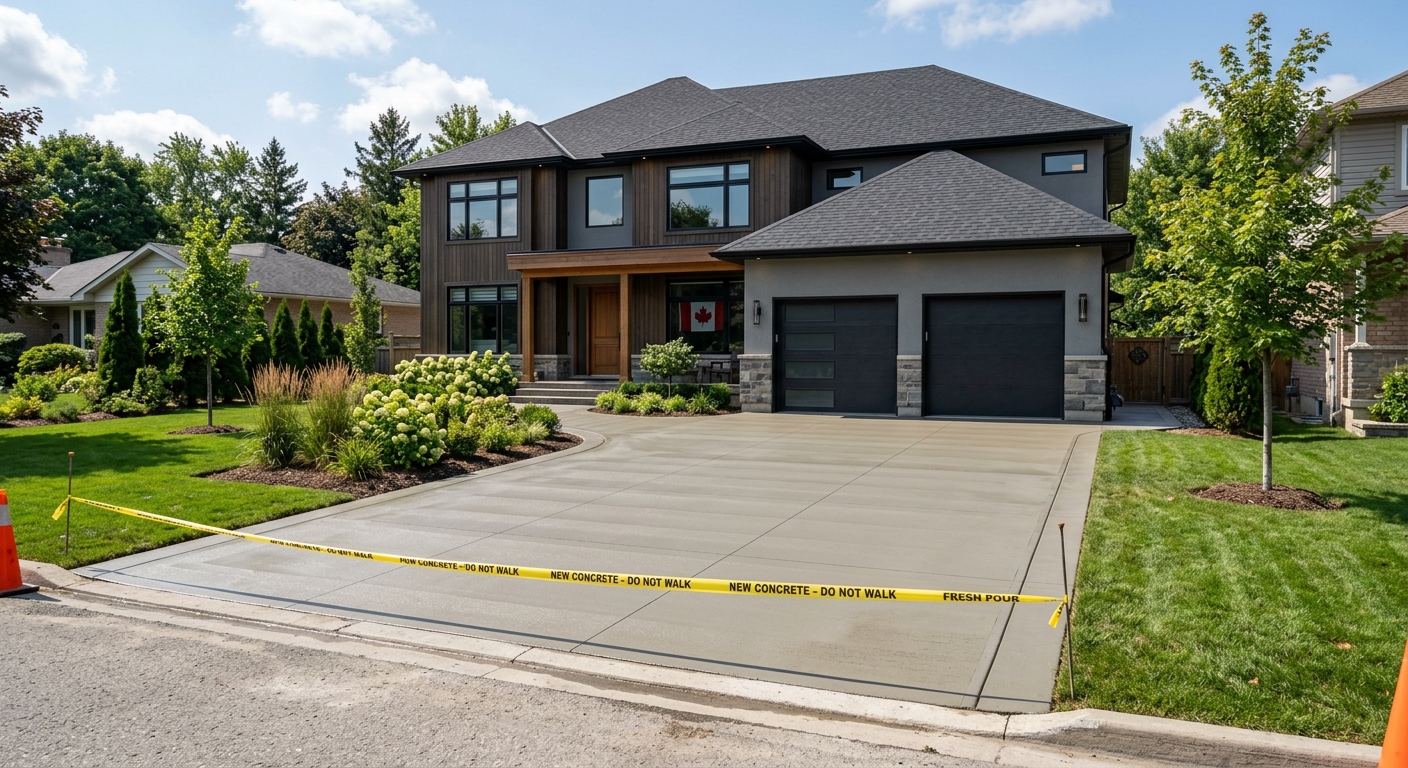
Concrete work options and costs in Morningside
Morningside is a popular part of the Toronto area for homeowners who want durable driveways, patios and walkways—and concrete is usually the go-to because it handles heavy use and the region’s harsh freeze–thaw seasons. With a population of 17,455 (Statistics Canada, 2021 Census), there’s steady demand for exterior flatwork, especially in family neighbourhood pockets where renovations and new builds are common. Toronto’s housing mix also matters: many lots are served by detached and semi-detached homes that place more stress on front entrances and garage approaches—areas that see salt, ploughing and repeated temperature swings. That combination influences both material specs and labour availability, which is why two quotes for the “same size” job can still land far apart.
In the Toronto economic region, pricing is strongly shaped by frost depth and freeze–thaw cycles. Ontario building practice typically requires structural footings to extend about 1.2 m (roughly 4 ft) below grade to help prevent frost heave and differential movement. Exterior slabs and driveways also need air-entrained concrete, proper drainage and a well-compacted granular base so saturated soils don’t expand and contract against the finished surface every winter. Most exterior pours are concentrated in warmer months to support proper curing; when temperatures drift toward 10 °C or below, contractors often add cold-weather protection, which increases cost.
If you’re in the West Morningside area (near Meadowvale-style access corridors and busier arterial roads), concrete crews often see higher scheduling demand because multiple homes start projects around the same time. Below is a practical comparison of common options and typical Toronto-area pricing to help you plan your budget, then we’ll break down the cost drivers.
| Application |
Typical Size |
Key Spec |
Finish Option |
Price Range |
| Concrete driveway (standard broom finish) |
400–600 sq. ft. |
Air-entrained mix, compacted granular base, drainage |
Broom finish + control joints |
$8,000–$15,000 |
| Exposed aggregate driveway |
400–600 sq. ft. |
Air-entrained mix, base prep, proper curing |
Exposed aggregate with sealer |
$11,000–$18,000 |
| Stamped concrete driveway or patio |
300–600 sq. ft. |
Air-entrained mix, reinforcement as needed |
Stamp pattern + integral or applied colour |
$10,000–$22,000 |
| Plain concrete patio or walkway |
200–400 sq. ft. |
Air-entrained mix, compacted base |
Smooth or broom finish + light broom edges |
$3,500–$9,000 |
| Garage floor (interior slab) |
300–500 sq. ft. |
Vapour control as needed, reinforced slab option |
Standard trowel finish + cure |
$6,000–$12,000 |
| Foundation footings (structural, below frost) |
Per linear foot (typical home) |
Concrete placement below frost depth + forming |
Typically formed/structural finish only |
$180–$300 |
Prices are estimates only and vary by project scope, site access and material selection.
What affects the price of concrete work in Morningside
In Morningside and across the Toronto economic region, it’s common to see the same concrete scope quoted 30–50% apart. The “why” usually comes down to specs that are driven by frost depth and freeze–thaw cycles, plus the amount of careful base work and curing protection a crew is willing to provide. For structural footings, Ontario practice commonly requires depths down to at least about 1.2 m (so the foundation system isn’t fighting frost heave). For exterior flatwork, contractors typically add air-entrainment and plan control joints to manage cracking. When temperatures drop toward 10 °C or below, curing and protection requirements increase, and that’s a cost driver even if the slab thickness looks unchanged on paper.
Two examples show how the local conditions change the final number. First, a driveway poured with proper granular base and drainage typically costs within the regional flatwork bands (driveway concrete often lands around $18–$28 per sq. ft.). If the same driveway is quoted with “minimum base” or unclear drainage, the contractor may look cheaper initially, but you’re more likely to see scaling, spalling or early surface deterioration when Ontario’s wet fall and spring conditions saturate the soil and then freeze. Second, stamped and decorative work costs more (often $24–$40 per sq. ft. for patterned finishes) because it requires tighter process control: colour consistency, stamp timing, and more labour-intensive finishing.
In older Morningside housing pockets, you may also run into deeper excavation, buried downspouts, or uneven subgrades. That added prep can push labour and disposal costs up. Conversely, a newer lot with easier access and clean grading can keep your project closer to the mid-range of $16–$26 per sq. ft. for patios and walkways—especially when the pour schedule stays in the warmer window.
| Price Factor |
Why It Matters |
Cost Impact |
| Frost line depth — determines footing depth and form height |
Controls how far below grade the concrete must extend to reduce frost heave risk |
Large variation based on required excavation and forming; can swing totals materially |
| Site preparation — excavation, grading, compacted granular base |
Frozen/saturated soils move; the base and drainage keep the slab stable |
Often adds the biggest “hidden” cost on difficult or uneven lots |
| Reinforcement — rebar or wire mesh requirement |
Helps control cracking and supports heavier loading |
Materials + labour; modest cost increase but improves performance |
| Mix design — air-entrainment and compressive strength spec |
Air helps concrete resist freeze–thaw damage in Ontario winters |
Can raise material cost but reduces premature spalling/scaling |
| Finish type — broom vs. stamped vs. exposed aggregate |
More complex finishes require extra labour and stricter timing |
Stamped/exposed generally adds a meaningful premium |
| Pour size and concrete truck access to site |
Access affects pump needs, truck fees, and staging time |
Poor access can add truck/pump and labour charges |
| Cold-weather curing precautions — heating and blankets |
Supports proper strength gain when temperatures fall toward 10 °C or lower |
Adds protection equipment and crew time during shoulder seasons |
| Control joint pattern and sealing cost |
Joints limit random cracking; sealing helps repel de-icing salts |
Typically mid-range cost, but important for longevity |
Permits & regulations in Ontario
In Ontario, structural concrete work—such as foundation footings, foundation walls, and grade beams—usually requires a building permit, and many projects also involve engineered drawings that the municipality reviews. Concrete flatwork (patios, walkways and many driveways) typically does not require a permit by default, but it can be required when the work affects lot grading, changes drainage patterns, or triggers municipal rules around impervious surface coverage or municipal right-of-way conditions. In Morningside, the practical takeaway is simple: if your driveway project changes how water flows, if you’re altering catch basins/downspout discharge, or if it impacts permit-triggering grading, assume you’ll need to confirm requirements before breaking ground.
For contractor due diligence, verify three things up front: (1) liability insurance, (2) WSIB/WCB coverage (where applicable), and (3) references from similar-scale Ontario projects. Then confirm licensing/eligibility through the correct provincial channels for the work being performed (many concrete contractors operate under trade classifications rather than a single “concrete licence” label). Ask the contractor for certificates of insurance—commonly a COI showing active coverage—and, if they use subcontractors, ask for their coverage details as well.
Step-by-step homeowner checklist: start by requesting the COI and WCB/clearance documentation, then check the contractor’s registry status online, verify the clearance letter matches the legal name on the invoice, and finally review project photos with timelines that match Ontario conditions (exterior work planned for curing windows and freeze–thaw management).
Getting concrete right in Morningside's freeze-thaw climate
Concrete in Morningside most often fails for predictable reasons: saturated base layers freeze and thaw, water gets under the slab edges, and de-icing salts accelerate scaling when the surface isn’t protected. In a Toronto-area freeze–thaw pattern, the strongest protection is the whole system: base prep, mix design, joints, curing and sealing. If any single piece is skipped—especially air-entrainment—you can get spalling and surface breakdown even when the concrete “looks fine” for the first season.
To spec the job correctly, start with base preparation: compacted granular sub-base to a depth that matches local subgrade conditions and frost sensitivity. Next, insist on an air-entrained exterior mix—typically about 5–7% air content for durable freeze–thaw performance—and a minimum compressive strength rating of 32 MPa for exterior structural flatwork. Third, plan control joints with a spacing pattern that limits random cracking. Fourth, curing matters: aim for at least 7 days of proper curing under suitable conditions, and if pours happen near cooler weather, ask about cold-weather blankets or other protection. Fifth, sealing: plan for a penetrating sealer applied 28 days after the pour to help repel de-icing salt intrusion.
Here’s a real-world cost perspective. If your driveway option is broom-finished standard concrete, budgeting around the local $18–$28 per sq. ft. band keeps things predictable. Switching to stamped concrete can move you toward the $24–$40 per sq. ft. range, which is justified when you want appearance plus the contractor’s ability to keep consistent stamp timing and curing. But in both cases, air-entrainment, base compaction and control joints are non-negotiable—those are what prevent Ontario’s freeze–thaw cycle from turning small imperfections into repairs.
| Spec |
Why It Matters in Morningside |
What to Ask For |
Impact if Skipped |
| Compacted granular base (depth?) |
Stable, well-drained support reduces movement during freeze–thaw |
Granular type and compacted depth, plus how drainage will be handled |
Settlement, edge heaving and early cracking |
| Air-entrained concrete mix (target air %?) |
Air void system protects against freeze–thaw damage in humid Ontario winters |
Target air content (commonly 5–7% for exterior flatwork) |
Higher risk of spalling and scaling |
| Compressive strength (MPa rating) |
Strength gain supports long-term durability and load resistance |
Minimum 32 MPa rating (or higher where required) |
Surface wear, cracking and reduced lifespan |
| Control joints (spacing per ACI guidelines) |
Manages shrinkage cracking so cracks occur where you intended |
Joint spacing plan and cutting/grout timing |
Random cracks and moisture pathways |
| Minimum 7-day curing period |
Proper curing helps concrete reach strength before it’s exposed to winter stress |
How curing will be protected; what happens if temperatures drop |
Weaker concrete and higher chance of scaling/spalling |
| Penetrating sealer (when applied after cure) |
Helps repel de-icing salts and slows moisture ingress |
Sealer type and application at 28 days post-pour (typical) |
Faster surface deterioration in winter |
How to choose a concrete work contractor in Morningside
Choosing the right contractor in Morningside is mostly about verifying proof—not just promises. Start with Ontario due diligence: request their liability insurance certificate (COI) and confirm WSIB/WCB coverage or a current clearance letter where applicable. Then verify the contractor’s registration/eligibility through the correct Ontario registry resources for their business status. If they’re using subcontractors for excavation, rebar installation or hauling, ask for those subcontractors’ coverage details as well.
Next, get 2–3 itemised written quotes. Ideally you’ll see labour and materials separated, including excavation, base material, reinforcement, concrete supply, finishing, saw-cutting/control joints and sealing. Avoid “lump sum only” quotes that don’t say what’s included. Read the scope for exclusions: is permit pulling included where required, is disposal/hauling of excess soil included, and are protection measures for lawns/driveways part of the price? A reputable crew will be clear about traffic management and concrete truck access planning.
Warranty matters too. Ask for a workmanship warranty length (and what it covers—cracks from shrinkage vs. workmanship defects), the product/manufacturer warranty (if any), and whether it’s transferable if you sell the home. For payment schedule, never pay more than 10–15% upfront; hold back a portion until the final walk-through confirms curing protection, joint finishing and sealing where included. Finally, insist on a start date and completion estimate in writing, since exterior pours in the GTA often shift with weather and curing windows.
- COI provided with active policy dates and legal business name match
- WSIB/WCB clearance or coverage documentation available on request
- Itemised quote showing base prep, reinforcement, finishing and concrete supply
- Explicit scope for drainage and grading tie-ins (downspouts/catch basins)
- Concrete mix specified as air-entrained for exterior work
- Control joint pattern and who supplies/cuts/finishes them
- Curing plan described (especially if temperatures drop toward 10 °C)
- Sealing included (or scheduled) and when it will be applied
- Proof of similar GTA projects in winter/spring freeze–thaw conditions
- Written start date, pour date, and estimated completion timeline
- Clear protection plan for landscaping and site cleanup
- Payment schedule: small deposit, holdback until completion and punch list
Concrete contractor red flags in Morningside: quoting “cheap concrete” without air-entrainment details, skipping or vague language on granular base depth and compaction, promising no cracking with control joints removed or reduced, refusing to provide COI/WSIB documentation, and asking for most payment upfront without a staged plan tied to completion.
Frequently asked questions — concrete work in Morningside
How long does a concrete driveway last?
In Morningside, a properly built concrete driveway commonly lasts 20–30 years, sometimes longer, because the main wear mechanism isn’t just traffic—it’s Ontario’s repeated freeze–thaw cycle and de-icing salt exposure. The biggest durability drivers are air-entrained concrete for exterior flatwork, correct granular base compaction, proper drainage at the edges, and a joint pattern that controls shrinkage cracking. Sealing (typically around 28 days post-pour) can also reduce moisture and salt intrusion. If a contractor cuts corners on base prep or uses the wrong mix without air content, you can see scaling and spalling much earlier. Budgeting within the local driveway concrete bands (often $18–$28 per sq. ft.) helps ensure you’re paying for the right system, not just the slab.
What is air-entrained concrete and why does it matter here?
Air-entrained concrete is mixed with tiny, evenly distributed air bubbles that act like pressure relief during freezing. In Ontario’s humid conditions, water in and around the slab expands when temperatures drop, and the air void system reduces the internal pressure that otherwise leads to scaling and spalling. For exterior flatwork in the Toronto area, contractors typically target about 5–7% air content and pair it with proper curing and joint layout. Without it, even a thick slab can deteriorate on the surface after one or two winters, especially if de-icing salts are used. When you compare quotes in Morningside, ask directly: “Is the concrete air-entrained for exterior exposure, and what’s the target air content?”
How do I prepare the base for a concrete slab?
The base is what keeps concrete from moving when soil freezes and thaws. Preparation usually means excavating to remove organic material, grading for proper slope, and installing a compacted granular sub-base sized to your frost sensitivity and local subgrade. In Morningside-area projects, you should expect a clear plan for compaction testing and for drainage so water doesn’t pond against the slab edges. If your lot has soft or saturated areas, base depth and material selection may need to increase. A contractor should also specify whether reinforcement is required and how it will sit at the right cover depth. If a quote is silent about granular base depth and compaction, that’s a major omission—one that can cost you later in repairs.
How do I compare concrete quotes?
Start by comparing apples-to-apples: scope, thickness, reinforcement, base preparation and finish. In Morningside, quotes can differ 30–50% because some include proper granular base and drainage, while others only price the concrete pour. Ask for an itemised breakdown (labour + materials) that covers excavation, compacted base, reinforcement (rebar or mesh where needed), concrete supply with air-entrainment for exterior use, saw-cut control joints, finishing, curing protection, and sealing if included. Confirm whether disposal/hauling is included and whether the quote covers protection for existing landscaping. Use your budget bands as a reality check—for example, patios and walkways often sit around $16–$26 per sq. ft., while stamped finishes frequently cost more. If a quote is far below the band with unclear specs, treat it as a risk.
Can concrete be poured in cold weather in Morningside?
Yes, concrete can be poured in cold weather in Morningside, but it requires cold-weather curing precautions and careful scheduling. Once temperatures drop toward 10 °C or below, concrete can take longer to gain strength, and it’s more vulnerable to freezing before it reaches adequate early strength. Reputable Toronto-area contractors address this with heaters, insulated blankets, and protection of the pour so curing is maintained long enough to perform. That added labour and equipment is why cold-weather pours typically cost more. Ask your contractor for their cold-weather method and how they’ll protect forms, joints and the surface during the first days. If your quote doesn’t mention curing blankets/heating and “minimum protection time,” it’s not a complete plan for Ontario’s winter edge conditions.
How do I maintain concrete in Morningside's freeze-thaw climate?
Maintenance is about keeping water and salt from attacking the surface. First, seal the concrete if it isn’t already protected—commonly with a penetrating sealer applied about 28 days after the pour. Second, during winter, use de-icing practices that reduce salt exposure where possible, and avoid letting large piles sit on the slab for long periods. Third, repair small cracks early to stop water from entering and freezing under the surface. Keep the surface clean so drainage isn’t blocked by debris around edges and joints. Finally, for flatwork built for Ontario’s freeze–thaw cycles, respect the joint layout—don’t caulk joints immediately after a pour unless the contractor specifies an approved method and timing. If your driveway was priced in the local range (often $18–$28 per sq. ft.), proper sealing and joint maintenance are what keep that performance going season after season.