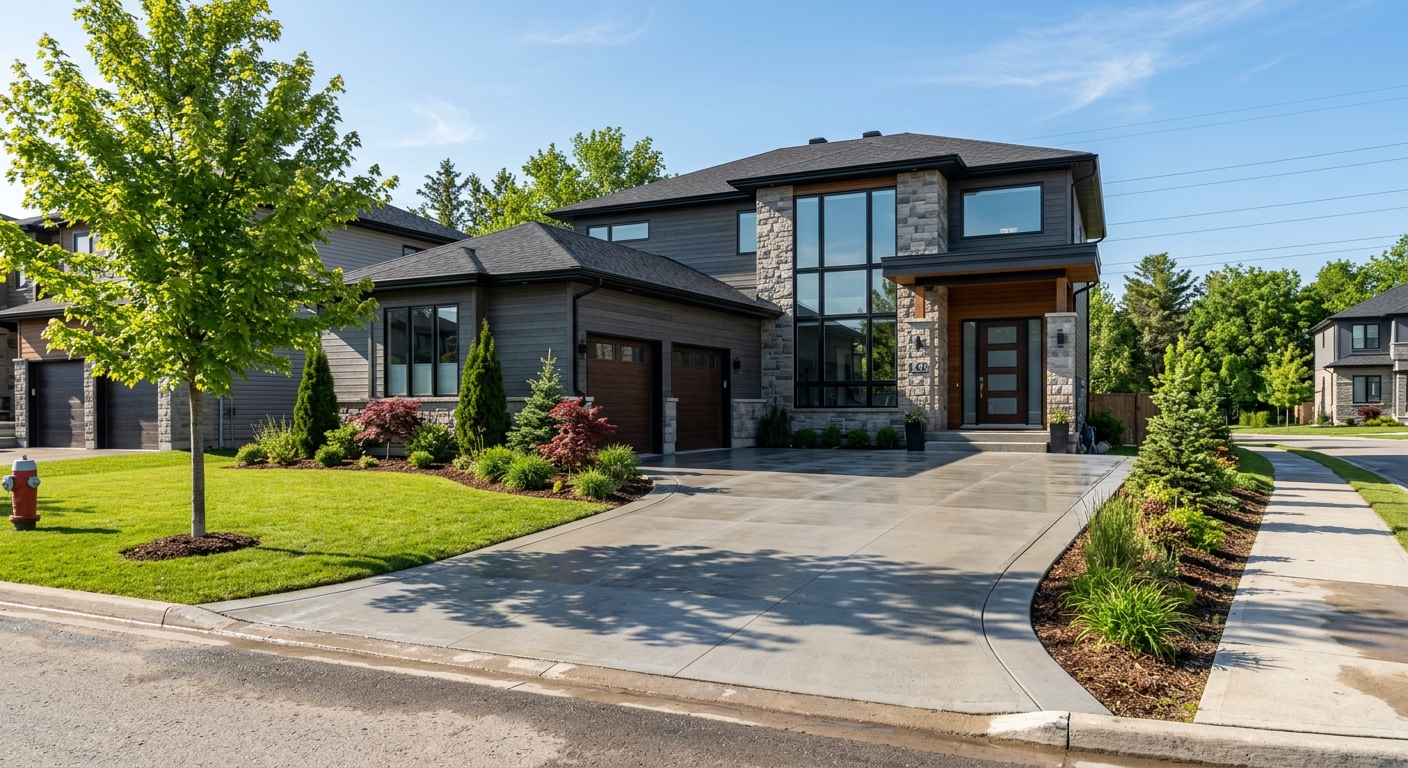
Concrete work options and costs in Brussels
In Brussels, Ontario, most homeowners start with practical concrete upgrades—driveways, patios and walkways—because they take daily wear and also face the worst of our freeze–thaw swings. The town’s population is small (1,158 residents per the Statistics Canada, 2021 Census), but that usually means quotes depend on local scheduling and the availability of crews that can handle the seasonal pour window. In the broader Toronto economic region, concrete contractors stay busy serving a housing stock that’s dominated by single-detached homes, which is exactly the type of property that needs long-lasting exterior flatwork.
Toronto-area concrete costs are shaped less by “style” and more by frost protection and curing management. For structural work, Ontario practice generally requires footings to extend at least 1.2 m below grade (below the design frost depth) to reduce frost heave risk. For exterior slabs, crews typically specify air-entrained mixes and well-compacted granular base so saturated soils don’t pump during winter. Even a driveway poured in late fall can cost more if cold-weather protection (insulating blankets or supplemental heating) is needed to keep curing on track.
In and around the residential corridors close to Downtown Brussels and the surrounding farm-supply roads, demand is especially high in spring as homeowners reopen projects paused over winter. Use the table below to compare the most common options and realistic budget ranges, then we’ll break down what pushes quotes up or down.
| Application |
Typical Size |
Key Spec |
Finish Option |
Price Range |
| Concrete driveway (standard broom finish) |
16 ft x 24 ft (384 sq. ft.) |
Air-entrained exterior mix, compacted granular base |
Broom finish, edging + control joints |
$18,000–$28,000 |
| Exposed aggregate driveway |
16 ft x 24 ft (384 sq. ft.) |
Air-entrained mix, proper curing to protect surface |
Exposed aggregate with sealer |
$24,000–$36,000 |
| Stamped concrete driveway or patio |
12 ft x 20 ft (240 sq. ft.) |
Air-entrained mix, thickness matched to use |
Stamp patterns + integral colour |
$24,000–$40,000 |
| Plain concrete patio or walkway |
10 ft x 16 ft (160 sq. ft.) |
Compacted base, control joints where needed |
Float/screed with light broom finish |
$2,600–$4,200 |
| Garage floor (interior slab) |
20 ft x 22 ft (440 sq. ft.) |
Vapour barrier (where required), reinforcement as needed |
Power-trowel or broom finish |
$7,200–$13,500 |
| Foundation footings (structural, below frost) |
Typical 1-storey footing package |
Excavation, forms, rebar, concrete to required depth |
Engineered structural concrete |
$180,000–$300,000 |
Prices are estimates only and vary by project scope, site access and material selection.
What affects the price of concrete work in Brussels
In the Toronto region, it’s common to see quotes for the “same” concrete project vary by 30–50% because the real work isn’t the pour—it’s the prep, specifications, and how crews protect the concrete while it cures. Contractors budget differently for frost-related excavation, base compaction, reinforcement, and cold-weather handling. Add to that the fact that exterior concrete in Ontario needs air-entrainment to manage freeze–thaw stress, and you can see why two driveways with the same square footage can price very differently.
Ontario climate and frost depth drive the first cost jump: footings must extend below the design frost depth to prevent frost heave and differential movement. For exterior slabs, repeated freeze–thaw requires air-entrained mixes (commonly targeting around 5–7% air) and a properly drained, compacted granular base. When temperatures trend toward 10 °C or below, contractors often need cold-weather curing precautions—insulating blankets and sometimes temporary heat—so the concrete reaches the minimum strength at the right pace. De-icing salt also accelerates spalling, which is why sealing is frequently recommended for long-term durability.
In Brussels, small site factors can meaningfully move the needle. For example, limited truck access or a narrow driveway may add labour for moving concrete and managing placement. Older properties with heavier clay can require deeper base replacement; that can shift a plain patio from the $16,000–$26,000 style band into a higher range once extra granular and drainage are included. Conversely, a straightforward walkway on stable, well-draining soil with easy access may stay closer to the lower end, while a stamped driveway priced in the $24,000–$40,000 range is usually justified by formwork complexity, decorative finishing labour, and added surface protection.
| Price Factor |
Why It Matters |
Cost Impact |
| Frost line depth |
Determines footing depth and form height |
More excavation and concrete volume; can move structural jobs up quickly |
| Site preparation |
Excavation, grading, compacted granular base |
Heavier soils or poor drainage add base replacement and compaction labour |
| Reinforcement |
Rebar or wire mesh requirement |
Material + placement time; required when loads or structural specs demand it |
| Mix design |
Air-entrainment and compressive strength spec |
Exterior durability specs typically increase material cost |
| Finish type |
Broom vs. stamped vs. exposed aggregate |
Decorative finishes add labour, materials, and cure/sealer coordination |
| Pour size and concrete truck access to site |
Placement speed and handling |
Long walks, tight turns, or limited access can add manpower and scheduling |
| Cold-weather curing precautions |
Heating and blankets |
Extra labour and materials; often required when temperatures drop |
| Control joint pattern and sealing cost |
Crack control and surface protection against salt |
More layout/time and sealer product; reduces long-term surface damage |
Permits & regulations in Ontario
In Ontario, structural concrete work is typically the part that requires the most oversight. For Brussels homeowners, footing and foundation elements—such as foundation footings, foundation walls, and grade beams (and any work that supports the building structure)—usually require a building permit, and engineered drawings are commonly reviewed by the municipality depending on the scope. Concrete flatwork like patios, walkways and driveways typically does not require a permit unless it affects lot grading, impervious surface coverage limits, or the municipal right-of-way (for example, drainage changes or work close to property lines). Always confirm details with the local authority before breaking ground.
Before you sign, verify the contractor has proper coverage and documentation. Ask for (1) liability insurance with an active certificate of insurance naming you as the property owner when needed, and (2) confirmation of WSIB/WCB coverage for workers. Then verify licensing status through Ontario’s public resources: check the contractor’s business information online, and request the clearance letter or proof they are in good standing (the exact paperwork varies by contractor type, but the certificate of insurance and WSIB/WCB confirmation are the essentials).
Step-by-step in plain terms: ask for their permit responsibility in writing, request insurance + WSIB/WCB proof, confirm they’ve done similar footing/foundation packages, and check that their quote includes any required inspections or documentation. If the contractor can’t clearly explain what requires a permit and who pulls it, treat that as a red flag.
Getting concrete right in Brussels's freeze-thaw climate
Concrete failures in Brussels usually trace back to one theme: water and temperature work together against the slab. Freeze–thaw cycles pull moisture in and out of the concrete and the base, which can lead to scaling and spalling—especially if the mix isn’t properly air-entrained, if the base isn’t compacted, or if the slab cures too cold/too fast. The fix is not just “stronger concrete”; it’s a complete spec: base preparation, correct mix design, controlled cracking, proper curing, and sealing.
Start with the base. Exterior slabs should sit on a compacted granular sub-base sized for local soil conditions and frost protection, with drainage that prevents standing water. Next, mix design: for exterior flatwork, air-entrained concrete is critical; a typical target is 5–7% air, paired with a minimum 32 MPa compressive strength so the slab can resist winter stress. Control joints matter because no slab is crack-proof—joints are where you want cracks to happen. Curing is equally important: plan for a minimum 7-day cure under suitable conditions, and when temperatures are low, cold-weather protection (blankets/heating) is often necessary to reach adequate early strength. Finally, sealing is a practical defence against de-icing salt; penetrating sealer is typically applied after the cure window—commonly around 28 days post-pour—so salts don’t rapidly degrade the surface.
Budget-wise, the difference between finishing options can be justified. For instance, a broom-finished patio on a basic base may land near $16,000–$26,000 (depending on size and access), while a stamped concrete patio often costs more due to labour and curing/finishing complexity—closer to the $24,000–$40,000 band. If a quote underprices air-entrainment or skips sealing, you’re paying later through surface damage and early repairs.
| Spec |
Why It Matters in Brussels |
What to Ask For |
Impact if Skipped |
| Compacted granular base (depth?) |
Reduces pumping during freeze–thaw and supports slab evenly |
Base depth and compaction requirements; drainage plan |
Settlement, uneven cracking, premature failure |
| Air-entrained concrete mix (target air %?) |
Protects against scaling and spalling from repeated freeze–thaw |
Air content target (commonly 5–7% for exterior flatwork) |
Surface spalling, scaling, faster deterioration |
| Compressive strength (MPa rating) |
Ensures enough durability and strength through winter stress |
Minimum 32 MPa (or higher if specified) |
Lower resistance to abrasion and freeze-related damage |
| Control joints (spacing per ACI guidelines) |
Controls where shrinkage cracks happen |
Joint spacing plan and saw-cut timing |
Random cracking and water entry into slab edges |
| Minimum 7-day curing period |
Develops early strength before winter exposure |
How they cure in cool weather; curing duration and protection |
Weak surface, higher chance of cracking and scaling |
| Penetrating sealer (when applied after cure) |
Repels de-icing salts and reduces moisture uptake |
Sealer type and application timing (typically around 28 days) |
Faster spalling and staining, shorter service life |
How to choose a concrete work contractor in Brussels
Choosing a contractor in Brussels (and the wider Ontario market) is mostly about verification and clarity. First, confirm Ontario compliance basics. Ask for the contractor’s liability insurance certificate (active coverage) and verify worker coverage through WSIB/WCB documentation. Then, check their business information and status using Ontario’s public resources available for contractor/business verification. Don’t rely on a verbal assurance—request the documents and keep copies for your records.
Next, get 2–3 itemised written quotes rather than one lump sum. You want a breakdown that separates labour from materials, includes excavation and base preparation, and states concrete specifications (including air-entrained mix and curing approach). Confirm what’s included: permit pull (if required for structural work), site protection, disposal of excavated material, saw-cutting and sealing schedule, and whether truck access or pumping is accounted for.
Review warranty terms. A solid workmanship warranty (length and what it covers) should be in writing, and you should also understand whether product/manufacturer warranties apply to sealer or materials used. Ask whether warranties are transferable if you sell the property. For payment, never pay more than 10–15% upfront; hold back a portion until completion and close-out documents are provided. Finally, require a written start date and completion estimate—winter scheduling and curing protection can affect the timeline in Ontario.
- Request proof of liability insurance and WSIB/WCB coverage before work starts.
- Confirm whether a permit is required for the specific scope you’re doing (footings vs. flatwork).
- Get quotes that include excavation depth, base thickness, and compaction notes.
- Require the concrete spec: air-entrainment target and minimum strength (e.g., 32 MPa).
- Ask about reinforcement: where wire mesh/rebar is used and where it isn’t.
- Check whether control joints and saw-cut timing are included in the quote.
- Ask about cold-weather curing plan if pours are near October/November.
- Confirm sealing is included or separately quoted (and when it’s applied).
- Ensure disposal and grading adjustments are clearly stated.
- Verify truck access/pumping plan and whether hose/pump costs are included.
- Review warranty duration and claim procedure in writing.
- Use a payment schedule with a holdback until cleanup, finishes, and cure/seal steps are done.
Red flags I see too often in Brussels concrete projects: quotes that skip air-entrainment details, vague curing promises (especially for fall pours), no mention of control joints, “cheap” pricing that doesn’t include base prep or compaction testing, and contractors who won’t provide insurance/WSIB/WCB documentation up front.
Frequently asked questions — concrete work in Brussels
How do I maintain concrete in Brussels's freeze-thaw climate?
For Brussels and the rest of Ontario, maintenance is mostly about managing water and de-icing salts. Sweep grit and sand regularly so you’re not grinding abrasive particles into the surface. Try to reduce salt use where possible; even when concrete is air-entrained, heavy salt can accelerate surface spalling over time. Keep an eye on drainage—if water pools near edges, that moisture cycle will stress the slab and base. Reapply penetrating sealer when it begins to lose water repellency (many homeowners do this on a practical cycle rather than waiting for visible damage). If you notice small chips or hairline cracks, patch them early so water can’t migrate and expand during freeze–thaw. For exterior flatwork, a well-done seal after cure (often around 28 days) is one of the best protections you can build into the job.
What causes concrete to spall in Brussels winters?
Concrete spalling in Brussels winters is most commonly caused by freeze–thaw stress plus moisture and salt. If the concrete mix isn’t properly air-entrained, the freeze cycles create internal pressure that chips off the surface. Even with air-entrainment, poor base preparation or poor drainage can keep the slab saturated, raising the damage risk. Over-salting in winter adds another layer: salts increase moisture movement at the surface and can worsen scaling/spalling. Curing also matters—if the slab is poured in cool weather without adequate protection, early strength may not develop properly, which can make the surface more vulnerable. That’s why reputable Ontario contractors specify exterior air content, adequate curing time (minimum 7 days), and often penetrating sealer after cure to repel de-icing salts.
What is rebar and when is it required in Ontario?
Rebar is steel reinforcement bars placed inside concrete to improve tensile strength and control cracking—concrete is strong in compression but weak in tension. In Ontario, whether rebar is required depends on the design load, slab thickness, soil conditions, and whether the element is structural. For foundations and many structural components like grade beams, rebar is often part of the engineered design and is typically included in the permit/inspection scope. For exterior flatwork like driveways, reinforcement may be specified depending on thickness, support, and traffic loads; some slabs use wire mesh, fibre reinforcement, or traditional rebar based on the contractor’s design and your exposure to freeze–thaw. The key for homeowners is to ask for the actual spec in the quote—don’t assume “mesh included” just because it’s a concrete driveway. A good contractor will explain where steel is needed and why.
How long does a concrete project take in Brussels?
In Brussels, the timeline depends on whether you’re doing a fast flatwork pour (patio/walkway/driveway) or a structural foundation/footing package. For exterior flatwork, the site work (layout, excavation, base prep, and forms/edging) often takes longer than the actual concrete placement. A typical driveway or patio can be completed within about 1 to 3 days of on-site labour, but curing and finishing steps stretch the calendar: final strength continues beyond the first week. Practically, many contractors plan work so the concrete gets at least a minimum 7-day cure under proper conditions before you treat it as fully “in-service.” If temperatures drop toward 10 °C or below, expect more time for cold-weather protection and careful curing management. For structural work like footings, schedule can be longer due to inspections, engineered requirements, and sequencing with other trades.
What is a concrete overlay and is it suited to Brussels?
A concrete overlay is a new concrete layer placed over an existing concrete slab, typically after surface preparation (sometimes including grinding, patching, and bonding strategies). In Brussels, it can be suited when the underlying slab is still structurally sound—no major settlement, deep spalling, or widespread failure—because overlays can follow the weaknesses of the base if the original problem isn’t addressed. The freeze–thaw climate increases the importance of proper prep and bonding; water intrusion and weak edges can undermine overlays over time. If the existing slab is cracked but stable, an overlay may be a cost-effective option compared with full removal—especially when access is tight. For many homeowners, the decision is a site-specific assessment. When you price it, compare it to a straightforward replacement in the standard bands for your size and finish (for example, a driveway-style project often falls into the $18,000–$28,000 range for standard work, while decorative options can be higher).
How do I seal concrete to protect it in Brussels?
Sealing helps protect exterior concrete in Ontario by repelling moisture and reducing how de-icing salts interact with the surface. In Brussels, the usual approach is a penetrating sealer applied after the concrete has fully cured—commonly around 28 days post-pour—so you don’t trap moisture inside the slab. Before sealing, the surface should be clean, dry, and free of dust, curing compounds, or contaminants that prevent penetration. Ask your contractor what sealer they use (penetrating vs. film-forming) and ensure they specify application timing in the contract. For winter readiness, sealing should be done during suitable weather so the sealer can cure properly. As a homeowner, you can extend service life by using less salt where possible, keeping runoff directed away from the slab edges, and re-sealing when water stops beading or when the surface starts to look dull and absorbent.