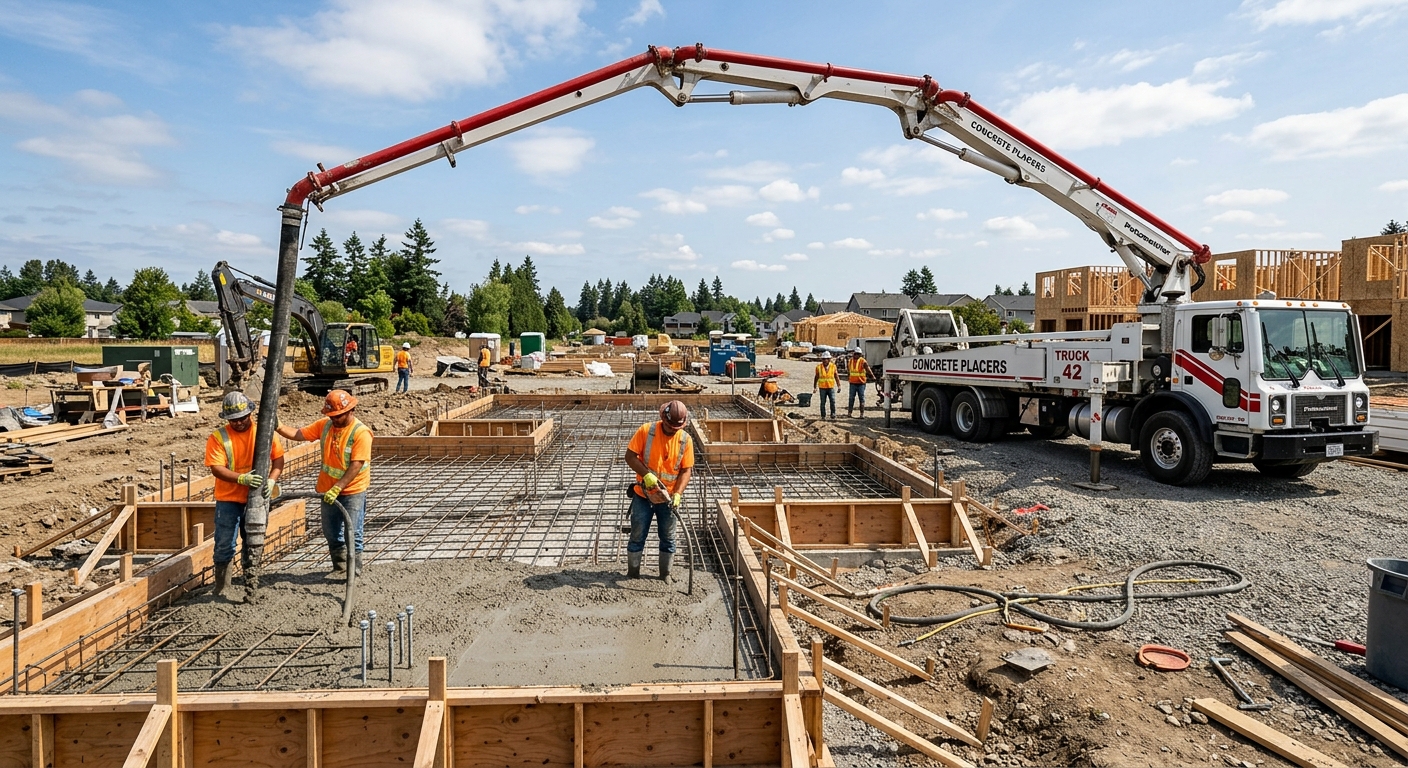
Concrete work options and costs in Country Hills East
Concrete work is a frequent home improvement choice in Country Hills East, Ontario—especially for driveways, patios, walkways, garage slabs, and structural foundation repairs. With a small local population of 2,546 (Statistics Canada, 2021 Census), you’ll often find that contractor availability depends on a tight GTA schedule, not just “who is closest.” That matters in a neighbourhood like country-side/estate pockets within Country Hills East, where longer access routes, larger properties, and mature trees can slow down excavation and concrete truck positioning. At the same time, Toronto-region demand is steady for exterior flatwork because many homes are owner-managed and routinely updated as they age.
In the Toronto economic region, costs are shaped by frost depth and freeze–thaw cycles. Most structural footings need to extend at least 1.2 m (about 4 ft) below grade to reduce frost heave and differential movement, and exterior slabs require properly prepared granular base and drainage so saturated soils don’t expand and contract against the concrete every winter. GTA contractors also prioritize air-entrained mixes, proper slab thickness, and control joints to manage cracking on flatwork. Pour season timing affects pricing: when temperatures drop toward 10 °C or below, crews often rely on cold-weather curing protection (insulation blankets and/or heating), which adds labour and materials. If you’re planning an exterior project in late fall or early spring, it’s common to see higher quotes due to scheduling pressure and curing management.
Because of those variables, comparing “like-for-like” specs is essential. Below are realistic typical ranges for Country Hills East homeowners before you request itemized quotes.
| Application |
Typical Size |
Key Spec |
Finish Option |
Price Range |
| Concrete driveway (standard broom finish) |
400–600 sq. ft. |
Air-entrained mix, compacted base, control joints |
Broom finish, 4 in (typ.) thickness |
$7,200 – $16,800 |
| Exposed aggregate driveway |
400–600 sq. ft. |
Air-entrained mix, proper curing to support clean reveal |
Exposed aggregate finish |
$9,000 – $21,000 |
| Stamped concrete driveway or patio |
300–500 sq. ft. |
Air-entrained mix, thicker wear surface, release agent |
Stamped pattern (e.g., stone/brick look) |
$7,200 – $20,000 |
| Plain concrete patio or walkway |
200–400 sq. ft. |
Air-entrained mix, compacted granular base, edging |
Float/trowel with broom or light broom texture |
$3,200 – $10,400 |
| Garage floor (interior slab) |
300–600 sq. ft. |
Smooth finish, curing plan, vapour considerations |
Light broom/satin finish |
$5,400 – $16,800 |
| Foundation footings (structural, below frost) |
Per linear foot + scope |
Below frost, engineered reinforcement and forming |
Structural concrete (not decorative) |
$180 – $300 |
Prices are estimates only and vary by project scope, site access and material selection.
What affects the price of concrete work in Country Hills East
In Country Hills East and across the Toronto economic region, it’s not unusual to see quotes for the “same” concrete job vary by 30–50%. The differences usually aren’t because concrete is wildly different—it’s because the specs that protect the concrete in Ontario’s climate change the labour, materials, and schedule. In freeze–thaw regions, your footings must extend below the design frost depth (in Ontario, typically in the 1.5–2.4 m range depending on location and design), and exterior slabs need air-entrained concrete and a properly compacted granular base. If those items are under-specified, you may get short-term looks and long-term failure (spalling, scaling, and early cracking).
Cold-weather work adds another cost lever. GTA contractors often concentrate exterior pours in warmer months to ensure curing proceeds reliably. When temperatures trend toward 10 °C or below, crews may need cold-weather protection—insulating blankets, heaters, and longer curing management—before the concrete can gain the strength it needs. De-icing salt also accelerates surface deterioration, which is why sealing is a practical add-on for exterior flatwork.
Two examples that commonly swing prices in Country Hills East: (1) Driveways with poor drainage or saturated soil usually require more granular removal and regrading; that can push you toward the higher end of standard driveway pricing (for example, the $18–$28 per sq. ft. typical band) because the base work is labour-heavy. (2) Decorative finishes like stamped concrete or exposed aggregate often cost more than plain flatwork (stamped typically in the $24–$40 per sq. ft. band) because the process requires extra materials, careful timing, and skilled finishing. If you’re upgrading from broom-finish to stamped, the price increase is justified when you’re targeting long-term curb appeal and willing to maintain the surface with the right sealing schedule—especially in humid, wet shoulder seasons around Toronto.
| Price Factor |
Why It Matters |
Cost Impact |
| Frost line depth — determines footing depth and form height |
Deeper footings reduce frost heave and settlement risk |
Raises foundation labour and forming cost; can shift quotes significantly |
| Site preparation — excavation, grading, compacted granular base |
Proper base prevents pumping and slab movement during freeze–thaw |
Often the biggest variable on driveways and patios |
| Reinforcement — rebar or wire mesh requirement |
Controls cracking and supports structural demands |
Adds material + install labour; required for many exterior slabs |
| Mix design — air-entrainment and compressive strength spec |
Air entrainment improves freeze–thaw durability and reduces spalling |
Premium mix and spec compliance; typically small per-yard compared to failure risk |
| Finish type — broom vs. stamped vs. exposed aggregate |
Surface finish drives material usage and skilled labour time |
Can increase cost materially versus plain broom finish |
| Pour size and concrete truck access to site |
Short access windows and long wheelbarrow distances increase labour |
Tends to raise labour cost and schedule risk |
| Cold-weather curing precautions — heating and blankets |
Ensures strength gain and prevents early damage |
Adds rental/energy/labour; common when season timing is tight |
| Control joint pattern and sealing cost |
Joints manage shrinkage cracking; sealing repels salts/water |
Small materials cost with noticeable durability payoff |
Permits & regulations in Ontario
In Ontario, structural concrete work typically needs municipal involvement because it can affect the building’s safety and load path. Work such as footings, foundation walls, and grade beams generally requires a building permit, and in many cases engineered drawings are reviewed by the municipality before construction. Concrete flatwork like patios, walkways, and driveways usually does not require a permit by itself—however, it can trigger requirements when it affects lot grading, changes how water drains, or impacts impervious surface coverage or municipal right-of-way conditions. Before you authorize anything in Country Hills East, confirm the municipal requirements with your local authority.
For contractor readiness, always verify insurance and coverage. Ask for proof of liability insurance and evidence of WSIB/WCB coverage (the contractor’s documentation should be current and aligned with the project scope). Then request references for similar-sized jobs—ideally in the GTA where freeze–thaw and salt exposure are part of everyday reality.
Step-by-step verification you can do as a homeowner:
- Ask for the contractor’s business details (legal name, address, and HST number).
- Request a certificate of insurance showing your project owner name (or at least the same legal entity) and the effective dates.
- Confirm WSIB/WCB coverage documentation before work begins.
- If the job is structural (footings/foundation), ensure the permit is pulled and that the contractor coordinates inspections and inspection scheduling.
- Use online registry resources and the contractor’s paperwork to cross-check name matches and coverage dates.
If anything is missing—no clear permit plan for structural work, lapsed insurance, or vague coverage documentation—pause and get it corrected before concrete is ordered.
Getting concrete right in Country Hills East's freeze-thaw climate
Concrete failures in Country Hills East are rarely “mystery” problems—they’re usually the result of poor base prep, inadequate air-entrainment, or insufficient curing and protection through Ontario’s freeze–thaw cycles. In exterior flatwork, water is the enemy. If subgrade is not properly compacted and drained, saturated soil expands and contracts, stressing the slab and lifting edges. In winter, de-icing salts can increase surface wear and, without the right air void system, freeze–thaw expands water inside the paste, leading to spalling.
To spec the job correctly, focus on five items. First, base preparation: excavate to the design depth and place a compacted granular sub-base so the slab sits on stable support. Second, mix design: for exterior flatwork, contractors typically target air entrainment around 5–7% and a minimum 32 MPa compressive strength so the concrete survives repeated freezing. Third, control joints: spacing should be planned to limit random cracking and keep cracks where they’re easiest to maintain. Fourth, curing: allow proper curing for at least 7 days under suitable conditions; cold weather may require additional protection to ensure strength gain. Fifth, sealing: apply a penetrating sealer after full cure (commonly around 28 days post-pour) to repel salt and water.
Here’s a practical dollar example: upgrading a plain broom-finish patio to a higher-performing air-entrained mix plus correct base and joint layout may cost only a modest amount versus cutting corners. However, skipping those steps can lead to early surface scaling—at which point you may be paying twice. If your starting point is a typical plain patio band of $16–$26 per sq. ft., spending a bit more on correct specs is usually a bargain compared with later repairs.
Use these specs to ask direct questions about freeze–thaw durability—especially whether the crew is placing an air-entrained mix and managing curing during shoulder-season cold snaps. That single decision is often what separates a patio that looks good for years from one that starts flaking and spalling within a short time.
| Spec |
Why It Matters in Country Hills East |
What to Ask For |
Impact if Skipped |
| Compacted granular base (depth?) |
Stable support reduces movement during seasonal soil expansion |
Granular base thickness and compaction testing/verification |
Edge heaving, uneven settlement, premature cracking |
| Air-entrained concrete mix (target air %?) |
Air voids protect against freeze–thaw pressure in Ontario winters |
Proposed air content (typically 5–7% for exterior flatwork) |
Higher risk of spalling and surface scaling |
| Compressive strength (MPa rating) |
Sufficient early strength supports safe finishing and long-term durability |
Minimum 32 MPa (confirm spec on the pour ticket) |
Weaker concrete, increased wear and cracking potential |
| Control joints (spacing per ACI guidelines) |
Manages shrinkage cracking where you can maintain it |
Joint spacing plan and saw-cut timing |
Random cracking patterns and harder-to-repair damage |
| Minimum 7-day curing period |
Curing affects strength gain before exposure to freeze conditions |
Protection plan if nights are cold during the pour |
Surface damage, poor durability, reduced weather resistance |
| Penetrating sealer (when applied after cure) |
Reduces water and salt penetration through concrete pores |
Application timing (commonly after 28 days) and sealer type |
Faster deterioration from salts and moisture |
How to choose a concrete work contractor in Country Hills East
Choosing the right concrete contractor in Country Hills East comes down to proof, not promises. First, verify Ontario licensing status where applicable to the scope, and—more importantly—confirm liability insurance and WSIB/WCB coverage. For insurance, request a certificate of insurance (and ensure coverage is active for the project dates). For WSIB/WCB, ask for documentation showing the contractor is properly covered for the work they’ll perform. If you can’t get clear paperwork before the pour, that’s a major red flag.
Next, get 2–3 itemized written quotes (not lump sums). A solid quote breaks down labour and materials separately—especially excavation/haul away, granular base, reinforcement, concrete supply, finishing, joints, sealing (if included), and protection for curing in cooler weather. Read the exclusions line carefully: it should say what’s included for demo, disposal, site protection, and whether a permit is required and who pulls it for structural work. If the quote is for exterior flatwork, confirm drainage assumptions (especially slope and tie-ins) because GTA freeze–thaw durability depends on it.
Finally, review warranty terms. Ask for the workmanship warranty length, what it covers (cracks, spalling, settlement issues), whether it covers material-only defects or labour as well, and whether it’s transferable if you sell your home. Use a sensible payment schedule: never pay more than 10–15% upfront, and hold back a portion until the job is complete, cleaned up, and the finish is approved. Get a start date and completion estimate in writing, including weather-condition contingencies for pours.
- Confirm insurance certificate dates match your project start and end.
- Request proof of WSIB/WCB coverage before any site work begins.
- Ask if the mix is air-entrained and request the spec (not just “regular concrete”).
- Ensure base prep is described (depth, compaction approach, drainage plan).
- Check whether reinforcement is included where required (rebar/wire mesh).
- Verify control joint spacing and whether joints are saw-cut or formed.
- Ask about curing protection if overnight temperatures are likely to be cold.
- Confirm whether sealing is included and the timing requirement after pour.
- Get disposal and haul-away included (or clearly excluded).
- Make sure the quote includes site access details for concrete trucks and pumps if needed.
- Clarify warranty terms in writing, including workmanship vs. product warranty.
- Use a payment schedule tied to milestones—not large upfront payments.
Concrete contractor red flags in Country Hills East include: refusing to provide insurance/WSIB paperwork, quoting “one price” without base prep or joint details, skipping air-entrainment for exterior flatwork, starting pours in marginal conditions without a curing protection plan, and pressuring you for large upfront deposits with no clear schedule or scope breakdown.
Frequently asked questions — concrete work in Country Hills East
What is rebar and when is it required in Ontario?
Rebar (reinforcing steel) is used to strengthen concrete and control cracking by adding tensile resistance where concrete is weak in tension. In Ontario, whether rebar is required depends on the structural design and what the concrete element is expected to carry—driveways can require reinforcement based on thickness, soil conditions, and load expectations, while foundation elements like footings and walls are typically engineered and often include rebar as part of the design. In Country Hills East, freeze–thaw cycles and soil movement make proper reinforcement and detailing especially important for exterior flatwork on unstable or poorly drained sites. When you request quotes, ask the contractor to identify where rebar or wire mesh is used (for example, in slab reinforcement) and to provide the spec thickness and spacing so the job matches Ontario structural expectations.
How long does a concrete project take in Country Hills East?
The timeline depends on the size and complexity, and in Ontario it’s heavily influenced by weather and curing needs. For a typical driveway or patio, the on-site work is often a matter of days: excavation/base prep, forming, reinforcement placement, the pour day, then finishing and protection. The concrete then needs proper curing—minimum 7 days before normal light use, and full performance is typically tied to longer curing (commonly assessed at 28 days for sealing). In Country Hills East, a cold snap near 10 °C or below can slow progress because crews may need insulating blankets or heating to protect the concrete during curing. That’s why contractors may schedule exterior work earlier in the season. If you’re comparing options, note that a stamped or exposed aggregate job can take longer than a broom-finished slab due to finishing steps, even though the pour itself is still “one day.”
What is a concrete overlay and is it suited to Country Hills East?
A concrete overlay is a new concrete layer placed over an existing slab (after preparation), often to restore appearance and improve surface wear without full demolition. In Country Hills East, overlays can be suited for some driveways and walkways when the existing concrete is generally sound—meaning it’s not significantly heaved, severely cracked, or failing at joints where water collects. The freeze–thaw climate is the reason overlays aren’t always the best first choice: if the underlying slab has movement from saturated soils, the overlay will usually reflect those problems. Proper prep is essential: cleaning, profiling, crack repairs, and ensuring drainage is addressed. Cost-wise, overlays often land below full replacement but vary widely based on prep and thickness; for many homeowners comparing a repair approach to new flatwork, the typical patio band is about $16–$26 per sq. ft., while replacement may be higher depending on finishes. Ask your contractor whether an overlay includes base/drainage fixes or is purely resurfacing.
How do I seal concrete to protect it in Country Hills East?
Sealing is a smart protective step for exterior concrete in Ontario because de-icing salts and repeated freeze–thaw can accelerate surface deterioration. The usual approach in Country Hills East is to apply a penetrating sealer after the concrete has fully cured—commonly around 28 days post-pour. Before sealing, the surface should be clean and dry, and any required repairs should be completed so you don’t lock in defects. Choose a penetrating sealer designed for salt resistance and water repellency rather than a film-forming coating unless your contractor recommends something more suitable for your exposure conditions. When you get quotes, ask whether sealing is included, which product is used, and whether the contractor includes surface prep and application timing. If sealing is skipped or applied too early, the concrete can retain moisture and reduce the effectiveness of the treatment.
What is the difference between concrete and cement?
Concrete is the finished material you see and walk on; it’s a mixture of cement, water, aggregates (sand and stone), and sometimes air-entraining admixtures and other performance additives. Cement is only one component—essentially the “binder” that reacts with water to form a hard matrix. This distinction matters because in Toronto and Country Hills East, performance additives like air-entrainment are chosen to handle freeze–thaw durability for exterior flatwork. So when a contractor says “we’re using a better cement,” what you actually want to confirm is the full concrete mix design—especially target air content (often around 5–7% for exterior flatwork), minimum compressive strength (commonly 32 MPa), and curing precautions if temperatures drop. If your quote is priced within a typical driveway band such as $18–$28 per sq. ft., make sure it’s not just about the cement—it’s about the entire mix and protective specs that prevent spalling and early cracking.
How much does concrete work cost in Country Hills East?
Concrete costs in Country Hills East generally track typical GTA price bands, but your final quote depends on base prep, reinforcement, access, finishing complexity, and curing/weather protection. For example, driveway work is often estimated in the $18–$28 per sq. ft. range for standard broom-finished concrete, while patios and walkways commonly fall around $16–$26 per sq. ft. Decorative options like stamped or enhanced finishes can run higher—stamped work often aligns with the $24–$40 per sq. ft. band because of additional labour, materials, and careful timing. For structural work, foundation/footings are commonly priced on the order of $180–$300 (as a typical per-unit budget range used in estimates) depending on scope and engineered requirements. Always compare quotes on included items: excavation depth, granular base compaction, reinforcement type, joint plan, and whether cold-weather curing precautions are included. That’s what usually explains the 30–50% quote spread even for “similar” projects.