Concrete work options and costs in High Park-Swansea
In High Park-Swansea, concrete work usually comes down to three things: how you use the surface (driveway, patio, walkway), how the base is prepared for local soils, and how the mix is built for Toronto’s freeze–thaw winters. With 23,925 residents in the High Park-Swansea area (Statistics Canada, 2021 Census), there’s a steady flow of residential concrete upgrades—especially as homeowners renovate existing lots and update entrances, steps, and outdoor living spaces. This neighbourhood’s housing stock is a strong driver of demand for flatwork: many properties rely on exterior concrete for driveways, sidewalks, and backyard paths to keep traction and reduce mud in shoulder seasons.
Toronto-area concrete pricing is shaped by regional frost protection and the realities of our curing window. In the Toronto economic region, structural footings are typically specified to extend at least 1.2 m below grade to reduce frost heave and differential movement, which affects excavation, forming, and the amount of concrete. For exterior slabs and walkways, contractors typically use air-entrained concrete and a proper joint layout to manage cracking over repeated freeze–thaw cycles, and they schedule pours during warmer months to support reliable curing. That scheduling pressure can raise labour rates and minimum project costs compared with “milder” regions.
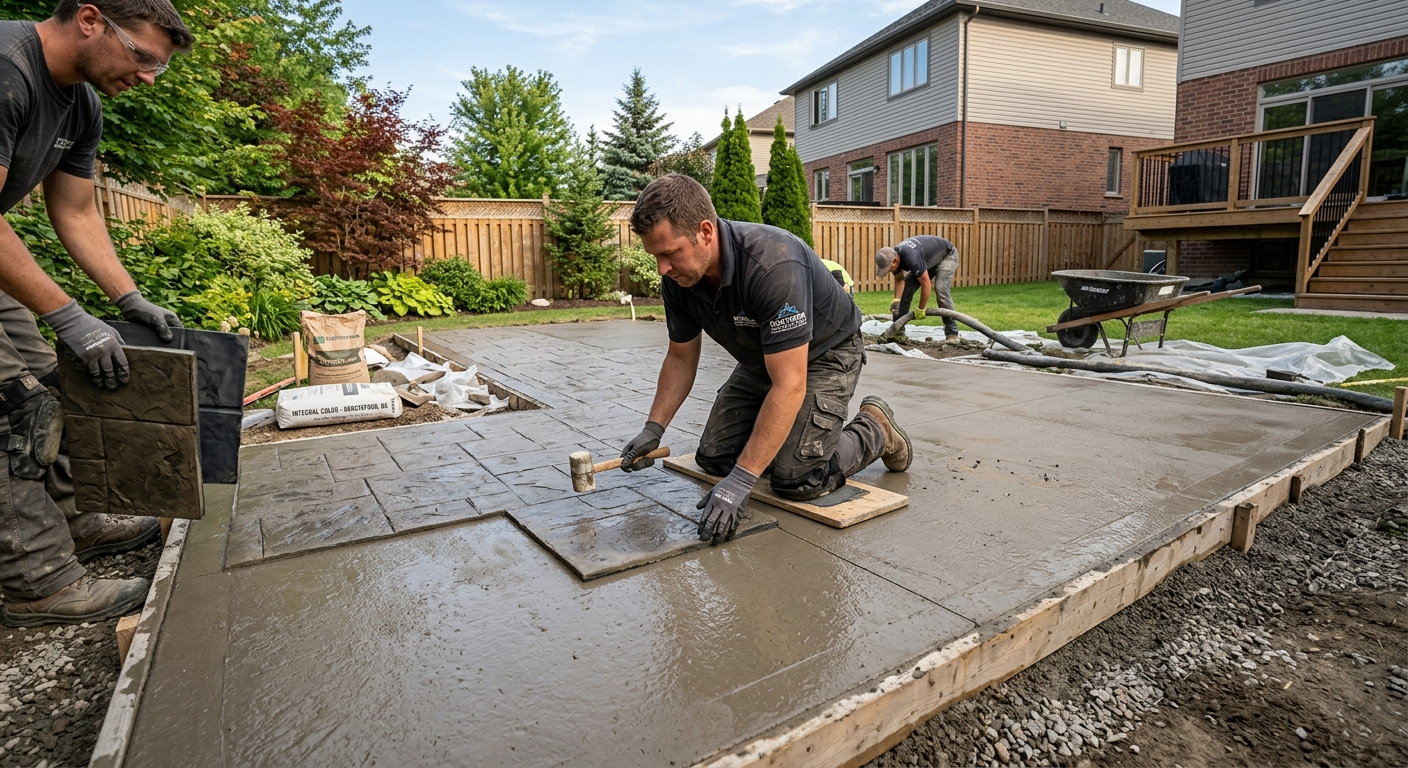
In High Park-Swansea—particularly around the High Park edge and the busy residential streets closer to Bloor—driveways and front steps are especially in demand because they’re visible year-round and take constant freeze–thaw stress. Below is a practical cost comparison to help you line up apples-to-apples scopes before you request quotes.
| Application |
Typical Size |
Key Spec |
Finish Option |
Price Range |
| Concrete driveway (standard broom finish) |
300–500 sq. ft. |
Air-entrained mix; compacted granular base; control joints |
Broom finish |
$18,000–$28,000 |
| Exposed aggregate driveway |
300–500 sq. ft. |
Air-entrained mix; proper base; aggregate reveal process |
Exposed aggregate |
$22,500–$35,000 |
| Stamped concrete driveway or patio |
200–450 sq. ft. |
Air-entrained mix; stamped mats; sealer plan |
Stamped pattern + colours |
$24,000–$40,000 |
| Plain concrete patio or walkway |
150–350 sq. ft. |
Compacted base; air-entrained exterior mix; expansion gaps at edges |
Broom or light trowel finish |
$16,000–$26,000 |
| Garage floor (interior slab) |
300–600 sq. ft. |
Vapour barrier (as required); thickness spec; mesh or reinforcement per design |
Float + broom/finish trowel |
$14,000–$26,000 |
| Foundation footings (structural, below frost) |
Varies by foundation plan |
Excavation to design depth; structural concrete; rebar per engineered drawings |
Structural finish |
$180,000–$300,000 |
Prices are estimates only and vary by project scope, site access and material selection.
What affects the price of concrete work in High Park-Swansea
In Toronto—and across Ontario—quotes for the “same” concrete job can swing 30–50% because the details that control durability are often bundled differently. A simple example: two driveway bids might both list “concrete,” but one includes the right granular base thickness, proper drainage and compaction, reinforcement as required, and an air-entrained exterior mix with correct curing protection. The other might cut corners on sub-base preparation or specify a mix that’s less suitable for Ontario’s freeze–thaw exposure, which is where you’ll see early cracking or scaling.
Frost depth and freeze–thaw cycles dictate the spec throughout the GTA. Footings for structural support typically need to extend below the design frost depth—often at least 1.2 m in Ontario—to prevent frost heave and differential movement. Exterior flatwork also needs air-entrained concrete mixes to handle repeated cycles, along with adequate thickness and well-planned control joints. When temperatures trend toward 10 °C or below, contractors often add cold-weather curing precautions (insulating blankets, protection, sometimes heat) so concrete reaches strength and doesn’t surface-riddle or scale early. Add de-icing salt use in winter, and sealing becomes a practical durability requirement; without it, surface spalling risk increases.
In High Park-Swansea, cost rises can also come from site conditions: older lots with established landscaping, mature trees near entrances, and tighter access on local streets. Conversely, costs can drop when demolition is minimal and the base is already close to grade. For context, a standard broom-finished driveway often lands around the mid-to-high end of the local driveway band (roughly $18–$28 per square foot), while a stamped driveway or patio can push into the $24–$40 range because of materials, forming complexity, and labour time.
| Price Factor |
Why It Matters |
Cost Impact |
| Frost line depth — determines footing depth and form height |
Deeper excavation and more structural concrete prevent frost heave and movement |
Can add significant labour + concrete volume; often one of the largest cost drivers for foundations |
| Site preparation — excavation, grading, compacted granular base |
Proper base prevents settlement and helps control cracking |
Often increases cost on sloped or tree-heavy lots; can reduce cost if access and grading are easy |
| Reinforcement — rebar or wire mesh requirement |
Supports slab performance and reduces cracking from shrinkage and load |
Moderate cost increase; major increase if rebar is required by design and access is tight |
| Mix design — air-entrainment and compressive strength spec |
Air entrainment improves freeze–thaw resistance for exterior concrete |
Small material premium, but essential for durability in Ontario winters |
| Finish type — broom vs. stamped vs. exposed aggregate |
More labour time and specialty materials for decorative finishes |
Stamped/exposed can increase overall price noticeably (often the difference between $18–$28 and $24–$40 bands) |
| Pour size and concrete truck access to site |
Smaller access-constrained pours require more labour handling and may limit truck routing |
Higher cost when pumping/extra labour is needed; can decrease with straightforward drive access |
| Cold-weather curing precautions — heating and blankets |
Protects curing to reach required strength and reduces surface scaling risks |
Can add day-of labour and material costs when pours occur later in the season |
| Control joint pattern and sealing cost |
Joints control cracking; sealing helps resist de-icing salt impact |
Sealing is a cost add-on but typically cheaper than early repairs |
Permits & regulations in Ontario
In Ontario, the rule of thumb is: structural concrete needs a permit and often engineered review, while basic flatwork usually does not. For example, work that typically does require a building permit includes structural concrete such as foundation footings, foundation walls, and grade beams—especially when the work affects load paths or structural stability. For these projects, municipalities commonly expect engineered drawings that match the footing depth requirements below design frost and the reinforcement details.
Concrete flatwork—like driveways, patios, sidewalks, and walkways—often does not require a permit on its own. However, you should still confirm with the local authority if the project impacts lot grading, drainage patterns, impervious surface coverage limits, or any municipal right-of-way area (for example, if you’re touching boulevard areas or changing how water runs at the curb line).
Step-by-step for High Park-Swansea homeowners: (1) ask the contractor for their Ontario licence number and verify it through the appropriate online registry; (2) request a current certificate of insurance showing liability coverage with your address listed; (3) confirm WSIB coverage (or a clearance letter, depending on the situation) before work starts; (4) get references on similar-scale pours (same footing depth, same exterior exposure). Finally, don’t break ground until you have clarity on whether your specific scope needs a permit and when the inspection would happen.
Getting concrete right in High Park-Swansea's freeze-thaw climate
Concrete failures in High Park-Swansea usually trace back to water movement and expansion during freeze–thaw cycles. The most common homeowner-visible problems are surface scaling and spalling, which often come from inadequate air-entrainment, poor base preparation, or curing that wasn’t protected when temperatures fell. If the sub-base isn’t compacted to the right depth and drainage isn’t planned, saturated soil can expand and contract against the slab every winter, pushing movement into the concrete.
To spec the job correctly in the Toronto market, insist on five practical elements. First, base preparation: a properly graded and compacted granular sub-base sized to your soil and local frost conditions. Second, mix design: exterior flatwork typically needs air-entrainment (commonly in the 5–7% air content range for durability targets) and a minimum 32 MPa compressive strength where applicable to the scope. Third, control joints: a joint pattern that limits random cracking—joints need to be placed early enough and detailed to handle shrinkage. Fourth, curing: plan for at least 7 days of curing under reasonable conditions, with extra protection when the weather cools. Fifth, sealing: apply a penetrating sealer after the concrete has cured (often around 28 days) to help repel de-icing salts.
Here’s a realistic dollar example: if you’re choosing between a standard broom-finish driveway and a decorative option, upgrading from plain flatwork into stamped concrete might add roughly the difference between the local driveway bands—say, closer to $18–$28 versus $24–$40—but that premium is only worth it if the base, mix, and joint/sealer plan are equally robust. Stamped finishes are more labour-intensive; the durability still depends on the structural and freeze–thaw specs.
| Spec |
Why It Matters in High Park-Swansea |
What to Ask For |
Impact if Skipped |
| Compacted granular base (depth?) |
Reduces settlement and blocks water-driven expansion under Toronto’s freeze–thaw |
Granular base to engineered/standard thickness; proof of compaction |
Cracks, pumping, uneven surfaces, and premature failure in winter |
| Air-entrained concrete mix (target air %?) |
Protects against freeze–thaw scaling on exterior slabs |
Air content specified for exterior exposure (commonly 5–7% target) |
Spalling and pop-outs during repeated cold cycles |
| Compressive strength (MPa rating) |
Ensures durability and performance under loading and seasonal stress |
Minimum 32 MPa for applicable exterior structural flatwork |
Surface wear, reduced longevity, and higher risk of cracking |
| Control joints (spacing per ACI guidelines) |
Controls where cracks happen instead of random cracking |
Joint spacing and layout details before the pour |
Random cracking that ruins appearance and may allow water entry |
| Minimum 7-day curing period |
Strength development is critical when curing slows in cooler spells |
Documented curing method; protection plan if temperatures drop |
Weaker surface, increased scaling risk, and long-term performance issues |
| Penetrating sealer (when applied after cure) |
Helps resist salt and moisture intrusion in Ontario winters |
Penetrating sealer applied after full cure (often around 28 days) |
Faster deterioration from de-icing salts and wet cycles |
How to choose a concrete work contractor in High Park-Swansea
Choosing the right concrete contractor in High Park-Swansea starts with verification, not promises. For Ontario licensing, ask for their licence details and confirm through the appropriate online registry. Next, request liability insurance—a certificate of insurance should name your project address (or clearly reference your site) and show current coverage. Finally, confirm WSIB/WCB coverage. In many situations you can verify this via a WSIB clearance document or by confirming the account status; don’t rely on a verbal “we’re covered.”
Then, get 2–3 itemised written quotes rather than one lump sum. The best quotes break down labour and materials (excavation, base, reinforcement, concrete supply, finishing, protection/curing, and sealing). Read the scope carefully: what’s excluded (tree roots, rock removal, hauling away excess material, saw-cutting existing concrete, form removal)? Is permit pull included if required? Is disposal/hauling included in the price?
Warranty matters for concrete too. Ask for the workmanship warranty length and whether it’s tied to the finish and conditions (for example, sealing responsibilities). Also ask about any manufacturer warranty for specialty products, and whether it transfers to you. Payment schedule should be conservative: never pay more than 10–15% upfront, and use a holdback until you’re satisfied with grading, finish quality, and any curing/sealer steps. In the contract, insist on a clear start date and completion estimate in writing.
- Licence and insurance provided before scheduling
- Proof of WSIB/WCB coverage (or clearance documentation)
- Itemised quote (labour, materials, base prep, reinforcement, curing, sealing)
- Clear exclusions (rock removal, disposal, tree/root remediation)
- Concrete mix details (air-entrainment for exterior exposure)
- Thickness and reinforcement notes (mesh vs rebar where required)
- Control joint layout and spacing described
- Curing plan included for cold snaps near 10 °C
- Sealer type and timing stated (often around 28 days post-pour)
- Schedule includes cure/protection time—not just “pour day”
- Written warranty and what triggers it
- Payment terms with holdback until completion and cleanup
Concrete contractor red flags in High Park-Swansea: they won’t discuss air-entrainment or joint layout; they suggest skipping base compaction “because it’s just a driveway”; they won’t show insurance/WSIB documents; they want a large deposit upfront; or they treat sealing as optional while you’re planning to use de-icing salts on a winter-exposed surface.
Frequently asked questions — concrete work in High Park-Swansea
What is rebar and when is it required in Ontario?
Rebar (reinforcing steel bars) is used to strengthen concrete by helping control cracking and improving performance under load and temperature/shrinkage effects. In Ontario, whether rebar is required depends on the design of your footing, slab, or foundation element—especially when engineered drawings are part of the permitting process for structural work. For many residential exterior slabs, contractors may use wire mesh or rebar depending on thickness, soil support, and load expectations (for example, a heavier driveway load). What’s most important in High Park-Swansea is not the label, but the spec: ask your contractor to confirm the reinforcement plan and show where it sits in the slab (proper concrete cover), and whether the job needs engineered reinforcement due to scope.
How long does a concrete project take in High Park-Swansea?
Project duration depends on excavation and base prep, whether you’re removing existing concrete, and the complexity of the finishing. A typical driveway or patio often takes about 1–3 days on site for demo/earthworks, form setup, reinforcement placement, and the pour. Finishing may extend into the following day for decorative work (stamps/exposed aggregate). However, the concrete needs curing time before it’s fully reliable—Ontario crews usually plan for at least 7 days of curing before normal use, and protective steps like sealing are typically done later (often around 28 days post-pour). In Toronto’s freeze–thaw climate, pours late in the season may require additional protection and can shift timelines to warmer curing windows to reduce surface scaling risk. If temperatures trend near or below 10 °C, expect extra curing precautions and longer “ready for use” timelines.
What is a concrete overlay and is it suited to High Park-Swansea?
A concrete overlay is a new concrete layer placed on top of existing concrete—commonly to level a driveway, restore a worn surface, or change the appearance without full demolition. In High Park-Swansea, overlays can be suitable when the existing slab is structurally sound (no major settlement, widespread failed base, or severe cracking that’s actively moving). If the old concrete is lifting, draining poorly, or has ongoing base problems, an overlay often fails quickly because water and movement are still present under the surface. Overlays are also a good option when you want to reduce disruption and hauling costs, but they still require correct surface preparation (grinding/profiling, cleaning, and bonding system selection). For cost, overlays can sometimes be less than a full replacement, but pricing varies widely—always ask whether the contractor includes repair of spalls, proper drainage fixes, and a durable mix specification for Ontario freeze–thaw.
How do I seal concrete to protect it in High Park-Swansea?
Sealing helps protect concrete from moisture and de-icing salt impact, which matters in High Park-Swansea because winter freeze–thaw cycles can accelerate surface deterioration. The key is timing and product choice: sealing is not a same-day fix. In practice, most contractors apply a penetrating sealer after the concrete has cured—commonly around 28 days post-pour—so you don’t trap excess moisture inside. Before sealing, the surface should be clean and dry, and the contractor should confirm the curing process is complete (especially if cold weather required blankets or heating). Ask for the sealer type, coverage rate, and whether they’ll protect surrounding landscaping/garage floors during application. Also keep realistic expectations: sealing won’t replace proper base prep, air-entrained mix, and control joints—those are the durability foundation in Ontario.
What is the difference between concrete and cement?
Cement is one ingredient inside concrete. Concrete is the full mixture—typically cement, water, fine and coarse aggregates (sand and stone), and often admixtures like air-entrainment agents for freeze–thaw durability. Homeowners sometimes hear “cement” used loosely, but when a contractor quotes concrete work in Ontario, they’re talking about the complete concrete system and how it’s specified and placed. For your High Park-Swansea exterior flatwork, the big durability driver is the concrete mix design (especially air-entrainment) plus proper base preparation and curing—not just “cement thickness” or brand. That’s why two bids that sound similar can vary in price and performance. When comparing quotes, look for mix details that align with exterior exposure requirements rather than only the word “cement.”
How much does concrete work cost in High Park-Swansea?
Concrete cost in High Park-Swansea varies by scope, access, and finish, but local Toronto-area price bands provide a helpful baseline. For a concrete patio or walkway, you’ll commonly see estimates around $16,000–$26,000 depending on size and site conditions. For driveways, standard broom-finished work often falls in the $18,000–$28,000 range, while stamped decorative concrete can climb to roughly $24,000–$40,000 because of labour-intensive forming and finishing. Structural foundation footings are typically quoted very differently—often in the $180,000–$300,000 band because excavation, rebar, and structural concrete below frost depth are major drivers. Prices also change if the job is scheduled during colder weather that requires curing blankets or heating, which is a Toronto freeze–thaw cost factor.