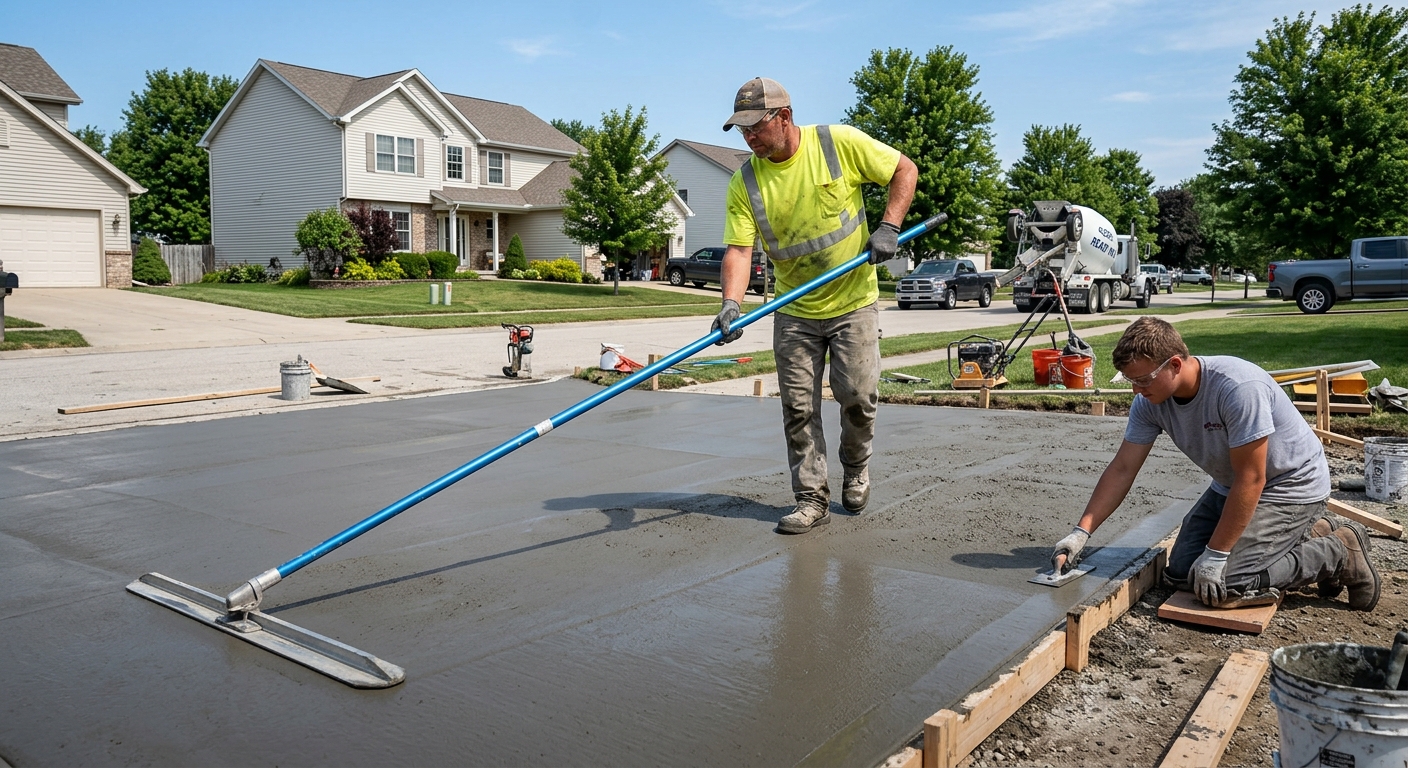
Concrete work options and costs in Welland
Concrete work is a big part of life in Welland, Ontario—especially for the areas of the city where single-detached homes make up 64.5% of dwellings. With 16,315 homeowner households (Statistics Canada, 2021 Census) and an older housing stock (65.6% of homes built before 1981, Statistics Canada, 2021 Census), you’ll see a steady mix of new flatwork, repairs, and foundation-related upgrades. That demand is strongest in established neighbourhoods like Lakeside and the broader East Welland area, where driveways and porch slabs are routinely replaced due to cracking, settlement, or surface spalling from the Great Lakes freeze-thaw cycle.
In the Hamilton–Niagara Peninsula, cold, wet weather off Lake Ontario and Lake Erie drives up concrete costs compared with milder parts of Canada. Most structural and exterior pours are scheduled roughly May–October to reduce the need for hoarding, heating, and cold-weather accelerators. We also design for deeper frost: regional practice typically places exterior footings at about 4 ft or deeper, extending below frost to limit heave. For driveways, patios, and walks, we specify air-entrained concrete and tighter control joint patterns to manage shrinkage and thermal movement—then allow longer curing and protection so the concrete reaches strength before freeze-thaw stress ramps up.
Below is a practical comparison of typical installed options, so you can align apples-to-apples when you review quotes for your property near downtown Welland or out toward the river corridor—then use the factors in the next section to refine expectations.
| Application |
Typical Size |
Key Spec |
Finish Option |
Price Range |
| Concrete driveway (standard broom finish) |
12 ft x 20 ft (240 sq ft) |
Air-entrained mix, compacted granular base, control joints |
Broom finish + light edging |
$3,360 – $5,280 |
| Exposed aggregate driveway |
12 ft x 20 ft (240 sq ft) |
Air-entrained mix, uniform wash exposure, proper drainage slope |
Exposed aggregate with sealed surface |
$4,080 – $6,000 |
| Stamped concrete driveway or patio |
10 ft x 20 ft (200 sq ft) |
Air-entrained mix, stamped pattern, base reinforcement as needed |
Stamp + integral colour (or colour hardener) |
$4,400 – $7,000 |
| Plain concrete patio or walkway |
10 ft x 12 ft (120 sq ft) |
Air-entrained mix, compacted base, expansion/control joints |
Broom or smooth trowel to suit use |
$1,440 – $2,400 |
| Garage floor (interior slab) |
20 ft x 22 ft (440 sq ft) |
Vapour barrier (if required), reinforcement, proper base prep |
Plain finish with saw-cut joints |
$6,600 – $9,900 |
| Foundation footings (structural, below frost) |
Typical 2–3 ft width runal footage (project dependent) |
Below-frost depth, rebar as designed, granular support |
Structural concrete + formwork |
$6,000 – $12,000 |
Prices are estimates only and vary by project scope, site access and material selection.
What affects the price of concrete work in Welland
Even when you’re comparing the “same” concrete job across Welland and the wider Hamilton–Niagara Peninsula, quotes can swing 30–50%. The cause usually isn’t the concrete itself—it’s the design depth, site prep, reinforcement, and the seasonal realities of labour and curing. Two contractors can price the same driveway area differently because one includes a thicker compacted granular base and air-entrained mix spec, while the other assumes standard lift thickness and skips details that matter here.
In the cold, wet Great Lakes corridor, frost line depth and freeze-thaw cycles dictate the entire spec. Exterior work needs footings extending below the design frost depth to prevent frost heave, and most residential structural footings end up roughly around 4 ft or deeper in local practice. For flatwork—driveways, patios, and walkways—we use air-entrained concrete to survive repeated freeze-thaw stress, along with tighter control joint spacing to limit random cracking. Because the pour season is shorter (often May–October), winter or early spring work may require hoarding, heating, and curing blankets, plus sometimes accelerators—all of which add cost. Also, de-icing salts speed up surface deterioration if you don’t plan for proper sealing after cure.
Cost can move up or down with local conditions. For example, older homes (65.6% built before 1981, Statistics Canada, 2021 Census) often have missing or failing drainage, so driveway replacement can include regrading and downspout control to protect the new slab. If you have poor access in established neighbourhoods—think tight driveways or limited concrete truck turning radius—mobilization and waste handling can add several hundred dollars. Conversely, a straightforward 240 sq ft broom-finish driveway might land closer to the $14–$22 per sq ft backbone; switching to stamped decorative work can justify the jump into the $22–$35 range when you want colour, texture, and proper reinforcement. The next section covers what to check so you can protect that money.
| Price Factor |
Why It Matters |
Cost Impact |
| Frost line depth — determines footing depth and form height |
Deeper, below-frost excavation reduces heave and cracking risk |
Can add significant excavation and formwork time (commonly several thousand dollars on footing runs) |
| Site preparation — excavation, grading, compacted granular base |
Good base prevents voids and settlement under freeze-thaw cycling |
Typical swing: hundreds to over $2,000 depending on soil and haul/disposal |
| Reinforcement — rebar or wire mesh requirement |
Supports loads and helps control cracking patterns |
Adds material and placement labour (often $600–$2,000+ depending on scope) |
| Mix design — air-entrainment and compressive strength spec |
Air-entrainment is critical to resist freeze-thaw deterioration |
Can increase material cost, typically reflected across the $12–$22 and $14–$22 flatwork bands |
| Finish type — broom vs. stamped vs. exposed aggregate |
Decorative finishes require more steps and surface finishing control |
Stamped/exposed can push pricing into the $22–$35 range for decorative work |
| Pour size and concrete truck access to site |
Access affects how many truck trips and how long crews can place concrete |
Long waits or multiple mobilizations can add hundreds to $1,500+ |
| Cold-weather curing precautions — heating and blankets |
Protects early-age strength during temperature swings |
Often adds $300–$1,200+ depending on timing and insulation needs |
| Control joint pattern and sealing cost |
Manages shrinkage cracking and reduces salt-driven surface damage |
Sealing is a separate line item; skipping it can reduce longevity and raise future repair costs |
Permits & regulations in Ontario
In Ontario, most structural concrete work in Welland—especially anything that supports the building—typically needs a building permit. That includes work like foundation footings, foundation walls, grade beams, and other structural elements designed and assessed by the local building department. Depending on the project, engineered drawings are commonly required or reviewed to confirm load capacity, rebar placement, and concrete specifications. If you’re doing a partial replacement of a footing due to settlement, or adding a new foundation element for a renovation, assume a permit will be required.
Concrete flatwork such as patios, walkways, and driveways usually does not require a permit by itself unless it affects lot grading, drainage, impervious surface coverage limits, or changes the municipal right-of-way area (for example, work tied to curb/sidewalk impacts). Even when a permit isn’t required, contractors should still follow good drainage and municipal constraints to avoid creating water problems for neighbours or your foundation.
Step-by-step, here’s how a homeowner in Welland can verify a contractor before breaking ground: (1) ask for their certificate of liability insurance naming you/your property as required by contract, (2) request proof of WSIB coverage (or applicable exemption documentation), (3) confirm they have a valid Ontario licence/registration if they’re performing regulated work associated with the broader scope, and (4) check for recent references on projects of similar size and seasonality. You can also request a clearance letter where applicable and ensure the contractor provides a signed contract with scope, exclusions, and curing/weather plan.
Getting concrete right in Welland's freeze-thaw climate
Concrete fails in Welland primarily because of freeze-thaw stress paired with water infiltration. When water gets into micro-spaces and the concrete surface isn’t protected, expansion during freezing can lead to scaling and spalling. The fix starts before the pour: proper base preparation with compacted granular sub-base to the correct depth for local soil and frost conditions, and good drainage so water doesn’t sit under or beside the slab. For mix design, specify air-entrainment for exterior concrete—typically 5–7% air content for flatwork—and a minimum 32 MPa compressive strength so the slab reaches reliable early-age performance. Decorative and thicker sections may require engineering input, but the freeze-thaw basics stay the same.
Then manage cracking and movement. Control joints should be planned to limit random cracks—often saw-cut within the appropriate time window or placed with a spacing approach consistent with industry practice for slabs-on-grade. Curing is non-negotiable: minimum 7-day curing under proper conditions, and in colder shoulder months we use curing blankets and protection to avoid rapid temperature swings. Finally, sealing matters in our Ontario winters: apply a penetrating sealer after the concrete has cured—commonly around 28 days post-pour—to help repel de-icing salts and reduce surface breakdown.
If you’re choosing options, the price difference should be tied to performance and longevity, not just appearance. For instance, a plain broom-finish patio might land near the $12–$20 per sq ft range, while a stamped decorative patio costs more (often within the $22–$35 range). If you’re adding drainage and sealing properly, the decorative premium is justified for curb appeal—but skipping air-entrainment or sealing is never worth it, because spalling repairs usually cost more than the original difference.
| Spec |
Why It Matters in Welland |
What to Ask For |
Impact if Skipped |
| Compacted granular base (depth?) |
Reduces settlement and limits water movement under slabs in frost conditions |
Specify granular base thickness and compaction requirements for your soil and frost design |
Voids and differential movement leading to cracking and trip hazards |
| Air-entrained concrete mix (target air %?) |
Improves resistance to freeze-thaw scaling and spalling |
Ask for air content target (commonly 5–7% for exterior flatwork) and confirm air-entrainment method |
Increased chance of surface scaling/spalling after Ontario winters |
| Compressive strength (MPa rating) |
Supports structural integrity through temperature swings and loading |
Minimum 32 MPa compressive strength specified for the pour |
Lower durability and strength gain, especially in cool weather pours |
| Control joints (spacing per ACI guidelines) |
Controls where cracking happens instead of letting it choose random locations |
Ask for joint spacing plan and timing for saw-cutting/placement |
Random cracks, wider openings, and more water ingress |
| Minimum 7-day curing period |
Builds early strength and reduces cracking risk from temperature changes |
Confirm cure method and protection if temperatures drop during/after the pour |
Weak early-age concrete and higher risk of early cracking and surface defects |
| Penetrating sealer (when applied after cure) |
Helps repel de-icing salts common in Welland winters |
Ask for penetrating sealer and application timing (commonly after ~28 days cure) |
Faster surface deterioration and more frequent repairs |
How to choose a concrete work contractor in Welland
To choose the right concrete contractor in Welland, start with proof. In Ontario, verify the contractor’s liability insurance certificate and confirm they carry WSIB coverage (or provide clear documentation if an exemption applies to their situation). Ask for current documents directly, not “we can get it later.” If they’re doing work that involves labour and site risks, you want the coverage in place before any excavation begins. You should also ask whether the contractor has the practical capacity for your schedule—especially if you’re aiming for a May–October pour window in the Hamilton–Niagara Peninsula.
Next, get 2–3 itemised written quotes. You want a breakdown of labour and materials, not just a lump sum, so you can compare base thickness, reinforcement, concrete mix spec, joints, and finishing. Scope clarity is everything: confirm what’s included for disposal, topsoil removal, any regrading to manage drainage, and whether the contractor pulls required permits (if applicable). Read exclusions line-by-line—common exclusions include sub-base changes due to unstable soils and additional concrete removal if existing concrete is worse than expected.
For warranty, ask for two layers: workmanship warranty length and whether the manufacturer warranty (for products like sealers or admixtures, where applicable) is transferable. Payment should be controlled: never pay more than 10–15% upfront, and hold back a meaningful portion until final cleanup, sealing (if included), and joint sealing are completed. Finally, insist on a written start date and completion estimate.
- Request their certificate of liability insurance and confirm coverage limits.
- Confirm WSIB coverage in writing (or document exemption where applicable).
- Ask for at least 3 references on driveways/patios of similar size in the Niagara region.
- Get itemised quotes: base prep, reinforcement, concrete mix, finishing, joints, sealing.
- Confirm granular base thickness and compaction requirements.
- Ask about air-entrainment and whether exterior slabs include it.
- Confirm joint plan: spacing and saw-cut/timing or preformed joint material.
- Ask about curing method and whether blankets/heat are used in cool weather.
- Clarify disposal and whether haul-off is included.
- Confirm protection of existing landscaping, fencing, and sidewalks during the pour.
- Verify timeline: start date, curing/return dates, and final sealing schedule.
- Use a payment schedule that limits upfront payment to 10–15% and holds final completion retention.
Concrete red flags in Welland include: (1) quotes that don’t mention air-entrainment for exterior flatwork, (2) vague curing plans (no blankets/temperature protection when temps fall), (3) no joint spacing detail or no commitment to sealing after cure, (4) paying a large deposit upfront, and (5) ignoring site access constraints—no truck/access plan often leads to cold joints and weak placement.
Frequently asked questions — concrete work in Welland
How much does concrete work cost in Welland?
In Welland, concrete pricing is driven by frost-related design requirements and the freeze-thaw cycle, so installed costs depend heavily on base prep, reinforcement, and finish complexity. For typical flatwork, you’ll often see a driveway/flatwork backbone like $14–$22 per sq ft for concrete driveways/slabs and $12–$20 per sq ft for patios/walkways. For example, a 240 sq ft broom-finish driveway usually lands in the $3,360–$5,280 range when granular base and joints are included. If you move to decorative work, stamped concrete commonly climbs into the $22–$35 per sq ft band, so a stamped 200 sq ft patio can come out around $4,400–$7,000 depending on colour and reinforcement details. If winter scheduling is involved, expect higher costs due to heating/blankets and slower curing protection.
How deep must footings be for Welland's frost line?
In Welland and the Hamilton–Niagara Peninsula, frost heave risk is why footing depth matters. Local foundation practice typically places exterior footings around 4 ft or deeper—below the design frost depth—to prevent movement that can cause cracking and settlement. Your exact depth should follow the building design and soil conditions for your specific site; a contractor should confirm frost depth assumptions and provide engineered drawings where required. If you’re working near an addition, repairing settlement, or replacing footing sections, the depth and excavation can be a major cost driver, along with the need for proper granular support and reinforcement placement. Don’t rely on “minimums” from older homes—remember 65.6% of houses in the local profile were built before 1981 (Statistics Canada, 2021 Census), so some older foundations may not match today’s durability expectations for freeze-thaw.
Why does concrete crack in Welland and how is it prevented?
Concrete cracks in Welland mainly due to shrinkage, thermal movement, and freeze-thaw cycles—especially when water gets into cracks or when the slab doesn’t have enough joints to control where it relieves stress. Prevention comes from a combination of correct base preparation (well-compacted granular sub-base), specifying air-entrained concrete for exterior work, and planning control joints so cracking occurs where it’s intended. In practice, we also manage curing and temperature swings; a minimum 7-day curing period under good protection matters. If a contractor offers a “flat price” driveway without discussing air-entrainment and joint patterns, that’s a major warning sign in Ontario’s Great Lakes climate. Sealing after cure also helps reduce de-icing salt driven surface deterioration, which is a common precursor to spalling that looks like cracking at the edges.
Stamped vs broom-finish concrete — cost difference?
Stamped concrete costs more than a broom-finish because it takes additional steps: forming the stamp pattern, finishing colour or applying colour hardener, and maintaining consistent surface texture and curing so the final look is uniform. In Welland, your finish choice often maps to the pricing backbone—broom finish driveways commonly sit in the $14–$22 per sq ft range, while stamped decorative concrete commonly sits in the $22–$35 per sq ft range. For example, a standard driveway might be around $3,360–$5,280 for a typical 240 sq ft job, while a stamped concrete driveway or patio can be approximately $4,400–$7,000 for a 200 sq ft decorative scope, depending on thickness, reinforcement, and access. If sealing and jointing aren’t handled correctly on either option, appearance won’t last—but the decorative premium is mainly for aesthetics and labour.
When is the best time to pour concrete in Welland?
The best time to pour concrete in Welland is during the warmer, more stable part of the year—roughly May to October—when crews can reliably cure without excessive heating and insulation. The Hamilton–Niagara Peninsula has a shorter effective exterior pour window because colder nights can slow strength gain and increase the risk of surface defects. If you must pour in cool shoulder months, contractors should plan for temperature protection: hoarding, heating, curing blankets, and a cold-weather curing approach so the concrete achieves early strength safely. Scheduling matters for durability in freeze-thaw weather; a late pour that doesn’t get adequate protection can cost more later through premature cracking or surface scaling. If you want the best balance of price and longevity, aim for a mid-season pour when possible and budget appropriately for curing protection if temperatures drop.
How long does concrete take to cure?
Concrete curing is about achieving sufficient strength and stability after placement—not just “drying.” For typical residential pours in Ontario, a minimum 7-day curing period under proper conditions is a common standard for early performance, and it’s especially important in Welland’s cold, wet freeze-thaw environment. Even if footings or slabs are walkable earlier, the concrete continues gaining strength over weeks. For sealing (commonly recommended for exterior flatwork), penetrating sealer is typically applied after the concrete has fully cured—often around 28 days post-pour—so the pores are ready to accept the protection. If the job is poured in cool conditions, curing can effectively require more protection time; good contractors will discuss blankets/heating as needed. Always ask your contractor what curing plan they’ll use, how they’ll monitor temperatures, and when you can safely use the area.