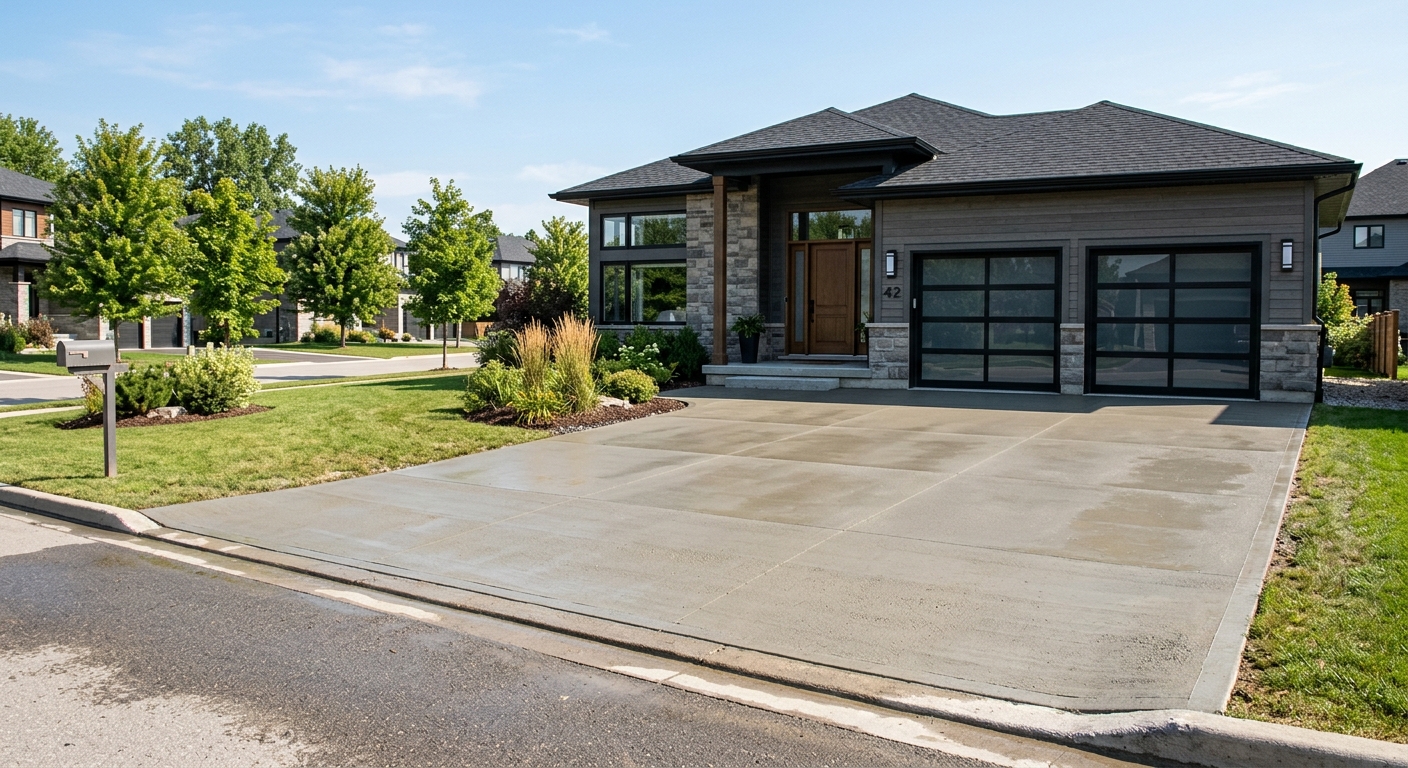
Concrete work options and costs in Arnprior
In Arnprior, concrete work is a year-round need, but pricing is mostly driven by how the job is built and scheduled through the freeze-thaw shoulder seasons. Arnprior’s housing stock leans heavily toward single-detached homes—51.7% of dwellings—so driveways, patios, walkway replacements, and basement-related concrete repairs are constant. With 2,730 homeowner households (Statistics Canada, 2021 Census), many projects are upgrades: replacing cracked flatwork, adding a new rear patio for entertaining, or doing foundation work when drainage issues show up. About half of homes were built before 1981 (50.2%), which often means older approaches to drainage, weeping tiles, and slab/footing details need attention before new concrete is poured.
In the Kingston–Pembroke region, concrete contractors cost more when site conditions are tight or when weather windows shrink. Frost depth and repeated freeze-thaw cycles demand footings set below the design frost level, and exterior slabs need air-entrained mixes to reduce the risk of surface scaling and spalling. The shorter warm-weather pour window can also compress labour availability, especially for finishing-heavy work like stamped or decorative surfaces. You’ll see high demand in older, established areas where driveways are narrower and regrading is common, such as around Queen Street and the broader downtown/commercial-adjacent blocks.
Below is a practical comparison of common concrete options and the typical price ranges homeowners see in Arnprior, based on our local market context. Use it as a budgeting starting point before you request itemised quotes.
| Application |
Typical Size |
Key Spec |
Finish Option |
Price Range |
| Concrete driveway (standard broom finish) |
12 ft x 20 ft (240 sq. ft.) |
Air-entrained exterior mix; control joints |
Broom finish, sealed optional |
$120 – $180 |
| Exposed aggregate driveway |
12 ft x 20 ft (240 sq. ft.) |
Air-entrained exterior mix; proper base |
Exposed aggregate with broom-blast texture |
$140 – $205 |
| Stamped concrete driveway or patio |
10 ft x 16 ft (160 sq. ft.) |
Colour integral; air-entrained mix |
Stamp pattern + release + sealer |
$160 – $280 |
| Plain concrete patio or walkway |
8 ft x 12 ft (96 sq. ft.) |
Exterior mix; compacted base |
Screed + light broom finish |
$90 – $150 |
| Garage floor (interior slab) |
20 ft x 20 ft (400 sq. ft.) |
Vapour/grade control as needed; reinforcement |
Float finish (option for hardener) |
$110 – $175 |
| Foundation footings (structural, below frost) |
Per linear foot; typical small house |
Engineered size/rebar; below frost level |
Cast-in-place structural concrete |
$180 – $320 |
Prices are estimates only and vary by project scope, site access and material selection.
What affects the price of concrete work in Arnprior
In the Kingston–Pembroke region (including Arnprior), quotes for the “same” concrete job can swing 30–50% because the slab is only part of the cost. The biggest variables are excavation, gravel base preparation, reinforcement, formwork complexity, and how much the contractor has to manage weather protection and curing discipline. Even before concrete arrives, site conditions decide the real workload: wet or poorly drained soils increase the amount of grading and granular base, and limited access can force smaller pours or more handling time. Labour availability can also tighten during the short warm-weather pour window, which affects scheduling and finishing labour.
Ontario’s freeze-thaw reality dictates critical specs that add cost. Frost line depth and repeated freeze-thaw cycles mean footings must extend below the design frost depth—commonly around 1.2 m below grade in Ontario practice—so formwork height, excavation depth, and disposal volumes rise as depth increases. All exterior slabs should use air-entrained concrete mixes to survive freeze-thaw movement and resist scaling. If you’re pouring during colder shoulder-season conditions, contractors may need cold-weather curing precautions like insulating blankets or temporary heating, which can add materials and labour. De-icing salt further accelerates surface wear in winter; sealing (often done after proper curing) becomes more than “optional” if you want long-term appearance.
Here’s how it plays out in Arnprior with practical examples. A driveway replacement may stay in the $120–$180 band when site access is good and the base only needs standard regrade/compaction. But if you discover soft subgrade or drainage failures, the same 12 ft x 20 ft driveway can climb toward the higher end because base depth, excavation, and possibly reinforcement adjustments increase. Decorative stamped work typically jumps from the $160–$280 band because stamping, integral colour, tighter finishing tolerances, and sealing are labour-intensive. Older homes built before 1981 often bring drainage challenges—fixing those now can cost more upfront, but it prevents premature cracking and patchwork, which is usually far more expensive later.
| Price Factor |
Why It Matters |
Cost Impact |
| Frost line depth — determines footing depth and form height |
Footings must be below design frost to prevent heave |
Higher excavation and deeper forms can add significant labour/material cost |
| Site preparation — excavation, grading, compacted granular base |
Concrete performance depends on support and drainage |
Wet/soft soils increase granular volume, compaction time, and disposal |
| Reinforcement — rebar or wire mesh requirement |
Reduces cracking and improves load resistance |
More steel, chairs/dowels, and placement labour raise costs |
| Mix design — air-entrainment and compressive strength spec |
Exterior freeze-thaw durability depends on air content |
Higher-spec mix and QA/placement discipline can increase unit pricing |
| Finish type — broom vs. stamped vs. exposed aggregate |
Surface protection and appearance affect labour tolerance |
Stamped/exposed work adds colour, stamping tools, and extra finishing time |
| Pour size and concrete truck access to site |
Impacts how quickly concrete must be placed and finished |
Poor access can require pump/small-load logistics and more crew time |
| Cold-weather curing precautions — heating and blankets |
Cold conditions slow strength gain and can damage surfaces |
Blankets/heaters and monitoring increase labour and materials |
| Control joint pattern and sealing cost |
Joints manage cracking; sealing repels de-icing salt |
More joints and proper sealing steps add but reduce long-term repairs |
Permits & regulations in Ontario
In Ontario, the rule of thumb is that structural concrete work almost always involves oversight, while typical decorative flatwork often doesn’t. In Arnprior, structural concrete elements such as footings, foundation walls, grade beams, and any work that supports the building typically requires a building permit, and it may require engineered drawings reviewed as part of the permit process. If you’re underpinning, adding new foundation walls, or modifying a foundation to repair a failure, expect permit requirements.
Concrete flatwork—like driveways, patios, sidewalks, and steps—typically does not require a permit unless the work affects lot grading, drainage/impervious surface limits, or ties into municipal right-of-way conditions. Even then, it’s often about the grading and drainage plan rather than the slab itself. Before breaking ground, confirm requirements with the local authority, especially if you’re changing slopes, lowering grade near the foundation, or relocating drainage discharge points.
For contractor compliance, verify you’re dealing with a legitimate, insured operator. Ask for a current certificate of insurance (general liability) showing coverage limits and the correct address/project name, and confirm Workers’ Safety and Insurance Board (WSIB) coverage where applicable. Then request references on similar-scale projects completed recently in Ontario. Where structural permits are involved, the right contractor should also coordinate schedule and documentation without pushing you into guessing what’s required.
Quick verification steps (what to look for): (1) proof of liability insurance certificate; (2) WSIB/WCB coverage or clearance letter; (3) any Ontario licensing details the contractor must provide for their work scope; (4) references for comparable Arnprior or nearby projects.
Getting concrete right in Arnprior's freeze-thaw climate
Concrete fails in Arnprior most often when the base, air content, or curing discipline are compromised—especially through Ontario’s freeze-thaw cycle. If the granular base isn’t compacted to the right depth and the drainage isn’t planned, water sits under the slab, freezes, expands, and forces movement. That movement can trigger random cracking and, on exterior surfaces, spalling when freeze-thaw pressure attacks the surface. For correct specs, start at the base: use a properly sized compacted granular sub-base designed for local soil conditions and frost behaviour, with good drainage away from the house and adequate compacted thickness under the slab.
Next, lock in the mix design: exterior flatwork in Ontario should use air-entrained concrete (commonly 5–7% air content for exterior slabs) and a minimum 32 MPa compressive strength so the concrete develops reliable early and long-term performance. Then plan control joints to limit random cracking—joints aren’t just cosmetic; they’re the “planned crack” that protects edges and reduces future moisture entry.
Curing is where shoulder-season pours get risky. Aim for a minimum 7-day curing period under proper conditions; in cool weather, contractors may need blankets or other precautions to protect strength gain and reduce surface damage. Finally, sealing matters for Arnprior driveways: apply a penetrating sealer after the concrete has properly cured (often around 28 days) to help repel de-icing salts.
What to ask so you don’t pay twice: “What air content will you target and how do you confirm it?” and “How will you protect the slab if temperatures drop at night?” For a budget comparison, standard broom-finish driveway work might land in the $120–$180 band, while stamped decorative driveways typically sit in the $160–$280 range. That price difference is justified when colour integral, stamping tolerances, and proper sealing are included—otherwise decorative jobs can still crack or spall if the base and air content aren’t right.
| Spec |
Why It Matters in Arnprior |
What to Ask For |
Impact if Skipped |
| Compacted granular base (depth?) |
Reduces pumping and movement under freeze-thaw |
Specified granular type and minimum compacted thickness; drainage plan |
Settlement, uneven cracking, and edge spalling |
| Air-entrained concrete mix (target air %?) |
Improves freeze-thaw durability for exterior exposure |
Target 5–7% air for exterior flatwork and how mix is verified |
Higher risk of scaling/spalling |
| Compressive strength (MPa rating) |
Ensures strength gain for load and surface integrity |
Minimum 32 MPa (or higher as required by scope) |
Surface damage and reduced longevity |
| Control joints (spacing per ACI guidelines) |
Controls where cracks occur during drying and thermal movement |
Joint layout and spacing plan appropriate to slab dimensions |
Random cracking and moisture infiltration |
| Minimum 7-day curing period |
Cold/damp conditions slow strength gain |
Curing method and protection steps for cool nights |
Lower strength, surface defects, and premature wear |
| Penetrating sealer (when applied after cure) |
Repels de-icing salts common in Ontario winters |
Sealer type and timing (commonly after cure; ~28 days) |
Faster surface deterioration and staining |
How to choose a concrete work contractor in Arnprior
Choosing a contractor in Arnprior is about proof and process, not just a low number. First, verify Ontario compliance: request their certificate of insurance for general liability (confirm it is current and matches the job site/address). Next, confirm WSIB/WCB coverage—ask for a clearance letter or equivalent documentation showing coverage status where required. If they’re doing work that requires permits or engineered drawings, the right contractor will be comfortable coordinating with the permit pathway and won’t treat approvals as your job.
Then gather 2–3 itemised written quotes. I strongly recommend pricing that breaks down labour and materials: excavation/grading, compacted granular base, reinforcement, formwork, concrete supply/delivery, finishing, joints, and sealing. Avoid vague line items like “concrete and finishing” because it hides the cost drivers that change outcomes. Ensure the quote states what’s included: permit pull (if needed), disposal/haul-away, protection of landscaping, and whether trucking distance or access limitations are assumed. If any of that is excluded, the final cost can jump.
Warranty matters. Ask for the workmanship warranty length and what it covers (typically cracking control and edge issues from workmanship, not normal wear). Also ask about any product/manufacturer warranties (like sealing systems) and whether they transfer if you sell the home. For payments, never pay more than 10–15% upfront; use a holdback until the work is complete and surfaces are cured/cleaned as agreed. Get a written timeline with start date and completion estimate so you can plan around the narrow Ontario pour window.
- Ask for a current certificate of insurance (liability) before work starts.
- Confirm WSIB/WCB coverage status in writing (clearance letter or proof).
- Request 2–3 itemised quotes with labour and materials separated.
- Verify the contractor includes excavation, compacted granular base, and compaction testing if applicable.
- Confirm air-entrained exterior mix and minimum strength (e.g., 32 MPa) are specified.
- Ensure reinforcement details are explicit (type, size, and placement depth/cover).
- Check control joint layout and spacing are included in scope, not “as needed.”
- Confirm curing protection steps for cool nights and how long curing is protected.
- Ask whether sealing is included and when it will be applied relative to cure time.
- Make sure disposal/haul-away and site clean-up are clearly listed.
- Require a written start date, completion date, and weather-protection plan.
- Understand warranty terms in plain language and get them in writing.
Concrete red flags in Arnprior: quotes that only state “concrete supply” without detailing base compaction; no mention of air-entrainment or control joints; plans that start pouring without a cold-weather protection plan; payment schedules requesting large deposits (more than 10–15%); and “we’ll seal if you want” with no discussion of cure timing or de-icing salt exposure.
Frequently asked questions — concrete work in Arnprior
How long does a concrete driveway last?
A well-built concrete driveway in Arnprior commonly lasts 20–30 years, and sometimes longer, when the base is properly compacted, the mix is air-entrained for freeze-thaw durability, and joints are installed to control cracking. The biggest killers here are water problems (standing water under the slab) and inadequate curing in cool weather, which can leave the surface less durable. If de-icing salts are used aggressively, sealing after proper cure helps slow scaling and staining. On budgeting, homeowners often start with standard broom-finish driveway pricing around $120 – $180 per typical project scope band, but the longevity usually depends more on specifications than finish alone.
What is air-entrained concrete and why does it matter here?
Air-entrained concrete is designed for cold-weather freeze-thaw cycles. It uses tiny, evenly distributed air bubbles that give freezing water room to expand without damaging the paste. In Arnprior, where the freeze-thaw cycle is a regular seasonal event, air-entrainment is one of the most important spec items for exterior slabs and driveways. If a contractor uses the wrong mix or skips air entrainment, the slab may look fine initially but develop surface scaling and spalling over time—especially once de-icing salts get involved. When you compare quotes, confirm the exterior mix is air-entrained and ask for the target air percentage and minimum strength (Ontario practice commonly uses 32 MPa or higher for structural/exterior durability requirements).
How do I prepare the base for a concrete slab?
Base preparation is where most performance is won or lost. For a driveway, patio, or walkway in Arnprior, the contractor should excavate to the required depth for frost considerations and then install a compacted granular sub-base designed for drainage and support. The granular material should be properly graded and compacted in lifts so the slab doesn’t settle. A good quote should explicitly cover excavation, grading, and compaction—not just “pour concrete.” If you have soft spots or water issues, expect additional base depth or drainage adjustments before concrete. This is also why prices can vary in the Kingston–Pembroke region by 30–50%: wet subgrade and regrading work cost time and materials even though the concrete line item might be similar.
How do I compare concrete quotes?
Compare quotes like a checklist, not like a single number. Ask for itemised scopes with labour and materials broken out: excavation/grading, compacted base, reinforcement (if applicable), concrete delivery, forms, finishing, joint layout, and sealing. Make sure each quote specifies air-entrainment for exterior work and the minimum strength (often 32 MPa). Confirm whether disposal/haul-away is included, and whether permit-related work (when required for structural work) is included or excluded. Check payment schedule terms and timeline in writing. As a reference point, stamped concrete driveway or patio work often sits in the higher band—around $160 – $280—so if one quote is dramatically lower than another, ask what was reduced: base prep, mix spec, reinforcement, stamping system, or sealing timing.
Can concrete be poured in cold weather in Arnprior?
It can be poured in cold weather in Arnprior, but only with proper protection and cold-weather procedures. Concrete strength gain slows when temperatures drop, which increases the risk of surface damage and early deterioration if the slab isn’t protected. A competent contractor will discuss temperature ranges, overnight lows, and how they will protect curing concrete (commonly by using insulated blankets, temporary heating where needed, and continuous monitoring). The key is that you should never treat “pour date” as the finish line; curing protection must be planned for the full curing period. If you’re comparing quotes, look for a line item or method statement describing cold-weather curing precautions—this is often where costs increase to keep the job durable over freeze-thaw cycles.
How do I maintain concrete in Arnprior's freeze-thaw climate?
Maintenance is simple, but it needs to be consistent. First, seal properly: apply a penetrating sealer after the concrete has cured (commonly around 28 days) so the surface repels de-icing salt and reduces staining/scaling. Second, manage water: keep downspouts directing water away from the slab edges and avoid directing runoff onto the driveway. Third, use de-icing products carefully—high-salt practices can accelerate wear, even on sealed surfaces. If you notice small cracks, address them early because freeze-thaw water can work into openings and widen defects. For homeowners, this is also about value: a basic broom-finish driveway around $120 – $180 may be a better long-term spend than a cheaper option if the contractor includes air-entrainment, joints, and sealing discipline from the start.