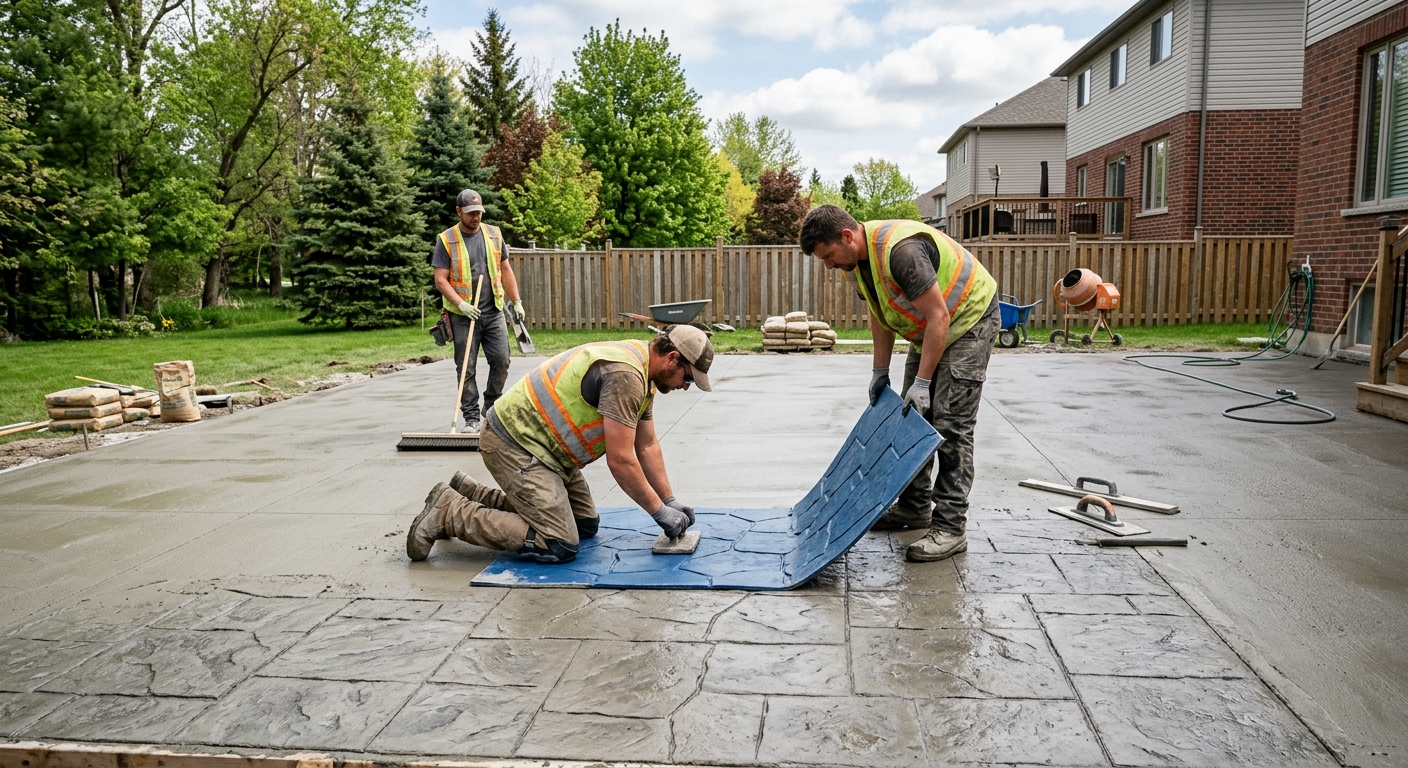
Concrete work options and costs in Greenway-Chaplin
In Greenway-Chaplin, concrete work is one of those “set it up right once” home improvements—especially for driveways, patios, walkways, and garage slabs that take a beating from Ontario weather. With a population of 14,146 in the community (Statistics Canada, 2021 Census), there’s steady demand, and most projects cluster around established neighbourhood pockets where homeowners are refreshing aging surfaces and upgrading curb appeal. Toronto’s broader housing mix matters too: the GTA continues to attract many single-detached households that commonly replace asphalt driveways with new concrete flatwork or expand patios for warmer-month entertaining.
What drives concrete costs in the Toronto economic region is the freeze–thaw cycle and the way it forces stricter specs. Exterior pours need air-entrained concrete and correct thickness over a compacted granular base so the slab can handle wet winters without heaving or spalling. Contractor availability also tightens during the warmer pour season; when temperatures trend toward 10 °C or below, curing management (blankets, protection, scheduling) adds labour and material costs. That’s why two homeowners with “the same” driveway can still see a meaningful quote spread in Greenway-Chaplin—site access, base condition, drainage, and finish choice (broom vs stamped) are usually the deciding factors.
If you’re planning work in high-traffic residential areas near shopping and school corridors—where access can be tighter—expect more time for protection, excavation staging, and cleanup. Use the table below as a realistic baseline before you request itemised quotes.
| Application |
Typical Size |
Key Spec |
Finish Option |
Price Range |
| Concrete driveway (standard broom finish) |
400–500 sq. ft. |
6 in (150 mm) slab on compacted granular base; air-entrained mix |
Broom finish |
$18,000–$28,000 |
| Exposed aggregate driveway |
400–500 sq. ft. |
Air-entrained mix; controlled wash/expose; good curing protection |
Exposed aggregate |
$22,000–$34,000 |
| Stamped concrete driveway or patio |
300–500 sq. ft. |
Stamped system; integral colour; joints planned for cracking control |
Stamped (pattern + colour) |
$14,000–$30,000 |
| Plain concrete patio or walkway |
200–350 sq. ft. |
4 in (100 mm) slab on compacted granular base; drainage considered |
Float & broom / light broom |
$3,200–$9,100 |
| Garage floor (interior slab) |
300–450 sq. ft. |
Vapour barrier + insulation (if required); 4 in (100 mm) typical |
Steel trowel / broom depending on use |
$6,000–$14,000 |
| Foundation footings (structural, below frost) |
Per linear foot scope |
Engineered/permit-driven; extend to at least 1.2 m below grade |
Structural concrete (not a finish item) |
$180–$300 |
Prices are estimates only and vary by project scope, site access and material selection.
What affects the price of concrete work in Greenway-Chaplin
In Greenway-Chaplin, even when you describe the “same” concrete job, quotes can easily swing by 30–50% across the Toronto area because the hidden variables drive labour time and concrete spec. The big one is frost protection: Ontario practice generally requires structural footings to extend below the design frost depth (commonly at least 1.2 m below grade) so the ground can’t lift and push the foundation or crack the slab. Exterior flatwork also needs air-entrained concrete mixes to survive repeated freeze–thaw cycles, and it must be built on well-compacted granular base with drainage so saturated soils don’t expand and contract against the concrete every winter.
The Toronto market also affects cost through scheduling and curing conditions. When pours land in cooler shoulder weather—especially toward nights when temperatures drop near or below about 10 °C—contractors may need cold-weather curing precautions (insulating blankets, temporary heat where feasible) and they’ll spend more time protecting the surface while it gains strength. De-icing salt use in winter accelerates surface spalling when the mix, curing, or sealing isn’t right, so sealing can become a practical add-on rather than an optional luxury.
In Greenway-Chaplin specifically, small site realities change the total: narrow driveways can mean extra labour for formwork and truck staging; older soils may require deeper excavation and more base; and existing asphalt removal can add hauling and disposal. If you’re comparing finishes, a plain patio or walkway typically fits the $16–$26 band, but stamped or exposed finishes can shift upward because they require additional materials and more finishing labour—often a justified upgrade when the design is visible year-round from the street.
| Price Factor |
Why It Matters |
Cost Impact |
| Frost line depth — determines footing depth and form height |
Controls how deep concrete must go to prevent frost heave and differential movement |
Higher depth increases excavation, forms, and concrete volume; can materially raise structural costs |
| Site preparation — excavation, grading, compacted granular base |
Base quality determines settlement and cracking resistance during wet/winter cycles |
Poor access or weak soils can add extra base material and compaction labour |
| Reinforcement — rebar or wire mesh requirement |
Limits cracking and improves load transfer, especially on driveways and garage floors |
Steel increases material and placement time; minimum standards may be non-negotiable |
| Mix design — air-entrainment and compressive strength spec |
Air entrainment is essential for exterior freeze–thaw durability |
Specified mixes can cost more but reduce long-term repairs and premature spalling |
| Finish type — broom vs. stamped vs. exposed aggregate |
Finishes change labour steps, curing demands, and replacement risk if done poorly |
Stamped/exposed generally increases cost relative to broom-finished flatwork |
| Pour size and concrete truck access to site |
Impacts how many loads, how fast the crew can place, and whether a pump/extra staging is needed |
Tight access can add labour and possible equipment rental costs |
| Cold-weather curing precautions — heating and blankets |
Protects strength gain and prevents surface defects in cooler pours |
More materials and man-hours when pours occur near colder thresholds |
| Control joint pattern and sealing cost |
Controls where cracks form and reduces salt-driven surface breakdown |
Adding joints correctly and sealing later reduces future deterioration risk |
Permits & regulations in Ontario
In Ontario, structural concrete work typically requires a building permit. That includes concrete that’s part of a home’s structure—such as foundation footings, foundation walls, grade beams, and other load-bearing elements. In most cases, the municipality expects engineered drawings for structural scope, and the permit process helps confirm that the design meets Ontario building requirements. For many homeowners in Greenway-Chaplin, this is the difference between a straightforward “flatwork” job and a project that triggers inspections, documentation, and longer lead times.
Concrete flatwork (patios, walkways, driveways) usually does not require a permit by itself. However, permits may come into play if the work affects lot grading, changes drainage patterns, increases impervious coverage beyond municipal limits, or involves work near a municipal right-of-way. Before you break ground, confirm with the local authority that your specific scope is permit-free.
To verify your contractor, ask for three things and check them in writing:
- Ontario licence/registration: request the contractor’s business information and check they’re properly registered/qualified for the work.
- Liability insurance: ask for a certificate of insurance naming you (or your property/interest) where appropriate; confirm current dates and coverage limits.
- WSIB coverage: if the contractor uses employees, they should provide proof of WSIB clearance/coverage status. For subcontractors, require their WSIB proof as well.
- References: request recent projects on similar-scale driveways or patios in the GTA, ideally with photos of finished work and any winter performance notes.
These steps are quick, but they protect you if something goes wrong—especially on exterior concrete where freeze–thaw performance is the real test.
Getting concrete right in Greenway-Chaplin's freeze-thaw climate
Concrete failures in Greenway-Chaplin are almost always a weather-and-spec combo: water gets into the slab or subgrade, the ground freezes, and freeze–thaw cycles expand and contract everything around it. The result is spalling, scaling, and random cracking—often blamed on “bad luck,” but usually preventable with the right base, mix, joints, curing, and sealing. For exterior flatwork in the Toronto market, the goal is to keep water out and manage shrinkage and thermal movement.
Start with base prep: excavate to the required depth, place compacted granular sub-base, and ensure drainage so saturated soils don’t expand and push against your slab. Next is mix design: specify air-entrainment for exterior durability (typically 5–7% air content) and a minimum 32 MPa compressive strength so the concrete reaches proper performance. Then control cracking using a joint pattern that aligns with expected contraction—don’t skip joints or place them randomly, because that’s where unsightly cracks tend to form. Curing comes next: plan for at least 7 days of proper curing conditions; in colder conditions near 10 °C and below, curing protection becomes more critical and can add time. Finally, apply a penetrating sealer after the cure period (commonly at 28 days post-pour) to repel moisture and help resist de-icing salt damage.
When comparing options, spend where it matters. For example, upgrading from plain broom-finish ($16–$26 per sq. ft. band for patios/walkways) to stamped concrete can cost noticeably more (often multiple dollars per sq. ft.). That premium can be justified if the finish is correct and joints are planned, but it won’t help if the base and air-entrainment are wrong—those issues are what trigger spalling after the first few winters.
| Spec |
Why It Matters in Greenway-Chaplin |
What to Ask For |
Impact if Skipped |
| Compacted granular base (depth?) |
Reduces settlement and limits water movement under the slab in wet spring/fall |
State excavation depth, granular type, and compaction requirement |
Early cracking, uneven surface, and higher risk of freeze–thaw damage |
| Air-entrained concrete mix (target air %?) |
Air voids protect against freeze–thaw scaling and spalling in Ontario winters |
Ask for an exterior air content target (typically 5–7%) |
Surface deterioration and spalling after a few freeze–thaw seasons |
| Compressive strength (MPa rating) |
Ensures the slab gains enough strength despite temperature swings |
Confirm minimum 32 MPa spec and test/certification approach |
Reduced durability and increased risk of surface damage |
| Control joints (spacing per ACI guidelines) |
Controls where shrinkage cracks happen and helps limit random cracking |
Ask for proposed joint layout and spacing for your slab dimensions |
Random cracks that look worse and can allow water infiltration |
| Minimum 7-day curing period |
Strength gain depends on temperature and moisture; cold snaps can slow curing |
Confirm curing method and how protection will be handled in cooler weather |
Surface weakness, finishing issues, and premature wear |
| Penetrating sealer (when applied after cure) |
Helps resist moisture and de-icing salt impacts common in GTA winters |
Ask for penetrating sealer and timing (commonly after 28 days) |
Faster scaling/spalling and higher maintenance needs |
How to choose a concrete work contractor in Greenway-Chaplin
Choosing the right contractor matters more in Greenway-Chaplin than many people expect, because freeze–thaw performance is tied to workmanship details—base compaction, air-entrained mix, joint layout, and curing protection. Start by verifying three core items in Ontario: liability insurance, WSIB/WCB coverage, and appropriate business registration/qualification for the scope.
How to check each:
- Liability insurance: request a current certificate of insurance and confirm coverage dates; ensure it aligns with your work start/end dates.
- WSIB/WCB: ask for WSIB clearance or proof of coverage for employees (and collect subcontractor proof too). If they’re not compliant, your project can become your responsibility.
- Work scope fit: make sure they regularly build exterior flatwork and not only form-and-pour foundations—driveways and patios fail differently than footings.
Next, get 2–3 itemised written quotes (labour + materials breakdown), not a single lump sum number. Itemisation should show excavation/base prep, reinforcement, concrete supply, forming, finishing, joints, curing/protection, and disposal. Carefully review exclusions: is removal/haul-away included, are permits included or excluded, and who handles municipal requirements if your project affects grading or drainage? Ask about warranties: workmanship warranty length, whether manufacturer product warranty exists for sealers/adhesives, and if anything is transferable to future owners. On payment schedule, never agree to more than about 10–15% upfront; hold back until the job is complete and looks right. Finally, request a written start date and completion estimate so weather-driven delays are planned for—not surprises.
- Ask what concrete mix they will use for exterior freeze–thaw durability (air-entrainment target and strength spec).
- Confirm slab thickness and base depth, not just “it’ll be on crushed stone.”
- Request a joint layout plan before work begins.
- Ask whether they will protect the slab during curing (especially near 10 °C).
- Get details on sealing: product type and timing (commonly after 28 days).
- Verify how they handle drainage (slope, tie-ins, and water flow away from the house).
- Confirm reinforcement type (mesh vs rebar) for driveways/garage slabs.
- Check that they include saw cutting (or forming) for joints—not “we’ll just float and hope.”
- Ask how they’ll manage concrete truck access and pour logistics to avoid cold joints.
- Confirm disposal/haul-away of asphalt/soil and any topsoil restoration.
- Ensure the quote states protection of landscaping during the work.
- Require a written warranty statement with what’s covered and for how long.
Red flags I see in Greenway-Chaplin concrete projects include contractors who won’t discuss air-entrainment and curing, vague joint spacing, quotes that exclude base compaction or drainage work, no proof of WSIB coverage, and demanding large upfront payments without a clear schedule and deliverables.
Frequently asked questions — concrete work in Greenway-Chaplin
What is a concrete overlay and is it suited to Greenway-Chaplin?
A concrete overlay is a new cement-based layer installed over an existing slab, usually to restore appearance and extend service life without removing everything. In Greenway-Chaplin and across Ontario’s freeze–thaw climate, overlays can be suitable only when the original concrete is structurally sound: minimal spalling, no widespread separation from the base, and good bonding potential. If the old slab is lifting, heavily cracked through, or draining poorly, an overlay can trap moisture and accelerate failure around weak areas.
Ask for preparation details—pressure washing, surface profiling, crack repair, and a proper bonding system. You should also confirm how the contractor plans drainage and joint strategy, since freeze–thaw cycles punish water intrusion. As a reference point, if you’re considering a patio/walkway approach, plain concrete in the Toronto band is often around $16–$26 per sq. ft., and an overlay should be priced competitively against full replacement once the prep and bonding steps are counted.
How do I seal concrete to protect it in Greenway-Chaplin?
For Greenway-Chaplin concrete, sealing is mainly about repelling moisture and reducing de-icing salt-driven surface breakdown. The key is timing and product choice. Most homeowners should plan for a penetrating sealer rather than just a topical film, applied after the concrete has properly cured—commonly around 28 days post-pour. Sealing too early traps moisture and can reduce performance.
Before sealing, the surface should be clean, dry, and free of laitance, dirt, and curing compounds. In GTA winters, even small surface defects can magnify with freeze–thaw cycles, so ask your contractor to confirm the surface prep process and coverage rate. If you’re comparing costs, sealing is typically far less than correcting failed slabs—especially when concrete is built to manage water at the base.
What is the difference between concrete and cement?
Concrete is the final building material you walk on: a mixture of cement, water, sand, and gravel (and often air-entraining admixtures for exterior durability). Cement is one component of that mixture—essentially the binder that reacts with water to create strength.
In Ontario flatwork projects, what matters to you is the concrete specification, not the term “cement.” When contractors talk about freeze–thaw durability in Greenway-Chaplin, they’re usually referring to the air-entrainment level, the compressive strength target (often minimum 32 MPa for quality specs), and how curing protection is handled during cold snaps. Two contractors may both say “cement,” but the quote should clearly identify the concrete type and exterior requirements.
How much does concrete work cost in Greenway-Chaplin?
Concrete pricing in Greenway-Chaplin is driven by size, thickness, base prep, reinforcement, finish complexity, and how the schedule overlaps Ontario’s colder curing windows. For quick budget expectations, patios and walkways often fall into the $16–$26 band, while stamped & decorative concrete is commonly higher (around $24–$40 per sq. ft. band depending on design and scope). Driveways often price in the $18–$28 band for standard concrete, and decorative options increase due to extra finishing steps.
Foundation footings are a different category: structural footings typically run about $180–$300 per linear foot in the provided Toronto-region band, and the real price depends heavily on frost-related excavation depth and engineered requirements. If you want a realistic number, insist on an itemised quote showing excavation/base, concrete and reinforcement, finishing, joints, curing protection, and disposal.
How deep must footings be for Greenway-Chaplin's frost line?
In Ontario, structural footings for many residential foundation designs must extend below the local design frost depth to prevent frost heave and differential movement. In the Toronto economic region, a common requirement is at least about 1.2 m (roughly 4 ft) below grade for typical structural footings. Your final depth should follow the engineered foundation design and the municipality’s permit requirements.
In practice, contractors in Greenway-Chaplin confirm footing levels based on the drawings, soil conditions, and how the foundation interacts with drainage and grading. If soil is poorly draining or if excavation reaches different material layers, you can see changes in excavation volume and base preparation costs. That’s why two “identical” homes can end up with different footing quantities—and why proper permitting and engineering reviews matter.
Why does concrete crack in Greenway-Chaplin and how is it prevented?
Concrete cracks are common in Ontario because concrete shrinks as it cures, expands and contracts with temperature changes, and is exposed to wet/dry cycles and freeze–thaw movement. In Greenway-Chaplin, the biggest drivers are often water management and inadequate joint planning. If the base isn’t compacted correctly, or if drainage allows saturation, freeze–thaw cycles can amplify movement and lead to surface spalling and cracking.
Prevention comes from a system: air-entrained exterior concrete, correct slab thickness, a well-compacted granular base, and a control joint pattern that directs cracking to planned locations. Proper curing (minimum 7 days, with additional protection when temperatures drop near 10 °C or below) also matters. Finally, sealing later (often after 28 days) helps reduce moisture and de-icing salt impacts. The goal isn’t “no cracks”—it’s controlled cracking and long-term durability.