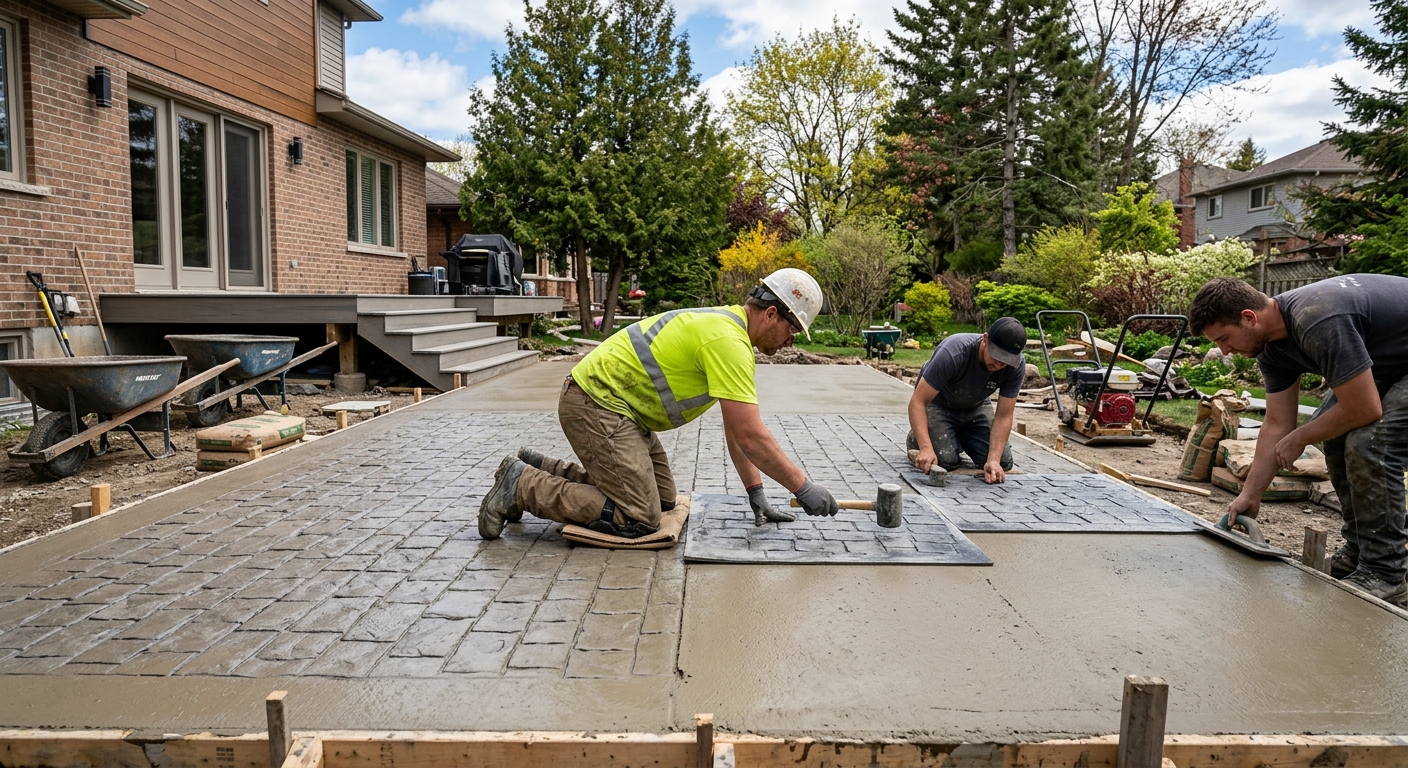
Concrete work options and costs in Walnut Grove
In Walnut Grove, concrete flatwork is a common upgrade—especially for homeowners replacing worn asphalt in driveways, patios, and walkways. With a population of 25,683 in the area (Statistics Canada, 2021 Census), there’s steady demand for new builds and renovations, and the Lower Mainland–Southwest housing pattern keeps contractors busy around the Vancouver–Surrey–Abbotsford corridor. While individual lot sizes vary, most concrete work here supports the region’s typical single-detached home layout: larger exterior slabs, more steps/entry transitions, and frequent garages that need durable, easy-to-clean floors.
Pricing in Walnut Grove reflects how the climate behaves close to the Fraser Valley. Even with milder winters and a shallow frost line, we still design for freeze–thaw cycling and wet, coastal conditions—so the base preparation, drainage attention, air-entrained mix design, and curing time are not “extras,” they’re part of getting long-term surface durability. That’s why quotes for similar slabs can diverge: more granular excavation, better compaction, and longer cure protections cost labour and materials, but they reduce callbacks for scaling and early cracking.
Contractor availability is also seasonal. When persistent rain or cool nights hit, we may need curing blankets and schedule adjustments to protect strength gain, which can affect timelines and manpower. In Walnut Grove, we often see especially strong demand along the older infill and main residential streets near the community core, where many homes are due for driveway and front-landing updates. With that in mind, the table below summarizes practical options and the typical price range you’ll see for Walnut Grove projects.
| Application |
Typical Size |
Key Spec |
Finish Option |
Price Range |
| Concrete driveway (standard broom finish) |
400 sq. ft. (e.g., 20 ft x 20 ft) |
Air-entrained exterior slab, compacted granular base |
Broom finish + control joints |
$4,500–$7,000 |
| Exposed aggregate driveway |
400 sq. ft. (e.g., 20 ft x 20 ft) |
Proper curing + wash/exposure timing for consistent texture |
Exposed aggregate finish |
$6,500–$10,500 |
| Stamped concrete driveway or patio |
250 sq. ft. (e.g., 10 ft x 25 ft) |
Colour hardener + release + air-entrained exterior mix |
Stamped pattern + sealer |
$6,000–$10,500 |
| Plain concrete patio or walkway |
200 sq. ft. (e.g., 10 ft x 20 ft) |
Air-entrained exterior slab + proper edge support |
Float/wood-trowel with broomed edges |
$3,000–$5,200 |
| Garage floor (interior slab) |
480 sq. ft. (e.g., 20 ft x 24 ft) |
Fibre or mesh/rebar as required + good sub-base compaction |
Steel-trowel finish or light broom |
$6,500–$11,500 |
| Foundation footings (structural, below frost) |
Typical footing package for a small addition |
Engineered thickness + below-design frost depth |
Reinforced concrete footings |
$6,000–$12,000 |
Prices are estimates only and vary by project scope, site access and material selection.
What affects the price of concrete work in Walnut Grove
In Walnut Grove and across the Lower Mainland–Southwest, the same “basic” concrete job can land 30–50% apart from one quote to the next, and that spread is usually explained by frost detailing, base prep quality, and the realities of wet, coastal scheduling. Contractors in British Columbia price risk—if a crew is set up for cold-weather protection, has reliable supply for air-entrained mixes, and can pour/finish within weather windows, the job tends to hold up better. If not, you may see lower upfront pricing that later shows up as surface scaling, patching, or replacement.
Frost line depth and freeze–thaw cycles dictate every exterior spec here. Even though coastal BC has a shallower frost depth (often treated as roughly 0.5–1.2 m in coastal BC practice), we still place footings and thickened edges below the design frost zone to prevent frost heave. Exterior slabs are also built with air-entrained concrete to survive repeated freeze–thaw and saturated soils. When nights cool or rain lingers, we may need curing blankets and longer cure times; these cold-weather precautions protect strength gain and durability, but add labour and equipment time. De-icing salt use in driveways accelerates surface spalling risk, so sealing becomes more than cosmetic.
In Walnut Grove, a few conditions commonly raise cost: tighter access paths that slow truck delivery, clay/organic topsoil that requires deeper excavation and more granular import, and steep grades that demand improved drainage and formwork. Conversely, cost can be lower when the site is already clear, drainage is straightforward, and the slab size is compact. For example, a plain broom-finished driveway often falls in the $18–$28 per sq. ft. band, while stamped work can push into the higher end (often $22–$36 per sq. ft.) when colour and release systems are included—so it’s normal for decorative options to justify the added cost with better visual finish and better overall detailing.
| Price Factor |
Why It Matters |
Cost Impact |
| Frost line depth — determines footing depth and form height |
Footings must sit below design frost to prevent heave |
More excavation and taller forms; higher concrete volume |
| Site preparation — excavation, grading, compacted granular base |
Compaction + correct base depth control settlement and cracking |
Extra labour/equipment for haul, grading and compaction |
| Reinforcement — rebar or wire mesh requirement |
Helps control cracking in heavier loads and edges |
Materials + chairing/tie-in labour increase |
| Mix design — air-entrainment and compressive strength spec |
Air content supports freeze–thaw durability |
Higher material spec + careful batch control |
| Finish type — broom vs. stamped vs. exposed aggregate |
Texture/colour systems affect labour time and curing steps |
Decorative finishes often add forms, labour and additives |
| Pour size and concrete truck access to site |
Access affects how quickly concrete can be placed |
Small pours with access issues may cost disproportionately |
| Cold-weather curing precautions — heating and blankets |
Protects strength gain when nights are cool |
Heaters/blankets, extra crew time, and schedule constraints |
| Control joint pattern and sealing cost |
Joints manage where cracking occurs; sealer repels salts |
Saw cutting + sealing adds line-item cost and labour |
Permits & regulations in British Columbia
In British Columbia, the rules depend on what you’re building. Structural concrete work—such as footings, foundation walls, grade beams, and other elements that support a building’s structure—generally requires a building permit, and engineered drawings are commonly reviewed as part of the permit process by the municipality. If you’re doing an addition, altering a foundation, or changing load paths, don’t rely on “it’s just concrete.” The engineering and permitting are part of how the public safety system protects you.
Concrete flatwork like patios, walkways, and driveways typically does not require a permit by default, especially when it’s simply replacing an existing slab or improving the surface without major changes to lot grading. However, permits can be triggered if the work affects lot grading, creates changes tied to stormwater management, alters impervious surface coverage rules, or impacts municipal right-of-way conditions (for example, curb approaches or drainage ties). Always confirm with your local authority before breaking ground.
For contractor verification in Walnut Grove, start with the licence and insurance paper trail. Step 1: Ask for the contractor’s business information and confirm their registration/licensing through the provincial licence lookup available online. Step 2: Request a current Certificate of Insurance showing liability coverage and the project address/name. Step 3: Confirm workplace coverage for workers (WSIB/WCB) by asking for proof/clearance documentation or coverage details. Step 4: Ask for references on similar-scale concrete projects in the Lower Mainland–Southwest, ideally with exterior freeze–thaw exposure. If they can’t provide these items quickly, treat it as a warning sign.
Getting concrete right in Walnut Grove's freeze-thaw climate
Concrete failure in Walnut Grove is usually a “system” problem: weak base preparation, the wrong concrete mix, poor control joints, or curing that doesn’t reach proper strength before weather stresses the surface. Even with a shallow frost depth compared to interior BC, freeze–thaw cycling plus saturated ground causes scaling and spalling when concrete is not air-entrained and when water can get trapped in or under the slab.
To spec the job correctly, focus on five practical requirements. (1) Base preparation: use a compacted granular sub-base placed to the project’s design depth and graded for drainage. (2) Mix design: for exterior flatwork, specify air-entrainment—commonly around 5–7% air content depending on exposure and slump—and a minimum 32 MPa compressive strength. (3) Control joints: include a joint plan that limits random cracking; joints should be cut early enough to guide crack formation. (4) Curing: plan for at least 7 days of curing under appropriate conditions, with curing blankets or other cold-weather protection when nights are cool or rain persists. (5) Sealing: apply a penetrating sealer after the full cure period (often around 28 days) so de-icing salts and wet winters don’t accelerate surface breakdown.
If you’re comparing options, this is where price differences are justified. For instance, adding air-entrainment and investing in proper base drainage may raise the project compared to a “cheapest concrete” approach, but that cost is typically small relative to re-doing a driveway. In Walnut Grove, a standard driveway may sit around $18–$28 per sq. ft., while stamped concrete can range into roughly $22–$36 per sq. ft.—the decorative uplift is visible, but the durability specs are what keep either option looking good through Lower Mainland winters.
When asking technical questions, the biggest avoidable failure is spalling from inadequate air-entrainment and insufficient curing. A contractor should be able to explain how they manage mix design, placement timing, and curing protection for your specific pour date and weather window.
| Spec |
Why It Matters in Walnut Grove |
What to Ask For |
Impact if Skipped |
| Compacted granular base (depth?) |
Controls settlement and frost-related movement in wet soils |
Base depth to design + compaction testing/verification |
Cracking, rocking slabs, premature surface damage |
| Air-entrained concrete mix (target air %?) |
Prevents freeze–thaw scaling and reduces spalling risk |
Exterior mix with target air content around 5–7% |
Scaling/spalling after winter freeze–thaw cycles |
| Compressive strength (MPa rating) |
Strength gain must meet durability needs before service |
Minimum 32 MPa specified for exterior flatwork |
Surface wear, reduced long-term durability |
| Control joints (spacing per ACI guidelines) |
Directs cracking to planned locations |
Joint layout with spacing appropriate to slab thickness |
Random cracks that look worse and admit more water |
| Minimum 7-day curing period |
Ensures strength development through cool/wet conditions |
How curing will be protected during rain/cool nights |
Weak surface, scaling, patching and early repairs |
| Penetrating sealer (when applied after cure) |
Helps repel de-icing salts and reduces water intrusion |
Penetrating sealer applied after full cure (often ~28 days) |
Faster surface deterioration and staining |
How to choose a concrete work contractor in Walnut Grove
Choosing a contractor in Walnut Grove comes down to verification, clarity, and the willingness to put durability specs into writing. Start by confirming British Columbia contractor licensing/business registration through the provincial online lookup. Next, ask for liability insurance and a Certificate of Insurance that names your project address and shows current coverage. For worker coverage, request proof of WSIB/WCB coverage (or clearance documentation) so you know the contractor is properly set up for jobsite work.
Then, get 2–3 itemised written quotes—not just lump sums. Ask for a labour + materials breakdown that clearly lists removal/disposal, excavation and granular base, reinforcement (if included), concrete supply with mix spec, finishing method, jointing, curing protections, and whether sealing is included and when it will be applied. Scope review matters: what’s excluded for site access, minor grading, or underground adjustments? Confirm whether permits (when required for structural work) are included or handled by you.
Warranty should be specific. Ask for a workmanship warranty length and confirm whether any product/manufacturer warranty applies to sealer or admixtures. Also ask if warranties transfer to future owners—this can matter for resale.
For payment schedule, don’t pay more than 10–15% upfront. Holdback until the job is complete, final cleanup is done, and you’ve confirmed key steps like finishing quality, joints, and curing/curing protection. Finally, get a written start date and realistic completion timeline—especially in seasons with frequent rain and cool nights.
- Ask for proof of BC business registration/licence before scheduling.
- Request a current Certificate of Liability Insurance with your address.
- Confirm WSIB/WCB coverage with clearance documentation.
- Insist on itemised quotes (base prep, concrete mix, reinforcement, finishing, joints, curing, sealing).
- Clarify disposal: is haul-away included or billed separately?
- Confirm whether permit pulls are included for structural concrete work.
- Ask who will test/verify sub-base compaction and how.
- Require a written joint plan (location and timing of saw cuts).
- Ask what cold-weather curing plan applies if nights are cool or rain is forecast.
- Get specifications for air-entrainment and minimum strength (don’t accept vague “standard mix”).
- Review warranty terms in writing and ask whether they transfer.
- Verify payment schedule and keep holdback until final inspection.
Concrete red flags in Walnut Grove include: quotes that don’t mention air-entrainment for exterior slabs, skipping base drainage/granular specs, “we’ll do it when the weather is good” without a curing plan, no proof of insurance/coverage, and refusing to itemise labour versus materials (or not providing start dates and schedule expectations).
Frequently asked questions — concrete work in Walnut Grove
How long does a concrete project take in Walnut Grove?
Timelines in Walnut Grove depend on weather windows, slab size, and prep depth, not just pour day. For a typical exterior flatwork job like a driveway or patio, you’ll often see prep and formwork in the first day(s), then the pour, then finishing and curing protection. Even when the concrete is placed quickly, you still need at least 7 days of curing for proper strength development, with full durability benefits building over time. Sealing usually happens after the cure period (often around 28 days), which can affect when you get the “best” water and salt resistance. In rainy stretches of the Lower Mainland–Southwest, contractors may adjust schedules and use curing blankets to protect strength gain through cool nights.
What is a concrete overlay and is it suited to Walnut Grove?
A concrete overlay is a thin layer of new concrete placed over an existing slab to restore surface shape and appearance. It can be suited to Walnut Grove when the original slab is structurally sound—no major settlement, widespread heaving, or deep spalling that undermines bond. The climate here brings freeze–thaw cycling and wet conditions, so bond and surface preparation are critical: the old concrete must be cleaned and profiled properly, and the overlay must be designed to manage moisture movement. If your slab is already failing or there are active movement issues, an overlay can just mask problems temporarily. Homeowners often compare overlay costs with a full replacement when they’re seeing scaling—sometimes a replacement ends up closer to the $18–$28 per sq. ft. band than expected once you include necessary repairs.
How do I seal concrete to protect it in Walnut Grove?
Sealing in Walnut Grove is mainly about reducing water and de-icing salt intrusion. For best performance, use a penetrating sealer and apply it after the concrete has fully cured—commonly around 28 days post-pour—so the surface isn’t still releasing moisture. Before sealing, the slab must be clean and dry; contractors usually pressure-wash and allow drying time, then confirm readiness before coating. In our coastal-wet conditions with freeze–thaw cycles, sealing helps slow down scaling and spalling, especially on driveways that see winter salt or frequent rain exposure. If your driveway is new, ask your contractor what sealer type they plan, how many coats (if any), and whether they’ll include the curing and prep steps needed for the sealer to bond and perform.
What is the difference between concrete and cement?
Cement is one ingredient inside concrete, not the finished product. In simple terms, cement is the binder—powder made from materials like limestone and clay—that reacts with water to help create strength. Concrete is the full mixture: cement plus water, aggregates (sand and gravel/crushed stone), and often admixtures such as air-entrainment for exterior durability. In Walnut Grove, the difference matters because air-entrained concrete for exterior flatwork is what helps manage freeze–thaw cycles and moisture exposure. A contractor may say “standard cement mix,” but what you really need to know is the concrete specification: targeted air content, compressive strength (often minimum 32 MPa for exterior work), and the curing plan.
How much does concrete work cost in Walnut Grove?
Concrete pricing in Walnut Grove typically depends on size, excavation and base prep, finish type, and whether you need extra curing protection due to cool or wet weather. For planning, many driveway and patio projects in the Lower Mainland–Southwest fall within common per-sq.-ft. bands: standard concrete driveways are often around $18–$28 per sq. ft., while stamped and decorative concrete usually lands higher, roughly $22–$36 per sq. ft. (depending on pattern complexity and surface prep). For patios/walkways, plain work is commonly around $16–$26 per sq. ft. When you see a big difference between quotes, look for what’s included: granular drainage prep, air-entrained mix spec, reinforcement, jointing, curing blankets, disposal, and sealing timelines. The most expensive jobs aren’t always the “best”—the key is matching the spec to freeze–thaw exposure.
How deep must footings be for Walnut Grove's frost line?
Footing depth is based on design frost depth for the site and is intended to sit below the local frost zone to prevent frost heave. In coastal BC practice, frost depth is often treated as roughly 0.5–1.2 m, which is shallower than many interior regions, but local soil conditions and engineering still control the final depth. For Walnut Grove, the safe approach is to follow the engineered foundation design for your home/addition—especially if you’re doing structural concrete like footings, foundation walls, or grade beams. Don’t guess or rely on “typical depth” from another neighbourhood, because saturated soils and drainage issues can change performance even when frost depth is relatively shallow. Your contractor and engineer should clearly state the specified footing elevation and thickness in writing before excavation.