Concrete work options and costs in Broadmoor
Concrete contractors in Broadmoor typically get called for driveways, patios and foundation scopes because this neighbourhood is built out with a lot of older single-family housing, where owners want durable flatwork and reliable foundations. In the Lower Mainland, the market is largely defined by family homes—Broadmoor’s population was 23,050 in 2021 (Statistics Canada, 2021 Census)—and that demand supports a steady pool of crews for winter scheduling, but not a “pile-on” rush like larger urban cores. In practical terms, most concrete work here is competitive on price, yet you still see differences between quotes because the project specs must respond to our shallow frost depth and the coastal-wet freeze–thaw behaviour that damages unprotected slabs.
Lower Mainland–Southwest concrete pricing is shaped by mild winters paired with rain, cool nights and repeated freeze–thaw cycles. Local practice often assumes a frost depth around 450 mm / 18", so footings, piers and thickened edges are placed below that line to avoid frost heave. Even when the frost line is shallower than interior BC, we still need engineered base prep, air‑entrained mixes, proper jointing and longer curing/cover strategies when the weather stays humid or drizzly. Areas where demand is especially visible include family pocket developments and the typical residential streets around South Fraser Way and the Broadmoor/Fraser Valley corridor, where driveways and yard access are common upgrade projects.
To compare options clearly, use the ranges below as a starting point, then we’ll cover the biggest cost drivers and how to spec the job correctly in the next sections.
| Application |
Typical Size |
Key Spec |
Finish Option |
Price Range |
| Concrete driveway (standard broom finish) |
400–600 sq. ft. |
Air‑entrained mix, compacted granular base, control joints |
Broom finish |
$18,000–$28,000 |
| Exposed aggregate driveway |
400–600 sq. ft. |
Air‑entrained mix, proper curing for consistent exposure |
Exposed aggregate (washed) |
$24,000–$36,000 |
| Stamped concrete driveway or patio |
300–600 sq. ft. |
Air‑entrained mix, release agent, proper jointing |
Stamped pattern + integral or acrylic colour |
$22,000–$40,000 |
| Plain concrete patio or walkway |
200–400 sq. ft. |
Air‑entrained mix, compacted base, joints as needed |
Float/screed + broom or light broom |
$16,000–$26,000 |
| Garage floor (interior slab) |
300–500 sq. ft. |
Minimum 32 MPa (typical), vapour control, reinforcement as required |
Steel trowel or broom finish (per use) |
$11,000–$19,000 |
| Foundation footings (structural, below frost) |
Per project/house design |
Excavation, formwork, rebar, placed below design frost depth |
Structural concrete |
$18,000–$34,000 |
Prices are estimates only and vary by project scope, site access and material selection.
What affects the price of concrete work in Broadmoor
In Broadmoor and across the Lower Mainland–Southwest, the same concrete job can come back 30–50% apart because quotes aren’t truly apples-to-apples: contractors may price different base thicknesses, concrete mix requirements, reinforcement levels, curing/seasonal precautions and finishing time. The cost can swing further when you compare BC to other provinces because colder regions typically face shorter pour seasons and higher winter labour/material costs (heating blankets, insulated curing, and slower scheduling). In BC’s coastal-wet environment, the issue is less about deep frost and more about keeping concrete protected long enough to reach design strength and preventing surface scaling.
Frost line depth and freeze–thaw cycles dictate every spec. Local practice commonly assumes a frost depth around 450 mm / 18", so footings, piers and thickened edges are placed below that to reduce frost heave. Exterior slabs also need air‑entrained concrete mixes to survive repeated wetting and cooling; without proper air entrainment, you’re more likely to see scaling and spalling. When temperatures drop, cold-weather curing precautions—like blankets, curing protection and (in some cases) temporary heating—add cost. De-icing salt in winter can accelerate surface deterioration, so sealing becomes a small line item with a big impact on appearance and longevity.
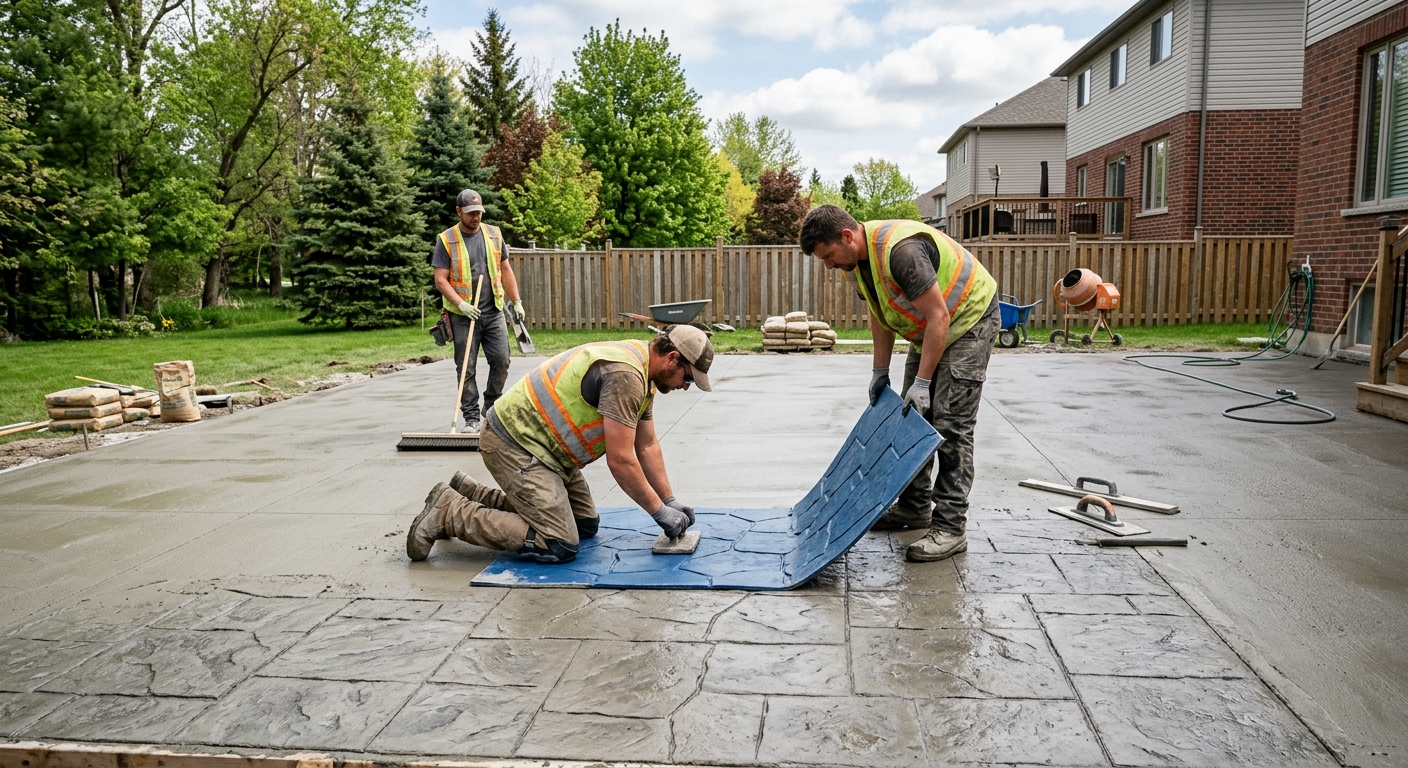
Two quick Broadmoor examples: switching from a broom-finished driveway to stamped concrete can add complexity with colour hardeners, stamps and extra finishing time, which is where you’ll see the move from the typical driveway backbone range of $18,000–$28,000 toward higher stamped/decorative totals. On the other hand, a plain patio may stay closer to the backbone of $16,000–$26,000 if excavation and access are straightforward—same slab size, different base prep and drainage can still push cost meaningfully.
Finally, many Broadmoor homes are older and have established grading, mature landscaping and tighter access, which increases excavation, disposal and formwork time—real dollars, not theory.
| Price Factor |
Why It Matters |
Cost Impact |
| Frost line depth — determines footing depth and form height |
Footings must extend below the design frost depth to prevent frost heave |
Higher excavation and more concrete/formwork; can materially change totals |
| Site preparation — excavation, grading, compacted granular base |
Poor base prep leads to settlement and cracking |
Can add significant labour; difficult access increases disposal and regrading |
| Reinforcement — rebar or wire mesh requirement |
Controls cracking and supports load capacity |
Material + placement labour; sometimes required by design |
| Mix design — air-entrainment and compressive strength spec |
Air entrainment protects against freeze–thaw scaling; strength supports durability |
Higher-spec mix may cost more per yard but reduces failures |
| Finish type — broom vs. stamped vs. exposed aggregate |
Finishing time and material system complexity differ |
Stamped/exposed typically costs more due to labour and product steps |
| Pour size and concrete truck access to site |
Smaller pours need tighter scheduling; access affects pump/placement method |
Access issues can add setup time, pumping cost or additional labour |
| Cold-weather curing precautions — heating and blankets |
Concrete must reach adequate strength under protected curing conditions |
Additional equipment/materials can increase costs, especially in shoulder seasons |
| Control joint pattern and sealing cost |
Joints manage cracking; sealing improves salt/UV resistance |
More labour for saw cuts and sealing products/crew time |
Permits & regulations in British Columbia
In British Columbia, structural concrete work generally requires a building permit, and many projects also need engineered drawings reviewed by the municipality or the local authority having jurisdiction. That typically includes: foundation walls, grade beams, footings and any structural elements tied to a foundation system. Concrete flatwork—patios, walkways and driveways—usually does not require a permit by itself, unless your project affects lot grading, drainage, or impervious surface coverage rules, or involves work near the municipal right-of-way. Because details vary by lot and scope, always confirm with the local authority before breaking ground.
For homeowner due diligence in Broadmoor, verify the contractor’s readiness in three steps. First, confirm licensing/registration where applicable using the public online registry (search the contractor’s legal business name). Second, ask for a certificate of insurance for liability coverage showing adequate limits for the scope. Third, confirm coverage for workers through WCB/WSBC clearance—request a clearance letter (or proof) and verify it’s current.
Then, ask for references specifically on similar-scale work in the Lower Mainland–Southwest climate—driveways, patios, or foundation scopes with air-entrained mix specs, drainage considerations and proper jointing. A contractor who can explain their curing plan for cool, damp weather is usually the one who follows through on the details your concrete needs.
Getting concrete right in Broadmoor's freeze-thaw climate
Concrete failures in Broadmoor are usually not “mystery defects”—they’re predictable when the climate and detailing don’t match. Our freeze–thaw cycles, saturated soils and frequent coastal rainfall mean water gets into the surface and edges, then expands as it freezes. The most common homeowner-visible problem is spalling and scaling from inadequate air entrainment, especially on exterior slabs where de-icing salts are used. The solution is to spec the whole system: base preparation, mix design, jointing and curing, then follow up with sealing at the right time.
(1) Base preparation: use compacted granular sub-base to the correct depth for the local soil and frost considerations, with attention to drainage so water can’t sit under the slab. (2) Mix design: request an air‑entrained mix with a target air content appropriate for exterior flatwork (often around 5–7% air). Pair that with a minimum compressive strength spec (commonly 32 MPa for typical structural/durable concrete requirements). (3) Control joints: place joints to control where cracking occurs; don’t rely on “it’ll be fine” with no joint plan. (4) Curing: protect and cure for at least 7 days; in cool, humid conditions, you may need blankets and longer attention to temperature and moisture to reach strength. (5) Sealer: apply a penetrating sealer after the recommended cure window—often around 28 days post-pour—so the slab resists de-icing salt intrusion.
A concrete choice where the price difference is justified: upgrading from plain to stamped on a driveway or patio might add labour and decorative materials, but choosing the correct air-entrained mix and adequate base prep is the decision that prevents the expensive “redo.” In other words, you can’t save money by skipping air entrainment—repairs after scaling usually cost far more than doing it right the first time.
| Spec |
Why It Matters in Broadmoor |
What to Ask For |
Impact if Skipped |
| Compacted granular base (depth?) |
Correct base thickness supports loads and limits settlement under wet coastal soils |
State base thickness and compaction method; confirm drainage plan |
Settlement, cracking, and water trapping under the slab |
| Air-entrained concrete mix (target air %?) |
Protects against freeze–thaw scaling and spalling in exterior conditions |
Ask for target air content (commonly 5–7% for exterior flatwork) |
Surface scaling/spalling, rough appearance and faster deterioration |
| Compressive strength (MPa rating) |
Design strength supports durability and reduces long-term deformation |
Confirm minimum strength (often 32 MPa for typical durable exterior work) |
Lower durability and higher risk of premature failure |
| Control joints (spacing per ACI guidelines) |
Joints manage shrinkage and thermal movement in slabs |
Ask for joint spacing plan and cutting/saw-cut timing |
Random cracking and uncontrolled crack widths |
| Minimum 7-day curing period |
Cool nights and humidity can slow strength gain without protection |
Ask how they cure and protect in damp/cold weather |
Reduced strength at early age and higher risk of surface damage |
| Penetrating sealer (when applied after cure) |
Helps repel salt and water from the slab surface |
Request timing—typically around 28 days post-pour after cure |
Faster salt-driven wear and poorer stain resistance |
How to choose a concrete work contractor in Broadmoor
Choosing the right concrete contractor in Broadmoor is mostly about verification and clarity. In British Columbia, confirm the contractor can legally perform the work (use the online registry to check the current business details), then obtain a current certificate of liability insurance showing limits appropriate for your project scope. Also request proof of workers’ coverage (WCB/WSBC clearance letter) for the period the work will be performed—this is important for homeowner protection if an injury occurs on site.
Next, get 2–3 itemised written quotes. The best quotes break down labour and materials—concrete volume, rebar/wire mesh, excavation, granular base, disposal, formwork, finishing, saw cutting and sealing. Avoid “lump sum” quotes that don’t state what thicknesses and mix specs they’re using. Read exclusions carefully: is debris hauling included? Are permits included if the scope requires them? Who is responsible for locate/utility marking (if needed)?
Warranty matters too. Ask for the workmanship warranty length and what it covers (cracking due to shrinkage with proper joints vs. structural issues). Confirm whether the product/manufacturer warranty applies to the system they’re using and whether it’s transferable to the homeowner. For payment schedule, never let upfront payments exceed about 10–15%; hold back part of the payment until the job is complete and cleaned. Finally, request a start date and an estimated completion timeline in writing so weather-driven delays don’t become “extra days billed.”
- Ask for the proposed air‑entrained mix and exterior curing plan for cool, damp weeks.
- Confirm frost-related details: footings below design frost depth, not “close enough.”
- Get base thickness and compaction specs in writing (not just “we’ll prep the ground”).
- Require a joint plan (layout + saw-cut timing), especially for driveways and patios.
- Confirm reinforcement type and placement (rebar chairs/ties vs. mesh resting on dirt).
- Make sure sealing is included or clearly excluded, including when sealer is applied after curing.
- Require line-item disposal costs and confirm haul-away routes are included.
- Ask if they use curing blankets/sealers in rainy/cold conditions.
- Confirm how they protect edges, forms and adjacent landscaping during pour and curing.
- Check insurance and WCB/WSBC clearance dates match your scheduled work window.
- Ask for at least 2–3 recent references from similar Lower Mainland–Southwest projects.
- Clarify payment milestones tied to measurable steps (forms set, pour complete, finishing done, final cure/clean-up).
Concrete red flags in Broadmoor include: vague specs (“standard mix” with no air entrainment statement), no mention of joints or sealing, missing or outdated insurance/WCB/WSBC proof, quotes that skip granular base depth/compaction details, and contractors who want large upfront deposits before any measurable preparation work begins.
Frequently asked questions — concrete work in Broadmoor
When is the best time to pour concrete in Broadmoor?
The best time in Broadmoor is usually late spring through early fall, when temperatures stay more consistently above the minimums needed for proper curing. In the Lower Mainland–Southwest, even “mild” winters can bring damp, cool nights and short freeze–thaw events, so contractors may still work, but they typically add curing blankets, protection, and extra monitoring. For homeowners, the key is not just the day of the pour—it’s the first several days of curing. A well-planned schedule matters as much as the mix. If you’re upgrading exterior flatwork like a driveway or patio, expect a more predictable outcome when weather windows reduce the risk of premature exposure to cold or heavy rain. If you’re comparing quotes, ask how each contractor handles cool nights and drizzle—this is where the real durability differences show up.
How long does concrete take to cure?
Concrete reaches initial set quickly, but “cure time” is about strength gain. For typical residential exterior work in British Columbia, you should plan around a minimum 7-day curing period under appropriate conditions so the concrete can gain early strength and reduce damage risk from water intrusion and early freezing. Full strength continues to develop beyond that—often approaching design performance closer to 28 days depending on mix and weather. In Broadmoor’s coastal-wet conditions, contractors frequently manage curing with protection during humid/cool stretches, because temperature swings can slow hydration. If you’re sealing (commonly around 28 days post-pour), that timing also depends on when the slab has sufficiently cured. If a quote doesn’t specify curing/blanket/protection steps, that’s a sign you should ask for clarification before proceeding.
Do I need a permit for concrete work in British Columbia?
In British Columbia, structural concrete work such as footings, foundation walls and grade beams typically requires a building permit, and engineered drawings may be part of the process. For concrete flatwork—patios, walkways and driveways—the work often does not require a permit by itself. However, a permit may be needed if your scope affects lot grading, drainage, impervious surface coverage limits, or work near municipal right-of-way. Because Broadmoor lot specifics can vary, confirm with the local authority before breaking ground. A good contractor will ask you about drainage and grading, and they should also tell you clearly whether a permit is included in their price (or excluded). Always verify liability insurance and WCB/WSBC coverage as part of contractor vetting, regardless of whether a permit is required.
Concrete vs pavers for a patio in Broadmoor?
Concrete and pavers both work well for patios in Broadmoor, but they perform differently with freeze–thaw, moisture and salt exposure. Concrete patios are strong, simpler to maintain in many cases, and when properly air‑entrained and jointed, they handle our wet cycles with less edge movement. Pavers can be attractive and flexible for design, and individual units can sometimes be replaced, but paver systems depend heavily on base prep and drainage; if the base settles, you’ll see rocking or gaps. Cost-wise, a plain concrete patio or walkway typically sits around the backbone of $16,000–$26,000 depending on size and access. Decorative concrete can be higher if you go stamped, while pavers can also climb when you include excavation, compaction and edging. The best choice comes down to whether you want a monolithic look and fewer joints (concrete) or a modular, replaceable surface (pavers) and your tolerance for re-lifting/patching if the base ever moves.
How long does a concrete driveway last?
A well-built concrete driveway in Broadmoor can last decades, especially if it’s air‑entrained, properly jointed and cured, and protected with sealing when appropriate. The main drivers of lifespan here are freeze–thaw resistance and how water and de-icing salt interact with the surface. Driveways also take loads and repeated wetting, so base prep and reinforcement matter. If the contractor uses an exterior-ready mix with correct air entrainment and doesn’t treat curing as optional, you reduce the risk of scaling and spalling—the early failure mode in wet coastal climates with temperature swings. When quality specs are in place, many homeowners see long service life without major repairs. Pricing can reflect the difference between “minimum build” and a durable system; driveway projects commonly land in the $18,000–$28,000 backbone range for standard broom finish, with decorative options costing more when labour and materials increase.
What is air-entrained concrete and why does it matter here?
Air-entrained concrete is designed to include tiny, evenly distributed air bubbles in the mix. Those bubbles give freezing water places to expand without tearing the paste, which is why air entrainment is crucial for exterior concrete in British Columbia’s freeze–thaw conditions. In Broadmoor, moisture from coastal rain and saturated soils soaks into surfaces and edges, then temperature changes can freeze and thaw repeatedly. Without adequate air entrainment and proper jointing, the slab surface is more likely to scale or spall over time—often seen as flaking or rough patches, especially in areas exposed to de-icing salt. For durable exterior flatwork, contractors commonly target an air content in the ballpark of 5–7% (exact target depends on the mix design and exposure). When you ask for this in the quote, you’re essentially asking for a freeze–thaw protection system, not just “concrete that looks good on day one.”